


国际汽油市场周报
一月疲软过后,二月汽油裂解价差增加

2020年1月美国墨西哥湾海岸汽油裂解价差(汽油批发和原油价差常被用来评估精炼利润)较前五年(2015-2019)均价相对减少,但在二月有所上升并在2月25号超过了之前的五年均值(图1)。一月,汽油低需求(根据供应的产品进行计算分析)、高库存、高炼厂运作率造成了汽油裂解价差变窄。到二月,炼厂停运,需求上涨,WTI原油价格平稳使得墨西哥湾裂解价差不断增长。
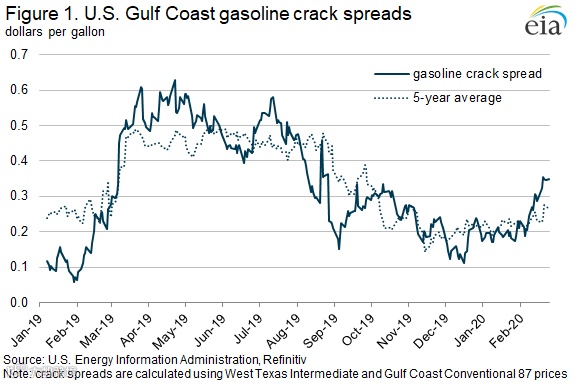
一月墨西哥湾汽油裂解价差均值为18美分/加仑,而五年均值为22美分/加仑。自2010年来,仅2015年和2019年的裂解价差较小,为12美分/加仑。
虽然炼厂运作率对汽油裂解价差十分敏感,但是在冬季,馏分裂解价差对总的炼厂利润有着更重要的影响,炼厂也只生产部分有可观利润的产品。因此,高的美国炼厂开工率和因季节性减少的国内汽油消费造成了汽油高库存,导致一月汽油价格下跌。墨西哥湾的炼厂运作率(美国一半的炼化产能来自这里)在2020年每周已经接近甚至超过了五年内的最高值。在1月31日当周,墨西哥湾的炼油厂四周平均总投料为920万桶/天,比去年同期多75,000桶/天。据统计, 1月24日当周,美国当地消费量下降到850万桶/天(四周滚动平均值),为自2017年2月以来的最低消费水平。
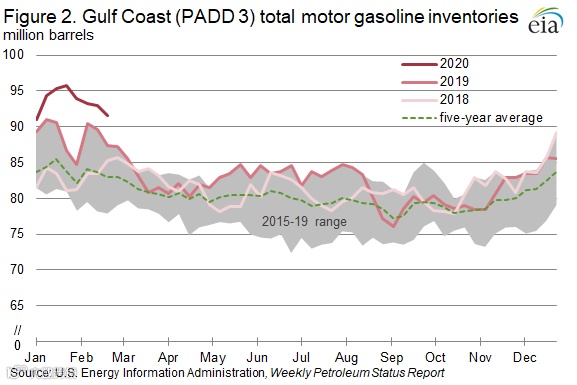
汽油消费少和炼厂运作率高使2020年年初汽油库存量达到历史高度。2020年1月24日,墨西哥湾汽油周库存达9580万桶(PADD3),美国汽油周库存总计2.612亿桶,二者都创下历史新高。
然而,2月6日新泽西州菲利普斯66贝威炼油厂和2月12日路易斯安那州埃克森美孚巴吞鲁日炼油厂停工造成了二月汽油市场趋紧和汽油价格上涨。此外,汽油需求量也增加了,截至2 月14日的一周,美国日产量达900万桶——较1月24日的低产记录增加49.8万桶/天——给汽油价格上涨提供了额外压力。
纽约港RBOB(即重新配制了氧化调和的调和组分油)价格从2月5日1.47美元/加仑(贝威停工前一天)涨至2月19日1.66美元/加仑,墨西哥湾汽油的价格(墨西哥湾常规87)同期从1.42美元/加仑涨至1.62美元/加仑。虽然墨西哥湾汽油价格在2月5日至25日增加15美分/加仑,WTI原油价格同期仅上涨6美分/加仑,导致墨西哥湾裂解价差上升。截至2月25日,墨西哥湾汽油平均裂解价差为38美分/加仑,比1月上涨20美分/加仑,比五年平均上涨12美分/加仑。
其他地区的市场也有着相似的汽油裂解价差变化趋势。北欧的阿姆斯特丹-鹿特丹-安特卫普(ARA)地区和新加坡1月的汽油裂解价差都相对疲软,但是最近几周相对于五年平均值都有所增加。1月份,ARA地区8美分/加仑的裂解价差是自2014年来在同月数据中倒数第二窄的。新加坡地区13美分/加仑的裂解价差则是自2011年来在同月数据中位列倒数第二。
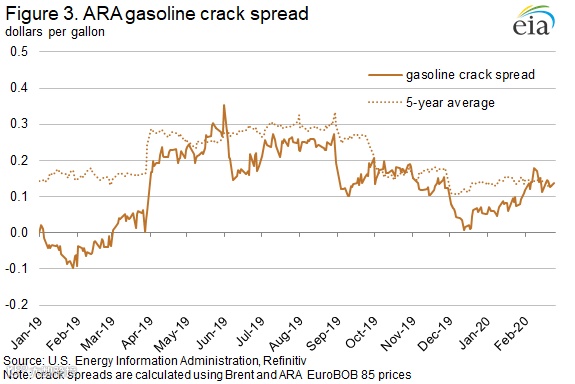
1月ARA地区裂解价差比之前的五年平均值低6美分/加仑,但在二月上涨,并在2月25日与五年平均值持平(图3)。ARA地区的裂解价差使用布伦特原油价格,截至2月25日其1月平均值下跌10美分/加仑。同时期,欧洲汽油价格(ARA EuroBOB85)仅下跌4美分/加仑。
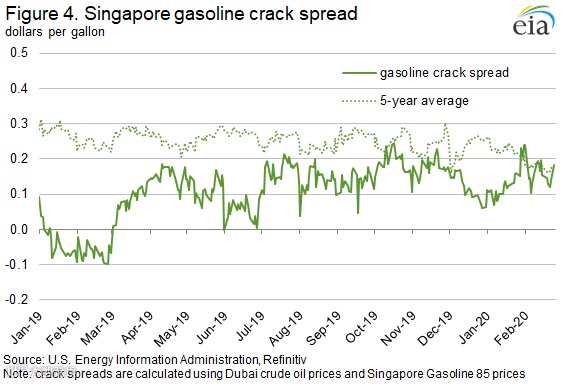
2月25日,新加坡的裂解价差为14美分/加仑,比1月上涨1美分/加仑(图4)。截至二月,新加坡汽油平均价格为1.46美元/加仑,自1月以来下降20美分/加仑。2月25日迪拜原油平均价格(用来计算裂解价差的地区基准)比1月均价低22美分/加仑,促使新加坡裂解价差上涨。由于新加坡和中国很相似,其汽油和原油价格较欧洲或美国更有可能受到引发巨大担忧的新冠肺炎病毒的影响。据贸易新闻社的文章报导,中国下降的炼厂运作率使原油价格下滑,抵消了因下滑的汽油价格裂解价差带来的影响。新冠肺炎病毒对石油市场的影响不明,并将持续发展。
● 翻译原文
This Week in Petroleum
After January weakness, gasoline crack spreads increase in February
U.S. Gulf Coast gasoline crack spreads (the difference between wholesale gasoline prices and crude oil prices that is often used to estimate refining margins) for January 2020 were relatively small compared with the previous five-year (2015–19) average, but they increased in February and as of February 25 are now wider than the five-year average (Figure 1). In January, weak gasoline demand (as measured by product supplied), high gasoline inventories, and high refinery runs all contributed to the narrow gasoline crack spreads. In February, refinery outages, increased gasoline demand, and flat West Texas Intermediate (WTI) crude oil prices contributed to the growing Gulf Coast crack spreads.
U.S. Gulf Coast gasoline crack spreads averaged 18 cents per gallon (gal) in January, compared with a five-year average of 22 cents/gal. Since 2010, only the crack spreads in 2015 and 2019 were smaller, when they averaged 12 cents/gal.
Although refinery runs are sensitive to gasoline cracks, distillate crack spreads are typically more important to overall refinery margins during the winter months, and refineries make a number of products that each have a respective margin. So, high U.S. refinery runs combined with seasonally low domestic gasoline consumption contributed to high inventories, putting downward pressure on gasoline prices in January. Refinery runs in the U.S. Gulf Coast (home to more than 50% of U.S. refining capacity) have been near or above the top of the five-year range each week in 2020. For the week ending January 31, the four-week average refinery gross inputs for the U.S. Gulf Coast was 9.2 million barrels per day (b/d), 75,000 b/d more than the same week last year. U.S. consumption, as measured by product supplied, dropped to 8.5 million b/d (four-week rolling average) for the week ending January 24, the lowest level of consumption since February 2017.
Weak gasoline consumption and strong refinery runs led to record-high gasoline inventories in early 2020. On January 24, 2020, weekly gasoline inventories reached 95.8 million barrels in the Gulf Coast (Petroleum Administration for Defense Districts, or PADD, 3) and 261.2 million barrels for the United States in total, both record highs (Figure 2).
Weak gasoline consumption and strong refinery runs led to record-high gasoline inventories in early 2020. On January 24, 2020, weekly gasoline inventories reached 95.8 million barrels in the Gulf Coast (Petroleum Administration for Defense Districts, or PADD, 3) and 261.2 million barrels for the United States in total, both record highs (Figure 2).
The New York Harbor RBOB (reformulated blendstock for oxygenate blending) price increased from $1.47/gal on February 5 (the day before the Bayway refinery outage) to $1.66/gal on February 19, and the price of Gulf Coast gasoline (Gulf Coast Conventional 87) increased from $1.42/gal to $1.62/gal during the same period. Although Gulf Coast gasoline prices increased by 15 cents/gal between February 5 and February 25, the WTI crude oil price only increased by 6 cents/gal during the same period, leading to rising crack spreads on the U.S. Gulf Coast. As of February 25, the average gasoline crack spread in the U.S. Gulf Coast was 38 cents/gal, up 20 cents/gal from the January average and up 12 cents/gal from the five-year average.
Other markets have seen similar trends in gasoline crack spreads. Gasoline crack spreads in the Amsterdam-Rotterdam-Antwerp (ARA) region of Northern Europe and in Singapore were also relatively weak in January, but they have both increased relative to their five-year averages in more recent weeks. In ARA, January crack spreads of 8 cents/gal were the second-narrowest for that month since 2014. In Singapore, crack spreads of 13 cents/gal were the second-lowest since at least 2011.
Crack spreads in ARA in January averaged more than 6 cents/gal below the previous five-year average but increased in February and were equal to the five-year average as of February 25 (Figure 3). Crack spreads in ARA use the price of Brent crude oil, which fell by 10 cents/gal from the January average as of February 25. During the same period, gasoline prices in Europe (ARA EuroBOB 85) fell by only 4 cents/gal.
Crack spreads in Singapore were 14 cents/gal as of February 25, an increase of 1 cent/gal over the January crack spread (Figure 4). Gasoline prices in Singapore have averaged $1.46/gal so far in February, which is down by 20 cents/gal from January. The price for Dubai crude oil (the regional benchmark used for calculating crack spreads) averaged 22 cents/gal lower on February 25 compared with the January average, providing some upward pressure on crack spreads in Singapore. Because of its proximity to China, gasoline and crude oil prices in Singapore are likely more affected by demand concerns stemming from the 2019 novel coronavirus (COVID-19) than prices in Europe or the United States. Decreasing refinery runs in China, as reported by trade press articles, are likely putting downward price pressure on crude oil, offsetting the effects of crack spreads of falling gasoline prices. The effects of COVID–19 on petroleum markets is uncertain and continues to evolve.
免责声明:该文章信息来源于EIA,我司对信息的准确性和完整性不做任何保证。文章仅做参考之用,在任何情况下均不构成对上述产品的购买建议,我司也不承担因根据本报告操作而导致的损失。
翻译:吴雯琪
排版:沈佳敏
www.zheyouzhongxin.com

浙油中心
专注成就未来
共享成长价值