
Overview
News Today
Market reality: A fast-growing market with a regulated environment, where compliance and preparation are important.
Best entry routes: Mainland LLC for full access, Free Zone for speed and tax benefits, Hybrid for long-term reach.
Set up timelines: 2 to 8 weeks, depending on the shareholder structure.
Tax and compliance: 9% corporate tax above AED 375,000, VAT mandatory above threshold, ESR and UBO checks for all structures.
People and visas: Fixed-term contracts only, Emiratisation required from 50 employees on the mainland, visa processes are increasingly digitalised, but still require careful compliance with immigration and labour regulations.
Banking: 1–3 months with KYC checks
Success factor: Real market validation before setup, backed by local presence and a structure that won’t collapse under regulatory pressure.
01
Why the UAE Has Become a Priority Market

The UAE has become the anchor market for international companies expanding into the Middle East. World-class infrastructure, stable regulation, and a government that actively supports foreign investment create ideal conditions for global firms. According to the UAE Ministry of Economy, the country attracted AED 167.6 billion in FDI in 2024, a 48% jump. Companies aren’t coming here by chance. They’re coming because the market works.
But here’s the part visitors don’t see: the UAE welcomes foreign investors, but not half-baked plans. What seems simple from a trade fair stand can collapse as soon as you start dealing with licensing, banking, or partner selection issues. CEOs want a clear business case. Export Directors want a setup that doesn’t collapse under regulatory pressure.
The companies that win here arrive ready: structured, informed, and focused.
02
Understanding the UAE:
A High-Potential Market With Clear Rules of Engagement
A sophisticated market
that rewards preparation
The UAE is a regulated, competitive business environment. Corporate tax at 9% above AED 375,000, a 15% minimum rate for large multinational groups under OECD Pillar Two, fixed-term employment contracts, Emiratisation quotas, and stronger corporate governance requirements all apply. While free zones offer attractive tax incentives, companies must still register for corporate tax and comply with substance requirements to remain compliant.
Regulation in the UAE isn’t just complex. It’s non-negotiable. Get it right early or risk delays that cost time, reputation, and local credibility.
🔗OECD Pillar Two:https://www.oecd.org/en/topics/sub-issues/global-minimum-tax/global-anti-base-erosion-model-rules-pillar-two.html
What international
companies often underestimate?
Companies often underestimate partner quality, approval timelines, and how critical real local presence is. One misstep in activity selection or documentation can delay market entry by months. Many firms assume that local decision chains are fast when in reality, they are not. Therefore, patience and process mastery matter.
Why does the UAE require
evidence-based decision-making?
Market validation isn’t optional; companies must reach out to clients, test pricing, and benchmark competitors. Early and well-informed market validation significantly reduces structural setup errors and the need for licence revisions. Evidence keeps internal expectations realistic and avoids costly restructuring.
ALTIOS Tip:
Ultimate Beneficial Owner Reporting (UBO Reporting) constitutes a mandatory compliance requirement established by the United Arab Emirates for anti-money laundering and counter-terrorist financing purposes. Chinese enterprises establishing local or free zone companies in the UAE must report details of the ultimate beneficial owners to the registration authority. This typically requires disclosure of natural persons holding direct or indirect shareholdings or control rights reaching 25%, with disclosure extending to the natural person level. UBO information must be updated promptly upon company formation and subsequent changes. Failure to comply may impact licence renewals, bank account openings, and expose entities to potential fines.
03
What Companies Need to Know Before Committing to the UAE
Confirming real market potential
Depending on the business model, companies entering the UAE may target local clients, government entities, the Gulf region, or operate from the UAE to serve international markets such as India, Southeast Asia, and Africa. Technology, renewable energy, logistics, finance, and AgriTech remain the most active sectors for foreign investment.
Understanding the
competitive landscape
Study the companies already succeeding. Look at what they offer, how they price, and how they sell. Companies misprice themselves more often than they misjudge regulation.
Evaluating regulatory
implications early
Corporate tax, VAT, Emiratisation, UBO reporting, Economic Substance and labour law requirements must be addressed early to avoid delays, operational disruptions, and potential fines.
04
Choosing the Right
Market Entry Strategy
Core Entry Models and
Their Tradeoffs
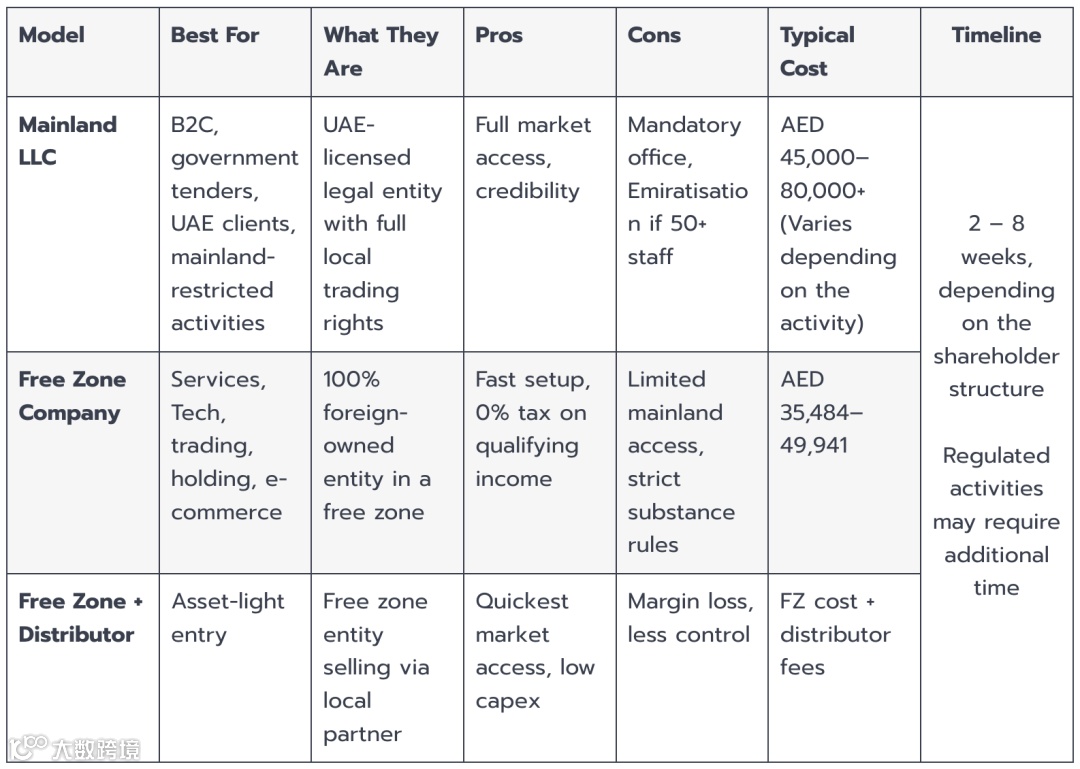
ALTIOS Insight:
Choosing the right structure and jurisdiction (free zone or mainland) depends on the company’s strategy and the business model it intends to deploy in the region.
Leveraging the UAE and
KSA Trade Corridor
Entering the United Arab Emirates does not just mean accessing the local market. It is a gateway to the wider Gulf region, particularly Saudi Arabia. Companies that establish themselves in the UAE can accelerate their access to the kingdom’s more than 35 million consumers and benefit from streamlined logistics, common regulations and an investor-friendly environment.
From a practical standpoint, this means that your entity in the UAE can serve as a springboard:
Regulatory efficiency: learn the ropes in a familiar GCC compliance framework.
Supply chain optimisation: Use UAE ports and distribution centres to quickly serve Saudi customers.
Business intelligence: Gather customer insights in the UAE, then adapt them to Saudi Arabia with minimal additional investment.
For companies targeting both markets, establishing an initial presence in the United Arab Emirates, combined with a regional strategy, can reduce lead times, lower costs, and improve operational visibility throughout the corridor. To find out more, read our article:
1 Launch 2 Markets-Leveraging the UAE and KSA Trade Corridor
05
Key Considerations for
the UAE Expansion
Building Credibility and Visibility
A local setup is key to building trust with local clients, as companies with on-the-ground teams tend to close deals faster than remote sellers.
Don’t underestimate the importance of in-person meetings and networks. Introductions, follow-through, and consistency shape trust.
Local buyers expect speed, clarity, and reliability. Lead times, documentation, service levels, and payment processes must be aligned accordingly.
Navigating Operational
and Compliance Requirements
Corporate structure, licensing,
and incorporation:
Selecting the right license type is critical: commercial, industrial, professional, media, financial, healthcare, or tech. A wrong code can block the entire setup.
HR, visas, and workforce mobility:
Staffing in the UAE is closely linked to visa availability, making early planning essential given fixed-term contracts and mandatory unemployment insurance.
Taxation, reporting,
and financial obligations:
Corporate tax applies to all companies. VAT registration is mandatory above AED 375,000. Many companies delay VAT, thinking it’s optional. It’s tied to your trade license. Without it, you cannot issue legal invoices.
Supply chain, logistics,
and sustainability expectations:
ESG is becoming a competitive advantage. Align your supply chain with energy efficiency and transparency. It increasingly influences client selection, especially in government and enterprise segments.
06
Top Opportunity Sectors
Here are the highest-potential sectors, based on the UAE government strategy and 2024 FDI reporting:
Software, IT, and Digital Services
Growth Outlook: Strong and accelerating. Digital transformation across government, finance, and logistics continues to drive demand for SaaS, AI, cybersecurity, and cloud services.
Policy Incentives: Smart Dubai, National Strategy for AI 2031, free zone incentives (DIFC, ADGM, Dubai Internet City), regulatory sandboxes for fintech.
Common Risks: Overcrowded segments, compliance gaps around data protection, and misalignment with sector-specific approvals.
ALTIOS Tip:
DIFC is the Dubai International Financial Centre, an international financial free zone in the United Arab Emirates catering to banking, asset management, insurance, investment banking, and financial technology (FinTech). It is suitable for financial institutions and FinTech companies.
ADGM, the Abu Dhabi Global Market, is an international financial free zone established in Abu Dhabi. Alongside DIFC, it forms one of the UAE's dual financial hubs, catering to private equity funds, family offices, and digital asset/Web3-related enterprises.
Renewable Energy and Clean Tech
Growth Outlook: One of the fastest-growing segments. The UAE’s Net Zero 2050 commitment drives investment in solar, hydrogen, grid modernisation, and energy efficiency.
Policy Incentives: Government tenders, R&D programs, and strong incentives for pilots that reduce emissions or improve energy resilience.
Common Risks: High capex, multi-agency approvals, and competition from established global players.
Logistics and Supply Chain
Growth Outlook: Robust. The UAE is the regional hub for aviation, ports, and re-export. Growth continues with e-commerce and trade flows.
Policy Incentives: Integrated clusters, customs facilitation, bonded warehouses, free zone logistics incentives.
Common Risks: High competition, thin margins, and dependency on regulatory clarity for cross-border goods.
Financial Services and Fintech

Fintech
Growth Outlook: High. Payments, digital wallets, insurance tech, and wealth management platforms are expanding rapidly.
Policy Incentives: DIFC and ADGM provide common-law frameworks, innovation hubs, and regulatory clarity for digital assets.
Common Risks: Heavy compliance, long licensing cycles, and high governance expectations.
Healthcare and Life Sciences
Growth Outlook: Strong, especially in medical tourism, diagnostics, and specialised care.
Policy Incentives: Health authority programs, cluster development, and incentives for R&D and telemedicine.
Common Risks: Strict clinical approvals, data privacy constraints, and long GTM cycles.
AgriTech and Food Security
Growth Outlook: High due to national dependence on food imports and climate constraints.
Policy Incentives: Health authority programs, cluster development, and incentives for R&D and telemedicine.
Common Risks: Strict clinical approvals, data privacy constraints, and long GTM cycles.
Media, Gaming, and
Creative Industries
Growth Outlook: Growing rapidly, with demand for content production, gaming studios, and digital talent.
Policy Incentives: twofour54, Dubai Media City, and creative zones with ownership incentives and talent visas.
Common Risks: Fast-changing consumer behaviour and dependence on content monetisation models.
How ALTIOS Supports International Companies Entering the UAE
ALTIOS Middle East supports companies throughout their international expansion by accelerating market entry in the UAE. With teams on the ground, we combine strategic insight with hands-on operational execution. Our services include:
Advisory – Market entry strategy and validation through on-the-ground engagement with key market players, collecting first-hand data and precise commercial insights
Corporate Services – Company incorporation and licensing across mainland and free zones, with ongoing corporate compliance
Global HR Solutions – Recruitment support, visa processing, and payroll hosting
Finance & Tax Managed Services – Accounting, bookkeeping and reporting, corporate tax and VAT compliance, financial statements preparation, and audit coordination
Our role is to help companies enter the UAE market with clarity, remain compliant as they grow, and scale their operations with confidence. As a one-stop partner, we support our clients at every stage of their development in the UAE.