TECHNIQUE
来源:National Enhanced Oil Recovery Initiative
编译:嘉洋天成国际教育科技(北京)有限公司-国际培训事业部-陈曦

最常见的二氧化碳驱是在已经开发了的油田中注入二氧化碳,二氧化碳会将原油从地层中“驱替”出来,原油从而就能流到井桶中。和油混合在一起的二氧化碳会在地面上的设备中被分离,再次注入到地层中。二氧化碳驱像是一个闭环系统,二氧化碳被注入,驱替产油,一部分会留在地层,一部分循环出并再次注入。
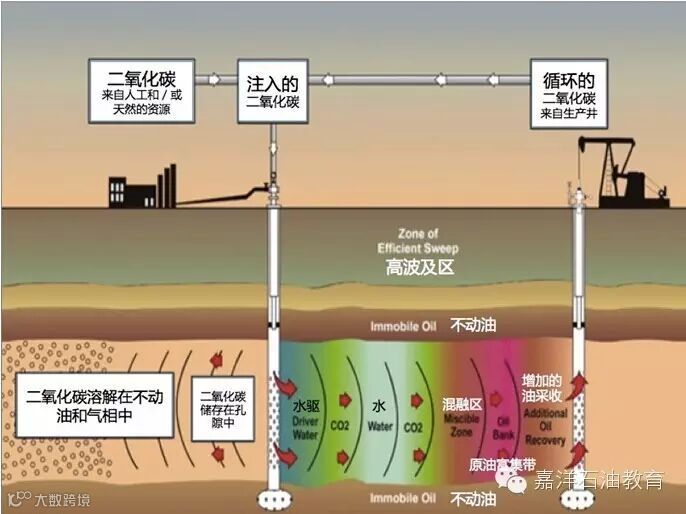
今天,大部分用于驱替的二氧化碳来自天然的地下二氧化碳气层,而由于天然的二氧化碳气层是有限的,所以通过收集发电厂和其他工业设施(化肥厂,乙醇厂,水泥厂和钢铁厂)排放的的二氧化碳也会被使用。二氧化碳被收集后就会被压缩,然后通过管道传输到油田。
由于石油,天然气在地表以下承受着极高的压力,初次打下生产井后,这些流体无需辅助措施即可流出油井,这就称为初次开发。
初次开发之后,油藏中仍然有很客观的储量,很多时候,80%-90%的油藏仍然存藏在油藏的孔隙中。
如果初次开发后没有弃井,就会进入二次开发阶段,第二阶段需要注入一些流体(通常是水)来增加地层的压力。注水井可以是新打,也可以改造生产井,被注入的流体能把油压到井桶中继续被开采储备出来。二次开采能开采出等于甚至大于初次开采的产量。但在二次开采之后,由于地层下复杂的构造等原因,很多油不能完全接触到水,所以仍然有50%-70%的原油留在储层中。
初次和二次开发通常被称为常规油气开发。
在三次开发中,油田再次注入一种注入物(通常是二氧化碳)来和原油反应来改变其物理性质,使其能在油层中更顺利的流动。几乎纯二氧化碳(纯度大于百分之九十五)具有和原油相溶的性质,相溶后原油的体积会扩张,质量变轻,从而从岩石表面分离出,在油藏中能更容易留到井桶中。在一个闭环系统中,二氧化碳和开采出的原油在地面上被分离,之后再次注入。二氧化碳驱一般能多开采出地层中4-15%的油。
原文
IWCF Launches Free Training Course

How does CO2-EOR work? CO2-EOR works most commonly by injecting CO2 intoalready developed oil fields where it mixes with and “releases” the oil fromthe formation, thereby freeing it to move to production wells. CO2 that emergeswith the oil is separated in above-ground facilities and re-injected into theformation. CO2-EOR projects resemble a closed-loop system where the CO2 isinjected, produces oil, is stored in the formation, or is recycled back intothe injection well.
Today, most of the CO2 used in EOR operations is from naturalunderground ‘domes’ of CO2. With the natural supply of CO2 limited, man-madeCO2 from the captured CO2 emissions of power plants and industrial facilities(e.g., fertilizer production,ethanol production, cement and steel plants) canbe used to boost oil production through EOR. Once CO2 is captured from thesefacilities, it is compressed and transported by pipeline to oil fields.
Primary Production refers to a new oil field discovery where productionwells are drilled into a geological formation and oil or gas is produced usingthe pent-up energy of the fluids in the reservoir.
At the end of primary production a considerable amount of the oil remainsin place, with sometimes as much as 80-90 percent still “trapped” in the porespaces of the reservoir. (Melzer, 2012)
If an oil field is not abandoned after primary production, it moves intoa secondary production phase wherein a substance (usually water) is injected torepressurize the formation. New injection wells are drilled or converted fromproducing wells, and the injected fluid sweeps oil to the remaining producingwells. Secondary production could yield up to an equal or greater amount of oilfrom primary production. But this has the potential to ultimately leave 50-70percent of the original oil remaining in the reservoir since much of the oil isbypassed by the water that does not mix with the oil. (Melzer, 2012)
Primary and secondary production are sometimes referred to as“conventional” oil production practices.
During tertiary production, oil field operators use an injectant(usually CO2) to react with the oil to change its properties and allow it toflow more freely within the reservoir. Almost pure CO2 (>95 percent of theoverall composition) has the property of mixing with oil to swell it, make itlighter, detach it from the rock surfaces, and cause the oil to flow morefreely within the reservoir to producer wells. In a closed loop system, CO2 mixed with recovered oil is separated in above-ground equipment forreinjection. CO2-EOR typically produces between 4-15 percent of the originaloil in place. (ARI, 2010)
References
Advanced Resources International (ARI), Improving Domestic EnergySecurity and Lowering CO2 Emissions with “Next Generation” CO2-Enhanced OilRecovery (CO2-EOR), June 20, 2011, DOE/NETL-2011/1504.
Melzer, L. S. (2012). Carbon Dioxide Enhanced Oil Recovery (CO2-EOR):Factors Involved in Adding Carbon Capture, Utilization and Storage (CCUS) toEnhanced Oil Recovery.
原文链接:http://neori.org/resources-on-co2-eor/how-co2-eor-works/
-
本文由嘉洋石油教育原创编译,转载需授权。