




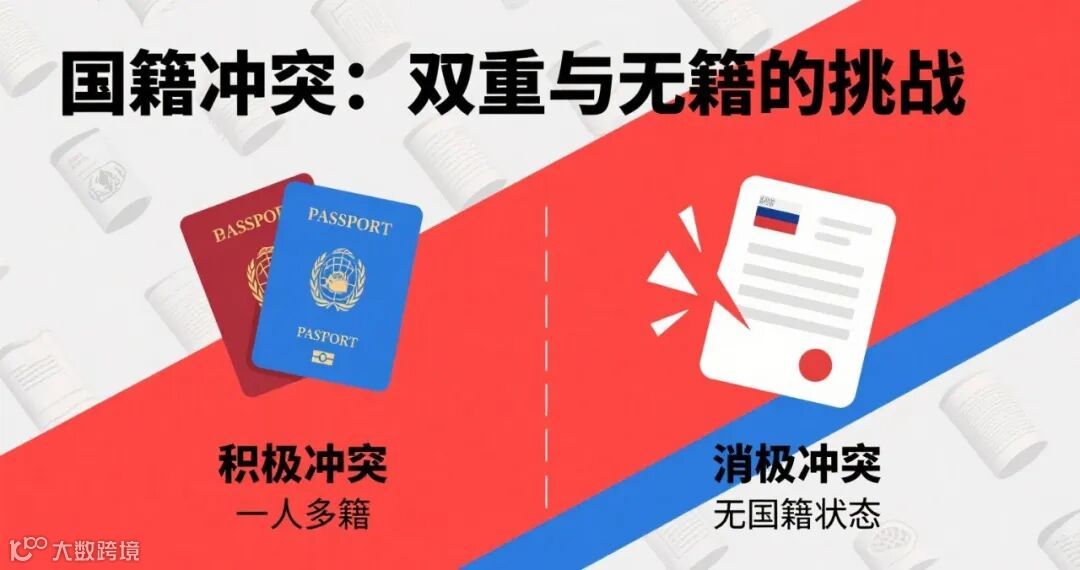
人员跨国流动日益频繁,“出生在 A 国、父母是 B 国公民”“定居 C 国后又申请 D 国国籍” 的情况愈发常见。然而,当不同国家的国籍法 “各执一词”,就可能催生两种棘手的局面:要么一个人同时拥有多国国籍,陷入 “履行义务时两国都要管,寻求保护时两国互相推” 的困境;要么一个人被所有国家 “拒之门外”,成为没有任何国籍的 “世界边缘人”。这就是国籍冲突 —— 法律层面的 “重叠” 与 “真空”,不仅关乎个人的出行、就业、权益保障,更与国家的主权认定、法律适用紧密相连。从 “中外宝宝” 的国籍选择难题,到无国籍人士的生存困境,读懂国籍冲突的成因、危害与中国立场,才能在跨国生活中避开身份认定的 “坑”。
The cross - border movement of people is becoming increasingly frequent. Situations such as "being born in country A with parents who are citizens of country B" and "applying for the nationality of country D after settling in country C" are becoming more common. However, when the nationality laws of different countries "hold different views", two difficult situations may arise: either a person holds multiple nationalities simultaneously and gets caught in a dilemma where "both countries want to manage when it comes to fulfilling obligations, but both countries shirk responsibility when it comes to seeking protection"; or a person is "shut out" by all countries and becomes a "marginal person of the world" without any nationality. This is the nationality conflict - the "overlap" and "vacuum" at the legal level, which is not only related to an individual's travel, employment, and rights protection, but also closely connected to a country's sovereignty determination and application of law. From the nationality - choosing dilemma of "Chinese - foreign babies" to the survival predicament of stateless people, only by understanding the causes, harms, and China's stance on nationality conflict can we avoid the "traps" of identity determination in cross - border life.
国籍冲突:当法律出现“重叠”或“真空”
|
|
|
|
Positive conflicts (dual or multiple nationalities)
Causes: Due to differences in the principles of nationality laws of various countries, there is an "overlap" in the application of laws.
Case A (arising from birth): A baby is born in the United States (jus soli), and his parents are Japanese citizens (jus sanguinis). This child is born with both American and Japanese nationalities simultaneously.
Case B (arising from application): A citizen of a country that allows dual nationality (such as Canada) obtains the nationality of another country that also allows dual nationality (such as France) through a naturalization application, thus having dual nationality.
Problems brought about:
Conflict in fulfilling obligations: One may be required to perform military service and pay taxes by two countries simultaneously.
Conflict in diplomatic protection rights: When encountering troubles in a third country, the two countries may simultaneously claim or shirk the consular protection rights.
Inconvenience in travel: Entering and exiting the country with different passports may cause trouble.
Negative conflict (statelessness)
Cause: A "legal vacuum zone".
Case: A stateless couple gave birth to a child in a country that adheres to the principle of jus sanguinis. The country does not grant nationality based on birthplace, and the child cannot inherit any nationality from their parents, thus becoming stateless.
Problems brought about: Stateless people lack the protection of any country, and they will face huge difficulties in basic human rights such as education, medical care, employment, and travel.
China's stance:
China does not recognize dual nationality for Chinese citizens.
According to Article 9 of the Nationality Law of the People's Republic of China, any Chinese citizen who has settled abroad and voluntarily acquired foreign nationality shall automatically lose Chinese nationality.

国籍,本应是个人与国家之间的 “安全纽带”,而国籍冲突却让这份 “纽带” 变得扭曲或断裂 —— 双重国籍者在义务与权利的 “拉扯” 中疲惫不堪,无国籍者在身份的 “真空” 里举步维艰。它不仅是个人的 “身份难题”,更是全球化时代下各国法律协调需要面对的共同挑战。中国 “不承认双重国籍” 的立场,既维护了国家主权与法律的统一性,也为跨国场景中的国籍认定提供了清晰边界;而对于无国籍问题,国际社会也在通过公约、合作等方式逐步推进解决。未来,随着各国国籍法的进一步协调,或许能减少更多因 “法律差异” 产生的身份困境,但在此之前,了解不同国家的规则、明确自身的身份定位,才是应对国籍冲突的最佳 “防御盾”。
Nationality is supposed to be a "safety bond" between an individual and the country. However, nationality conflicts distort or break this "bond" - those with dual nationality are exhausted in the "tug - of - war" between obligations and rights, and stateless people find it extremely difficult to move forward in the "vacuum" of identity. It is not only an "identity problem" for individuals, but also a common challenge that the legal coordination of various countries in the era of globalization needs to face. China's position of "not recognizing dual nationality" not only safeguards the unity of national sovereignty and laws, but also provides a clear boundary for nationality determination in trans - national scenarios. Regarding the issue of statelessness, the international community is also gradually promoting its solution through conventions, cooperation, etc. In the future, with the further coordination of nationality laws of various countries, more identity dilemmas caused by "legal differences" may be reduced. But before that, understanding the rules of different countries and clarifying one's own identity positioning are the best "shields" to deal with nationality conflicts.
更多信息获取可加入中创侨智—知识星球,将为您提供全面的外国人来华相关信息、专业的政策解读与指导、实时的行业动态与资讯、互动交流与学习机会以及定制化的服务方案等多种资源和服务。这些资源和服务将帮助您更好地了解和适应中国,为您的跨境之旅提供有力支持。扫描下方二维码可付费加入。
或点击下方小程序加入
or click on the mini program below to join
可以添加中创侨智顾问
进行详细评估咨询


欢迎关注公众号:中创侨智
如对相关政策有疑惑,想要了解更多的

国际生 吃大亏 白规划了这么久?! 国籍冲突一定要搞清楚!!
为什么有很多长期定居中国的外籍华人不把国籍改回来?都从外国回来了,甚至定居,国籍为什么还是不改?

由于近期公众号规则调整,大家很可能无法第一时间收到我们的推送。所以如果你希望我们能正常出现在你的时间线,恐怕你要手动设置个星标了,阅读完后顺手点一下「在看」,记得哦~
声明:此文章乃中创侨智原创不易,杜绝任何形式的抄袭行为
图片来自网络,如有侵权请联系删除