

Whatis Fapiao? – The tax control instrument of the Chinese government
“Everything you need to know about “Fapiao” as a foreign investor”
If you’ve been doing business in China or with Chinese entities, you might have across the term “Fapiao”. If not– then this item also goes by the name “VAT letter” or “company invoice” inChina which is vital to do legal transactions within the jurisdiction.
Since most countries don’t have a Fapiao, it is often difficult for most foreign companies or individuals to understand the significance of it. To clear out the confusion, we at WowCommerce are bringing you a guide to Fapiao which can be used as a reference any time to understand the concept.
Officially, here’s how the government described this tiny yet important piece of paper in its own wording.
“A fapiao is an official invoice issued by the Chinese Tax Bureau (but provided by the seller) for any goods or services purchased within the country. The Chinese government uses these invoices to track tax payments and deter tax evasion.”
However, its implications are much higher especially if you’re an import/export business. Basically, having the ability to issue or show Fapiao adds another layer of credibility to your transaction. Only Chinese entities can issue a Fapiao and the recipient must be involved in some transaction with said entity.
To get a better understanding of what exactly is Fapiao, keep reading our explanation below. This article will cover a number of frequently asked questions and concepts related to the following:
The similarities and differences between an invoice and a Fapiao.
The latest policy about Value Added Tax in China.
The different types of Fapiao – there are two in total.
What kind of information is shown on a Fapiao?
The significance of Fapiao and why do you exactly need it?
What are the tax implications and government levy in relation to Fapiao?
Before we get started, let us talk a little about its importance to foreign companies and individuals. Do you even need to worry about it? You might want to know that first before jumping into a detailed description of what it really is.
Generally, as a foreign investor, it’s not necessarily important for you to know each and every detail about the internal workings of a Fapiao.
In simple terms, Fapiao was put in place by the Chinese government to have better control overpayments made within China – the Fapiao puts credibility into a transaction because it can only be issued by a legal entity approved by the legislation to operate in its region. Fapiao also assures that the right amount of tax is being paid without any misinformation involved.
After reading the details regard the Fapiao above, you must be wondering – “isn’t that just an invoice”?
There is a major difference that sets the two types of documents apart. The key concept is to show and verify the amount of money paid, and the amount of money received in a transaction, and by whom. Two parties – mainly companies – enter into a transaction, and to give proof that the transaction happened, or to request the payment, the company will issue an invoice that shows how much money is being exchanged.
And that is true for both Fapiao and the traditional Invoice. However, Fapiao’s can only be produced by government offices or your local tax bureau before making it into the hands of the end-consumer. Businesses have to buy or receive their share of Fapiao from the government and then issue the original document to the customer to complete the transaction.
Traditional invoices, on the other hand, are usually prepared by businesses for general transactions between them and their customers. There is no prescribed standard behind how an invoice should be used or in what format.
Fapiaoon the other hand, has greater implications.
China’smost recent VAT policy came in to further tighten the Fapiao rule.
In some cases, the country made it necessary for certain transactions to have a valid Fapiao. Banks were instructed to enforce the use of Fapiao especially for foreign businessmen looking to withdraw or pay money. Most of the time, it is almost impossible to receive a legit payment in China unless a Fapiao is provided – if you try to do otherwise, both parties involved in the transaction can get heavy consequences.
Since this article doesn’t talk about the exact details of the VAT policy, we can produce another one later that will cover all of what’s included in the new rule. Let us know in the comments if you’d like to know more about it!
These days, there are two different kinds of Fapiao available to businesses in China.
There’s a general Fapiao – called Pupiao(普票) – is issued to non-VAT registered businesses that are still small-to-medium. The other kind, known as Zhuanpiao(专票) allows the issuer to charge tax to the payee.
The general Pupiao works in most ways for most common transactions, but for larger transactions, a Zhuanpiao might be needed. To become eligible to issue Zhuanpiao, you must be a VAT-legal company, meaning your company is large enough to collect VAT from its customers for the government.
To become eligible for a VAT license, your Chinesecompany’s annual turnover must be over ¥1,000,000 a year.
Unless you’ve had the opportunity to take a look at a Fapiao before, you’re probably curious about what exactly are the shown contents. What kind of information is written on top of a Fapiao for it to be significant?
If you’ve never seen one, check out the picture below:
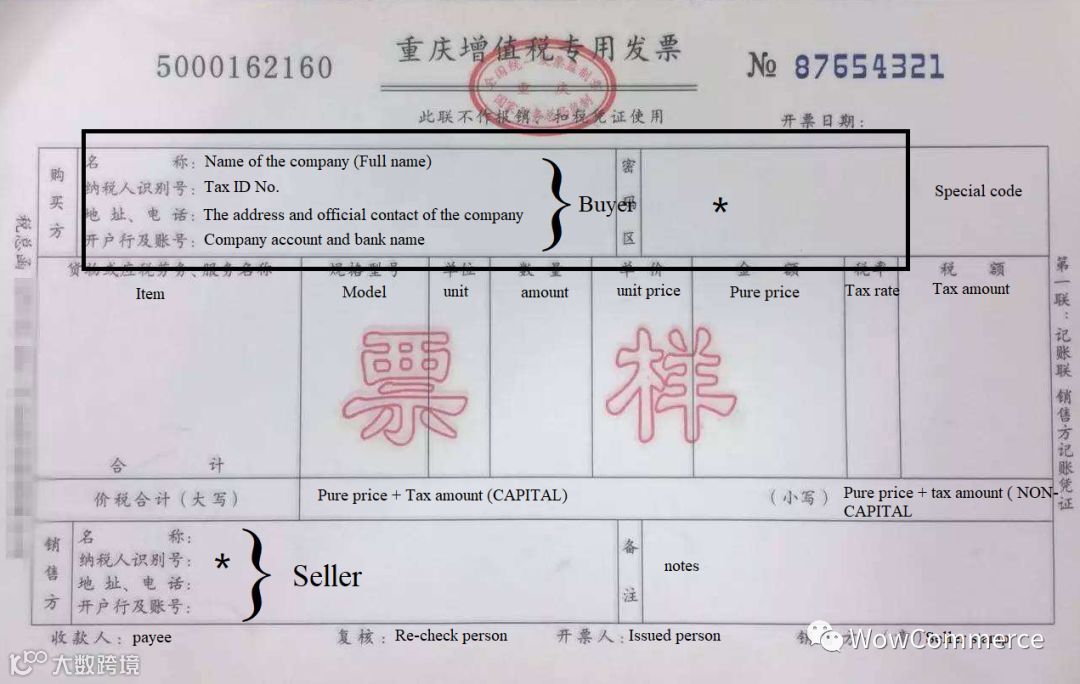
The picture above shows an empty Zhuanpiao ( the special one) ticket which has not been filled yet. As you can see, the ticket talks about pretty much all of the information of the parties involved in the transaction, including the company name, tax ID number, tax paid, and even the bank name.
The Pupiao (the general one) looks pretty much the same except two differences – the general ticket does not mention bank details and the address of the company involved in the transaction and can be used for most day-to-day exchanges.