



Click “WowCommerce“ Above To Follow Us
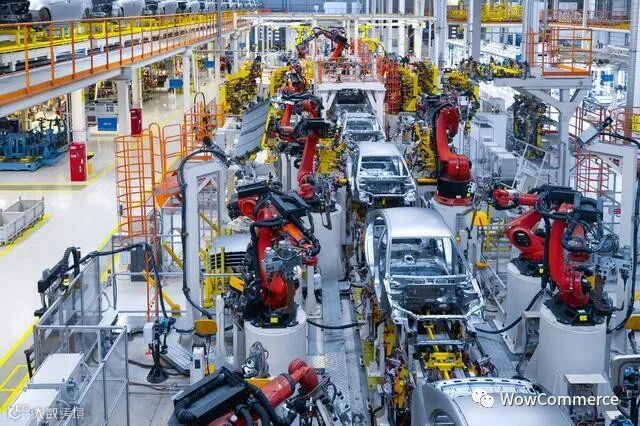 Billions of dollars are being invested by the US, EU, Japan, and South Korea into a new production wave of electric vehicles and autonomous vehicles technology in China.
01
China automotive industry
Automotive is a key industry, especially for developing nations as it produces an array of second and third-tier manufacturers, all supporting the major global manufacturers. So, it was in China at the time, when all sorts of different foreign investors turned up to establish WFOEs or JVs. There were companies involved in high tempered glass, manufacturing windscreens, companies that specialized in wing mirrors, tire manufacturers, companies that made component parts for tires, such as steel wire, rubber, and the chemicals used. There were car seat manufacturers, engine part makers, sunroof manufacturers, car key makers, steering wheel designers, and headlight bulb installers. These were heady days and were followed up by Chinese state-owned enterprises (SOEs) buying well-established international auto brands. Put simply, the Chinese manufacturing process could make cars faster and more cheaply than many of the global manufacturers, a similar situation that had seen the likes of Toyota take a chunk of US market share in the 1990s.
02
China races ahead in electric vehicles, autonomous vehicles
Today, China hasn't just overtaken the US auto manufacturing market in terms of size, it completely dominates in terms of production. In 2018, the US manufactured 11,314,705 vehicles. China produced 27,809,196. The third-largest auto manufacturer, Japan, produced 9,728,528 vehicles, with India fourth with 5,174,645, meaning that China produced more than the total number of vehicles made by Japan, India and the United States combined. A new wave, however, is coming. What was manufactured before was old tech. Now with new tech, in the form of new energy vehicles or NEVs - both driverless and electric vehicles, this is ushering in a new wave of investment into China.
03
China's autonomous vehicle market
This new wave of NEV vehicle production in China is already underway and is a multi-billion-dollar investment spend, happening right now to get into the market. China opened up part of its self-driving auto industry to foreign investment earlier in the year. Some market analysis firms predict that China’s shared mobility market will reach a valuation of RMB 2.25 trillion (US$352 billion) by 2030, or a compound annual growth rate of 20 to 28 percent. If autonomous vehicles can penetrate this market, the rewards may be enormous. There is wide scope in the fields newly open to foreign investment, including areas such as hardware development and manufacturing, autonomous driving technology R&D, security technology R&D, and development of testing and evaluation mechanisms, among others.
German investors have been making significant investments, for example, with 12 announced investments - either VC injections or JVs. These included BMW (a new US$3.9 billion plant), VW (a new factory), Porsche and Daimler, two JVs with CATL and Geely, two JVs via BASF, a minority investment into circuit boards, and VC investments into Chinese robotics - looking at driverless cars.
China auto tech is very much a hot market right now, with the United States also making two sizeable investments in automotive tech, including one by Intel into Geely, and France’s Renault restructuring and recapitalizing its China JV. Sweden has also been busy with restructuring Swedish capital investments into China’s automotive sector, four of which were related to preparing Volvo for its EU IPO. That needs to excite investors with new auto tech vehicles.
Mazda also restructured both of its auto Chinese JVs, while South Korea’s SK Innovation, a leading NEV battery maker, announced a US$1.04 billion investment in a new battery factory in China, showing the changeover to EV is being motivated with increasing RCEP trade cooperation. RCEP - the Regional Comprehensive Economic Partnership - is a free trade agreement that has just been ratified. It includes all 10 ASEAN nations, China, Australia, New Zealand, Japan, and South Korea. SK Innovation knows that by the time their new EV battery manufacturing plant is ready in China, the RCEP deal will be in force and they will be able to use that production facility to sell across the RCEP free trade area. The expansion will almost certainly be required very soon to meet demand.
This wave of New Auto investment will spur, just like the old wave of auto investment, new layers of investment into China. The likes of BMW, VW, BASF, Mazda, and so on will soon be requiring their own new auto tech suppliers to support them. Investment may well be available from China to help them do that.
New tech and new lifestyles await a post-COVID world. Billions are being invested in that change. Getting to know where the foreign capital investment flows are going are primary opportunity signal for foreign investors.

WowCommerce
Keep Your Business Updated
WeChat: 501212685
WhatsApp:+(86)13591604300