

Compilation of Export Import Policies of December 2021


On January 14, 2022, the General Administration of Customs released the December statistics of China’s import and export. Exports from China (in U.S. Dollar terms) grew by 20.9% year on year, above market forecast of a 18.2% increase and after a 22% growth in November. Imports into China (in U.S. Dollar terms)rose by 19.5% year on year, missing market forecast of a 22% increase and after a 31.7% increase in November.
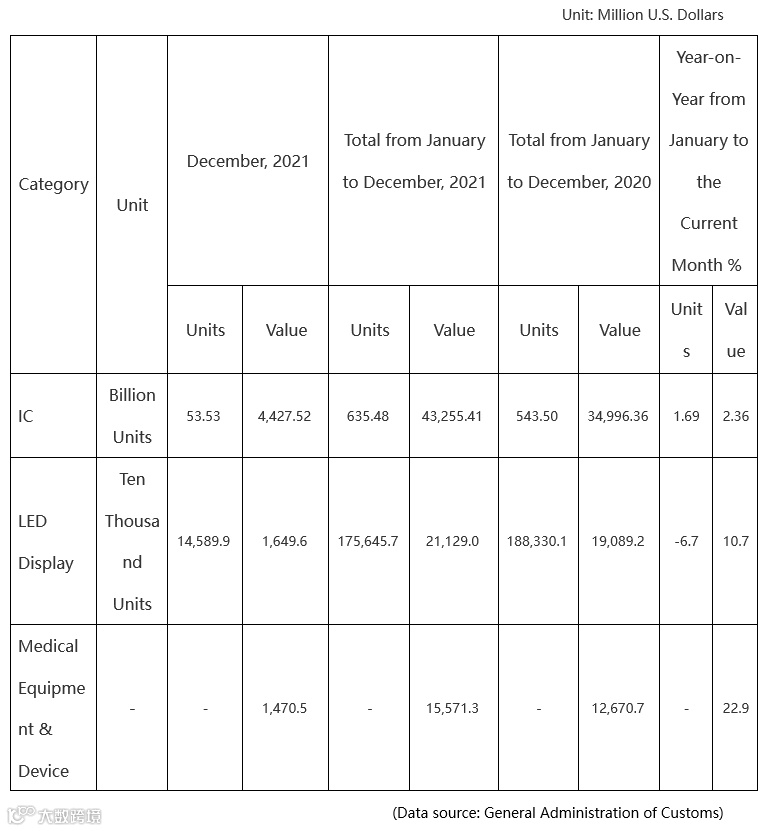
In 2021, total imports and exports amounted to 6.05 trillion U.S. Dollars,surpassed 5 trillion and 6 trillion U.S. dollars at one go in 2021, a new highin history eight years after 2013, when China’s foreign trade reached 4trillion U.S. dollars. Foreign trade grew by 1.4 trillion U.S. dollars from a year ago. In Yuan terms, China’s goods trade amounted to 39.1 trillion yuan in 2021, up 21.4% year on year. Imports and exports of electromechanical products continued growing. In 2021, China’s exports of electromechanical products rose to 12.83 trillion yuan, up 20.4%, accounting for 59% of the total exports.Among them, exports of automatic data processing equipment and parts, mobile phones, and automobiles grew by 12.9%, 9.3%, and 104.6% respectively. In the same period, the imports of electromechanical products reached 7.37 trillionyuan, an increase of 12.2%, accounting for 42.4% of the total imports. The foreign trade of integrated circuits (IC), LED display, and medical equipment and devices grew to varying degrees.
It was a fabulous result, but we also need to face the challenges. The threefold pressure -a contraction in demand, supply shocks, and weaker expectations- is also pronounced in the foreign trade field. According to Ren Hongbin, Vice Minister of the Ministry of Commerce, under the impact of the pandemic, the global economy is in a fragile recovery, and foreign demand has been growing slowly; the shortage of chips, containers, and workers and the rise of freight, raw material cost, energy resource price, and the yuan will add to the burden facing enterprises directly. At the same time, periodic factors that were pillars of the high foreign trade growth in 2021, such as orders returning to China, rising prices, will not be sustainable. That, together with the impact of the high base of 2021, will create unprecedented obstacles for stabilizing foreign trade in 2022.

01

The White Paper on China's Export Controls was promulgated.
Link:
The framework of China's export control mainly consists of the Export Control Law of the People's Republic of China (effective since December 1, 2020), the Catalogue of Technologies Prohibited or Restricted from Export (revised on August 28, 2020), and the Provisions on the Unreliable Entity List (effective since September 19, 2020). Export control means taking measures to prohibit or restrict the export of items, including dual-use items, military products, nuclear materials, and other goods, technologies, and services associated with the safeguarding of national security and interests and the fulfilment of international obligations such as non-proliferation. As a common practice in the international world, it will further contribute to the optimization of license management, the improvement of law enforcement, compliance promotion, and the fulfillment of international obligations.
Therefore, enterprises need to build an effective import and export compliance system and a commodity compliance database for their import and export practices as soon as possible.
The information about the export controls on China's dual-use items, military products, and nuclear materials is shown as follows:
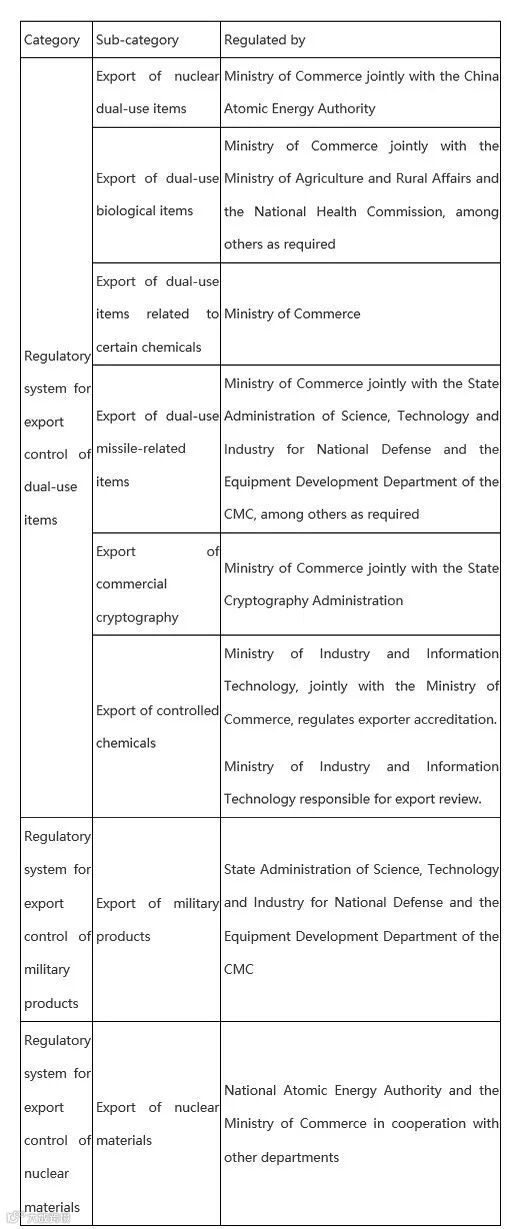
The Ministry of Commerce and the General Administration of Customs promulgated the Control List of the Import and Export License for Dual-Use Items and Technologies (MOC announcement No. 48, 2021).

02

Announcement of the Customs Tariff Commission of the State Council on the Issuance of the Customs Import and Export Tariff of the People's Republic of China (2022)
Link:
2022 will be an important year for changes to customs codes.This update involves the addition of 1,063 new HS codes, the deletion of 665 and the modification of 1,097. Part of fiberglass products under 7019 were updated on January 10, with 64 added and 32 deleted.
HMG's commodity management system will synchronize the customs code update on the update day. The data will be synchronized to local archival databases (local customs account books) through one-time update of the classification database to ensure the consistency of customs codes. And prompts will be set up in all systems for modified and deleted customs codes to avoid potential misuses, as a way to safeguard the code update for all users in the New Year.
Relevant announcements are shown as follows:
Notice of the Customs Tariff Commission of the State Council on the 2022 Tariff Adjustment Plan (CTCSC No.18 [2021])
http://gss.mof.gov.cn/gzdt/zhengcefabu/202112/t20211215_3775137.htm
Announcement No.119 of 2021 of the General Administration of Customs (Announcement on Implementing the 2022 Tariff Adjustment Plan)
http://www.customs.gov.cn//customs/302249/302266/302267/4123301/index.html
Announcement of the Customs Tariff Commission of the State Council on the Sixth Extension of Tariffs Exclusion List of U.S. Products Subject to Additional Tariffs (CTCSC Announcement, No. 9 [2021])
http://gss.mof.gov.cn/gzdt/zhengcefabu/202112/t20211224_3777971.htm

03

Revision and Adjustment to the Commodities and Headings of the Customs Import and Export Tariff Schedule (2022) by the General Administration of Customs
Link:
This revision of the Explanatory Notes to the Customs Tariff was based on the 2017 version, involving 14 chapters and 19 headings. The modification of general notes, heading notes, and annexes clarified the classification of relevant commodities.

04

List of Expired Decisions on Commodity Classification of the General Administration of Customs
Link:
http://www.customs.gov.cn/gss/zcfg97/gfxwj26/4096097/index.html

05

Announcement No. 101 of 2021 of the General Administration of Customs (Announcement on Matters concerning the Quarantine Approval of Certain Entry Animals and Plants and Products Thereof by Authorized Customs Offices Directly under the General Customs Administration)
Link:
http://www.customs.gov.cn//customs/302249/2480148/4043877/index.html

06

Announcement No.102 of 2021 of the General Administration of Customs (Announcement on the Issuance of the Revised Origin Criteria under CEPA with Hong Kong)
Link:

07

Announcement No.103 of 2021 of the General Administration of Customs (Announcement on Matters concerning the Implementation of the Regulations of the People's Republic of China on the Registration and Administration of Overseas Manufacturers of Imported Food and the Measures of the People's Republic of China for the Administration of Import and Export Food Safety)
Link:

08

Announcement No.105 of 2021 of the General Administration of Customs (Announcement on the Implementation of Matters concerning the Measures of the Customs of People's Republic of China for the Administration of Approved Exporters)
On December 10, 2021, the General Administration of Customs issued the Announcement on the Implementation of Matters concerning the Measures of the Customs of People's Republic of China for the Administration of Approved Exporters. According to the Announcement, where applications are recognized by approved exporters, applicants shall submit the Application Recognized by Approved Exporters of the Customs of PRC via the Information System for Approved Exporters Management on the China International Trade Single Window or the “Internet + Customs” integrated online service platform. The customs will issue documents and notifications to applicants and approved exporters via the approved exporter system.
Attention: When approved exporters have issued a declaration of origin via the approved exporter system, the issuer will sign or seal the declaration in accordance with the requirements of the applicable agreement to confirm that goods involved in the declaration comply with the rules of origin under the relevant preferential trade agreement.
Link:
The General Administration of Customs issued the measures for the administration of exporters to coincide with the successful launch of RCEP on January 1. According to relevant provisions, enterprises that meet the following three requirements are eligible to apply to be an approved exporter: 1) being an Authorized Economic Operator; 2) understanding the rules of origin under relevant preferential trade agreements; 3) having established a file administration system for qualification of origin. After being approved, such enterprises can issue declarations of origin for goods originated from China that they produce and export to other parties without having to apply for certificates of origin to certification institutions. Relevant goods are eligible for preferential tariff treatment under free trade agreements while other parties are making an import declaration.
However, it is necessary to confirm whether the customs of the import and export country has received the information of approved exporters of the other party before import and export. For example, the issuer of RCEP declarations of origin of Japan currently recognized by the China customs is JCCI and the China customs has not received any information about other approved exporters from Japan.

09

Announcement No.106 of 2021 of the General Administration of Customs (Announcement on the Implementation of Matters concerning the Regional Comprehensive Economic Partnership)
Link:
The official coming into force of RCEP means the most promising free trade zone with the biggest population involved on the biggest economic scale has come true. The first batch of participating countries include six ASEAN members, which are Brunei, Cambodia, Laos, Singapore, Thailand, and Vietnam, and four non-ASEAN members, which are China, Japan, New Zealand, and Australia. According to news released by the Ministry of Trade, Industry and Energy of South Korea on December 6, 2021, approved by its National Assembly and having been communicated to the Secretariat of ASEAN, RCEP will come into force in South Korea as of February 1, 2022.

10

Announcement No.107 of 2021 of the General Administration of Customs (Announcement of the Customs of the People's Republic of China on Promulgating the Administrative Measures for the Places of Origin of Import and Export Goods under the Free Trade Agreement between China and the Kingdom of Cambodia)
Link:
Although the implementation of RCEP received wide media coverage, the Free Trade Agreement between China and Cambodia that came into force on the same day will also benefit enterprises in our city. The Free Trade Agreement between the PRC and the Kingdom of Cambodia (the China-Cambodia FTA) came into force as of January 1, 2022. The liberalization of goods trade and the service market access of the China-Cambodia FTA both represent the highest level among China's agreements with other free trade partners.
In terms of goods, the proportion of zero-tariff products in goods trade granted to Cambodia by China reached 97.53%, and that granted to China by Cambodia reached 90%, both the highest level given by each side to its FTA partners. In terms of services, the two sides opened their markets in service further based on the FTAs they are already engaged in, reflecting the highest level among the two sides’ agreements with their FTA partners respectively.

11

Announcement No. 111 of 2021 of the General Administration of Customs (Announcement on Closing Foshan and Zhaoqing Railway Ports in Guangdong)
Link:

12

Announcement No. 112 of 2021 of the General Administration of Customs (Announcement on Abolishing Announcement No. 64 of 2006)
Link:

13

Announcement No. 113 of 2021 of the General Administration of Customs and the State Administration for Market Regulation (Announcement on Fully Incorporating the "Multiple Certificates in One" Reform into the Archival Filing of Declaration Entity)
Link:

14

Announcement No. 115 of 2021 of the General Administration of Customs (Announcement on Implementing Mutual Recognition of Authorized Economic Operator (AEO) between Customs in China and Brazil)
Link:
http://www.customs.gov.cn/customs/302249/2480148/4085296/index.html
By the end of 2021, China customs signed mutual AEO agreements with 47 countries and regions and 21 economies, such as Singapore, South Korea, and the EU, ranked first in the world in the number of mutual recognition countries and regions.

15

Announcement No.116 of 2021 of the General Administration of Customs (Announcement on Promoting Paperless Declaration for Cross-Border Transportation)
For the purposes of further regulating and simplifying the supervision procedure of the customs for cross-border goods, the GAC decided to promote paperless declaration for cross-border transportation. Relevant matters are hereby announced as follows:
I. Paperless declaration for cross-border transportation means the customs will evaluate the electronic data of cross-border transportation declaration forms submitted by enterprises using information technologies, with no need to collect paper documents. Where the customs need to check paper documents, enterprises shall submit them as required.
II. Relevant enterprises shall submit the electronic data of cross-border transportation declaration forms to the customs following the norms of data fields and filling explained in this announcement (see annexes 1 and 2) strictly. After the approval of the customs, enterprises that do not conduct cross-border transportation or need to modify the electronic data of their declaration forms shall apply to the customs to delete the old data.
III. Where enterprises cannot submit the electronic data of cross-border transportation declaration forms to the customs due to internet outage or other force majeure, they can, with the consent of the customs, go through cross-border formalities with paper documents and submit relevant data to the customs when everything goes back to normal.
Link:

16

Announcement No.118 of 2021 of the General Administration of Customs (Announcement on Matters concerning the Declaration of COVID-19 Detection Kit and Other Epidemic Prevention and Control Materials)
Link:

17

Announcement No.119 of 2021 of the General Administration of Customs (Announcement on Implementing the 2022 Tariff Adjustment Plan)
Link:
Major adjustments include: to add or reduce the provisional import tariff rates on some medical equipment and devices and consumer products; to impose zero tariff on radium chloride injection, a new anti-cancer drug; to lower import tariffs on some medical products, such as intracranial thrombectomy stents and artificial joints; to reduce the import tariffs on key parts such as graphite accessories for silicon carbide (a third generation of new semiconductor material) epitaxy, high-voltage cables for high-speed trains, membrane electrode assemblies, and bipolar plates for fuel cells.

18

Announcement No.120 of 2021 of the General Administration of Customs (Announcement on Expanding the Applicable Coverage of Policies and Systems Adopted in the Yangpu Bonded Port Area)
Link:

19

Announcement No. 121 of 2021 of the General Administration of Customs (Announcement on the Temporary Exemption of Tax-Deferred Interest for Domestic Sales of Processing Trade Enterprises in 2022)
Link:

20

Announcement No.45 of 2021 of the Ministry of Commerce, the Ministry of Ecology and Environment, and the General Administration of Customs (Announcement on Publishing the Extended Catalogue of Repair Products in Comprehensive Bonded Zones)
Link:

21

Announcement No.46 of 2021 of the Ministry of Commerce and the General Administration of Customs (Announcement on Imposing Export Control on Potassium Perchlorate)
Link:

22

Decree No.47 of the National Development and Reform Commission and the Ministry of Commerce - Special Administrative Measures (Negative List) for Foreign Investment Access (2021)
Link:

23

Decree No. 48 of the National Development and Reform Commission and the Ministry of Commerce - Special Administrative Measures (Negative List) for Foreign Investment Access in Pilot Free Trade Zones (2021)
Link:
In recent years, China has been advancing high-level opening-up in depth and relaxing foreign investment access steadily. The national negative list and the FTZ negative list were revised in four consecutive years, from 2017 to 2020. Special measures for foreign investment access were reduced to 33 and 30 items from 93 and 122 items respectively, and a batch of crucial opening-up measures were released in fields such as finance and automobile.
The 2021 Negative List for Foreign Investment Access revised this time was further shortened, in which the administrative system for foreign investment access was improved and the administration accuracy was enhanced. The new national and FTZ negative lists were condensed to 37 and 27 items respectively, reflecting the further opening up of China.

24

Notice on Adjusting the Relevant Catalogues of the Import Tax Policies for Crucial High-Tech Equipment (MIIT Lian Zhong Zhuang No.198, [2021])
Link:
The policy mainly involves three catalogues: the Catalogue of Crucial High-Tech Equipment and Products that Enjoy the State Support (2021), the Catalogue of Imported Key Parts and Raw Materials for Crucial High-Tech Equipment and Products (2021), and the Catalogue of Crucial High-Tech Equipment and Products Not Exempted from Tax in Imports (2021), all of which shall come into force as of January 1, 2022.
It is important to note that parts and raw materials imported duty-free under the import tax policies for crucial high-tech equipment are goods under customs control, meaning within the customs control period, they are not allowed to be transferred, used for other purposes and disposed in other manners without the evaluation and consent of the customs.

25

Announcement of the National Medical Products Administration on Issuing the Emergency Examination and Approval Procedures for Medical Devices (No.157, [2021])
Link:
Compared to the 2009 Emergency Examination and Approval Procedures for Medical Devices, the new one modified Food and Drug Administration to Medical Products Administration, Food and Drug Administration Departments to Medical Products Administration Departments, and China Food and Drug Administration (CFDA) to National Medical Products Administration (NMPA). The provisions regarding various medical devices, the timeliness of relevant permissions and licenses, and relevant conditions were further clarified. Entities at all levels of the Emergency Examination and Approval Procedures for Medical Devices and the corresponding procedures were further clarified.

26

Notice of the National Medical Products Administration and the General Administration of Customs on Making Zhongshan Port a Point of Entry for Drugs (No.154 of 2021)
In accordance with the Drug Administration Law of the People's Republic of China and with the consent of the State Council, Zhongshan Port was made a point of entry for drugs. Relevant matters are hereby announced as follows:
I. As of the date of promulgation of this announcement, imported Chinese medicines (including Chinese herbal medicines) and chemical drugs (including aesthetic medicine and psychoactive drugs), except for those under Article X of the Administrative Measures for the Import of Drugs, can be imported via Zhongshan Port, Zhongshan.
II. The Market Supervision Administration of Zhongshan was made the port administration of drugs and will be responsible for the archival filing for drugs imported via Zhongshan Port.
III. Guangdong Institute for Drug Control will be the organization responsible for drug control at Zhongshan Port. As of the date of promulgation of this announcement, Guangdong Institute for Drug Control shall be responsible for drug control at Zhongshan Port.
Link:

27

Announcement of the National Medical Products Administration on Approving the Registration of 187 Medical Products (November, 2021) (No.147 of 2021)
Link:

28

Announcement of the National Medical Products Administration on Matters concerning the Implementation of the Catalogue of Class I Medical Devices (No.107 [2021])
Link:

29

Notice No.49 of 2021 of the Ministry of Finance, the General Administration of Customs, the State Taxation Administration on Adjusting the "Zero-Tariff" Policy on Raw and Auxiliary Materials in the Hainan Free Trade Port
Link:

30

Announcement No. 37 of 2021 of the Ministry of Finance and the State Taxation Administration on the Insurance VAT Policy for Export Goods
Link:
In accordance with the Cai Shui Document No. 36 of 2016, insurance services for export goods provided by domestic units and individual salesmen, including export goods insurance and export credit insurance, shall be exempt from VAT. Goods insurance is a sort of property damage insurance, whereas export credit insurance is a sort of credit insurance. In addition to them, there are also liability insurance and guarantee insurance, which were not exempt from VAT. This oversight was dealt with in this Announcement, which resolved the VAT exemption issue of liability insurance and guarantee insurance, so that the VAT exemption policy can cover the whole series of property insurance for export goods.
However, this Announcement only dealt with the VAT issue of insurance of goods sold and exported by domestic sellers. The VAT of insurance of export goods purchased by domestic buyers still need to be paid (in this case, the taxpayer is a foreign seller and the domestic buyer pays the tax on behalf of the former). Therefore, although insurance companies are not mentioned in the announcement, it is actually a preferential policy tailored for domestic insurance companies.

31

Notice of the General Administration of Customs on Soliciting Public Opinions on the Measures for Administration of Quarantine Access of Entry Animals and Plants (Consultation Paper)
Link:

声明:本公众平台发布内容(文字、图片及影音等素材)部分来源于网络,转载内容不代表本平台观点,如涉及版权请直接与我们联系。