近来,为满足国内和全球对防疫防护物资的巨大需求,不少中国企业纷纷跨界生产防疫物资,成为复工复产中的一抹亮色。根据工商信息查询网站的数据,目前全国有几万家企业新增了口罩、消毒液、防护服等防疫物资的生产业务。仅口罩产能,一个月时间就扩大4倍多,日产能突破1亿只。
1亿只口罩产能的背后,是制造企业的快速转产,从中折射出的,是中国制造的优势和潜能。
湖北仙桃市,因300余家无纺布制品企业集群发展,被誉为“中国非织造布产业名城”。
——在恒天嘉华非织造有限公司熔喷布生产车间,轰鸣的自动化流水线上只有4—5名工人,一卷卷白色熔喷布不断从机器中传送出来。“每条线每天可以生产8吨熔喷布。”公司负责人邓华连介绍,公司原来生产SMS无纺布,2月中旬,根据疫情防控工作需要,紧急转产用于医用口罩的熔喷布。现在每天产量达到20多吨,可以生产口罩2000万只以上,为此企业投入近800万元。“我们生产的熔喷布达到了颗粒过滤和细菌过滤99%的标准,至今价格都没有涨多少。”邓华连说。
——在裕民防护用品有限公司生产车间,工人们有序分排而坐,每个人都忙着手里的防护布料缝纫加工。“这是普通透气膜防护服,即将出口到美国、欧洲。”公司负责人张威告诉记者,公司主营防护服,作为一家外向型企业,之前已经拿到了欧盟和美国的认证。“一天赶制五六百件。”生产线上,正在缝制拉链的胡勤娇说,这是她最累的一个春节。疫情初始,国内医用防护服紧缺,市领导上门沟通,能不能转产保供。张威立即停掉所有外贸订单,转向生产医用防护服。随着国内疫情缓解,他们又开始转向国际市场。
——同样调整产能的,还有新鑫无纺布有限公司,“100元的出口单价,西班牙客商一次就订20万件。”总经理潘元静说。最近,她的手机成了国际热线,大多是长期合作的国际采购商找她下单和问询。“产品出厂就由集装箱车直接拉到武汉、上海、长沙等地的机场。现在国际疫情形势越来越严峻,有的客商等不及,直接包机运输。”
“现在每天全市外贸订单交易额达5亿元,后期还会增加40%以上,大多数企业订单都排到了5月中旬。”据仙桃市委书记周志红介绍,全市自营出口的企业达146家,八成以上非织造布制品以出口为主,半数以上企业通过了ISO9002等国际产品认证。下一步,仙桃市将全力建设以国家应急防护物资储备基地和国家级非织造布产业创新中心等为核心的“四基地两中心”,实现年产医用防护服2000万件、N95医用口罩1亿只、一次性医用口罩20亿只以上。
“当前,我们的工人90%都已复工,产能也恢复90%左右。”多位企业负责人表示,随着产能进一步释放,供应速度将明显提升。
完整齐全的工业体系,使迅速调整生产、重组产业链成为可能,充分显示了中国是全世界唯一拥有联合国产业分类中所列全部工业门类国家这一独特优势。就像只有拥有各种颜料的调色盘,作画才有随机应变的底气。
数量充足、素质不断提升的劳动力资源,让企业迅速形成转产战斗力。由于是转产业务,有的企业要在短时间内担负起设计研发和生产制造的双重任务。设计人员能够及时研发改建生产线,产业工人能够迅速掌握新的生产技能,都是企业成功转产形成生产力的关键因素。
时下,在加强国际抗疫合作的同时,中国制造也积极参与全球产业链重构,利用当前市场需求倒逼攻克更多核心技术,吸引全球高端制造落户,加速建设新兴产业集群,为畅通全球产业链循环做出贡献。
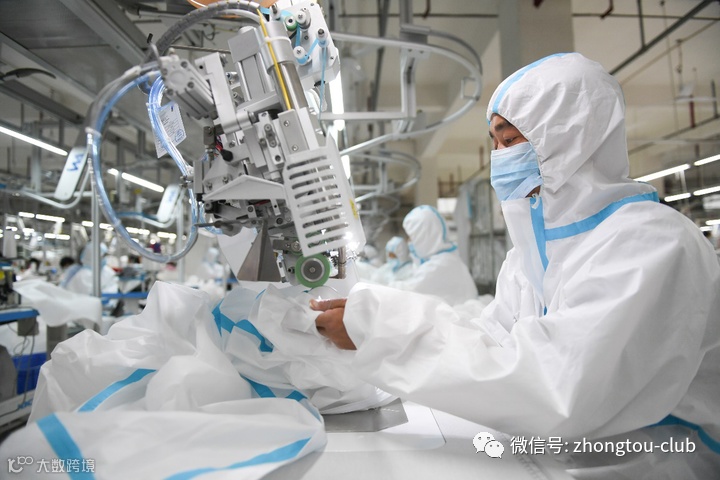
3月25日,湖北省潜江市奥瑟夫制衣有限公司员工在加紧生产医用防护服。日产量8000达到件,出口美、日、韩及欧盟等国家和地区,助力国际防疫。吴燕军/人民图片
人民日报记者 汪晓东 赵展慧
What lies behind China’s daily output of 100 million pieces of masks?
Many Chinese enterprises recently completed cross-industry transfer to meet the domestic and foreign demandsfor protective materials, becoming a highlight in China’s work resumption.
According to statistics, tens of thousands of enterprises had joined the production of masks, disinfectant liquids, and protective suits. The output of masks alone expanded fourfold in just a month, exceeding 100 million pieces per day.
What lies behind the 100-million-piece capacity is the quick transfer of manufacturers, which reflects the advantages and potential of the Chinese manufacturing industry.
Xiantao, central China’s Hubei province, is hailed as a “capital of non-woven fabric” for its over 300 such manufacturers.
“The production lines are able to produce 8 tons of melt-blown non-woven fabric each,” said an executive of Xiantao-based CHTC Jiahua Nonwoven Co., Ltd., where only 4 to 5 personnel work onthe humming automatic production lines.
The executive Deng Hualian introduced that the company used to produce the tri-layer SMS (spunbond + melt-blown + spunbond) non-woven fabric, but it shifted its production priority to melt-blown non-woven fabric, something used on medical masks, since mid-February to cope with COVID-19.
Now the daily output has reached over 20 tons, which are able to manufacture 20 million pieces of masks. To achieve such performance, the company has invested nearly 8 million yuan.
“Our melt-blown non-woven fabric is able to filter 99 percent of particles and bacteria, and we don’t raise its price,” said Deng.
Another company in the city that produces protective suits Hubei Safe Way Protective Products Co., Ltd. said it has acquired qualification from the European Union and the U.S. and is ready to export its breathable film protective suits to these two destinations.
“We make 500 to 600 suits each day,” said Zhang Wei, an executive of the company.
Hu Qinjiao, a worker of the company, said she had spent the most tiring Spring Festival of her life as the company transferred its production to medical protective suits at the request of the government to meet the demand during the epidemic. As the disease is gradually controlled at home, the company shifted its business to overseas market.
Xinxin Non-woven Fabric Co., Ltd. also readjusted its production. “One of our Spanish customers placed an order of 200,000 items with a unit price of 100 yuan,” said Pan Yuanjing, general manager of the company. Now her mobile phone has become an international hotline that receives frequent calls from the company’s partners.
“The products are shipped to the airports in Wuhan, Shanghai and Changsha in containers after being produced. Some clients use charter flights to transport the products as the pandemic is becoming severer globally,” Pan told People’s Daily.
“Now the city sees a daily foreign trade transaction of 500 million yuan, and the figure is expected to go over 40 percent higher. The orders received by most of the enterprises now can only be delivered till mid-May,” said Zhou Zhihong, secretary of the CPC Xiantao Municipal Committee.
According to Zhou, the city is home to 146 exporting manufacturers, 80 percent of which mainly produce non-woven fabric, and over half of them hold ISO9002 certifications.
Xiantao will make full efforts to construct the city into a national base for emergency supply storage, non-woven fabric production, non-woven fabric raw material supply and non-woven fabric manufacturing, as well as a state center of quality inspection and innovation for non-woven fabric products. It is expected to produce 20 million protective suits, 100 million N95 masks and 2 billion disposable masks.
At present, 90 percent of the workers in the city have returned to work, recovering 90 percent of the capacity. Enterprises’ managers believe that the supply will be further accelerated as the capacity releases.
The complete industrial system enabled the quick production readjustment and the recombination of industrial chains, which indicates China’s unique advantage as the world’s only country that obtains all the industrial categories listed in the United Nations industrial classification.
The sufficient labor force constantly improving its capabilities also contributed to the quick transfer of enterprises. Some enterprises had to design and produce the products at the same time after the business transfer, so both the timely reconstruction of the production lines done by designers and the workers’ quick learning of new production skills played a factor role.
When enhancing international cooperation on combating COVID-19, China is also actively participating in the reconstruction of the global industrial chain. It is forcing the development of more core technologies with market demand, attracting global high-end manufacturers, and accelerating the development of industrial clusters, so as to straighten the global industrial chain.
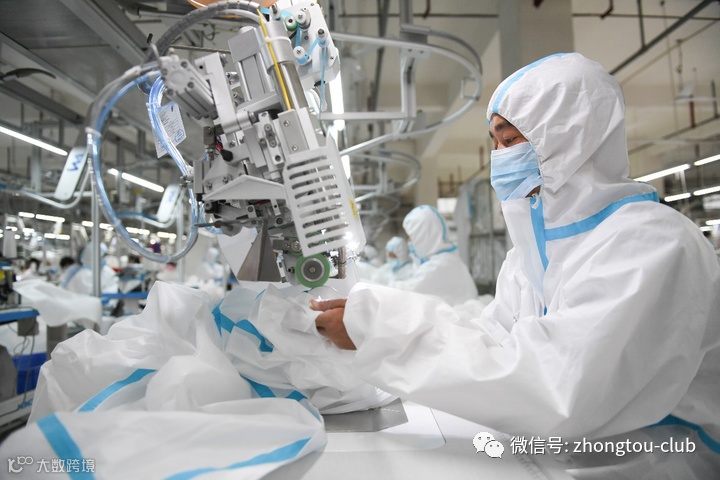
Workers of Hubei Ourselves Garment Co. Ltd., are producing medical protective suits. The company is able to produce 8,000 suits on a daily basis, and the products will be exported to the U.S., Japan, South Korea and the European Union to help them fight the COVID-19 pandemic. Photo by Wu Yanjun, People’s Daily Online
By Wang Xiaodong, Zhao Zhanhui, People’s Daily
来源:人民日报
责任编辑:张晰敏
中国投资发展促进会
中投会植根尼日利亚,致力构建工商经贸交流平台,维护工商权益。目前中投会共有四种会籍类别,包括团体会员、商号会员、个人会员及联席会员,经营业务遍及工商各业、政联机构、大型金融与商业组织和中小型企业,形成强大广阔的商贸联系网络。中投会为会员提供多种交流平台、以便分享丰富的资源和商机,并共同建设具有影响力的海内外华商网络,为经贸、教育、文化和社会发展作出贡献。成为中投会的会员,不但能够分享彼此间强大的归属感、认同感,而且可以享受多种服务、设施与活动优惠。