开发满足不同特定需求的功能材料在生物医学中应用具有重大的挑战性。树枝状聚合物,凭借其精确的结构和多价协同性,是定制精密功能材料典范。近日,法国国家科学研究中心-马赛跨学科纳米研究中心与中国药科大学合作并成功开发了一种基于bola型两亲性树形分子(bola-amphiphilic dendrimers)的精确载体平台, 可选择性递送不同类型核酸药物(siRNA和DNA)(Figure 1),用于肿瘤治疗。结果发表在综合性期刊Proceedings of the National Academy of Sciences of the U. S. A.(DOI: 10.1073/pnas.2220787120)
合作团队设计和开发了不同代数的bola型两亲性树形分子并对其递送不同核酸分子的能力进行了研究。结果表明,bola树形分子的代数、核酸分子的大小以及bola树形分子与核酸分子之间多价协同作用在很大程度上影响其选择性递送核酸分子的能力。例如,更高代数的bola8A能更有效地将大尺寸质粒DNA 压缩成小的纳米复合物,显著提高了DNA在靶细胞的摄取,展现出更为优异的DNA转染活性;较低代数的bola4A则在有效保护短链siRNA分子的同时,能更高效地促进siRNA 的胞内释放,进而发挥强有力的基因沉默效果 (Figure 2)。此外, 该类bola两亲性树形分子所构建的核酸药物递送系统能选择性富集在肿瘤组织,并在肿瘤细胞内ROS刺激下特异性地释放核酸,实现核酸药物在肿瘤细胞的靶向递送。更令人欣喜的是,上述递送体系在宫颈癌和卵巢癌异种移植小鼠肿瘤模型、以及高侵袭性的黑色素瘤和三阴性乳腺癌转移模型中,均表现出可媲美商业化载体的核酸递送效率,能够精准调控致病基因的表达,发挥高效的抗肿瘤活性和抗肿瘤转移效果 (Figure 3)。本研究成果彰显了bola型两亲性树形分子作为按需定制核酸药物递送载体的巨大潜力。
在过去的几年中,法国国家科学研究中心-马赛跨学科纳米研究中心与中国药科大学合作制备了一系列精确两亲性树形分子用于核酸药物递送(Nat. Protoc.2021,16, 327–351; Chem. Commun. 2022, 58, 4168–4171),并系统总结了具有不同构型的两亲性树形分子用于核酸药物递送优点和局限性以及未来的发展方向(Acc. Mater. Res. 2022,3, 484-497)。为推动新型核酸药物递送载体的开发奠定了研究基础,为生物材料的开发和疾病的精准治疗开辟了新的技术平台和思路。
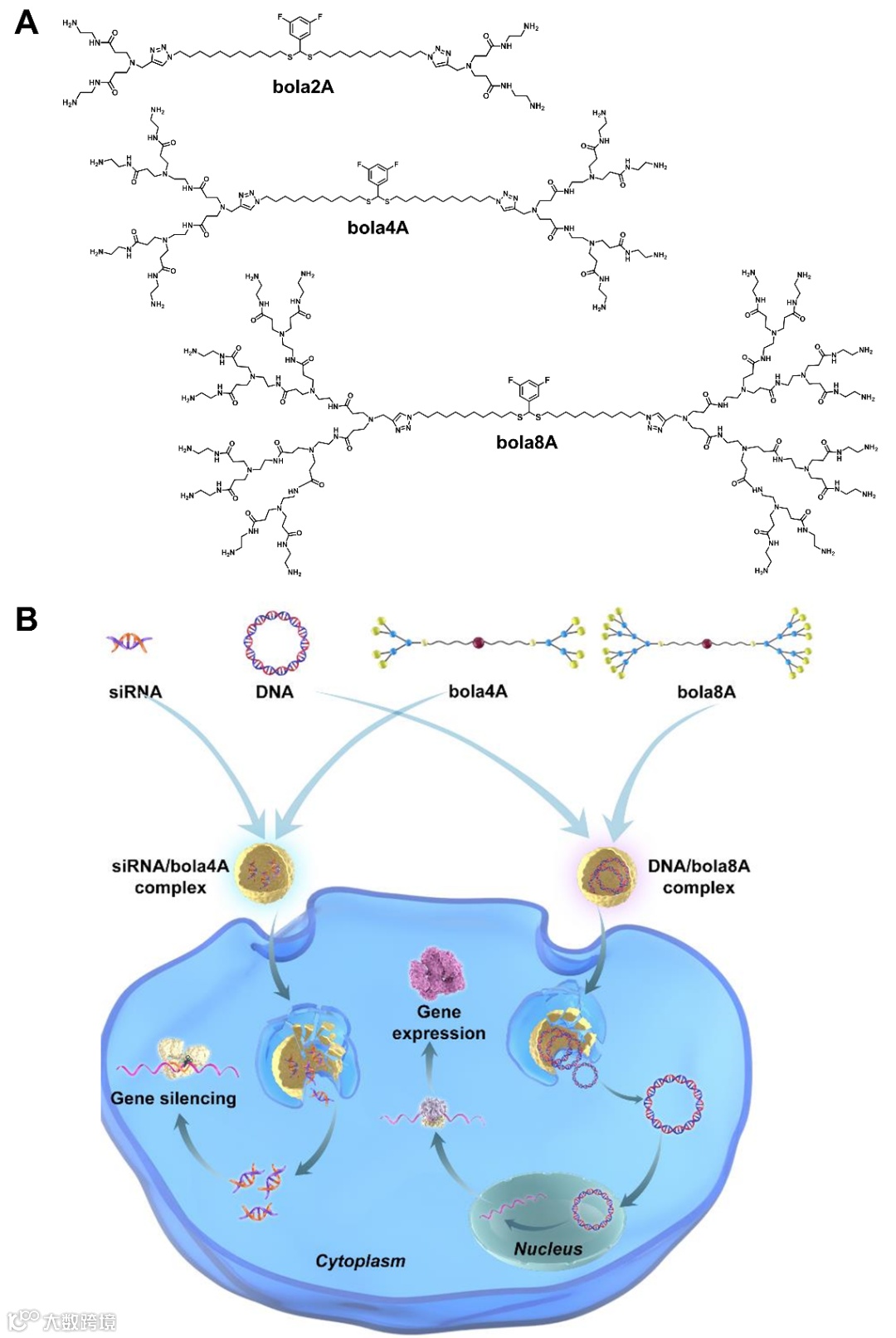
Fig. 1. Bola-amphiphilic dendrimers for cargo-specific nucleic acid delivery. (A) Chemical structures of the bola-amphiphilic dendrimers bola2A, bola4A, and bola8A studied in this work. (B) Cartoon illustration of bola-amphiphilic dendrimers bola4A and bola8A for cargo-selective and adaptive delivery of the two distinct nucleic acid types, DNA and siRNA.
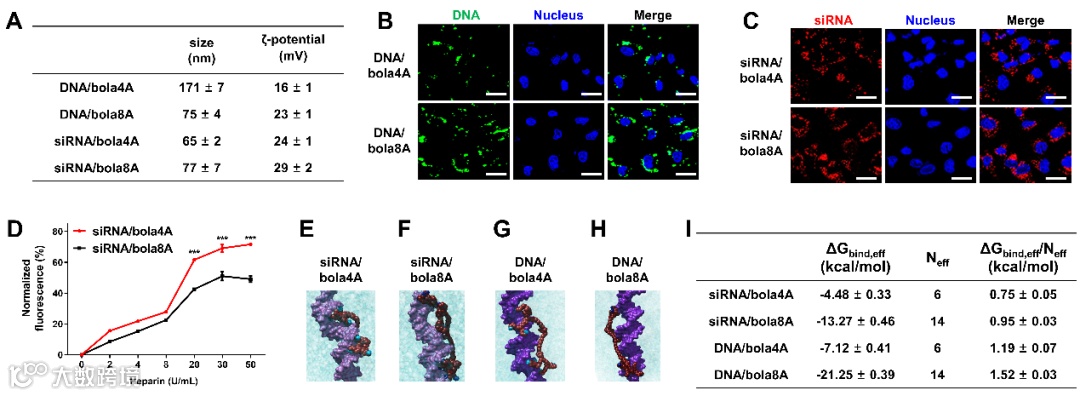
Fig. 2. Physicochemical characterization of and rationale behind the cargo-selective delivery performance of bola4A and bola8A. (A) The sizes and the ζ-potentials of the DNA/dendrimer complex and the siRNA/dendrimer complex obtained with DNA (24 ng/μL) at an N/P ratio of 2 and siRNA (1.0 μM) at an N/P ratio of 10. (B, C) Cellular uptake and intracellular trafficking of DNA and siRNA delivered by the bola-amphiphilic dendrimers bola4A and bola8A. Confocal imaging of the cellular uptake of (B) the DNA/dendrimer complexes (12 ng/μL YOYO-1-labeled DNA, N/P ratio of 1.0) and (C) the siRNA/dendrimer complexes (50 nM Cy5-labeled siRNA, N/P ratio of 10) in SKOV-3 cells, evaluated using confocal microscopy. The green channel image shows the YOYO-1-labeled DNA (green), the red channel image shows the Cy5-labeled siRNA (red), and the blue channel image shows the nuclei of the SKOV-3 cells stained by Hoechst33342 (blue). (D) The siRNA release from the siRNA/dendrimer complexes assessed using heparin-coupled ethidium bromide (EB) fluorescence assays. ***p < 0.001 versus siRNA/bola4A or siRNA/bola8A, and significance was determined using two-way ANOVA (mean ± SD, n = 3). Atomistic MD simulations of bola4A and bola8A in the presence of siRNA (E and F) and DNA (G and H), respectively. Bola4A atoms are shown as “firebrick spheres”, with the terminal charged amine groups highlighted in deep sky-blue, while bola8A atoms are depicted as dark red spheres with the terminal charged amines colored in navy blue. The siRNA (“orchid” light purple) and the DNA (dark purple) are portrayed as their van der Waals surface and the oxygen atoms in water are shown as cyan transparent spheres. Hydrogen atoms, ions and counterions (Na+ and Cl-) are omitted for clarity. (I) Binding data of bola4A and bola8A with siRNA and DNA as derived from atomistic MD simulations: free energy of effective binding (ΔGbind,eff), number of effective charges (Neff), and effective-charge-normalized free energy of binding (ΔGbind,eff/Neff) for the nucleic acid/dendrimer complexes are listed.
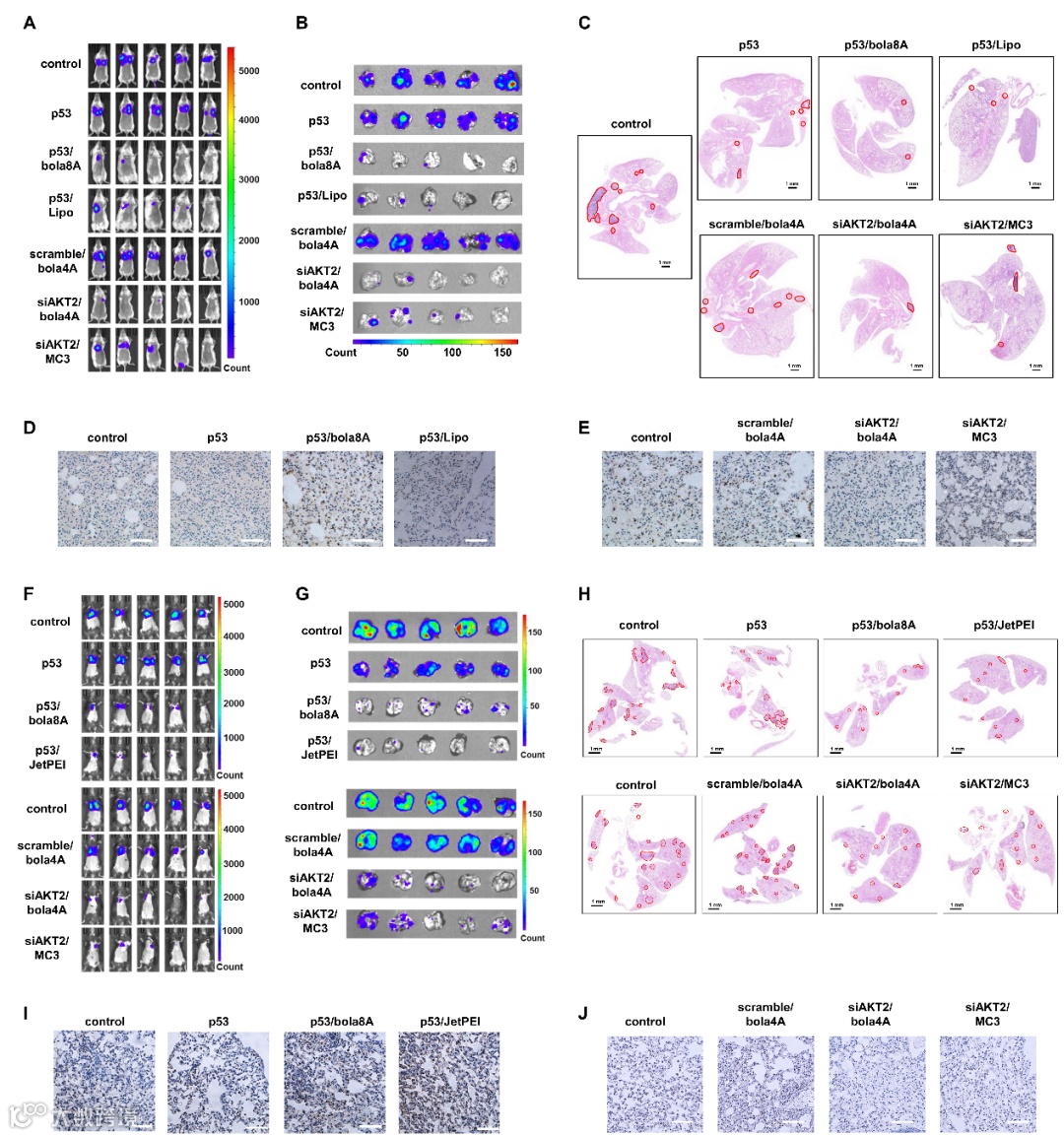
Fig. 3. Effective inhibition of tumor metastasis using DNA and siRNA therapeutics delivered by bola8A and bola4A respectively in lung metastatic cancer model. (A-E) 4T1-luc metastatic tumor-bearing mice received intravenous injections of PBS buffer (control), p53 alone, p53/bola8A complex, p53/Lipo complex (2.0 mg/kg DNA, 1.5 mg/kg bola8A, N/P ratio of 1.0), siAKT2 alone, siAKT2/bola4A complex, or siAKT2/MC3 complex (1.0 mg/kg siRNA, 3.9 mg/kg bola4A, N/P ratio of 5.0) (n=5): (A) In vivo bioluminescence imaging of 4T1-luc tumor metastases in the mice. (B) Ex vivo bioluminescence imaging of 4T1-luc tumor metastases in the lung at the experimental end point post treatment. (C) Histological analysis of lung tissues from 4T1-luc metastatic tumor-bearing mice at the experimental end point post treatment. The metastatic lesions (red solid outlines) were identified as cell clusters with darkly stained nuclei. Scale bars, 1 mm. (D) p53 and (E) AKT2 protein expression revealed by immunohistochemistry staining after treatments. Scale bar, 200 μm. (F-J) B16-F10-luc metastatic tumor-bearing mice received intravenous injections of PBS buffer (control), p53 alone, p53/bola8A complex, p53/JetPEI complex (2.0 mg/kg DNA, 1.5 mg/kg bola8A, N/P ratio of 1.0), siAKT2 alone, siAKT2/bola4A complex, or siAKT2/MC3 complex (1.0 mg/kg siRNA, 3.9 mg/kg bola4A, N/P ratio of 5.0) (n=5): (F) in vivo bioluminescence imaging of B16-F10-luc tumor metastases in the mice. (G) Ex vivo bioluminescence imaging of B16-F10-luc tumor metastases in the lung tissue or images of excised lung tissues at the experimental end point post treatment. (H) Histological analysis of lung tissues from B16-F10-luc metastatic tumor-bearing mice at the experimental end point post treatment. The metastatic lesions (red solid outline) were identified as cell clusters with darkly stained nuclei. Scale bars, 1.0 mm. (I) p53 and (J) AKT2 protein expression revealed by immunohistochemistry staining after treatments. Scale bar, 200 μm. p53: plasmid DNA expressing tumor suppressor protein p53, siAKT2: siRNA targeting AKT2.
中国药科大学药物科学研究院博士后陈家轩(中国药科大学与法国艾克斯-马赛大学联合培养博士)和博士后朱丹丹为本文共同第一作者。中国药科大学药物科学研究院刘潇璇教授和法国国家科学研究中心-马赛跨学科纳米研究中心彭玲研究员为本文共同通讯作者。
原文链接:
https://www.pnas.org/doi/10.1073/pnas.2220787120

高分子科技原创文章。欢迎个人转发和分享,刊物或媒体如需转载,请联系邮箱:info@polymer.cn

欢迎专家学者提供稿件(论文、项目介绍、新技术、学术交流、单位新闻、参会信息、招聘招生等)至info@polymer.cn,并请注明详细联系信息。高分子科技®会及时推送,并同时发布在中国聚合物网上。
欢迎加入微信群 为满足高分子产学研各界同仁的要求,陆续开通了包括高分子专家学者群在内的几十个专项交流群,也包括高分子产业技术、企业家、博士、研究生、媒体期刊会展协会等群,全覆盖高分子产业或领域。目前汇聚了国内外高校科研院所及企业研发中心的上万名顶尖的专家学者、技术人员及企业家。
申请入群,请先加审核微信号PolymerChina (或长按下方二维码),并请一定注明:高分子+姓名+单位+职称(或学位)+领域(或行业),否则不予受理,资格经过审核后入相关专业群。