


传统凝胶聚合物电解质(GPEs)虽兼具液态电解液与固态电解质的优势,却因离子电导率低,难以抑制锂枝晶生长,导致电池循环稳定性差,严重制约了锂金属电池的实际应用。添加无机填料虽能提升性能,但高负载易导致团聚和界面相容性问题;有机填料的应用也面临机械强度与离子传导的平衡挑战。
近日,香港城市大学张其春教授、陈福荣教授、李振声教授联合中南大学陈立宝教授、旷桂超教授选用具有周期性多孔结构的二维共价有机框架(COF)CityU-43 作为 “纳米牢笼”,通过原位聚合,使 PDA 链在 CityU-43 孔道内形成物理交联网络,仅需 0.03 wt% 的 CityU-43,即可实现聚合物链的均匀分布与界面相容性优化。
2025年6月11日,该文章以Nanoconfined Polymerization Facilitates Efficient Li+ Transportation in Quasi-Solid Electrolytes为题发表在国际顶级期刊Angewandte Chemie International Edition上。娜仁托雅,顾钱锋为本文第一作者。
1. 性能跃升:电导率与稳定性的双重突破
离子传导效率:PDA@CityU-43 电解质在 25℃下实现了 6.02×10⁻³ S/cm 的高离子电导率;锂离子迁移数达 0.82,有效促进锂均匀沉积。
循环稳定性:对称 Li||Li 电池在 0.1 mA/cm² 电流密度下稳定循环超 6000 小时;Li||LFP 全电池在 0.1 C 倍率下循环 550 次后容量保持率达 96.1%,高负载 NCM₈₁₁电池循环 100 次后容量保持 72.5%。
安全性能:引入 CityU-43 后,电解质阻燃性显著提升,直接接触火焰 2 秒内不燃烧,且热分解温度超 300℃,为电池安全再加一道 “防护网”。
2. 机理解析:从“无序扩散” 到 “定向高速路”
纳米限域效应:CityU-43 孔道约束聚合物链构象,形成连续离子传输通道;其醚氧基团与锂离子强相互作用,降低离子迁移能垒至 9.46 kJ/mol(纯 PDA 为 14.45 kJ/mol)。
SEI 膜调控:NCP 策略促进形成富含 LiF 的稳定固态电解质界面(SEI),抑制电解液降解与锂枝晶穿透,实现界面化学均匀性调控。
3. 应用前景:迈向高能量密度锂金属电池
该电解质电化学稳定窗口达 4.9 V,可匹配高电压正极材料(如 NCM),为 5 V 级锂金属电池开发提供可能。CityU-43 制备工艺简单,仅需 0.03 wt% 低负载即可实现性能提升,降低材料成本与工艺复杂度,为产业化应用奠定基础。
这项研究通过纳米受限聚合策略,将 COF 材料的有序孔道与聚合物电解质的柔性优势结合,为高性能锂金属电池电解质设计提供了 “纳米级” 解决方案。未来,随着该技术的进一步优化,锂金属电池有望在电动汽车、储能系统等领域释放更大潜力,推动能源存储技术迈向新高度。
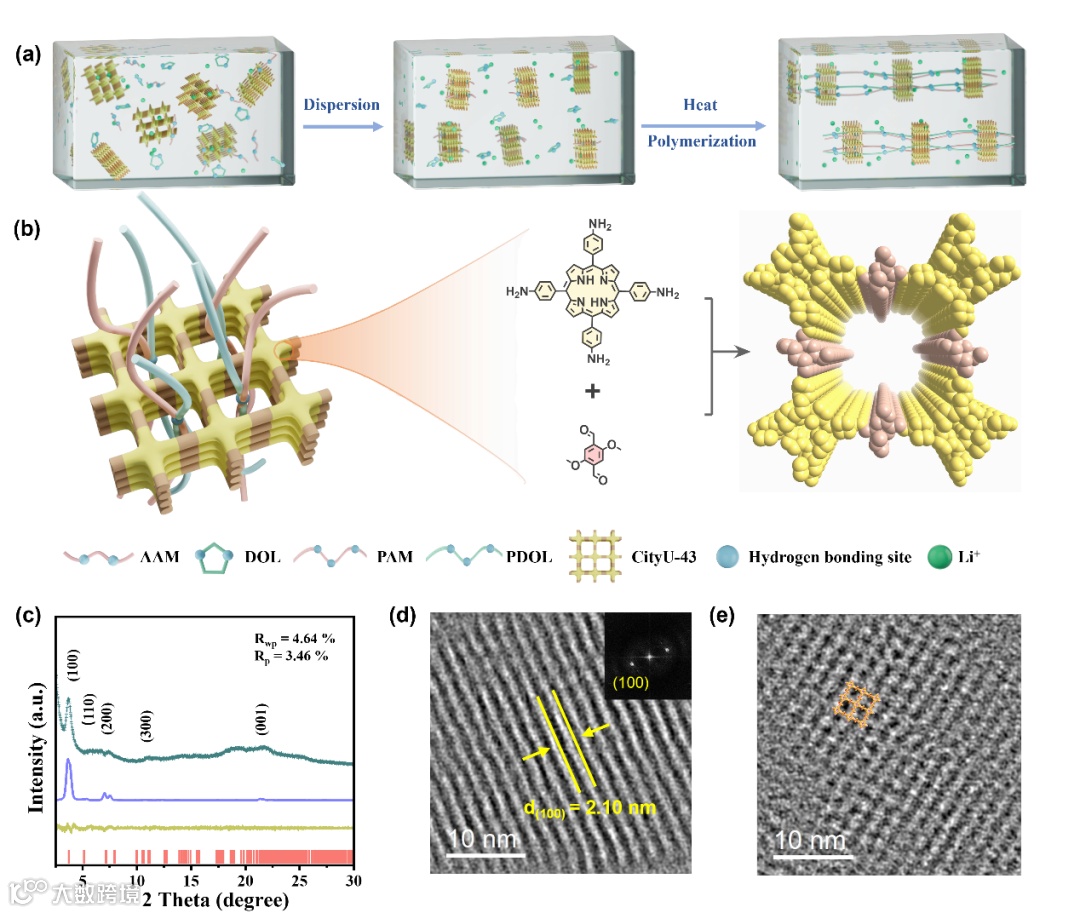
Figure 1. Schematic of preparation and characterization of NCP GPEs and COFs. (a) Schematic illustration of the GPEs prepared by the NCP strategy. (b) The assembled configurations of GPE fabricated using PDA@CityU-43, where CityU-43 was illustrated separately. (c) Experimental and Pawley refined diffraction profiles of CityU-43. Simulated AA-stacking diffraction pattern was employed for comparison. cerulean: Pawley refined profile; dark cyan: experimental diffraction pattern; blue: AA-stacking profile; golden: difference; red: diffraction position. (d) HRTEM image of CityU-43 with lattice spacing and corresponding plane labelled. Inset: corresponding fast Fourier transform (FFT) pattern. (e) HRTEM image taken along the [001] direction with corresponding structure labelled.
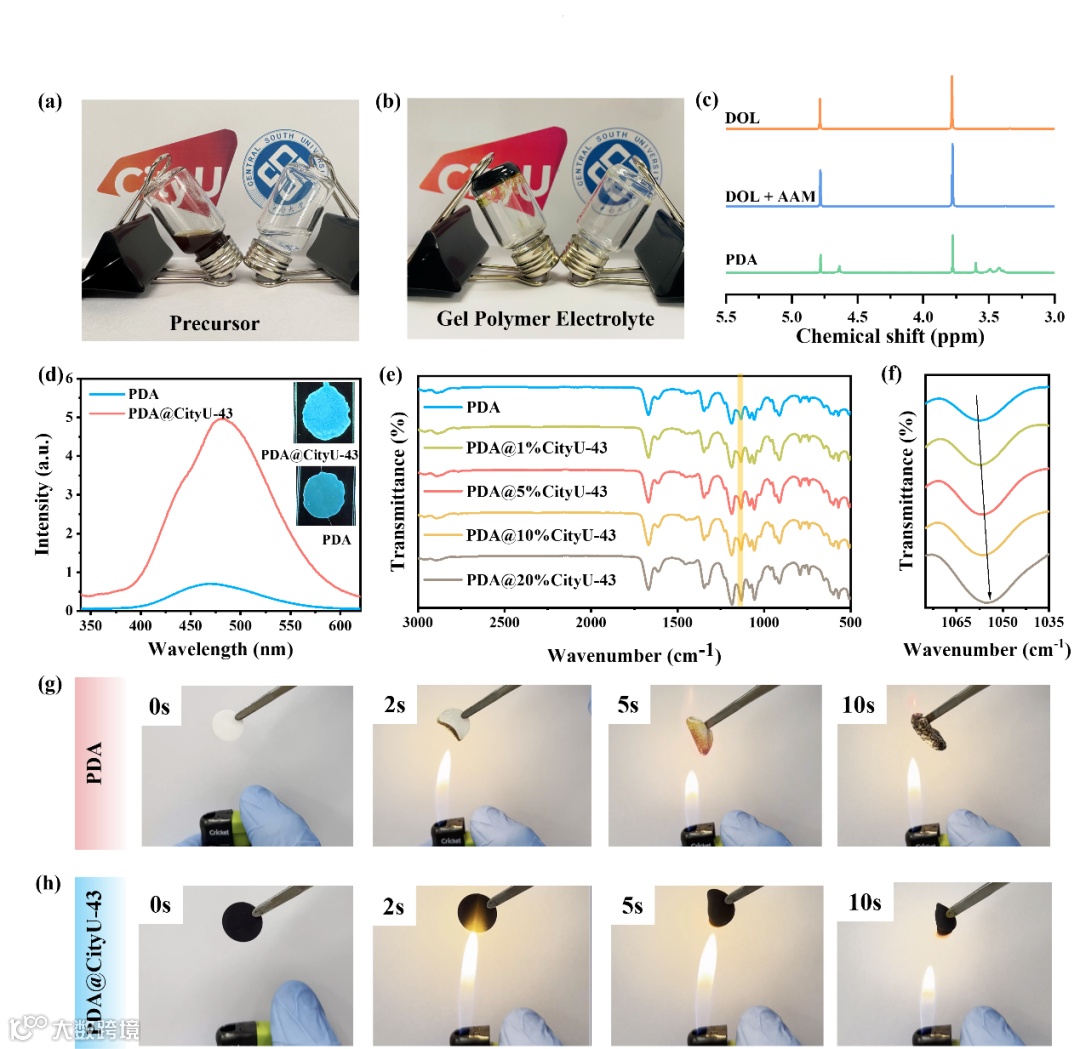
Figure 2. Characterizations of the GPEs. Optical photographs of the PDA and PDA@CityU-43 (a) before and (b) after polymerization. (c) 1H NMR spectra of DOL, AAM, and PDA in DMSO-d6. (d) PL spectra of PDA and PDA@CityU-43 under 300 nm excitation. Inset: optical photographs of PDA@CityU-43 (upper) and PDA (lower) under UV irradiation. (e) FTIR spectra of PDA and PDA@CityU-43 with different contents of CityU-43. (f) Enlarged FTIR spectra of PDA and PDA@CityU-43 with different concentrations of CityU-43. Flammability test of (g) PDA and (h) PDA@CityU-43.
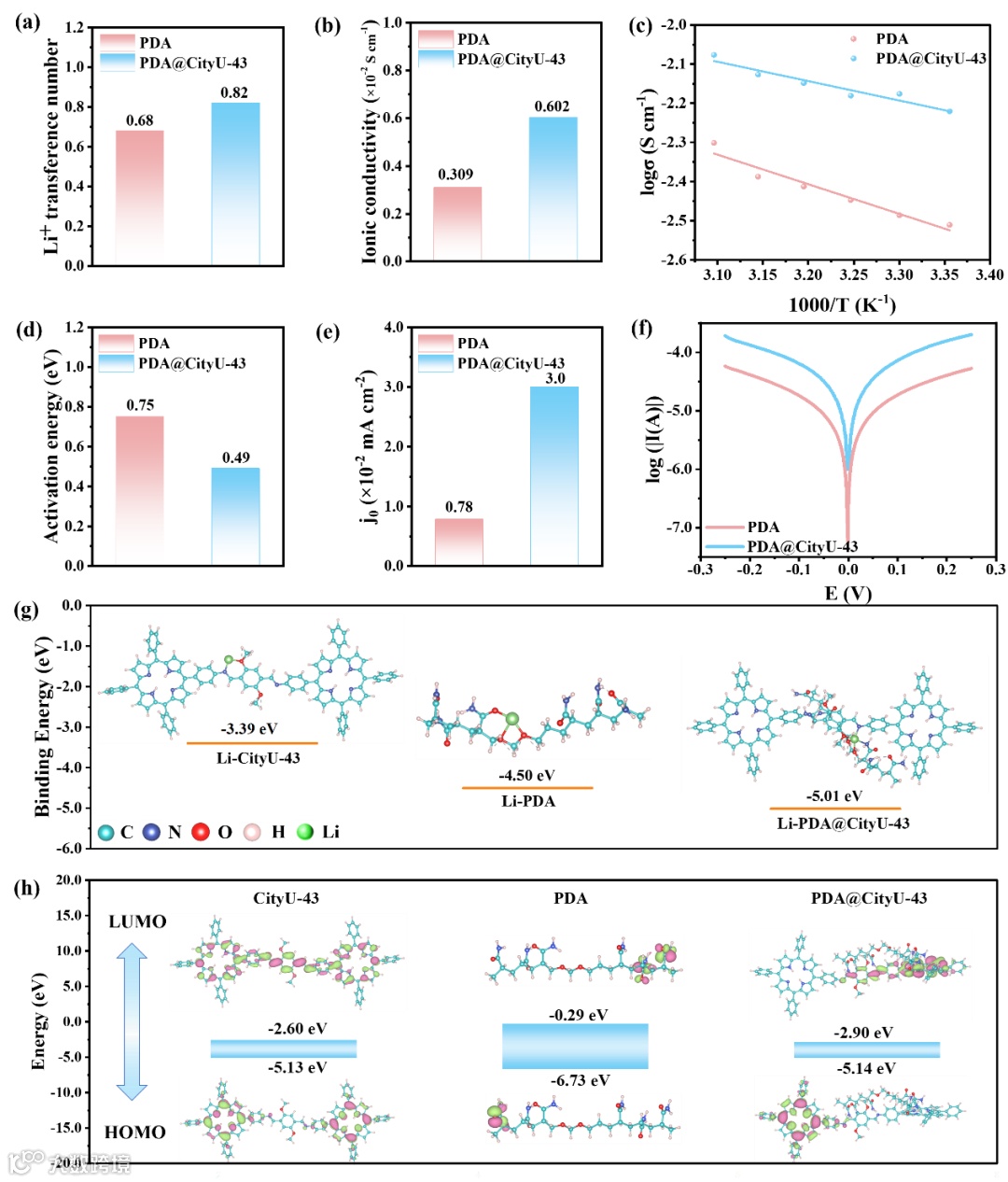
Figure 3. The electrochemical characterization of GPEs. (a) tLi+ of PDA and PDA@CityU-43. (b) Li+ conductivity of PDA and PDA@CityU-43. (c) Temperature-dependent Arrhenius plots of ionic conductivity for PDA and PDA@CityU-43. (d) Ea of PDA and PDA@CityU-43. (e) Exchange current density of PDA and PDA@CityU-43 symmetric cells. (f) Tafel plots of Li||Li cells assembled using the PDA and PDA@CityU-43. (g) The binding energy of CityU-43, PDA and PDA@CityU-43 towards Li+. (h) The HOMO and LUMO energy levels of CityU-43, PDA and PDA@CityU-43.
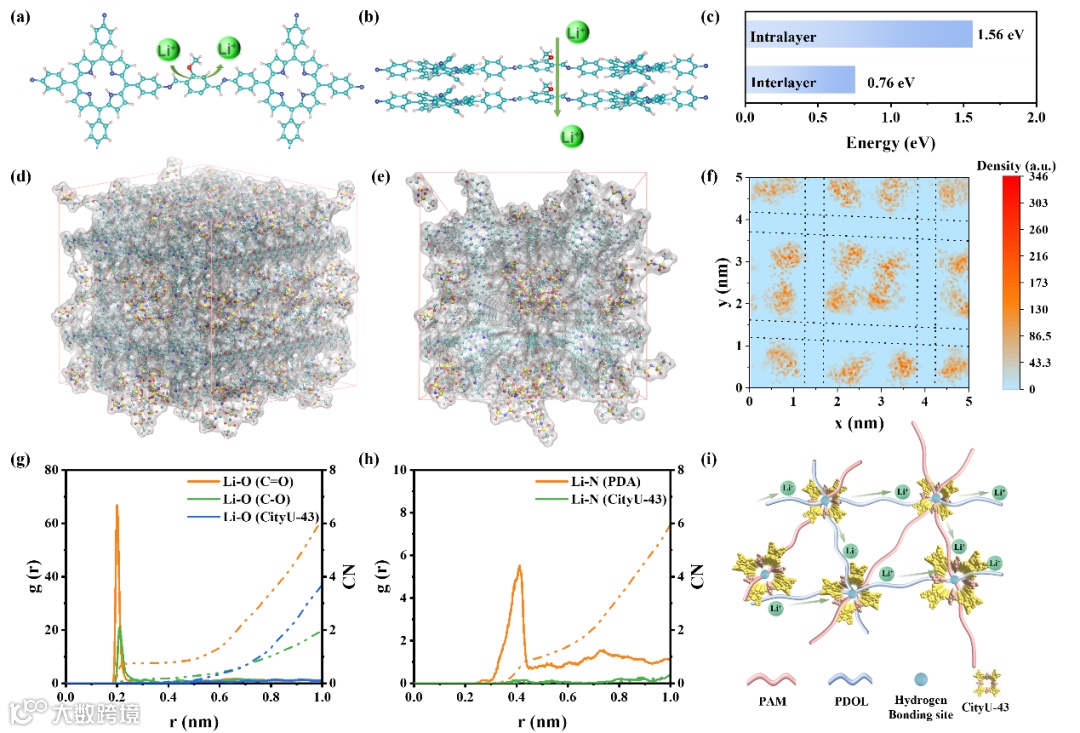
Figure 4. Schematic diagrams and characterization of the Li+ coordination structure and Li+ transport modulation. Schematic illustration of Li+ migration behaviors along the (a) parallel and (b) vertical pathways. (c) Energy barriers for Li+ migration along two pathways. (d) Side and (e) top view of conformation analysis of PDA@CityU-43 systems based on MD simulations. (f) 2D number density distribution of PDA near CityU-43. (g) RDF g(r) and CN of the Li-O (C=O), Li-O (C-O), and Li-O (CityU-43) pairs calculated from MD simulation trajectories in PDA@CityU-43. (h) RDF g(r) and CN of the Li-N (PDA), Li-N (CityU-43) pairs calculated from MD simulation trajectories in PDA@CityU-43. (i) Schematic illustration of PDA@CityU-43 network for Li+ migration.
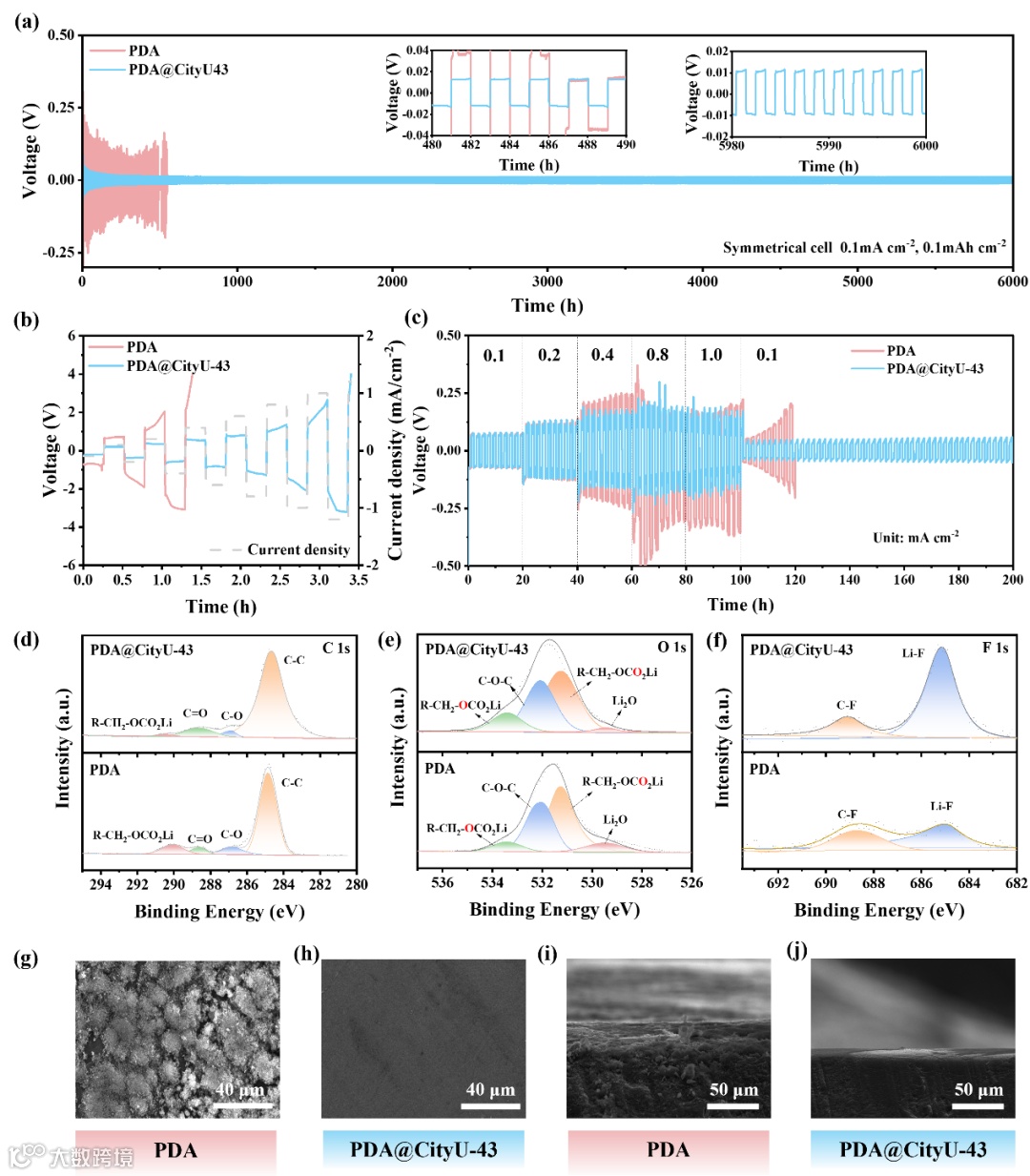
Figure 5. The characterization of SEI layer for withstanding the Li dendrites. (a) Galvanostatic cycling of symmetric Li cells with PDA and PDA@CityU-43 at 0.1 mA cm-2, 0.1 mAh cm-2. Inset: enlarged cycling curves at corresponding duration. (b) Critical current density (CCD) of PDA and PDA@CityU-43. (c) The rate performances at various current densities from 0.1 to 1 mA cm-2. High-resolution (d) C 1 s and (e) O 1 s (f) F 1s XPS spectra of Li anode. Surface (g,h) and cross section (i,j) SEM images of Li anode with (g,i) PDA and (h,j) PDA@CityU-43 electrolytes after 100 cycles at 0.1 mA cm-2, 0.1 mAh cm-2.
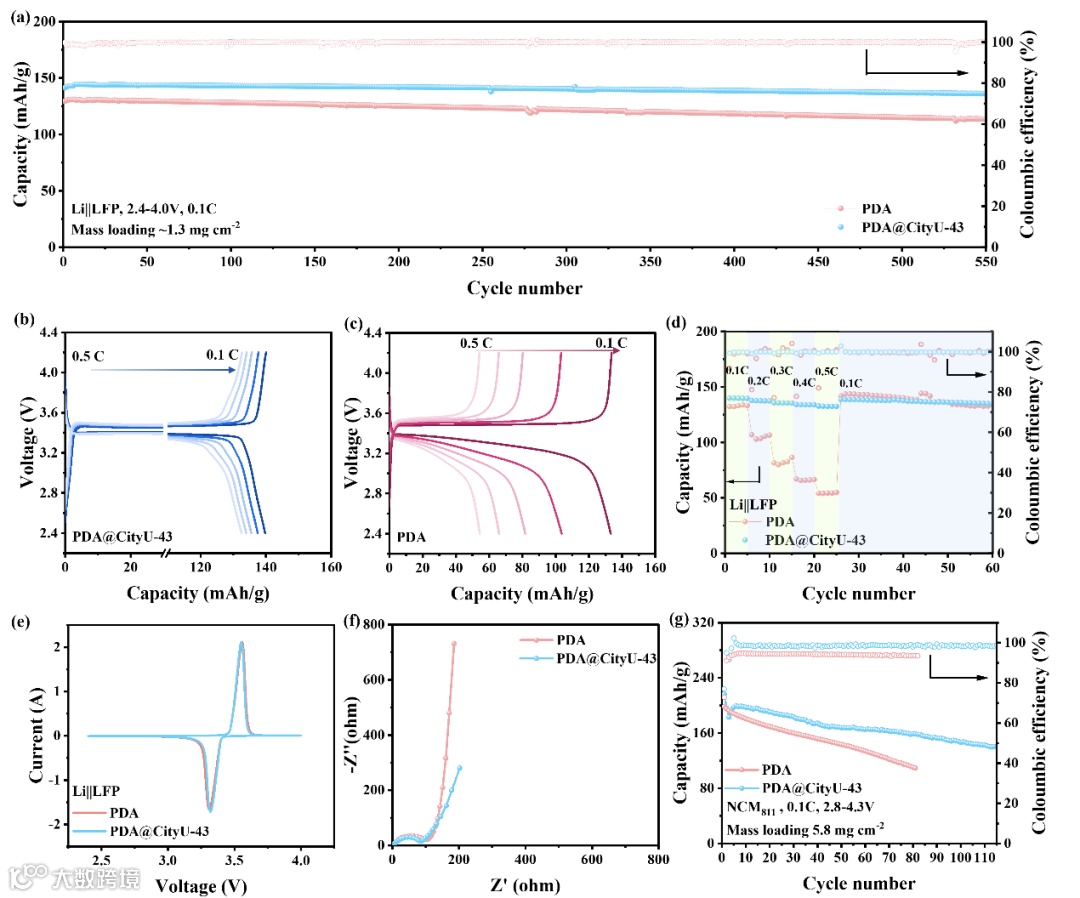
Figure 6. Full battery performance of GPEs. (a) Cycling performance of Li||LFP batteries with PDA@CityU-43 and PDA electrolytes at 0.1 C. (b) Nyquist plots for Li||LFP batteries with PDA@City-U43 and PDA electrolytes. (c) Cyclic voltammetry curves of Li||LFP batteries with PDA@CityU-43 and PDA electrolytes at a sweep rate of 1 mV s-1. (d) Rate performance of PDA@CityU-43 and PDA electrolytes cells at 0.1 to 1 C (1 C = 170 mAh g-1). Galvanostatic charge/discharge profiles of the Li||LFP batteries with (e) PDA@CityU-43 and (f) PDA electrolytes. (g) Cycling performance of Li||NCM811 batteries with PDA@CityU-43 and PDA electrolytes at 0.1 C.
原文链接:
https://onlinelibrary.wiley.com/doi/10.1002/anie.202509921
作者简介
向上滑动阅览
张其春教授,1992年南京大学本科毕业,1998年中科院北京化学所物理化学硕士毕业,2003年美国加州大学洛杉矶分校 (University of California, Los Angeles)有机化学硕士毕业,2007年在美国加州大学河滨分校(University of California, Riverside)无机化学博士毕业,2007-2008年美国西北大学(Northwestern University)从事博士后研究,2009年起担任新加坡南洋理工大学材料科学与工程学院助理教授。2014年3月,晋升为新加坡南洋理工大学材料科学与工程学院副教授(终身职位)。2014年12月受聘于新加坡南洋理工大学数理学院副教授。2020年9月受聘于香港城市大学大学材料科学与工程学院终身教授,香港城市大学化学系终身教授,香港城市大学超金刚石及先进薄膜研究中心副主任。张教授长期致力于富碳有机共轭材料、新概念晶态聚合物和共价有机框架材料的制备,实现在光电器件、能量转换/存储、电/光催化等领域的广泛应用拓展。在Nature Chem.、Nature Commun.、J. Am. Chem. Soc.、Angew. Chem. Int. Ed.、Chem. Sci.、Adv. Energy Mater.、ACS Nano、Chem. Commun.、Adv. Funct. Mater.、Org. Lett.和J. Org. Chem.等国际著名学术期刊上发表论文600余篇,被引超50000次,H-index: 118,44篇入选ESI高被引论文;获授权专利20余项。张教授连续7年获科睿唯安“1%全球高被引学者”(2018-2024年)。张教授于2017年当选为英国皇家化学会会士,现担任J. Solid State Chem.和SusMat副主编。目前是Mater. Chem . Front.、Inorg. Chem. Front.、Chem. Asian J.、J. Mater. Chem. C、Mater. Adv.、Aggerate、Sci. China Mater.、Small Struct.、Organic Materials、FlexMat和Coatings等期刊杂志的顾问委员会成员。
张教授课题组主页:https://personal.cityu.edu.hk/qiczhang/Research/Research.html
相关进展
高分子科技原创文章。欢迎个人转发和分享,刊物或媒体如需转载,请联系邮箱:info@polymer.cn

诚邀投稿
欢迎专家学者提供稿件(论文、项目介绍、新技术、学术交流、单位新闻、参会信息、招聘招生等)至info@polymer.cn,并请注明详细联系信息。高分子科技®会及时推送,并同时发布在中国聚合物网上。
欢迎加入微信群 为满足高分子产学研各界同仁的要求,陆续开通了包括高分子专家学者群在内的几十个专项交流群,也包括高分子产业技术、企业家、博士、研究生、媒体期刊会展协会等群,全覆盖高分子产业或领域。目前汇聚了国内外高校科研院所及企业研发中心的上万名顶尖的专家学者、技术人员及企业家。
申请入群,请先加审核微信号PolymerChina(或长按下方二维码),并请一定注明:高分子+姓名+单位+职称(或学位)+领域(或行业),否则不予受理,资格经过审核后入相关专业群。

点
这里“阅读原文”,查看更多