


Click on the Blue Name & Follow Us
点击蓝字关注我们
According to MundoMaritimo:
Sea Intelligence analyzed the global capacity shift of the container fleet by tracking position changes of over 16,000 vessels between 2024 and 2025. The analysis concludes that the “cascade effect” which represents the shift of capacity from primary to secondary routes, has entered a new process during the second half of this year.
In 2024, a large amount of capacity was absorbed by the Asia-Europe route, in order to manage the disruption due to the Red Sea crisis, however, these routes have reached saturation levels, excess capacity had to transfer to secondary routes according to current data.
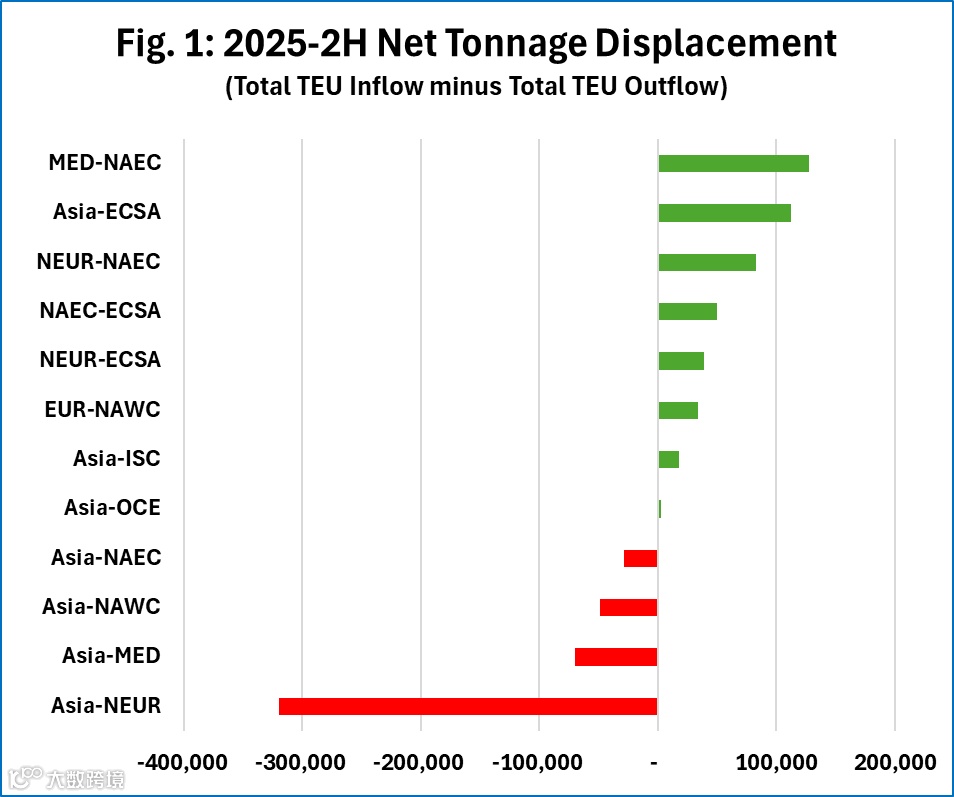
The graph shows the net capacity shift during the second half of 2025, calculated as the total capacity received by a route minus the capacity it transfers to other routes (inflow minus outflow of cascaded capacity).
图表显示了2025年下半年的净容量变动,计算方式为一条路线接收的总容量减去其转移至其他路线的容量(流入减去级联容量的流出)。
Sources: Sea Intelligence
The data showed a significant change in structure in the Asia-Mediterranean route. Primarily absorbed displaced capacity from Asia-North Europe in 2024, this route transferred capacity to other routes actively, acting as an important role in the global network.
Moreover, the Mediterranean-North America East Coast (NAEC) route became the largest net receiver of cascade capacity in the second half of 2025, with 127,686 TEU of cascaded capacity, this number was driven by 178,189 TEUs from Asia-Mediterranean, with a transfer of 11 vessels of 14,000-15,000 TEU. Meanwhile, the Asia-East Coast South America route became the second-largest net gainer of cascaded capacity, with 112,998 TEUs, mainly consisting of mid-sized vessels of 8,000-14,000 TEU, which were shifted from the main East-West trade routes.
此外,地中海-北美东海岸(NAEC)航线在2025年下半年成为级联运能最大的净接收者,级联运能达127,686标准箱,这一数字由来自亚洲-地中海的178,189标准箱推动,另有11艘14,000至15,000标准箱的船舶转运。与此同时,亚洲-南美东海岸航线成为级联运力净增第二大航线,累计112,998标准箱,主要为8,000至14,000箱的中型船舶,这些船只从东西方主要贸易航线转移而来。
The data shows that this process can be considered as a profound structural change within global network, as 97% vessels shifted to Asia-East Coast South America did not return to previous routes. This shows that excess capacity caused by the Red Sea crisis is saturating the outlying routes of the global network. Therefore, the congestion and delay problem we mentioned about previously that may cause by the large-scale of return to the Red Sea will probably not occur in the near future. However, the return is still worth being aware of in order to recognize various situations that may happen, such as re-routing, the shift of capacity and so on.
数据显示,这一过程可视为全球航线内的深刻结构性变化,97%的船只转移至亚洲-南美东海岸,并未返回原有航线。这表明红海危机导致的过剩容量已使全球网络中的外围航线趋于饱和。因此,我们之前提到的因大规模回归红海可能造成的拥堵和延误问题,近期内很可能不会发生。不过,这仍值得关注,以便识别可能发生的各种情况,比如重新规划航线、运力转移等。
Stay tuned on TIBA for more market dynamics.
请关注TIBA,我们将为您带来更多市场动态。

The Predicted Slowdown is Challenging the Outlook of 2026


点“阅读原文”了解更多
Click the "READ MORE" button & visit our website for more information.