

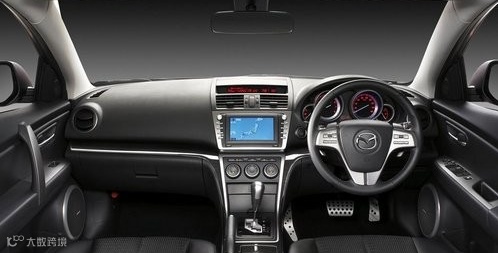
INTRODUCTION:
Smartphone navigation is one potential market disruptor that could slow any potential growth for in-vehicle navigation.Many OEMs are still trying to find a channel to utilize the smartphone in the vehicle,while maintaining safety for the driver.When that balance is met,in-vehicle navigation could begin to disappear.However,there are still reasons why OEMs should keep navigation embedded or on-board versus off-board.
Navigation Overview
IHS uses the following definition for in-vehicle navigation:Any system that features on-board navigation functionality,including an embedded GPS receiver and an embedded navigation engine will be counted as a navigation system.
The distinction that should be made here is that the IHS definition of navigation is on-board navigation with an embedded GPS receiver.Systems that use a smartphone as the navigation engine will not be included in the following forecasts and market share scenarios.For example,solutions like Chevrolet's MyLink with the Bringo app,PSA's Mirror Screen,and Renault's R&GO are not included in the IHS definition of in-vehicle navigation.
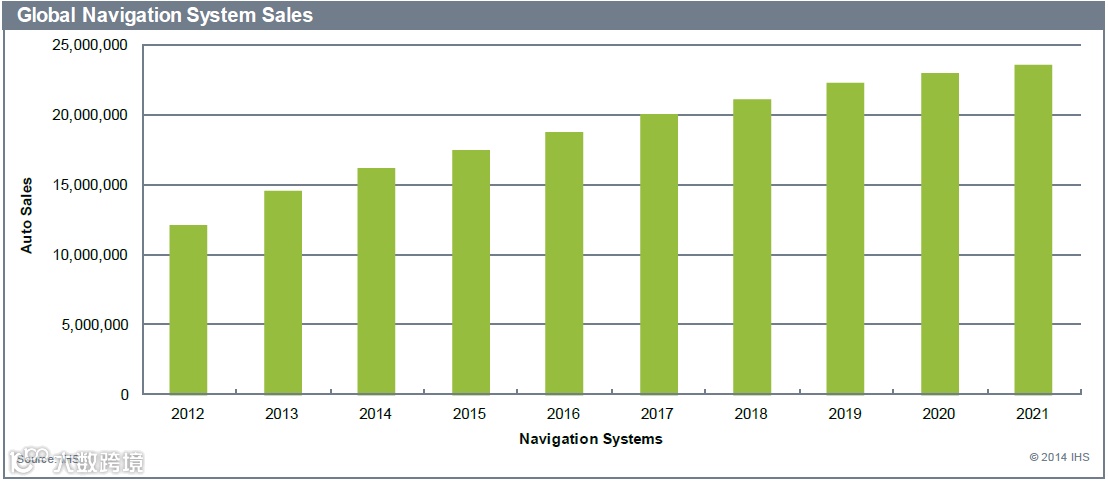
Globally,navigation systems sales have been increasing.There are two main factors:first,many OEMs are finally starting to include navigation systems on higher volume brands and models now that the cost of embedded navigation systems has decreased due to scale of economies.When navigation was first available,it was mainly found on luxury brands and models.However,GPS receivers,system software,and other hardware components have dropped in price,allowing OEMs to include navigation on higher volume models.
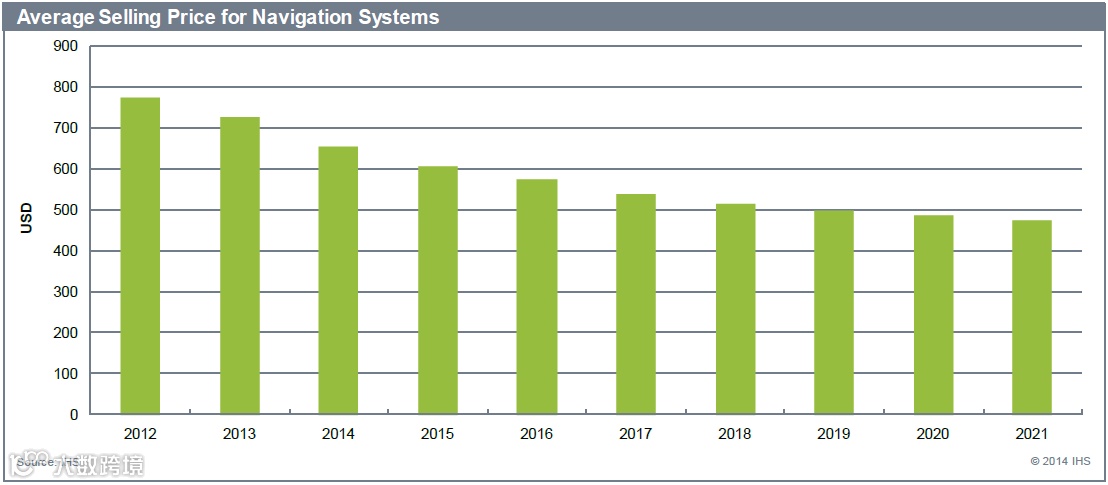
As the above figure shows,the average price for a navigation system has dropped from nearly $800USD in 2012 to just over $600usd in 2014 and is projected to drop another $100usd in the next six to seven years.
Second,OEMs are introducing navigation systems to newer markets.Asia and South America have seen a dramatic increase in vehicle purchases,especially in countries like India,Brazil,Russia,and China.As the level of wealth in these countries increases,so do the available features found on vehicles sold there.China and Russia have seen an incredible increase in vehicle sales with navigation systems,and India and Brazil are on the verge of seeing similar growth.
Navigation systems use many different types of technology to store the map data and the navigation software needed for the system.Navigation systems used CDs that included the map information and would only work with the CD in the optical drive. CDs were effective but limited in the amount of information that could be stored.After CDs,DVDs and hard disk drivers(HDDs) began to appear in vehicles,which allowed for more storage,and thus larger and more detailed maps.HDDs also allowed for in-vehicle storage without the aid of a disc like a CD or a DVD.
More recently,solid state drives(SSDs),embedded flash,and secure digital(SD) cards have been used in navigation systems.These systems allow for the same storage as HDDs but on average cost less than HDDs and are better suited to the automotive environment.
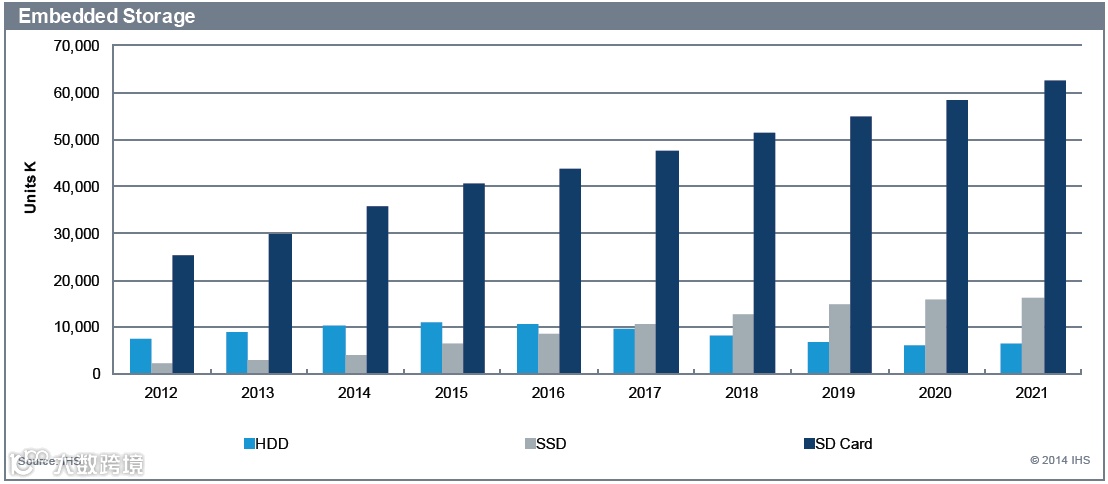
This chart shows the historical numbers and forecast for HDD,SSD,and SD cards being used in the vehicle.It should be noted that these are not always used for navigation,they could also be used for music storage or other types of storage,but more often than not they are included with navigation systems.HDDs really do not see significant growth,and in fact see a decline after their peak in 2016.SSD sees minimal growth over the years,but SD card is where the most growth occurs.Map makers and navigation software makers have been able to compress file sizes,while SD card makers have been able to increase storage size,which has been ideal for car manufacturers.The price of including an SD card slot is also significantly lower than it is for an OEM to include an HDD or SSD in the vehicle.
Disruptors:
In-vehicle embedded navigation has faced several major disruptors over the years,but it has seemingly overcome each one so far.Originally,the biggest barrier for embedded navigation was price.As stated previously though,it appears as if price is no longer a significant barrier.
About five to seven years ago portable navigation devices(PNDs) were considered a huge disruptor for in-vehicle navigation.There were many forecasts and predictions that said in-vehicle navigation could not compete with the cheap solution that PNDs provided.Two things happened though in the OEMs' favor:One was because of the OEMs and another that was due to the overall market.The OEMs proactively set-out to provide better services than the competing PNDs-this was mainly through telematics,but was also due to infotainment in the vehicle.OEMs were able to include connected traffic,send-to-car destinations,and local search functions that PNDs at the time could not offer.At the same time this was happening,the market was undergoing a huge change as well.Smartphones were becoming increasingly popular with consumers,and most included a form of navigation like Google Maps on the phone so PNDs were no longer needed.
Although in-vehicle navigation survived the PND scare,it now faces a larger threat from the competition that eliminated the PND market,the smartphone.Smartphones appear to be a more serious threat to in-vehicle navigation than PNDs ever were.Smartphones provide free or low-cost navigation with connected services to the same customers that would have to spend around $500USD for a similar in-vehicle system.
At first,OEMs combatted this by pointing out the screen size difference,but with smartphone and phablets approaching the screen size found in vehicles,this argument is quickly becoming moot.Now OEMs are beginning to embrace smartphones within the vehicle and instead replace in-vehicle navigation systems with display audio systems that allow apps from the OEM or smartphone be used on the screen.Another solution is to just project onto the screen the phone's navigation screen via Apple CarPlay,Android Auto,or MirrorLink.
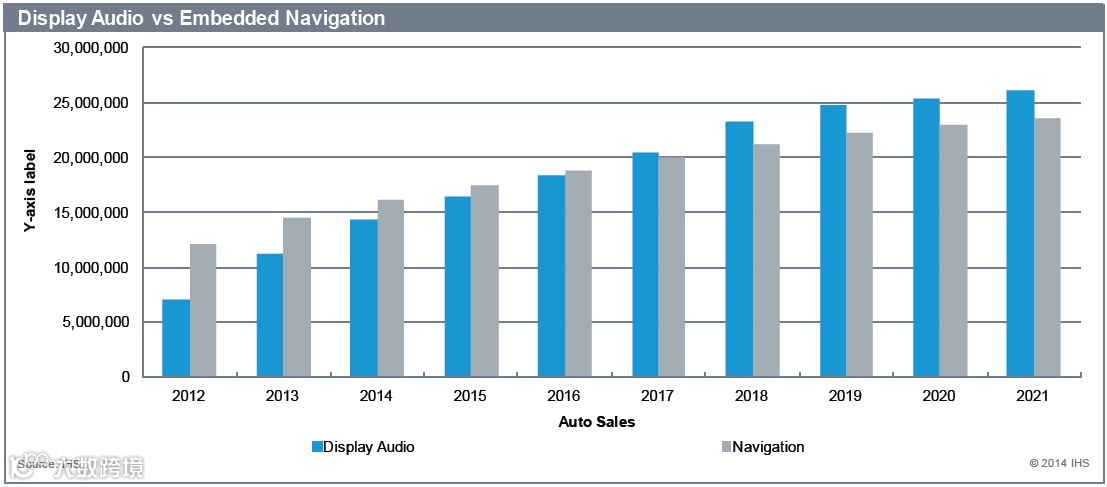
As the numbers show here,display audio catches navigation in 2017 and over takes it in 2018.It should also be noted though that navigation continues to go up.So,although display audio will take away some of the growth from in-vehicle embedded navigation systems,it will not completely disrupt it as navigation continues to grow.
The Americas
The United States
The embedded in-vehicle navigation market has reached maturity over the recent years.The US market,like the mature European markets and the Japanese market started in the 80s as a luxury option on mostly luxury vehicles.Like most automotive technologies,as the system took hold because of newer advancements in technology and greater popularity,scales of economy allowed the now cheaper solution to be offered on higher volume vehicles to the mass public rather than just luxury brands.Embedded navigation has reached a point now where it is now being offered as an option on low cost high volume vehicles,including those in the A and B segments.
Navigation is a popular option in the U.S. In particular because many U.S. Metropolitan areas are spread out and include many suburbs,plus Americans have a proclivity to take cross-country road trips to areas where they are not familiar with the roads.
Although it looks like navigation has bright future in the U.S.,it is important to stress it has reached mature levels.There is little room for navigation to grow and although it is being offered on more vehicles,display audio is sometimes a more attractive option to consumers because it is usually a cheaper option and still has options,via apps,for navigation.
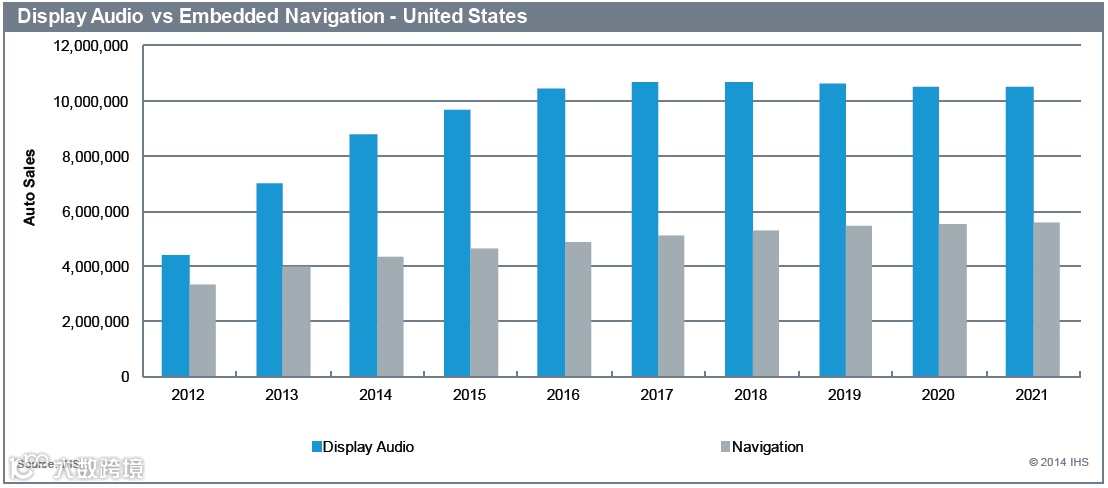
The previous figure shows that display audio is not only currently outpacing embedded navigation,display audio will also continue to grow until about 2016 where it will plateau.Embedded navigation has almost reached its plateau but it is important to note that it does decrease in sales as display audio sales increase,holding between 5 million units and 6 million units annually.
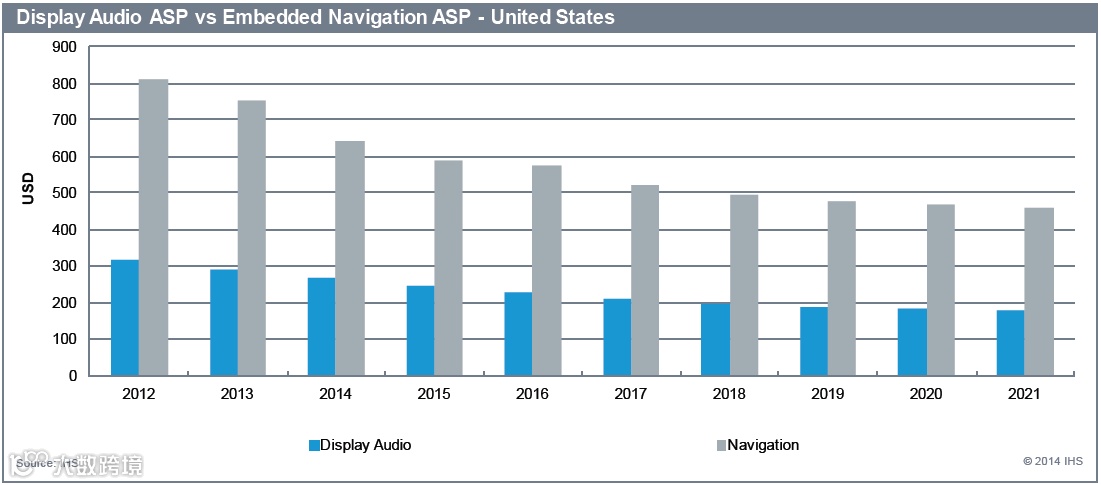
The figure above highlights why display audio is a big disruptor for embedded navigation in the U.S..The average selling price for a display audio system is between $200 and $300 compared to navigation which in 2012 was over $800,but even at its lowest point barely goes below $500.Assuming the consumer has the option between an embedded navigation system at $500,or a display audio system with a navigation app at $200,it is fairly obvious what the choice will be.
It should also be noted that most of the top selling brands of embedded navigation systems in the U.S. Also offer a display audio option.
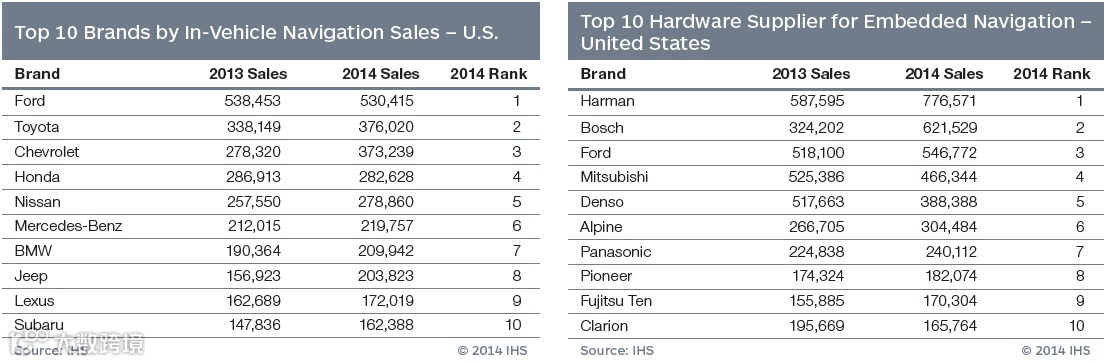
Ford,Toyota,and Chevrolet all offer a display audio option.If these top three brands only had navigation as an option and did not include display audio options,it is very likely that the above sales figures would be much higher.
The leading supplier of embedded navigation in the United States,much like the rest of the world,is Harman.
Harman has a clear lead over its competitors in the United States.Harman is one of Chrysler's top suppliers for the UConnect system that is found in Chrysler, Dodge,and Jeep.Harman is also found in many of the premium brands where navigation is more prevalent.Ford is listed on here as the supplier of its system because Ford uses components from several different sources rather than a navigation system unit provided by a traditional Tier1 supplier.
Brazil
Brazil is one of the world's largest growing markets both in terms of automotive sales as well as navigation.Brazil is beginning to see more and more imported vehicles with navigation systems as its automotive market begins to rise.Automotive OEMs are paying more attention to countries like Brazil where more and more individuals are able to buy vehicles,roads are being improved,and navigation software companies are offering maps and solutions.
Just like the U.S. Though,Brazil is seeing more growth in display audio systems than in embedded navigation.Display audio is a major disruptor in this market as it provides a low-cost solution for navigation in a market where cost is crucial.
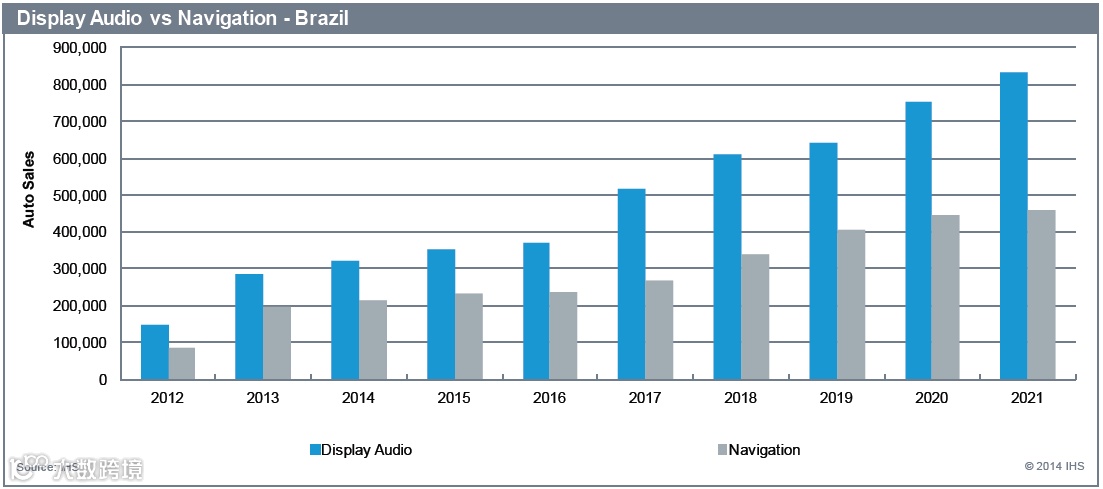
As the figure shows,much like the U.S.,display audio is well outpacing navigation in the Brazilian market.There is a difference though between the Brazil figure here and the previous U.S. Figure,and that difference is that in Brazil even though display audio is growing rapidly,so is navigation.The navigation market in Brazil has not reached maturity like it has in the U.S.,which means navigation goes from just over 200000 vehicles in 2014 to over double that in 2021.
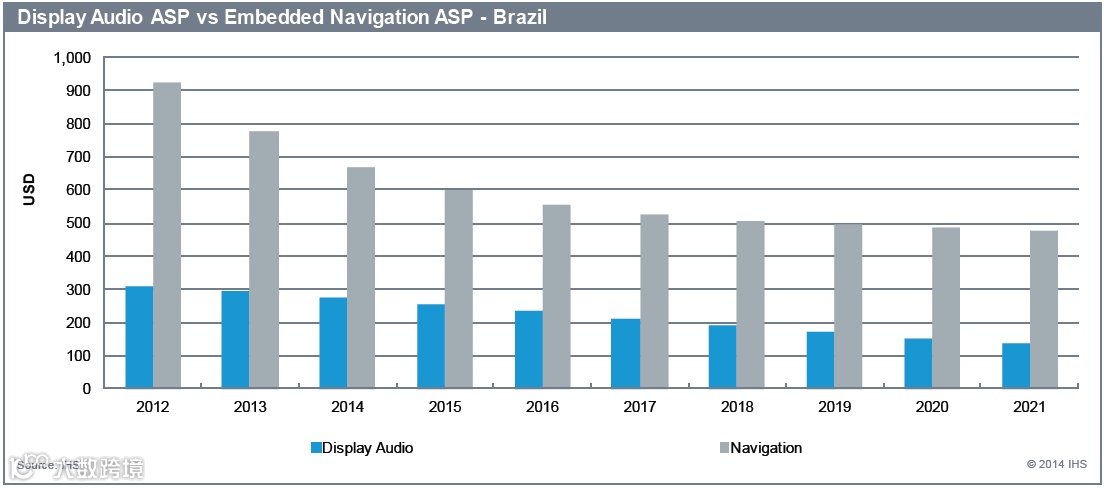
As this figure shows,price remains a huge barrier for navigation to gain any large traction in Brazil.Although navigation has made some progress from the over $900 price in 2012 to under $700 in 2014 and under $500 in 2021,navigation's price is nowhere near the cost of a display audio system.Display audio will continue to be a major disruptor in Brazil because of cost,unless OEMs can figure a way to significantly lower the cost of their embedded navigation systems.Lowering the cost of embedded navigation though is not likely to happen because even in the United States where the navigation market has matured,the average price has not dropped below $400,nor is it forecasted to.
In Brazil,the top selling navigation brands do not offer a display audio option.If Renault or Hyumdai offered a display audio option it is likely the navigation sales numbers would be dramatically lowered.Renault demonstrates here that its MediaNav system was not only a huge success in Europe(Dacia in Europe) but also abroad in other countries like here in Brazil.The reason for Renault's success is partially due to the relative low cost of the system,and also because the systems is so easy to use.
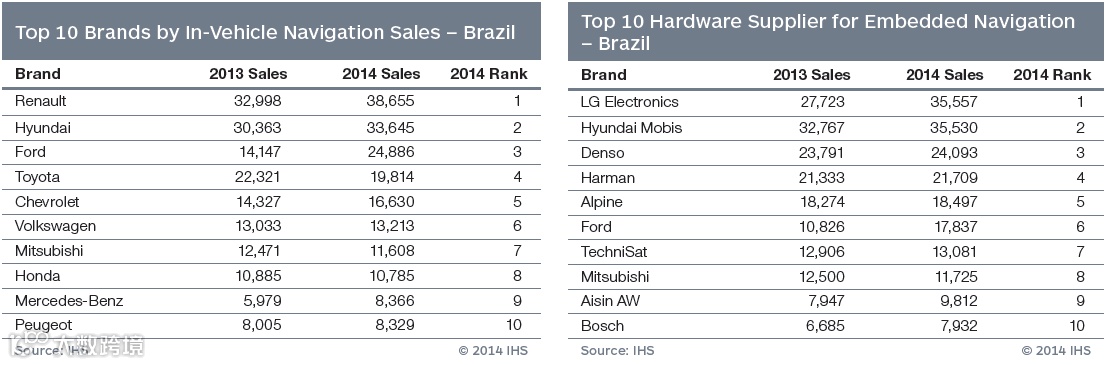
LG Electronics is at the top of the list because it supplies the system found on Renault models in Brazil and Hyundai Mobis obviously supplies to Hyundai.If this trend continued Ford would be next on the list,but instead Denso,Harman,and Alpine are there because they are Tier 1 suppliers that have relationships in Brazil with multiple OEMs.
APAC
China
China is one of the BRIC countries;however,it has seen a bit more success in the automotive market than the other members of the BRIC designation.China's automotive sales have been very large and continue to grow at a steady pace,and unlike other developing markets the automotive sales have not just been economy vehicles,but have also included a large portion of luxury vehicles and vehicles with lots of features.
It is also important to note that display audio is not quite the disruptor in China as it is other countries.Rather than looking at navigation sales compared to display audio in China,to understand the full picture of the Chinese market and how far it has come,a view comparing navigation sales to those in the United States might give a better overall picture.
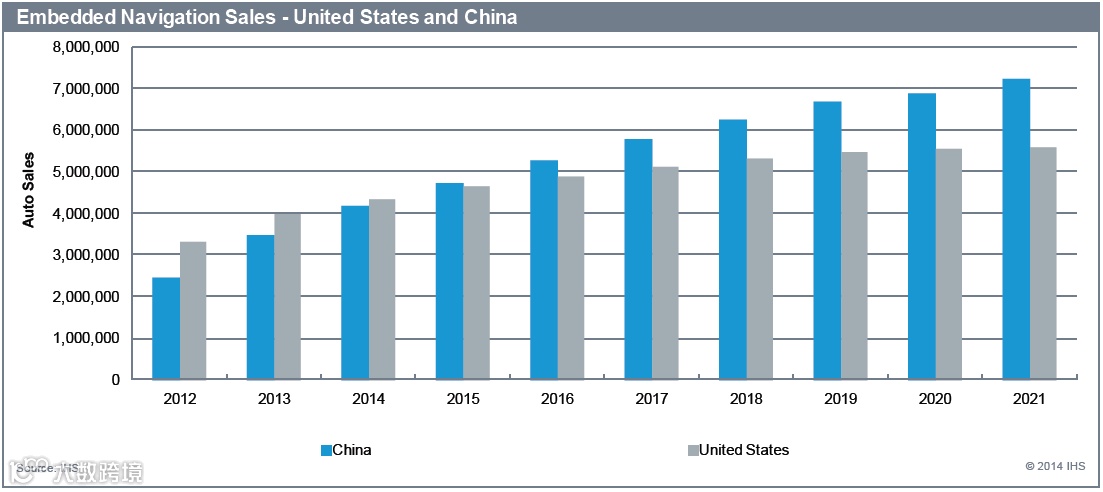
As the figure shows here,China almost has drawn level with the United States in 2014.After 2014 though,China continues to surge past the United States,while the United States flattens out.As discussed before,the U.S.plateaus because of display audio and reaching market maturity.China is continuing to grow because display audio is not as prevalent as it is in the U.S. ,and China has not come close to reaching market maturity.In fact in2014,China is at just over 4M units,and in 2021 they are getting close to doubling that with over 7M units.At some point further down China will also plateau like the U.S.,but it remains to be seen though exactly where that point is.
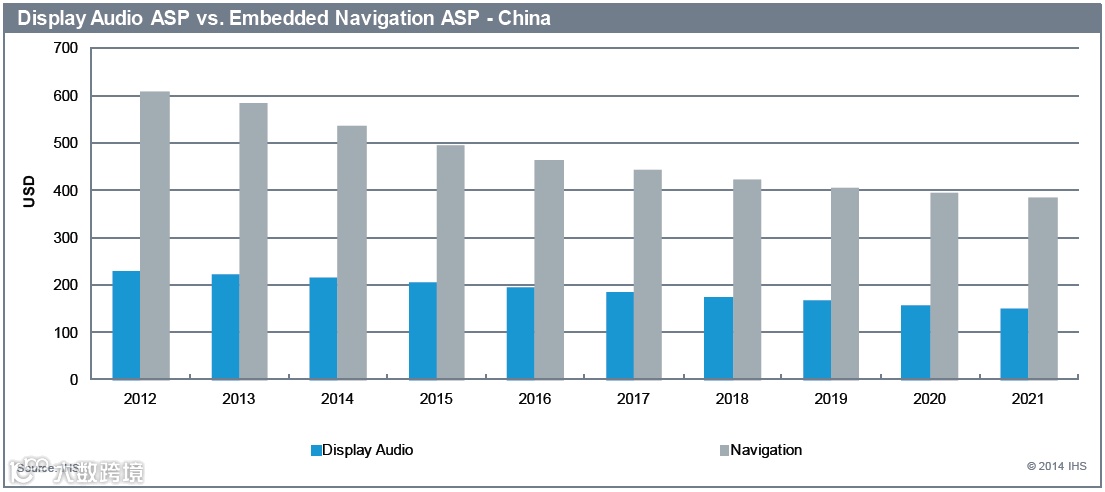
Display audio is not as big of a factor in China as it is in other areas of the world.Navigation appears to be only slightly affected by the inclusion of display audio.Navigation in China continues to grow largely because of the large decrease in price it is forecasted to have over the next seven years.Systems are a little over $500 currently in china,but by 2019 and beyond,navigation prices are forecasted to drop below $400.OEMs tend to see large attachment tates if they can drop the price of navigation systems below $500,which China is forecasted to do.
Since navigation will grow rapidly over the next few years,it is equally important to see who the current leaders are in market share both from an automotive OEM/brand perspective as well as a supplier perspective.
Seven out of the 10 brands here are foreign imports,and of those seven three of them are luxury brands.This is a vastly different table than the Brazilian one,where they were all imports and mostly higher volume brands.The fact that there are more luxury brands on this list in China just shows that in the automotive market,there is a lot of higher end clients than when compared to other BRIG countries.It also shows the health of the Chinese automotive market,with three domestic brands(Changan,BYD,Chery) being able to enter the top 10 as well.Lastly,the VW group has a dominant lead over its competitors in China since both the Volkswagen and Audi are part of the same organization.
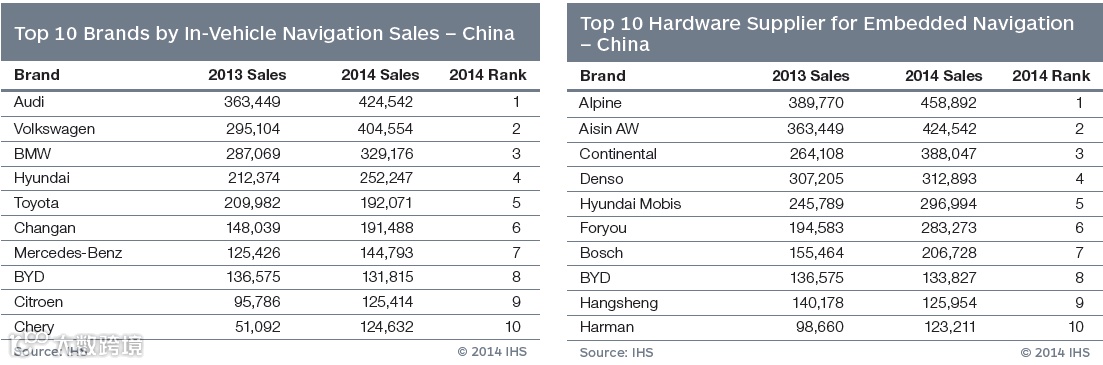
The supplier picture is a little bit different than the previous brand table.There is no runaway leader as the top four are all relatively close in sales.It should be noted here that there are three domestic suppliers(Foryou,BYD,Hangsheng) on this table,which again is vastly different than the other BRIG countries.It also shows that global navigation supplier leader Harman has definite room to improve on its global lead if it can increase in China.
-----------------------------------------