日日在各大媒体上被人工智能刷屏?不了解人工智能、机器学习、深度学习的区别和应用?究竟什么业务场景下最合适应用机器学习?本文将向您介绍这些概念间的区别和联系。
There is hardly a day where there is no news on artificial intelligence in the media. Anyway, there is high level of confusion around those terms. This post should help to understand the differences and relationships of those fields.
下图解释了人工智能、机器学习和深度学习三个概念。
The following picture explains the three terms artificial intelligence, machine learning, and deep learning:
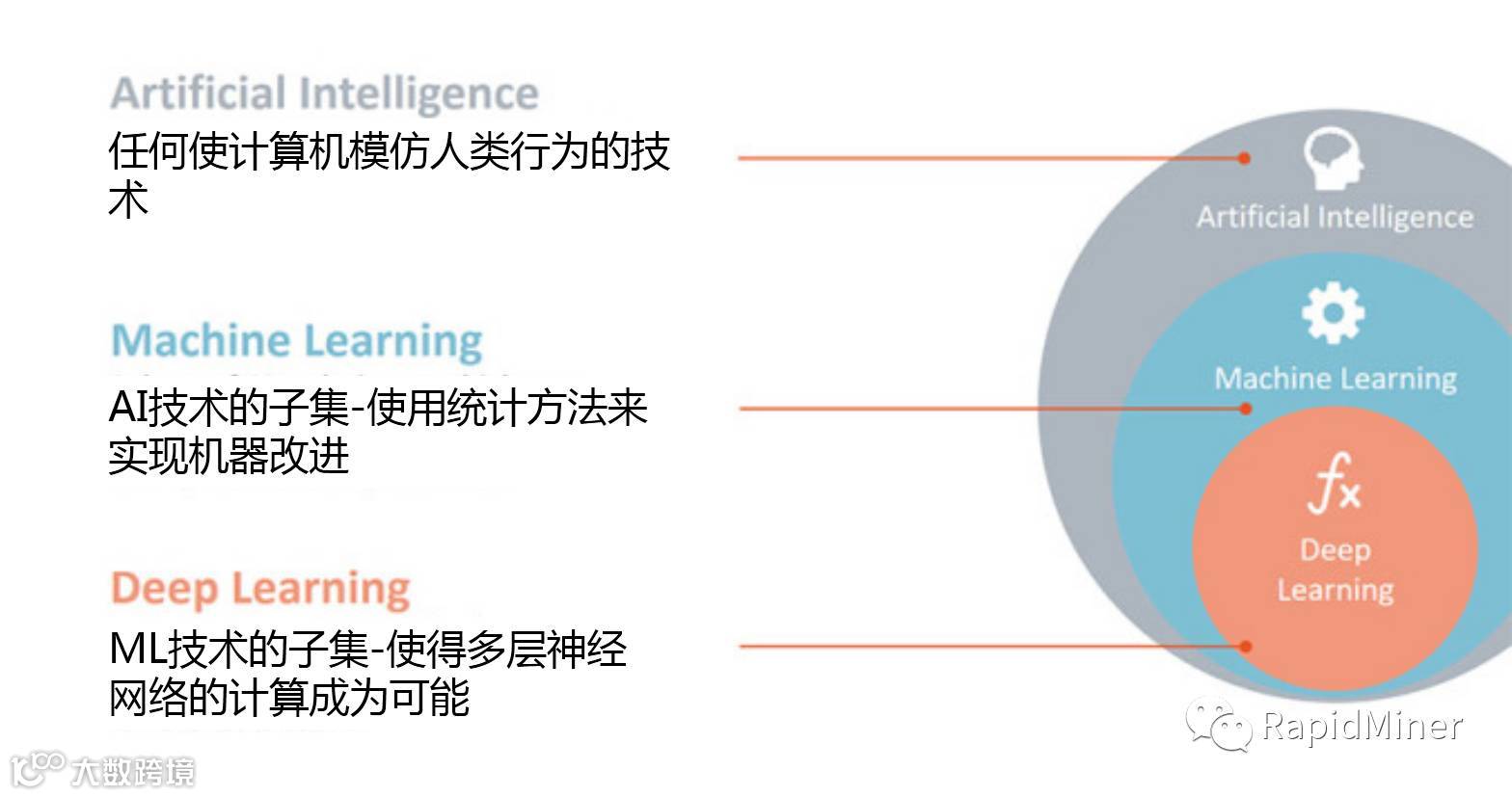
人工智能涵盖了任何使计算机能像人类的行为。与Siri对话获得答案,已经非常接近。使用机器学习进行自动交易系统也属于这类范畴。
Artificial Intelligence is covering anything which enables computers to behave like a human. If you talk to Siri on your phone and get an answer, this is close already. Automatic trading systems using machine learning to be more adaptive would also already fall into this category.
机器学习是人工智能的一个子集,能够从数据集中提取模式。这意味着机器可以找到最佳行为的规则,根据外界变化而变化。
Machine Learning is the subset of Artificial Intelligence which deals with the extraction of patterns from data sets. This means that the machine can find rules for optimal behavior but also can adapt to changes in the world.
深度学习是使用复杂神经网络的特殊的机器学习算法。在某种意义上,它是一如决策树或支持向量机之类的相关技术的集合。深度学习是机器学习方法的一个子集。
Deep Learning is a specific class of Machine Learning algorithms which are using complex neural networks. In a sense, it is a group of related techniques like the group of “decision trees” or “support vector machines”. Deep learning is a subset of methods from machine learning.
以下是这三个概念最重要的研究领域和方法的总结:
人工智能:机器学习,规划,自然语言理解,语言合成,计算机视觉,机器人学,传感器分析,优化与仿真等
机器学习:深度学习,支持向量机,决策树,贝叶斯学习,k均值聚类,关联规则学习,回归等
深度学习:人工神经网络,卷积神经网络,递归神经网络,长期记忆,深层信念网络等
Below is a summary of the most important research areas and methods for each of the three groups:
Artificial Intelligence: Machine Learning, planning, natural language understanding, language synthesis, computer vision, robotics, sensor analysis, optimization & simulation, among others.
Machine Learning: Deep Learning, support vector machines, decision trees, Bayes learning, k-means clustering, association rule learning, regression, and many more.
Deep Learning: artificial neural networks, convolutional neural networks, recursive neural networks, long short-term memory, deep belief networks, and many more.
下图说明了数据科学与这三个概念之间的联系:
The picture below gives an idea how Data Science relates to those fields:
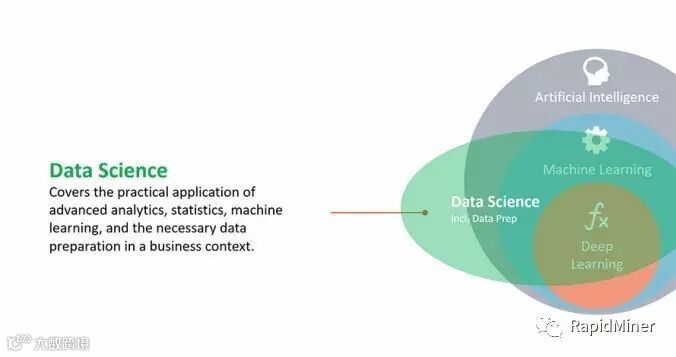
数据科学是所有这些领域(AI,ML,DL)在业务环境中的实际应用。它还涉及传统统计和可视化等相关领域,同时也包括进行分析所需的数据准备工作。
Data Science is the practical application of all those fields (AI, ML, DL) in a business context. It also covers related fields like traditional statistics and the visualization of data or results. Finally, Data Science also includes the necessary data preparation to get the analysis done.
但无论您的业务环境是什么,目标总是相同的:
从数据中提取洞察
预测发展
获得最佳结果的最佳行动
或者自动化方式执行这些操作
But whatever the context of your application is, the goals are always the same:
extracting insights from data
predicting developments
deriving the best actions for an optimal outcome
or perform those actions in an automated fashion
数据科学家是在业务应用环境中应用所有这些分析技术和必要的数据准备的人。只要结果正确可靠,这些工具并不重要。即使不写一行代码,也可以成为好的数据科学家。
Data scientists are people who apply all those analytical techniques and the necessary data preparation in the context of a business application. The tools do not matter to me as long as the results are correct and reliable. People can be good data scientists even if they do not write a single line of code.
无论何时您需要快速做出大量类似的决策,机器学习和人工智能就能获得最大的价值。比如:
在需求快速变化的市场中定义产品的价格
在电子商务平台上进行交叉销售
批准信用
检测高风险的客户流失
停止欺诈交易
...等等
Machine Learning and Artificial Intelligence deliver most value whenever you need to make lots of similar decisions quickly. Good examples for this are:
Defining the price of a product in markets with rapidly changing demands,
Making offers for cross-selling in an E-Commerce platform,
Approving a credit or not,
Detecting customers with a high risk for churn,
Stopping fraudulent transactions,
…among others.
企业利用AI或ML却失败的大多数情况是他们在错误的业务环境中使用了这些技术。如果您只需要做出一个重大决定,机器学习模型的意义并不大。在这种情况下,分析所做的是帮助提供您做出此决定所需的数据,或者以可视化方法呈现这些数据。这些单一的重大决定往往是非常具有战略意义的,这种情况下通过自己的判断做出的决定往往比机器学习或人工智能的结果更有效。
In most of the cases where organizations fail with AI or ML, they used those techniques in the wrong context. ML models are not very helpful if you have only one big decision you need to make. Analytics still can help you in such cases by giving you easier access to the data you need to make this decision. But those single big decisions are often very strategic. And often they also do not yield better results than just making the decision on your own.
机器学习在实现模型运营化和自动化数百万个决策时,才能发挥最大的价值。
Machine learning delivers most value when we operationalize models and automate millions of decisions.
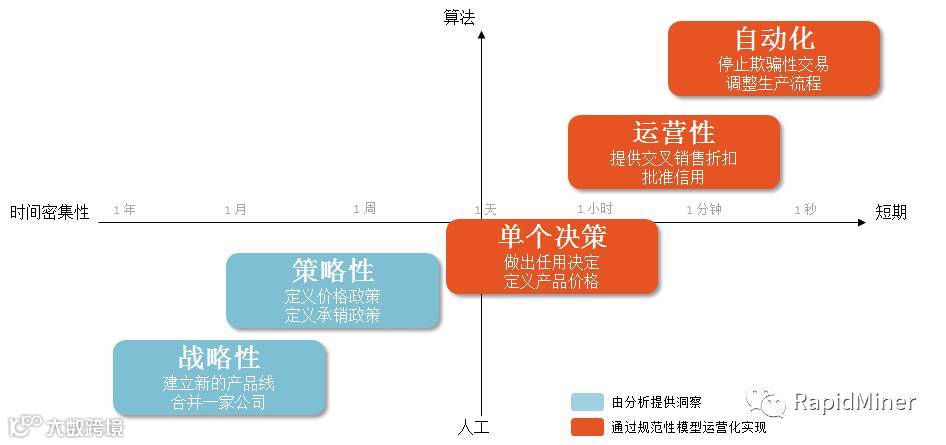
下面的图像显示了决策类型和人们做出这些决策需要的时间。橙色框是AI和ML发挥真实价值之处。所需自动执行的决策越多,价值越高。
The image below shows this spectrum of decisions and the times humans need to make those. The orange boxes are situations where AI and ML show real value. And the interesting observation is: the more decisions you can automate, the higher this value will be (upper right end of this spectrum).
(本文选自https://ingomierswa.com,Ingo Mierswa,RapidMiner CEO)
RapidMiner是当今行业领先的数据科学平台,连续四年被Gartner评为数据科学平台领导者,帮您构建从洞察到行动的桥梁。
RapidMiner named a Leader in the Gartner Magic Quadrant for Data Science Platforms for the fourth year in a row, is today's industry-leading data science platform that helps you close the loop between insight and action.
扫描以下二维码立即报名RapidMiner基础培训课程!
Scan the following QR code to register for the RapidMiner basic training course now!

您也可登录www.rapidminerchina.com下载最新RapidMiner7.5进行试用。
You can go to www.rapidminerchina.com to downlaod the latest RapidMiner 7.5 for a trial.
如果您有任何疑问欢迎直接拨打021-6040-8383或发送邮件至sales@rapidminerchina.com,我们将尽快给您回复。感谢您的支持!

阅读往期精彩内容:
最新资讯:
RapidMiner在2017年连续第四年被Gartner评为数据科学平台魔力象限领导者
RapidMiner被Forrester誉为预测分析和机器学习解决方案的领导者
RapidMiner 7.5 性能全面升级,正式发布咯~
干货分享: