Click the Text in Blue on the Top, Follow us!
Effective from 1 January 2024, Malaysia implemented Capital Gains Tax (“CGT”) on gains or profits from the disposal of capital assets by certain chargeable persons. This marks a significant development in the Malaysian tax framework, with implications for corporate taxpayers and investment structures. The CGT provisions are legislated under Section 4(aa) of the Income Tax Act, 1967 (“ITA”) and apply to companies, limited liability partnerships (“LLP”), trust bodies, and co-operative societies (collectively referred as “chargeable persons”).
Types of Capital Assets Chargeable to Income Tax
Currently, CGT is imposed on gains or profits from disposal of capital assets which consists of:
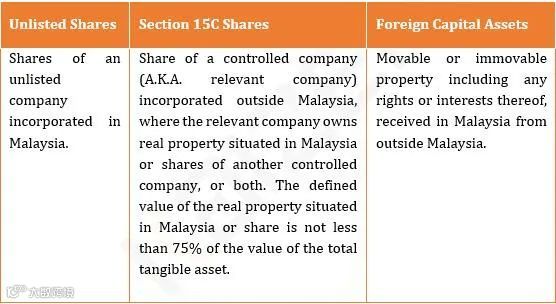
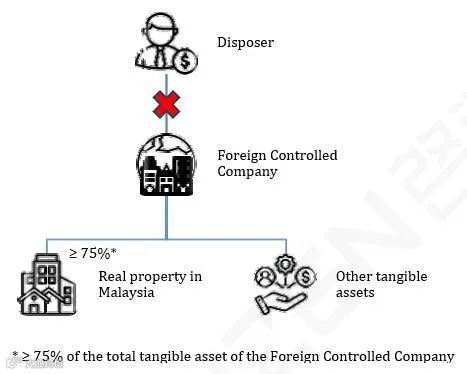
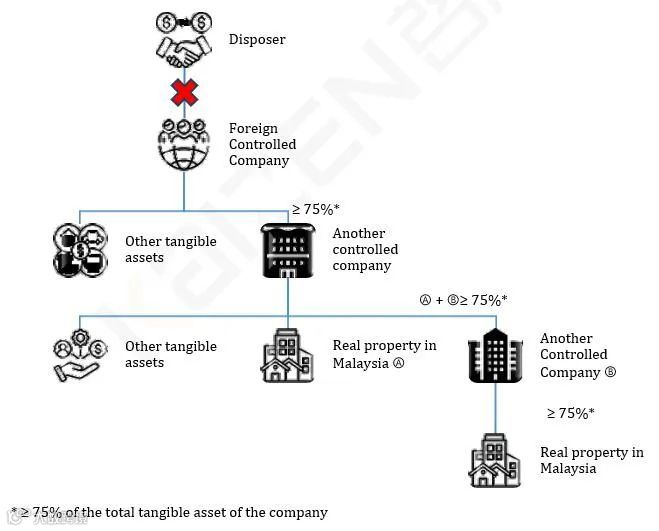
For illustrations purposes, the two common Section 15C shares scenarios are illustrated below.
(1). Scenario A – Foreign Controlled Company owns real property situated in Malaysia
(2). Scenario B – Foreign Controlled Company owns real property situated in Malaysia
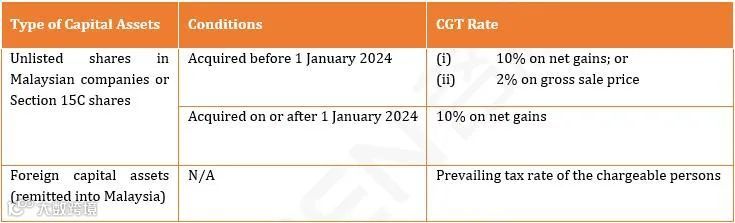
Tax Rates of CGT
The tax treatment and applicable rate depends on when the asset was acquired and its derivation provision. The following table summarises the CGT rates:
Determination of Disposal Date and Acquisition Date
Accurately identifying the disposal date of a capital asset is essential for tax compliance, as it determines the year of assessment (“YA”) in which the gain must be reported and the sixty (60) days filing deadline for the CGT return. Malaysia’s CGT framework, governed under Section 65F of the ITA, outlines specific rules for different disposal scenarios to avoid disputes and ensure consistent treatment.
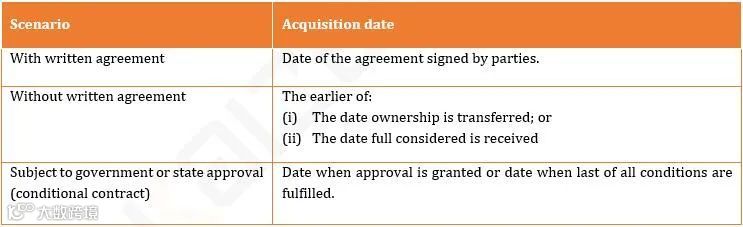
Once the disposal date is established, it is also used as the acquisition date for the acquirer.
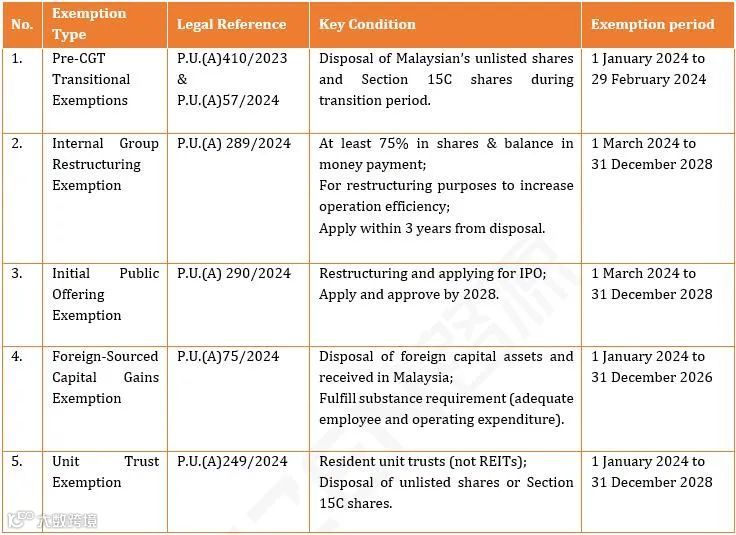
Summary Table of CGT Exemptions
Under Malaysia’s CGT regime, the government has issued several exemption orders through gazette notifications. These exemptions may apply when disposing of capital assets, but they are subject to specific conditions and procedures.
Exemption of CGT
We hereby provide a brief summary of the various CGT exemption orders as follows:
Pre-CGT Transitional Exemptions (January to February 2024)
Several exemptions applied during the transition period before CGT came into full effect:
Income Tax (Exemption)(No.7) Order 2023 [P.U.(A)410/2023]
Exemption on gains from disposal of unlisted Malaysian shares
Income Tax (Exemption)(No.2) Order 2024 [P.U.(A)57/2024]
Exemption on gains from disposal of shares under Section 15C of the ITA
Exemptions above is applied for disposal of Malaysian’s unlisted shares or Section 15C shares made between 1 January 2024 to 29 February 2024.
Exemptions do not apply if the gains are taxed under Section 4(a) of the ITA as business income.
Internal Group Restructuring Exemption
Income Tax (Restructuring of Companies Scheme)(Exemption) Order 2024 [P.U.(A) 289/2024]
Disposals of Malaysian’s unlisted shares to a Malaysia-resident acquirer company under a group restructuring scheme are CGT exempt, provided that:
The disposal is made between 1 March 2024 to 31 December 2028.
The restructuring aims to enhance operational efficiency within the group.
Consideration must consist substantial in shares in the acquirer company, of at least 75% in shares and the balance in monetary payment, and the shares shall be issued to the chargeable person.
A written application must be submitted to Inland Revenue Board of Malaysia (“IRBM”) three (3) years from the disposal date.
Any conditions issued by the Ministry of Finance (“MOF”) via IRBM guidelines under Section 134A must be complied with.
The exemption does not apply if:
Gains are taxed under Section 4(a) of the ITA as business income.
The same disposal qualifies under a different CGT exemption [e.g. Initial Public Offering (“IPO”)].
The person has obtained a tax exemption under Sections 127(3)(b) or 127(3A) for the same disposal.
Subsequent disposal by the acquirer:
If the acquirer company subsequently disposes of the shares acquired under this exemption, the acquisition amount or value of consideration for CGT purpose shall be deemed to be:
The original amount or value of consideration paid for the shares by the original disposer, as determined under paragraph 65E(2)(b) of the ITA; and
The allowable expenses incurred by the original disposer under subparagraphs 65E(2)(a)(i) and (ii).
This ensures continuity and fairness in CGT computation when shares are further transferred within or outside the group.
Income Tax (Initial Public Offering) (Exemption) Order 2024 [P.U.(A) 290/2024]
A chargeable person is exempted from CGT on gains or profits derived from the disposal of Malaysian’s unlisted shares in connection with an IPO, provided that:
The disposal is made between 1 March 2024 to 31 December 2028.
The shares are disposed of as part of a company’s restructuring for the purpose of an IPO.
The IPO application (Main Market, ACE Market or LEAP Market) is submitted within one (1) year from the disposal date.
Approval for the IPO shall obtained on or before 31 December 2028.
The chargeable person submits a written application to IRBM within one (1) year from the approval date.
The exemption does not apply if:
Gains are taxed under Section 4(a) of the ITA as business income.
The same disposal qualifies under a different CGT exemption (e.g. restructuring).
The person has obtained a tax exemption under Sections 127(3)(b) or 127(3A) for the same disposal.
Foreign-Sourced Capital Gains Exemption
Income Tax (Exemption)(No. 3) Order 2024 [P.U.(A)75/2024]
Gains from the disposal of overseas capital assets [excluding intellectual property rights (“IPR”)] received in Malaysia are exempt, provided that:
The income is received in Malaysia between 1 January 2024 to 31 December 2026.
The chargeable person must comply with any conditions issued by the MOF via IRBM guidelines under Section 134A, which shall include the following conditions:
o Employ an adequate number of employees in Malaysia.
o Incur adequate operating expenditure in Malaysia.
The exemption does not apply to:
Gains from disposal of IPR where the chargeable persons is the owner or licensee of such IPR (Capital receipt not subject to Income tax).
Businesses in banking, insurance, sea transport or air transport.
Unit Trust Exemption
Income Tax (Unit Trust)(Exemption) Order 2024 [P.U.(A)249/2024]
Resident unit trusts are eligible for exemption from CGT on disposal of Malaysian’s unlisted shares or Section 15C shares, provided that:
The disposal is made between 1 January 2024 to 31 December 2028.
Disposal of unlisted shares in Malaysian companies.
Disposal of shares under Section 15C of the ITA.
This exemption applies only to unit trusts that are resident in Malaysia, and does not extend to the following entities:
Real Estate Investment Trusts (“REITs”); and
Property Trust Funds listed on Bursa Malaysia.
Exemptions do not apply if:
The gains are taxed under Section 4(a) of the ITA as business income.
Key notes during submission of CGT
Separate Computation for Each Capital Asset
Under the Malaysian CGT regime, gains or profits from the disposal of capital assets during the basis period of a YA must be computed on a transaction-by-transaction basis. Each disposal is treated as a separate source of income.
This means that chargeable persons must prepare a distinct CGT computation for each individual disposal, regardless of whether multiple disposals occur within the same YA.
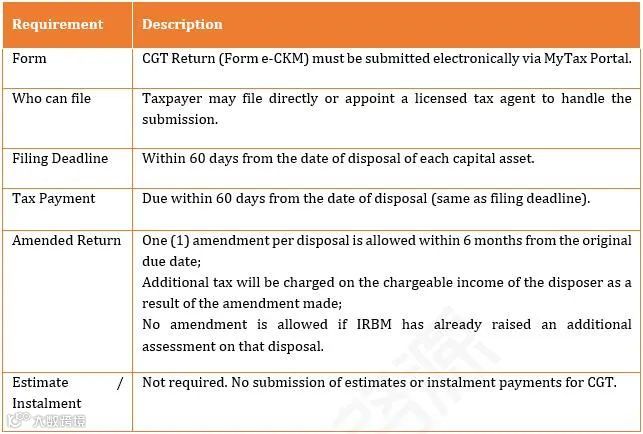
Filing and Compliance Requirements for CGT
Malaysia’s CGT framework imposes clear compliance obligations on persons disposing of chargeable capital assets, especially unlisted shares in Malaysian companies and Section 15C shares. Understanding these obligations is essential to ensure timely and accurate reporting.
Disposer's Responsibilities
Only the disposer is required to file the CGT return and pay the associated tax. The acquirer has no withholding or reporting obligations (unlike disposal of Real Property Company shares).
Malaysia adopts a self-assessment system, where submission of a CGT return is deemed a notice of assessment.
Foreign Capital Gains
Foreign-sourced capital gains are not subject to CGT. However, if proceeds are remitted into Malaysia, they may be taxable under foreign income rules unless exempted under P.U.(A)75/2024 or Paragraph 28, Schedule 6 of the ITA.
Grace Period for IRBM Assessments
If the IRBM raises additional tax assessments, the tax is payable within 30 days from the date of the assessment notice. A grace period of seven (7) days beyond the due date is provided.
Filing Related Offences and Penalties
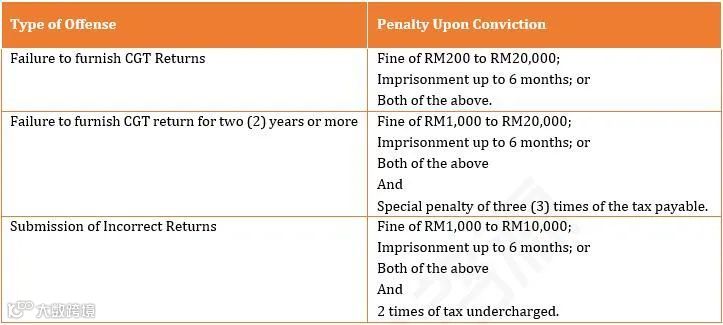
Non-compliance with CGT filing obligations or the submission of incorrect information can lead penalty imposed by the IRBM.
The table below summarises the key CGT-related offences and the corresponding penalties under the ITA:
Capital assets is a stock-in-trade sell in the ordinary course of business.
Capital assets generally refer to non-business assets such as shares held for investment. Gains from the disposal of such assets are typically regarded as non-business income. However, if the disposal occurs frequently or as part of the ordinary course of business, the gains may be taxed as business income under the Section 4(a) of the ITA.
Where the capital assets qualify as stock-in-trade or part of an adventure in the nature of trade, the profits will be assessed under ordinary business income provisions and not subject to CGT. This distinction is crucial for proper tax classification and compliance.
KAIZEN Group, together with its associate firms in Malaysia, can help the clients to perform these compliances formalities so as to maintain the Malaysia company in good standing. Please call and talk to our professional accountants in Kaizen for further clarification.
Note
The original text of this article comes from the WeChat public account:
啓源KAIZEN

Kaizen CPA Limited
Wechat:kaizencpa
If you wish to obtain more information or assistance, please visit the official website of Kaizen CPA Limited at
www.kaizencpa.com
or contact us through the following and talk to our professionals:
Email:info@kaizencpa.com
Tel: +852 2341 1444
Mobile :+852 5616 4140
+86 152 1943 4614
WhatsApp/ Line/ WeChat:
+852 5616 4140
Skype: kaizencpa