2023年合成生物学竞赛·创新赛第一期《常规赛科普专题》文章来自中国地质大学(武汉)的CUG-China团队,题为“生物膜与环二鸟苷酸”。
生物膜与环二鸟苷酸
生物膜概述
生物膜 (Biofilm) 是由微生物分泌的胞外多聚物 (Extracellular polymeric substance, EPS) 与微生物共同构成的生物群落。自然界中超过百分之九十九的微生物都生活在基于生物膜构成的细胞群落中,其余的微生物则以游离方式存在[1]。对微生物生长发育的研究表明,微生物有着复杂的生长行为,菌落中的单个细胞就可以通过某种方式影响整个菌落。生物膜就是微生物进行相互交流,互相影响的重要媒介。作为世界上最成功的繁殖形式之一,生物膜几乎无处不在。无论是从土壤、沉积物、矿物、植物与动物表面,到冰川、热喷口,还是核电站等高辐射区域,均有它们存在的痕迹[2]。
随着人们对生物膜研究的深入,人们开始逐渐利用它的特性为人类做贡献。生物膜已被应用于废水处理、营养物与污染物去除、微生物燃料电池发电、化工生产等。然而,由生物膜带来的一系列问题也不容小觑。在管道中,主要是在给排水系统中,生物膜会引起腐蚀并限制导热;生物膜还会积累重金属和有毒化合物[39],污染隐形眼镜、气管导管、机械心脏瓣膜、假体关节、手术缝合线等[40]。有研究发现,细菌侵染宿主后,会释放抗原并刺激宿主释放抗体,外来细菌产生的生物膜能够有效阻止抗体的作用,并可能使抗体对周围组织造成免疫复合物损伤[41]。即使在具有高功能免疫反应的个体中,生物膜感染也很难被宿主的免疫机制彻底清除[42]。抗生素治疗通常可以抑制由生物膜释放的游离细胞引起的症状,却无法彻底杀死以生物膜形式存在的病原微生物[43],故生物膜感染会周期性复发,直到生物膜被完全清除[44]。研究发现生物膜可能具有多种机制来应对抗菌筛选进而产生耐药性,其中一种设想机制是由于胞外基质以及聚合物的阻拦,抗生素的扩散速度被限制,使得抗生素难以进入生物膜内的细胞;另一种假设是生物膜中某些细胞通过调控基因表达,改变生物膜的表型,藉此逃脱抗药性筛选[25]。
纵观全局,生物膜对人类来说是一把双刃剑,通过对生物膜的深入研究,了解其调控机制并对其进行调控,将有助于人们对其化弊为利,促进医疗行业乃至社会的发展。
生物膜的组成
EPS是构成生物膜的主要成分。其成分主要包括胞外多糖、胞外 DNA (Extracellular deoxyribo nucleic acid, eDNA) 及部分胞外蛋白质[5]。对 Shewanella 等电活性微生物来说,生物膜中还含有导电的电活性化合物如细胞色素等[6-7]。见图 1.1 。
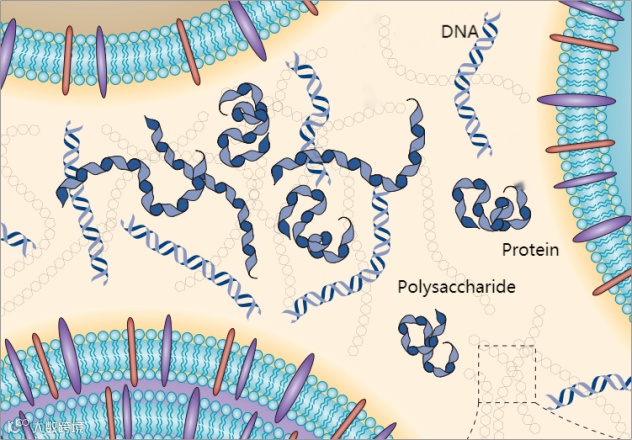
图1.1 胞外多聚物包括蛋白质、DNA与多糖[8]
胞外多糖在生物膜形成的多个过程中起着至关重要的作用,影响生物膜形成及稳定性等[9]。例如,铜绿假单胞菌 (Pseudomonas aeruginosa) 能够产生3种与生物被膜形成密切相关的核心胞外多糖:海藻酸盐、Pel 和 Psl[10-12]。海藻酸盐推动微菌落的形成[13];Pel 介导气液界面生物膜的形成[14-15];Psl 促进细胞附着并维持生物膜的结构[16]。
胞外蛋白质包括一系列的酶如脂肪酶、降解酶、几丁质酶以及一些毒性因子。比如铜绿假单胞菌中,其胞外蛋白质包括蛋白酶 LasA 和 LasB 、脂肪酶 LipA 和 LipC 、磷脂酶 C 、碱性磷酸酶等。有些酶是毒性因子,单独或与其他酶相互作用时可导致宿主细胞死亡、组织损伤或坏死[17]。其余大部分蛋白质则起着酶解蛋白质、与金属离子结合、维持生物膜结构稳定等作用[18]。
eDNA 在生物膜生命周期的初始阶段中可能发挥着一定的作用[19-20]。研究发现未成熟的生物膜在添加DNase Ⅰ(脱氧核糖核酸酶 Ⅰ) 的情况下无法正常形成生物膜,而成熟的生物膜扩散不受 DNase Ⅰ 的作用。即使是极低的 eDNA 浓度改变,都会对生物膜的形成造成巨大影响[21]。
EPS对于生物膜的形成、结构与功能都非常重要。由于环境中的有毒物质需要直接接触到细胞表面,或者进入细胞内部,才能对细胞起作用。EPS的存在就像给微生物穿上“盔甲”,可以阻止抑菌剂、生物化学制剂进入生物膜内的细胞,并对环境压力(如 pH 、渗透压、紫外辐射、水分缺失等)提供缓冲[22-24]。不产生 EPS 的细菌相较于产生 EPS 的细菌具有更低的粘附性。一般情况下,宿主的免疫系统能够迅速杀死非黏附的细菌,而高黏附性的细菌则具有更高的存活率,这主要也是由于 EPS 对细胞的保护作用[25-26]。
生物膜的生命周期
生物膜的形成包括以下阶段:(1) 细胞附着;(2) 定植;(3) 扩散。见图 1.2 。
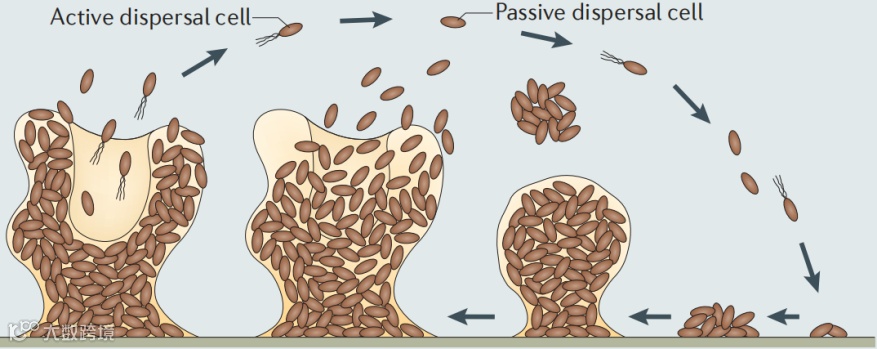
图1.2 生物膜的生命周期[27]
细胞附着是生物膜形成的第一步,可分为可逆阶段与不可逆阶段[28]。微生物首先通过分泌胞外基质附着到相应物体表面,此时它仍旧具有布朗运动(布朗运动是指微粒所做的永不停息的无规则运动)的规律,可以轻易地将其从表面移除,我们将其称为可逆阶段[29]。在一段时间后,随着细胞的增殖,细胞表面的范德华力,疏水作用力等,将促进细胞进入不可逆阶段。此时细胞分泌的 EPS 会将细胞锚定在基质上,同时细胞表面的菌毛,鞭毛等会加固细胞的附着[30]。
在表面附着之后,微生物自发形成生物群落,同时分泌 EPS 与微生物自身共同构成生物膜。EPS 为微生物细胞提供了一个三维支架,能够改变生物膜的理化参数,如疏水性、孔隙大小等[30]。生物膜则为微生物细胞提供了一个微环境。其中多孔通道的存在,可促进生物膜内营养物质与水分的传递[31];同时生物膜内的细胞排列紧密,有助于细胞间进行物质交换与信息交流,促进它们繁殖[32]。
生物膜发展的最后阶段是生物膜的扩散,即微生物主动或被动地脱离生物膜,在新的环境中定植。被动脱离一般是由于外界干扰对生物膜的侵蚀,导致微生物脱离[33-34],主动脱离则涉及细胞逐渐由生物膜形态过渡到游离形态。当出现营养限制、氧气消耗、温度变化等就会迫使细菌脱离当前生存环境,寻找新的生存环境[35-38]。
环二鸟苷酸介导的生物膜调控途径
当今对生物膜形成有关调控机制的研究已足够透彻。生物膜形成主要受到胞内信号分子、胞外群体感应、种间作用的调控[45]。其中胞内信号分子占据主导地位,最主要的调控信号分子就是c-di-GMP [46]。C-di-GMP 是第二信使,其结构为环状二核苷酸,由两个单磷酸鸟苷构成,通过磷酸二酯键连接在一起。其首次被发现于木葡糖酸醋杆菌 (Gluconacetobacter xylinum) ,作为纤维素合酶的变构调节因子[47-48]。早期研究表明,c-di-GMP 的功能主要是协调细菌生长及行为的各个方面,包括运动、毒性、细胞周期及生物膜形成等[49-51]。
胞内 c-di-GMP 的浓度由含有 GGDEF 结构域的二胍酸环化酶 (diguanylate cyclases, DGCs) 和含有 EAL/HD-GYP 结构域的磷酸二酯酶 (phosphodiesterases, PDEs) 共同控制。在 PDEs 催化下,c-di-GMP 分解为 pGpG 或 GMP ,在 DGCs 催化下,两分子的 GTP 合成 c-di-GMP [52]。见图 1.3 。
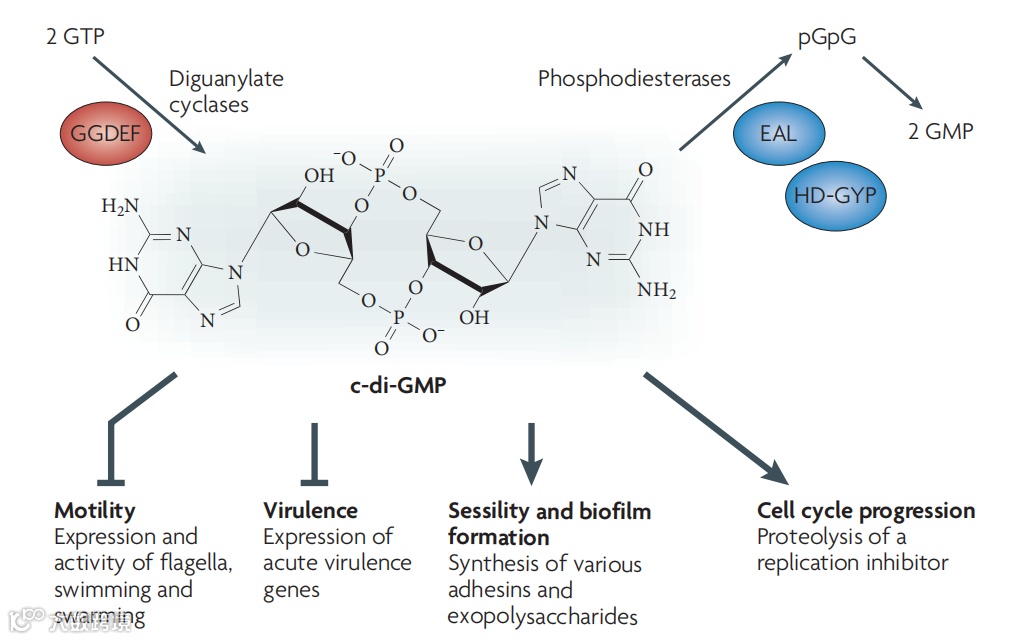
图1.3 C-di-GMP 结构与代谢[46]
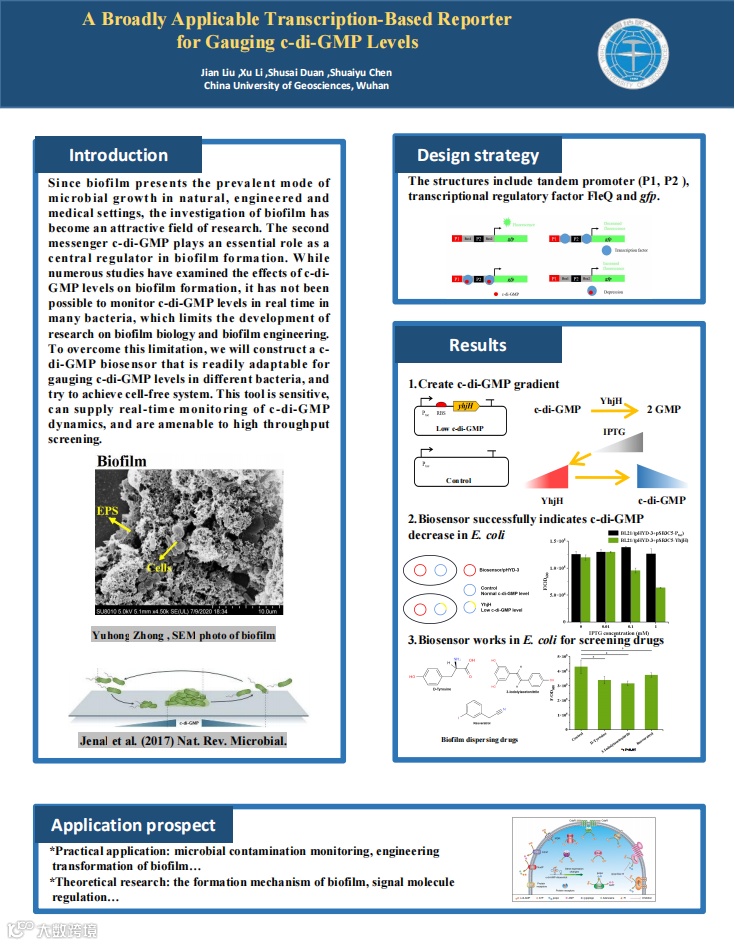
C-di-GMP 在对生物膜形成来说是一种重要的调节因子。胞内 c-di-GMP 水平可影响生物膜的形成,高水平 c-di-GMP 促进胞外聚集和胞外多聚物、粘附蛋白等分泌,进而促进生物膜形成,低水平 c-di-GMP 促进蛋白酶分泌,诱发生物膜解离,增强细胞运动性[53]。由于其在生物膜形成过程中的重要调节作用,c-di-GMP 在生物膜相关研究中受到广泛关注。比如,c-di-GMP 作为潜在靶向分子开发抗病原药物,用于治疗由铜绿假单胞菌生物膜引起的感染[54];提高大肠杆菌中的 c-di-GMP 浓度,获得高效稳定的生物膜催化剂生产精细化学品[55];提高电活性微生物中 c-di-GMP 浓度,促进电活性生物膜形成进而提高电输出[56]。无论是对于生物膜调节机理的探索还是对于生物膜工程改造的研究,监测 c-di-GMP 浓度都至关重要。
[1] Costerton JW, Stewart PS, Greenberg EP. Bacterial bio-films: a common cause of persistent infections[J]. Science, 1999, 284: 1318-22.
[2] Davey ME, O’Toole GA. Microbial biofilms: from ecology to molecular genetics[J]. Microbiology and Molecular Biology Reviews, 2000, 64(4): 847-67.
[3] Gilbert P, Das J, Foley I. Biofilms susceptibility to antimicrobials[J]. Advances in Dental Research, 1997, 11(1): 160-67.
[4] Flemming H-C. Biofilms and environmental protection[J]. Water Science and Technology, 1993, 27(7): 1-10.
[5] Tsuneda S, Aikawa H, Hayashi H, et al. Extracellular Polymeric Substances Responsible for Bacterial Adhesion onto Solid Surface[J]. FEMS Microbiology Letters, 2003, 223(2): 287-292.
[6] 梁伊丽, 尹华群, 刘学端. 奥柰达希瓦氏菌生物膜研究进展[J]. 现代生物医学进展, 2009, 9(9): 1799-1802.
[7] 阎俊, 谢晶. 希瓦氏菌生物被膜研究进展[J]. 微生物学杂志, 2020, 40(5): 104-111.
[8] Flemming HC, Wingender J. The Biofilm Matrix[J]. Nature Reviews Microbiology, 2010, 8: 623-633.
[9] Sutherland I. Biofilm Exopolysaccharides: A Strong and Sticky Framework[J]. Microbiology, 2001, 147(1): 3-9.
[10] Colvin KM, Irie Y, Tart CS, et al. The Pel and Psl Polysaccharides Provide Pseudomonas aeruginosa Structural Redundancy Within the Biofilm Matrix[J]. Environmental Microbiology, 2012, 14(8): 1913-1928.
[11] Branda SS, Vik S, Friedman L, et al. Biofilms:The Matrix Revisited[J]. Trends Microbiology, 2005, 13(1): 20-26.
[12] Ramsey DM, Wozniak DJ. Understanding the Control of Pseudomonas aeruginosa Alginate Synthesis and the Prospects for Management of Chronic Infections in Cystic Fibrosis[J]. Molecular Microbiology, 2005, 56(2): 309–322.
[13] Nivens DE, Ohman DE, Williams J, et al. Role of Alginate and Its O Acetylation in Formation of Pseudomonas aeruginosa Microcolonies and Biofilms[J]. Journal of Bacteriology, 2001, 183(3): 1047-1057.
[14] Ghafoor A, Hay ID, Rehm BH. Role of Exopolysaccharides in Pseudomonas aeruginosa Biofilm Formation and Architecture[J]. Applied and Environmental Microbiology, 2011, 77(15): 5238-5246.
[15] Friedman L, Kolter R. Genes Involved in Matrix Formation in Pseudomonas aeruginosa PA14 Biofilms[J]. Molecular Microbiology, 2004, 51(3): 675-690.
[16] Ma L, Conover M, Lu H, et al. Assembly and Development of the Pseudomonas aeruginosa Biofilm Matrix[J]. PLoS Pathogens, 2009, 5(3): e1000354.
[17] Galloway DR. Pseudomonas aeruginosa elastase and elastolysis revisited: recent developments[J]. Molecular Microbiology, 1991, 5(10): 2315-2321.
[18] Konig B, Jaeger KE, Sage AE, et al. Role of Pseudomonas aeruginosa lipase in inflammatory mediator release from human inflammatory effector cells (platelets, granulo-cytes, and monocytes)[J]. Infection and Immunity, 1996, 64(8): 3252-3258.
[19] Montanaro L, Poggi A, Visai L, et al. Extracellular DNA in Biofilms[J]. International Journal of Artificial Organs, 2011, 34(9): 824-831.
[20] Tang L, Schramm A, Neu TR, et al. Extracellular DNA in Adhesion and Biofilm Formation of Four Environmental Isolates: A Quantitative Study[J]. FEMS Microbiology Ecology, 2013, 86(3): 394-403.
[21] Whitchurch CB, Tolker-Nielsen T, Ragas PC, et al. Extracellular DNA Required for Bacterial Biofilm Formation[J]. Science, 2002, 295(5559): 1487.
[22] Satpathy KK. Effects of biofouling on the cooling water quality of a nuclear power plant[J]. Bulletin of Electrochemistry, 1999, 15(3-4): 143-47.
[23] Min B, Logan BE. Continuous Electricity Generation from Domestic Wastewater and Organic Substrates in a Flat Plate Microbial Fuel Cell[J]. Environmental Science and Technology, 2004, 38(21): 5809-5814.
[24] Nicolella C, Van Loosdrecht MC, Heijnen JJ. Wastewater Treatment with Particulate Biofilm Reactors[J]. Journal of Biotechnology, 2000, 80(1): 1-33.
[25] Costerton JW. Introduction to biofilm[J]. International Journal of Antimicrobial Agents, 1999, 11(3-4): 217-21.
[26] Costerton JW, Stewart PS, Greenberg EP. Bacterial biofilms: a common cause of persistent infections[J]. Science, 1999, 284(5418): 1318-22.
[27] McDougald D, Rice SA, Barraud N, et al. Should we stay or should we go: mechanisms and ecological consequences for biofilm dispersal[J]. Nature Reviews Microbiology, 2011, 10(1): 39-50.
[28] Zobell CE. The Effect of Solid Surfaces upon Bacterial Activity[J]. Journal of Bacteriology, 1943, 46(1): 39-56.
[29] Rittman BE. The Effect of Shear Stress on Biofilm Loss Rate[J]. Biotechnology and Bioengineering, 1982, 24(2): 501-506.
[30] Flemming HC, Neu TR, Wozniak DJ. The EPS Matrix: the “House of Biofilm Cells.”[J]. Journal of Bacteriology, 2007, 189(22): 7945-7947.
[31] Bishop PL, Zhang TC, Fu YC. Effects Of Biofilm Structure,Microbial Distributions and Mass Transport on Biodegradation Processes[J]. Water Science and Technology, 1995, 31(1): 143-152.
[32] Blenkinsopp SA, Costerton JW. Understanding Bacterial Biofilms[J]. Trends in Biotechnology, 1991, 9(1): 138-143.
[33] Kaplan JB. Biofilm Dispersal: Mechanisms, Clinical Implications, and Potential Therapeutic Uses[J]. Journal of Dental Research, 2010, 89(3): 205-218.
[34] Stoodley P, Hall-Stoodley L, Lappin-Scott HM. Detachment, Surface Migration, and Other Dynamic Behavior in Bacterial Biofilms Revealed by Digital Time-Lapse Imaging[J]. Methods in Enzymology, 2001, 337: 306-319.
[35] Michael, Winn, Joanne, et al. Biofilms and Their Engineered Counterparts: A New Generation of Immobilised Biocatalysts[J].Catalysis Science and Technology, 2012, 2(8): 1544-1547.
[36] Guilhen C, Forestier C, Balestrino D. Biofilm Dispersal: Multiple Elaborate Strategies for Dissemination of Bacteria with Unique Properties[J]. Molecular Microbiology, 2017, 105(2): 188-210.
[37] Kaplan JB, Ragunath C, Ramasubbu N, et al. Detachment of Actinobacillus actinomycetemcomitans Biofilm Cells by an Endogenous Beta-Hexosaminidase Activity[J]. Journal of Bacteriology, 2003, 185(16): 4693-4698.
[38] Davey ME, Caiazza NC, O'Toole GA. Rhamnolipid Surfactant Production Affects Biofilm Architecture in Pseudomonas aeruginosa PAO1[J]. Journal of Bacteriology, 2003, 185(3): 1027-1036.
[39] Hope CK, Bott TR. Laboratory modelling of manganese biofiltration using biofilms of Leptothrix discophora[J]. Water Research, 2004, 38(7): 1853-61.
[40] Edmiston CE, Seabrook GR, Goheen MP, et al. Bacterial Adherence to Surgical Sutures: Can Antibacterial-Coated Sutures Reduce the Risk of Microbial Contamination?[J]. Journal of the American College of Surgeons, 2006, 203(4): 481-489.
[41] Cochrane DM, Brown MR, Anwar H, et al. Antibody response to Pseudomonas aeruginosa surface protein antigens in a rat model of chronic lung infection[J]. Journal of Medical Microbiology, 1988, 27(4): 255-261.
[42] Khoury AE, Lam K, Ellis B, et al. Prevention and control of bacterial infections associated with medical devices[J]. ASAIO J, 1992, 38(3): M174-8.
[43] Marrie TJ, Nelligan J, Costerton JW. A scanning and transmission electron microscopic study of an infected endocardial pacemaker lead[J]. Circulation, 1982, 66(6): 1339-1341.
[44] Costerton JW, Lewandowski Z, Caldwell DE, et al. Microbial biofilms[J]. Annual Review of Microbiology, 1995, 49(1): 711-745.
[45] Li MH, Yan SS, Li DZ, et al. Advances on the mechanisms regulating the formation of the biofilm of Listeria monocytogenes[J]. Chinese Journal of Biotechnology, 2021, 37(9): 3151-3161.
[46] Hengge R. Principles of c-di-GMP signalling in bacteria[J]. Nature Reviews Microbiology, 2009, 7(4): 263-273.
[47] Ross P, Weinhouse H, Aloni Y, et al. Regulation Of Cellulose Synthesis in Acetobacter xylinum by Cyclic Diguanylic Acid[J]. Nature, 1987, 325(6101): 279-281.
[48] Ross P, Mayer R, Weinhouse H, et al. The cyclic diguanylic acid regulatory system of cellulose synthesis in Acetobacter xylinum. Chemical synthesis and biological activity of cyclic nucleotide dimer, trimer, and phosphothioate derivatives[J]. Journal of Biological Chemistry, 1990, 265(31): 18933-18943.
[49] Cotter PA, Stibitz S. c-di-GMP-mediated regulation of virulence and biofilm formation[J]. Current Opinion in Microbiology, 2007, 10(1): 17-23.
[50] Jenal U, Reinders A, Lori C. Cyclic di-GMP: second messenger extraordinaire[J]. Nature Reviews Microbiology, 2017, 15(5): 271-284.
[51] Tamayo R, Pratt JT, Camilli A. Roles of cyclic diguanylate in the regulation of bacterial pathogenesis[J]. Annual Review of Microbiology, 2007,61: 131-148.
[52] Hengge R. Principles of c-di-GMP signalling in bacteria[J]. Nature Reviews Microbiology, 2009, 7(4): 263-273.
[53] Wu Y, Ding Y, Cohen Y, et al. Elevated level of the second messenger c-di-GMP in Comamonas testosteroni enhances biofilm formation and biofilm-based biodegradation of 3-chloroaniline[J]. Applied Microbiology and Biotechnology, 2015, 99(4): 1967-1976.
[54] Gjermansen M, Ragas P, Tolker-Nielsen T. Proteins with GGDEF and EAL Domains Regulate Pseudomonas putida Biofilm Formation and Dispersal[J]. FEMS Microbiology Letter, 2016, 265(2): 215-224.
[55] Hu Y, Liu X, Ren ATM, et al. Optogenetic Modulation of a Catalytic Biofilm for Biotransformation of Indole into Tryptophan[J].ChemSusChem, 2019, 12(23): 5142-5148.
[56] Hu Y, Wu Y, Mukherjee M, et al. A Near-Infrared Light Responsive C-di-GMP Module-Based AND Logic Gate in Shewanella oneidensis[J]. Chemical Communications, 2017, 53(10): 1646-1648.
合成生物学竞赛·创新赛由中国生物工程学会合成生物学专业委员会指导并主办。创新赛聚焦合成生物学领域,汇聚全球领域内领军专家学者,面向对合成生物学有热情的在校大学生以及在读硕士研究生,为青年学生提供一个与顶尖学者面对面交流学习、展现自身创新力的创智、创造平台。创新赛践行合成生物学“造物致知、造物致用”的理念鼓励当代学生从兴趣出发,探索合成生物学在不同领域的创新和应用,同时为合成生物学、生命科学、交叉学科培养后备生力军。