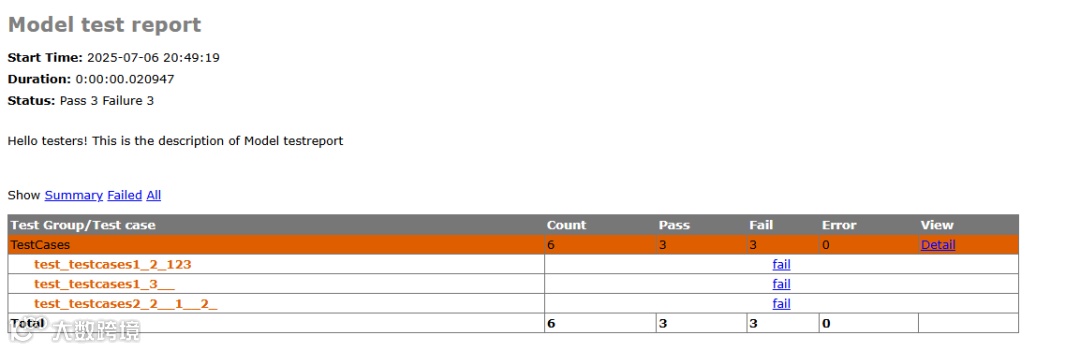
HTMLTestRunner 是 Python unittest 的扩展,用于生成美观的 HTML 测试报告。它将控制台输出的文本结果转换为可视化网页,用颜色区分通过/失败用例,展示执行时间、统计信息等,便于阅读和分享。兼容标准 unittest,只需替换 TextTestRunner 即可使用,适合需要简单直观展示测试结果的场景,提升团队协作效率。
python3的HTMLTestRunner.py
import datetimeimport ioimport sysimport timeimport unittestfrom xml.sax import saxutilsclass OutputRedirector(object):""" Wrapper to redirect stdout or stderr """def __init__(self, fp):self.fp = fpdef write(self, s):self.fp.write(s)def writelines(self, lines):self.fp.writelines(lines)def flush(self):self.fp.flush()stdout_redirector = OutputRedirector(sys.stdout)stderr_redirector = OutputRedirector(sys.stderr)__version__="0.8.2"# Templateclass Template_mixin(object):"""Define a HTML template for report customerization and generation.Overall structure of an HTML reportHTML+------------------------+|<html> || <head> || || STYLESHEET || +----------------+ || | | || +----------------+ || || </head> || || <body> || || HEADING || +----------------+ || | | || +----------------+ || || REPORT || +----------------+ || | | || +----------------+ || || ENDING || +----------------+ || | | || +----------------+ || || </body> ||</html> |+------------------------+"""STATUS = {0: 'pass',1: 'fail',2: 'error',}DEFAULT_TITLE = 'Unit Test Report'DEFAULT_DESCRIPTION = ''# ------------------------------------------------------------------------# HTML TemplateHTML_TMPL = r"""<?xml version="1.0" encoding="UTF-8"?><!DOCTYPE html PUBLIC "-//W3C//DTD XHTML 1.0 Strict//EN" "http://www.w3.org/TR/xhtml1/DTD/xhtml1-strict.dtd"><html xmlns="http://www.w3.org/1999/xhtml"><head><title>%(title)s</title><meta name="generator" content="%(generator)s"/><meta http-equiv="Content-Type" content="text/html; charset=UTF-8"/>%(stylesheet)s</head><body><script language="javascript" type="text/javascript"><!--output_list = Array();/* level - 0:Summary; 1:Failed; 2:All */function showCase(level) {trs = document.getElementsByTagName("tr");for (var i = 0; i < trs.length; i++) {tr = trs[i];id = tr.id;if (id.substr(0,2) == 'ft') {if (level < 1) {tr.className = 'hiddenRow';}else {tr.className = '';}}if (id.substr(0,2) == 'pt') {if (level > 1) {tr.className = '';}else {tr.className = 'hiddenRow';}}}}function showClassDetail(cid, count) {var id_list = Array(count);var toHide = 1;for (var i = 0; i < count; i++) {tid0 = 't' + cid.substr(1) + '.' + (i+1);tid = 'f' + tid0;tr = document.getElementById(tid);if (!tr) {tid = 'p' + tid0;tr = document.getElementById(tid);}id_list[i] = tid;if (tr.className) {toHide = 0;}}for (var i = 0; i < count; i++) {tid = id_list[i];if (toHide) {document.getElementById('div_'+tid).style.display = 'none'document.getElementById(tid).className = 'hiddenRow';}else {document.getElementById(tid).className = '';}}}function showTestDetail(div_id){var details_div = document.getElementById(div_id)var displayState = details_div.style.display// alert(displayState)if (displayState != 'block' ) {displayState = 'block'details_div.style.display = 'block'}else {details_div.style.display = 'none'}}function html_escape(s) {s = s.replace(/&/g,'&');s = s.replace(/</g,'<');s = s.replace(/>/g,'>');return s;}/* obsoleted by detail in <div>function showOutput(id, name) {var w = window.open("", //urlname,"resizable,scrollbars,status,width=800,height=450");d = w.document;d.write("<pre>");d.write(html_escape(output_list[id]));d.write("\n");d.write("<a href='javascript:window.close()'>close</a>\n");d.write("</pre>\n");d.close();}*/--></script>%(heading)s%(report)s%(ending)s</body></html>"""# variables: (title, generator, stylesheet, heading, report, ending)# ------------------------------------------------------------------------# Stylesheet## alternatively use a <link> for external style sheet, e.g.# <link rel="stylesheet" href="$url" type="text/css">STYLESHEET_TMPL = """<style type="text/css" media="screen">body { font-family: verdana, arial, helvetica, sans-serif; font-size: 80%; }table { font-size: 100%; }pre { }/* -- heading ---------------------------------------------------------------------- */h1 {font-size: 16pt;color: gray;}.heading {margin-top: 0ex;margin-bottom: 1ex;}.heading .attribute {margin-top: 1ex;margin-bottom: 0;}.heading .description {margin-top: 4ex;margin-bottom: 6ex;}/* -- css div popup ------------------------------------------------------------------------ */a.popup_link {}a.popup_link:hover {color: red;}.popup_window {display: none;position: relative;left: 0px;top: 0px;/*border: solid #627173 1px; */padding: 10px;background-color: #E6E6D6;font-family: "Lucida Console", "Courier New", Courier, monospace;text-align: left;font-size: 8pt;width: 500px;}}/* -- report ------------------------------------------------------------------------ */#show_detail_line {margin-top: 3ex;margin-bottom: 1ex;}#result_table {width: 80%;border-collapse: collapse;border: 1px solid #777;}#header_row {font-weight: bold;color: white;background-color: #777;}#result_table td {border: 1px solid #777;padding: 2px;}#total_row { font-weight: bold; }.passClass { background-color: #6c6; }.failClass { background-color: #c60; }.errorClass { background-color: #c00; }.passCase { color: #6c6; }.failCase { color: #c60; font-weight: bold; }.errorCase { color: #c00; font-weight: bold; }.hiddenRow { display: none; }.testcase { margin-left: 2em; }/* -- ending ---------------------------------------------------------------------- */#ending {}</style>"""# ------------------------------------------------------------------------# Heading#HEADING_TMPL = """<div class='heading'><h1>%(title)s</h1>%(parameters)s<p class='description'>%(description)s</p></div>""" # variables: (title, parameters, description)HEADING_ATTRIBUTE_TMPL = """<p class='attribute'><strong>%(name)s:</strong> %(value)s</p>""" # variables: (name, value)# ------------------------------------------------------------------------# Report#REPORT_TMPL = """<p id='show_detail_line'>Show<a href='javascript:showCase(0)'>Summary</a><a href='javascript:showCase(1)'>Failed</a><a href='javascript:showCase(2)'>All</a></p><table id='result_table'><colgroup><col align='left' /><col align='right' /><col align='right' /><col align='right' /><col align='right' /><col align='right' /></colgroup><tr id='header_row'><td>Test Group/Test case</td><td>Count</td><td>Pass</td><td>Fail</td><td>Error</td><td>View</td></tr>%(test_list)s<tr id='total_row'><td>Total</td><td>%(count)s</td><td>%(Pass)s</td><td>%(fail)s</td><td>%(error)s</td><td> </td></tr></table>""" # variables: (test_list, count, Pass, fail, error)REPORT_CLASS_TMPL = r"""<tr class='%(style)s'><td>%(desc)s</td><td>%(count)s</td><td>%(Pass)s</td><td>%(fail)s</td><td>%(error)s</td><td><a href="javascript:showClassDetail('%(cid)s',%(count)s)">Detail</a></td></tr>""" # variables: (style, desc, count, Pass, fail, error, cid)REPORT_TEST_WITH_OUTPUT_TMPL = r"""<tr id='%(tid)s' class='%(Class)s'><td class='%(style)s'><div class='testcase'>%(desc)s</div></td><td colspan='5' align='center'><!--css div popup start--><a class="popup_link" onfocus='this.blur();' href="javascript:showTestDetail('div_%(tid)s')" >%(status)s</a><div id='div_%(tid)s' class="popup_window"><div style='text-align: right; color:red;cursor:pointer'><a onfocus='this.blur();' onclick="document.getElementById('div_%(tid)s').style.display = 'none' " >[x]</a></div><pre>%(script)s</pre></div><!--css div popup end--></td></tr>""" # variables: (tid, Class, style, desc, status)REPORT_TEST_NO_OUTPUT_TMPL = r"""<tr id='%(tid)s' class='%(Class)s'><td class='%(style)s'><div class='testcase'>%(desc)s</div></td><td colspan='5' align='center'>%(status)s</td></tr>""" # variables: (tid, Class, style, desc, status)REPORT_TEST_OUTPUT_TMPL = r"""%(id)s: %(output)s""" # variables: (id, output)# ------------------------------------------------------------------------# ENDING#ENDING_TMPL = """<div id='ending'> </div>"""# -------------------- The end of the Template class -------------------TestResult = unittest.TestResultclass _TestResult(TestResult):# note: _TestResult is a pure representation of results.# It lacks the output and reporting ability compares to unittest._TextTestResult.def __init__(self, verbosity=1):TestResult.__init__(self)self.stdout0 = Noneself.stderr0 = Noneself.success_count = 0self.failure_count = 0self.error_count = 0self.verbosity = verbosity# result is a list of result in 4 tuple# (# result code (0: success; 1: fail; 2: error),# TestCase object,# Test output (byte string),# stack trace,# )self.result = []def startTest(self, test):TestResult.startTest(self, test)# just one buffer for both stdout and stderrself.outputBuffer = io.StringIO()stdout_redirector.fp = self.outputBufferstderr_redirector.fp = self.outputBufferself.stdout0 = sys.stdoutself.stderr0 = sys.stderrsys.stdout = stdout_redirectorsys.stderr = stderr_redirectordef complete_output(self):"""Disconnect output redirection and return buffer.Safe to call multiple times."""if self.stdout0:sys.stdout = self.stdout0sys.stderr = self.stderr0self.stdout0 = Noneself.stderr0 = Nonereturn self.outputBuffer.getvalue()def stopTest(self, test):# Usually one of addSuccess, addError or addFailure would have been called.# But there are some path in unittest that would bypass this.# We must disconnect stdout in stopTest(), which is guaranteed to be called.self.complete_output()def addSuccess(self, test):self.success_count += 1TestResult.addSuccess(self, test)output = self.complete_output()self.result.append((0, test, output, ''))if self.verbosity > 1:sys.stderr.write('ok ')sys.stderr.write(str(test))sys.stderr.write('\n')else:sys.stderr.write('.')def addError(self, test, err):self.error_count += 1TestResult.addError(self, test, err)_, _exc_str = self.errors[-1]output = self.complete_output()self.result.append((2, test, output, _exc_str))if self.verbosity > 1:sys.stderr.write('E ')sys.stderr.write(str(test))sys.stderr.write('\n')else:sys.stderr.write('E')def addFailure(self, test, err):self.failure_count += 1TestResult.addFailure(self, test, err)_, _exc_str = self.failures[-1]output = self.complete_output()self.result.append((1, test, output, _exc_str))if self.verbosity > 1:sys.stderr.write('F ')sys.stderr.write(str(test))sys.stderr.write('\n')else:sys.stderr.write('F')class HTMLTestRunner(Template_mixin):""""""def __init__(self, stream=sys.stdout, verbosity=1, title=None, description=None):self.stream = streamself.verbosity = verbosityif title is None:self.title = self.DEFAULT_TITLEelse:self.title = titleif description is None:self.description = self.DEFAULT_DESCRIPTIONelse:self.description = descriptionself.startTime = datetime.datetime.now()def run(self, test):"Run the given test case or test suite."result = _TestResult(self.verbosity)test(result)self.stopTime = datetime.datetime.now()self.generateReport(test, result)print(sys.stderr, '\nTime Elapsed: %s' % (self.stopTime-self.startTime))# print >>sys.stderr, '\nTime Elapsed: %s' % (self.stopTime-self.startTime)return resultdef sortResult(self, result_list):# unittest does not seems to run in any particular order.# Here at least we want to group them together by class.rmap = {}classes = []for n,t,o,e in result_list:cls = t.__class__if not cls in rmap:rmap[cls] = []classes.append(cls)rmap[cls].append((n,t,o,e))r = [(cls, rmap[cls]) for cls in classes]return rdef getReportAttributes(self, result):"""Return report attributes as a list of (name, value).Override this to add custom attributes."""startTime = str(self.startTime)[:19]duration = str(self.stopTime - self.startTime)status = []if result.success_count: status.append('Pass %s' % result.success_count)if result.failure_count: status.append('Failure %s' % result.failure_count)if result.error_count: status.append('Error %s' % result.error_count )if status:status = ' '.join(status)else:status = 'none'return [('Start Time', startTime),('Duration', duration),('Status', status),]def generateReport(self, test, result):report_attrs = self.getReportAttributes(result)generator = 'HTMLTestRunner %s' % __version__stylesheet = self._generate_stylesheet()heading = self._generate_heading(report_attrs)report = self._generate_report(result)ending = self._generate_ending()output = self.HTML_TMPL % dict(title = saxutils.escape(self.title),generator = generator,stylesheet = stylesheet,heading = heading,report = report,ending = ending,)self.stream.write(output.encode('utf8'))def _generate_stylesheet(self):return self.STYLESHEET_TMPLdef _generate_heading(self, report_attrs):a_lines = []for name, value in report_attrs:line = self.HEADING_ATTRIBUTE_TMPL % dict(name = saxutils.escape(name),value = saxutils.escape(value),)a_lines.append(line)heading = self.HEADING_TMPL % dict(title = saxutils.escape(self.title),parameters = ''.join(a_lines),description = saxutils.escape(self.description),)return headingdef _generate_report(self, result):rows = []sortedResult = self.sortResult(result.result)for cid, (cls, cls_results) in enumerate(sortedResult):# subtotal for a classnp = nf = ne = 0for n,t,o,e in cls_results:if n == 0: np += 1elif n == 1: nf += 1else: ne += 1# format class descriptionif cls.__module__ == "__main__":name = cls.__name__else:name = "%s.%s" % (cls.__module__, cls.__name__)doc = cls.__doc__ and cls.__doc__.split("\n")[0] or ""desc = doc and '%s: %s' % (name, doc) or namerow = self.REPORT_CLASS_TMPL % dict(style = ne > 0 and 'errorClass' or nf > 0 and 'failClass' or 'passClass',desc = desc,count = np+nf+ne,Pass = np,fail = nf,error = ne,cid = 'c%s' % (cid+1),)rows.append(row)for tid, (n,t,o,e) in enumerate(cls_results):self._generate_report_test(rows, cid, tid, n, t, o, e)report = self.REPORT_TMPL % dict(test_list = ''.join(rows),count = str(result.success_count+result.failure_count+result.error_count),Pass = str(result.success_count),fail = str(result.failure_count),error = str(result.error_count),)return reportdef _generate_report_test(self, rows, cid, tid, n, t, o, e):# e.g. 'pt1.1', 'ft1.1', etchas_output = bool(o or e)tid = (n == 0 and 'p' or 'f') + 't%s.%s' % (cid+1,tid+1)name = t.id().split('.')[-1]doc = t.shortDescription() or ""desc = doc and ('%s: %s' % (name, doc)) or nametmpl = has_output and self.REPORT_TEST_WITH_OUTPUT_TMPL or self.REPORT_TEST_NO_OUTPUT_TMPL# o and e should be byte string because they are collected from stdout and stderr?if isinstance(o,str):# TODO: some problem with 'string_escape': it escape \n and mess up formating# uo = unicode(o.encode('string_escape'))uo = e# uo = o.decode('latin-1')else:uo = oif isinstance(e,str):# TODO: some problem with 'string_escape': it escape \n and mess up formating# ue = unicode(e.encode('string_escape'))ue = e # ue = e.decode('latin-1')else:ue = escript = self.REPORT_TEST_OUTPUT_TMPL % dict(id = tid,output = saxutils.escape(uo+ue),)row = tmpl % dict(tid = tid,Class = (n == 0 and 'hiddenRow' or 'none'),style = n == 2 and 'errorCase' or (n == 1 and 'failCase' or 'none'),desc = desc,script = script,status = self.STATUS[n],)rows.append(row)if not has_output:returndef _generate_ending(self):return self.ENDING_TMPL############################################################################### Facilities for running tests from the command line############################################################################### Note: Reuse unittest.TestProgram to launch test. In the future we may# build our own launcher to support more specific command line# parameters like test title, CSS, etc.class TestProgram(unittest.TestProgram):"""A variation of the unittest.TestProgram. Please refer to the baseclass for command line parameters."""def runTests(self):# Pick HTMLTestRunner as the default test runner.# base class's testRunner parameter is not useful because it means# we have to instantiate HTMLTestRunner before we know self.verbosity.if self.testRunner is None:self.testRunner = HTMLTestRunner(verbosity=self.verbosity)unittest.TestProgram.runTests(self)main = TestProgram############################################################################### Executing this module from the command line##############################################################################if __name__ == "__main__":main(module=None)
HTMLTestRunner生成测试报告
目录结构
../HTMLTestRunner.py
../test.py
-
实例
test.py文件
import unittestfrom ddt import ddt, data, unpackimport HTMLTestRunnerimport timeimport os# 代表这个测试类使用了数据驱动ddtclass TestCases(unittest.TestCase):def setUp(self):print("*******************************")print("每一条case执行之前都会执行这个方法")def tearDown(self):print("每一条case执行之后都会执行这个方法\n")@data("hello", "123", " ") # 代表传入的参数,一共三个参数,每次执行传一个值给value。def test_testcases1(self, value):print("这是一条测试用例case")try:self.assertTrue(value.isalpha())print("test pass")except Exception as e:print("出错啦,错误结果是%s" % e)print("test failed")raise e@data((1, 1), (1, 2), (1, 1.0)) # 代表传入的参数,一共三个参数,每次传入两个值,下面两个value分别来接收两个值。@unpack # 告诉我们的测试用例传入的是两个以上的值def test_testcases2(self, value1, value2):print("这是一条测试用例case")try:self.assertEqual(value1, value2)print("test pass")except Exception as e:print("出错啦,错误结果是%s" % e)print("test failed")raise eif __name__ == "__main__":# unittest.main(verbosity=2)#构造测试集suite = unittest.TestSuite()#按测试类添加loader = unittest.TestLoader()suite.addTest(loader.loadTestsFromTestCase(TestCases))report_dir = "../java/"BASE_DIR = os.path.dirname(os.path.abspath(__file__))print(BASE_DIR)now = time.strftime("%Y-%m-%d %H-%M-%S")# print(now)reportname = BASE_DIR + "/" + now + " Test report.html"# print(reportname)with open(reportname, "wb+") as file:runner = HTMLTestRunner.HTMLTestRunner(file, 2, title="Model test report",description="Hello testers! This is the description of Model test""report")runner.run(suite)
生成html文件