



点击上方北京互联网法院获取更多精彩内容~
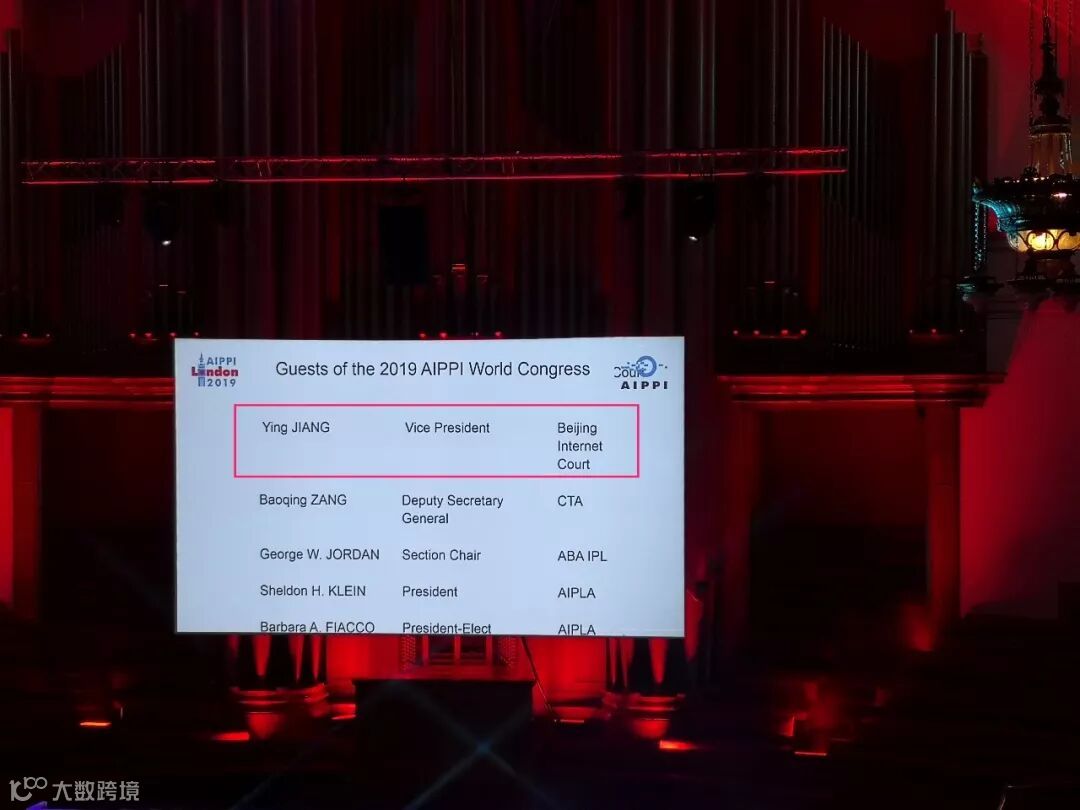
9月15日-18日,2019年AIPPI世界知识产权大会在伦敦召开。北京互联网法院党组成员、副院长姜颖受邀参加,并用英文就北京互联网法院著作权司法保护实践情况作主题发言。
本次大会参会人员达2000多人。来自世界贸易组织、欧洲专利局、美国专利和商标局等组织和机构的代表,各国法官、律师以及企业代表参加本次大会。大会为期4天,议程包括专业委员会会议、执委会会议、专题会议、女性论坛等,专题讨论议题涵盖人工智能作品的版权、非销售行为的知识产权侵权损害赔偿要求以及药品专利保护等前沿问题。

当地时间18日上午,在“热议话题”分会场上,姜颖副院长以北京互联网法院著作权保护的司法实践为主题,从在线诉讼模式构建、天平链建设及应用、互联网审判规则树立三个方面分享了北京互联网法院成立一周年来在探索互联网新型审理机制与知识产权网络空间治理上的经验与成果。
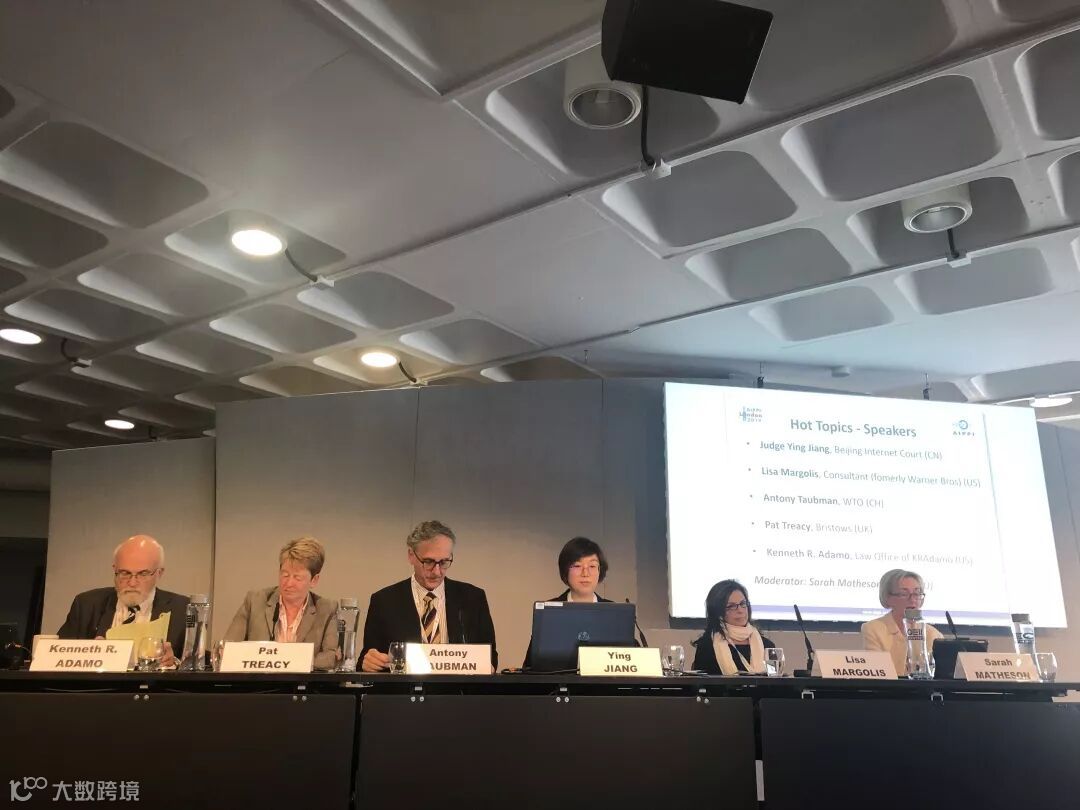
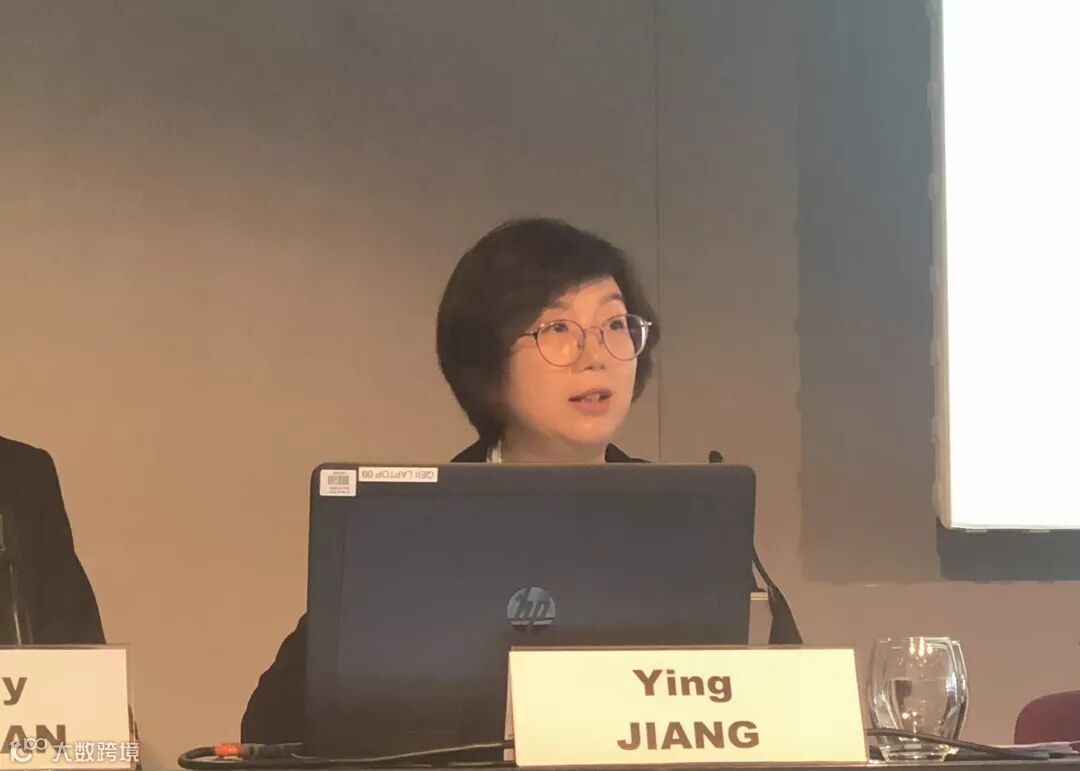
她表示,北京互联网法院以科技与司法的深度融合为牵引,在“互联网+审判”不断推陈出新,回应了信息化时代下的法治所需与民心所向,希望北京互联网法院的有益经验能够分享给世界各国,在全球范围内共同营造鼓励创新、尊重知识价值的法治化营商环境。姜颖副院长全程用英语发言,并与在场听众积极互动交流,赢得了参会人员的一致好评。

知多一点

成立于1897年的AIPPI(国际保护知识产权协会)是世界领先的国际组织,致力于在国际和国家层面推动知识产权保护水平的不断提升。AIPPI总部设在瑞士,现有6大洲100多个国家和地区的9000多名会员,每年举办一次的世界知识产权大会已成为参会人数最多、参会国家和地区范围最广、最有影响力的知识产权领域国际盛会之一。
姜颖副院长英文发言稿全文附

Judicial Practice of Copyright Protection
in Beijing Internet Court
Ladies and gentlemen:
Good morning!
Thanks to AIPPI for inviting me to attend this conference. It’s my great honor to take this opportunity to introduce you how Beijing Internet Court has strengthened copyright protection in the internet environment.
First of all, please allow me to introduce some basic information about my court. Beijing Internet Court was officially established on September 9th, 2018. Now it has 35 specialized judges and 148 staff. Beijing Internet Court governs 11 types of internet-related cases within the jurisdiction of Beijing.
In the past year, Beijing Internet Court had accepted 34,263 cases, among which copyright cases accounted for about 78%.
The typical feature of Beijing Internet Court is “online case heard online”. On one hand, we have made immense efforts to apply new technologies to make online trials more convenient and intelligent; on the other hand, we have established rules through our adjudications in order to build a healthy and orderly cyberspace.
I guess you may have some questions like what benefits the parties can enjoy in an internet trial comparing with the traditional trial, how we deal with the security issues, and what challenges we have had. I am now going to answer those questions from three aspects.
Firstly, Beijing Internet Court has established the internet trial model to provide parties with convenient, cost-effective, efficient and environment-friendly judicial services.
We have built an online litigation platform applying technologies of the internet, Big Data, artificial intelligence and blockchain, and have developed an online trial model that covers the entire process of case filing, document delivery, evidence submission, hearing, appeal and execution. This model has brought the following benefits to the parties:
І. It has made litigation much more convenient. Our online litigation platform provides online trials and court hearing, and ensures all nodes throughout the litigation process are available online 24 hours a day. The parties are no longer restricted by the working hours of the court when they file a new case, submit evidence and other materials. They can participate in the proceedings without leaving their offices or home. According to our statistics, 28% of the cases we received in the past year had been submitted during off-duty hours, and 99% of the cases were heard online. This has provided immense convenience to the parties.
II. It has reduced the cost significantly. In addition to saving time and cost for the parties, the whole online process can also reduce expenses in terms of lawyers’ fees. Our online litigation platform includes an automatic complaint-generation system and a litigation risk assessment system, which are intelligent assistant tools for copyright owners lack of relevant legal expertise. Without the help of a lawyer, the copyright owner can file a complaint simply by answering a few questions and entering certain information based on their actual situation. The parties can also learn about the litigation risks through the assessment system. All of these mechanisms can provide significant savings on the legal cost of both parties.
III. It has improved work efficiency. The online trial model has also greatly improved the efficiency of litigations. The average hearing time of Beijing Internet Court is 37 minutes, and the average duration of trials is 40 days. We also use an intelligent judgment-generation system to generate judgments for certain type of simple cases, therefore significantly improving the efficiency of decision making.
ІV. It is very environment-friendly. Online litigation model not only brings a lot of convenience to the parties, but also helps protect the environment. We call it “a green litigation model”. It saves millions of pieces of paper, alleviates traffic pressure, and reduces carbon emissions. We believe that the online litigation model should be the future trend of judicial development.
Secondly, we have adopted blockchain technology in our online systems to address the problems regarding evidence in copyright cases.
To address the problem that electronic evidence in copyright cases can be easily deleted and tampered, and the difficulty in preserving, collecting and verifying evidence, we have initiated a judicial blockchain system named “Tian Ping Chain”.
First, “Tian Ping Chain” can ensure that all materials submitted by the litigants to the platform cannot be tampered. Second, the evidence that the parties have uploaded onto the litigation platform are automatically verified. After a party uploads the evidence on the “Tian Ping Chain”, the party will receive the file number and a bc document of the stored evidence. When filing a lawsuit, the party can submit the original electronic data and the file number of the evidence, then "Tian Ping Chain" will verify whether the electronic evidence submitted by the party and the bc document stored on the "Tian Ping Chain" are consistent, and send the result to the judge. This process breaks the temporal and spatial constraints on electronic preservation of evidence and greatly reduces the cost. Moreover, it reduces disputes by sending the verification result directly to the judge, greatly improving the reliability of electronic evidence.
So far we have had over 200 cases that involved the verification of 1,579 pieces of cross-chain stored evidence. No party has raised any questions to the authenticity of the blockchain evidence.
Thirdly, we have been actively exploring the rules of internet trial and strengthening the judicial role in guiding and ensuring the development of emerging areas and models of the internet.
We uphold the principle of balance of interests and encourage the creation of high-quality original content. On one hand, we have included new types of communication content reflecting originality on the internet with respect to copyright protection. The cases handled in our Court involve issues such as whether a 13-second-long video constitutes cinematographic work, and whether emojis and web designs constitute works of fine art. To convey the idea of encouraging the production and communication of innovative works, we believe that an object involved shall constitute a work if it can reflect the creator's individual expression. On the other hand, we resolutely deny the infringement of copyright in the name of fair use in the internet environment. In the copyright case involving the "Graph Movie", we considered that the defendant capturing screenshots of TV dramas, which basically covered the main images and the entire plot, was not for the purpose of introducing the drama or commenting on it, but rather to fulfill the need of users to learn the plot and see the main images in a short time. This behavior substantially replaced the TV drama involved. Therefore, it was not a fair use and constituted infringement of copyright.
We encourage the application of new technologies and actively explore the rules on protecting new objects brought about by new technologies. In a copyright case, we made the judicial response to the question whether the content generated by a computer software constitutes a work and how to protect it. The judge pointed that the content was not created by a natural person and cannot be protected as a work according to the current Copyright Law. However, software users shall be granted corresponding rights and interests due to their contribution to the generation of content by paying for using the software and putting forward relevant requirements. This is only an assumption put forward by the judge, and how to implement it needs further design.
As for the legal liability of internet service providers, we believe that in some cases, ISP cannot enter the safe harbor. In the copyright case involving the "Douyu Live Streaming Platform", the network anchor played other people's music works without authorization. The presiding judge found there is an agreement between the anchor and the live streaming platform that the ownership of the IP rights, and related interests regarding the anchor's live streaming results belong to the platform company, then the judge said that the live streaming platform should perform its duties as per the rights it enjoys, hence, it shall bear the liability for copyright infringement.
Although it has only been a year since its establishment, Beijing Internet Court has made some valuable explorations in both the internet judicial trial model and the protection of copyrights. In May this year, we had the privilege of meeting President Renata Righetti and her delegation, at Beijing Internet Court. I was highly impressed by Mr. Jonathan Osha’s talk on whether AI-generated content constitutes copyright, one of the topics that AIPPI has spent a lot of time on this year. This topic coincides with the case I just mentioned. We hope that we can share our experience with all countries in the world. As stated in the aims and purpose of AIPPI, we will work hard to improve and promote the protection of IP rights on both international and national levels, and build a legal business environment on a global scale, where innovation is encouraged and protected.
Thank you.
供稿:张乃毓
编辑:张瑞雪

微信订阅号

微信服务号
长按识别二维码关注北京互联网法院