
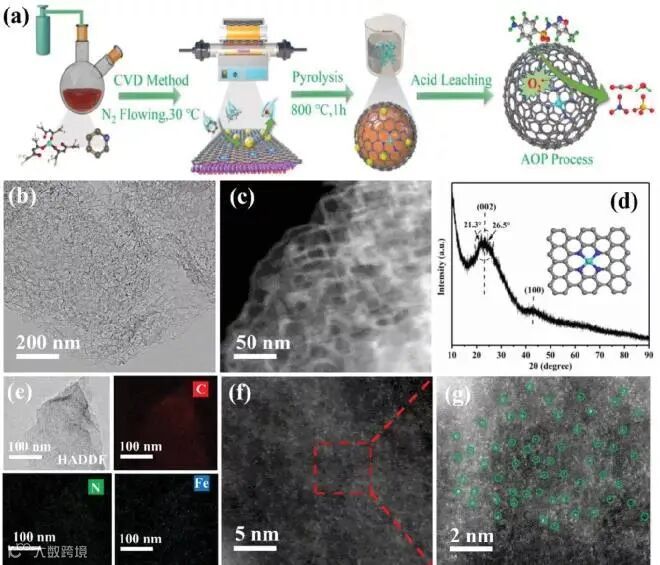
Fig. 1. The synthesis process and morphology characterization. Schematic for the synthesis of Fe-N4-PC-2 materials (a), HRTEM image (b), HAADF-STEM image (c), XRD pattern (d), EDS mapping images (e), Aberration-corrected HAADF-STEM image (f), and enlarged image of single Fe atom in green circles (g). Copyright 2021, Wiley Inc.
材料合成中,我们首先将乙酰丙酮铁分散于吡啶溶液中,通过化学气相沉积的方法,将混合液体通过载气带入管式炉中,在氢氧化镁表面进行沉积,再通过酸洗的方法去除金属颗粒,最终获得单原子分散的铁催化剂。根据XRD,TEM和球差电镜的测试我们确定铁是以单原子形式存在。
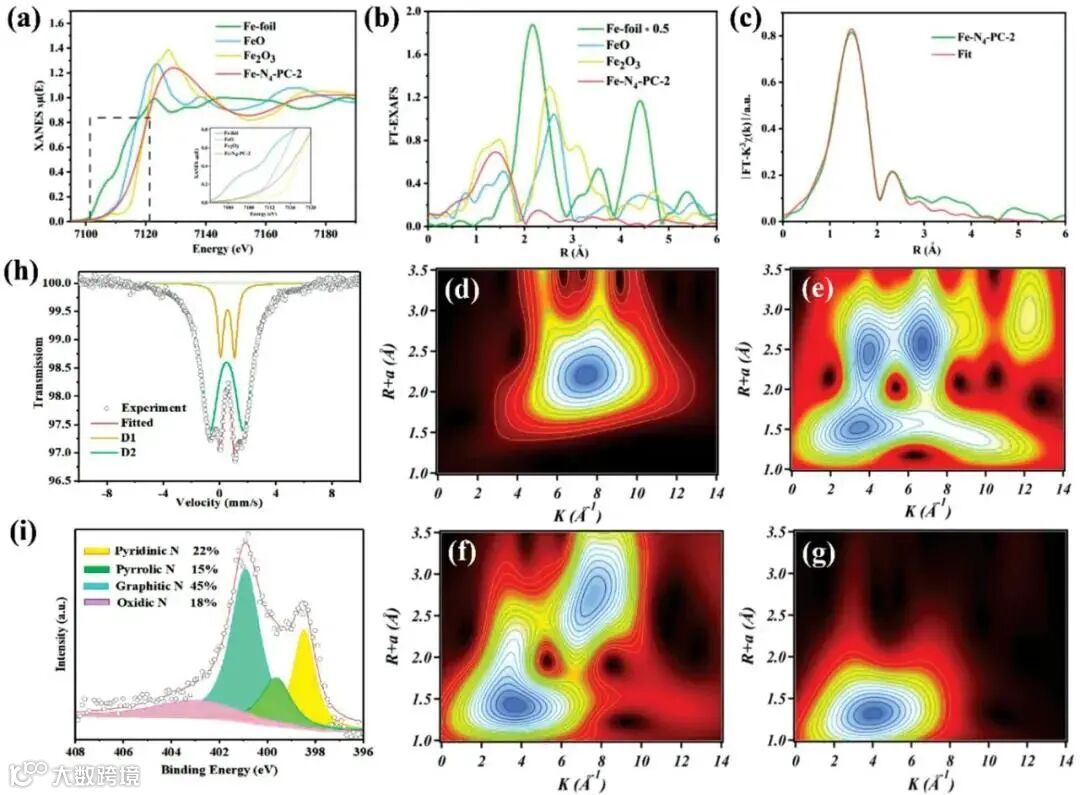
Fig. 2. Chemical environment of Fe-N4-PC-2 catalyst. (a) Fe K-edge XANES spectra of Fe foil, FeO, Fe2O3 and Fe-N4-PC-2 (inset was the magnified image), (b) The Fourier transformed (FT) k3-weighted EXAFS, (c) EXAFS fitting curves of Fe-N4-PC-2 at R space, (d-g) WT of the Fe K-edge (d-Fe, e-FeO, f-Fe2O3, g- Fe-N4-PC-2), (h) The 57Fe Mössbauer spectrum measured at 25 oC, (i) N 1s XPS spectra. Copyright 2021,Wiley Inc.
为了进一步确定Fe的单原子存在形式和配位环境,我们进行了根据同步辐射(XANES)测试和穆斯堡的测试。根据结果可知,单个Fe原子与四个N原子进行原位配位,另外根据XPS的结果也对N的存在类型进行了确定。
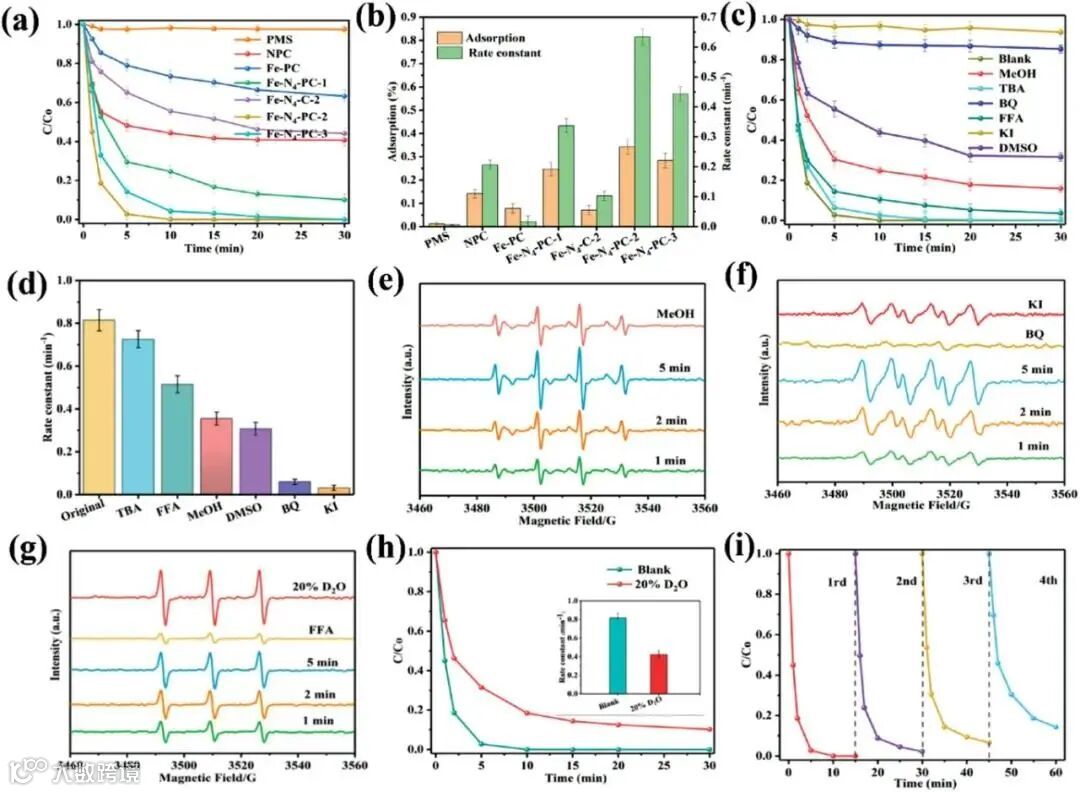
Fig. 3. Catalytic degradation test and mechanism analysis. (a) The removal of SMX in different reaction systems, (b) The relationship between adsorption ability and the reaction rate constants on different catalysts, (c) Inhibition effect of different quenchers on SMX degradation, (d) Comparison of reaction rate under different quenching conditions, (e) EPR spectrum of DMPO-•OH and DMPO-SO4•− radicals, (f) EPR spectrum of DMPO-O2•− radical, (g) EPR spectrum of TMPO-1O2 radical, (h) The effect of reaction solvents upon degradation (inset was the reaction rate constants), (i) Catalyst recyclability tests. Copyright 2021, Wiley Inc.
所制备的Fe-N-PC材料对抗生素类污染物展现了优异的吸附和降解性能,根据猝灭自由基实验和EPR可知,基于表面降解的自由基过程在单原子降解体系中起着主导作用。
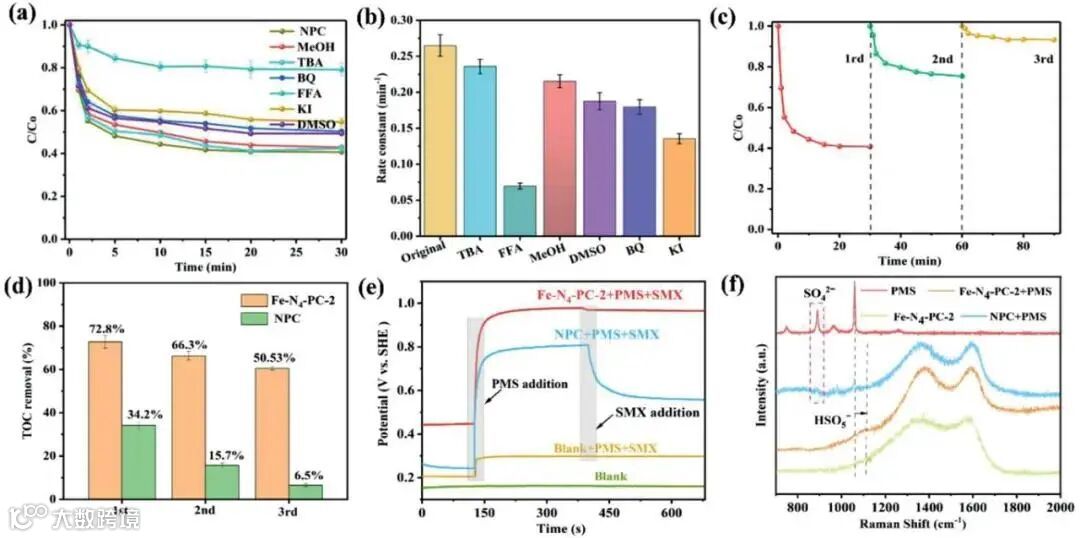
Fig. 4. The PMS activation route transition from non-radical to free radicalprocess with single Fe atoms introduced in the Fe-N4-PC-2/PMS system. (a) The influence of different quenchers on SMX degradationin NPC/PMS system, (b) Comparison of reaction rate under different quenching conditions, (c) Catalyst recyclability tests in NPC/PMS system, (d) TOC removal, (e) Open-circuit potential curves, and (f) In-situ Raman spectra. Copyright 2021, Wiley Inc.
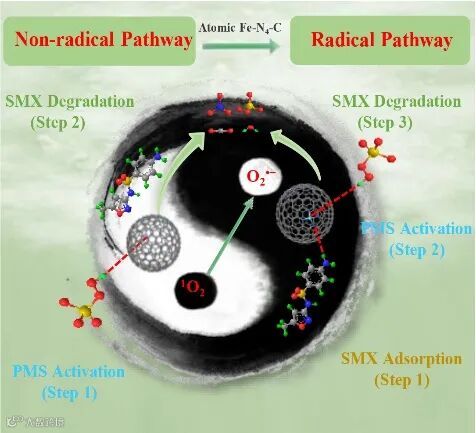
根据对比催化剂的稳定性可知,Fe单原子的引入大大提高了催化剂的稳定性,将使得催化剂重要的的活性位点从石墨N转移到了Fe-N4结构,并且将PMS活化途径从非自由基过程转变为自由基过程主导。另外,关于非自由基过程,通过开路电位和原位拉曼进行了进一步的证明。
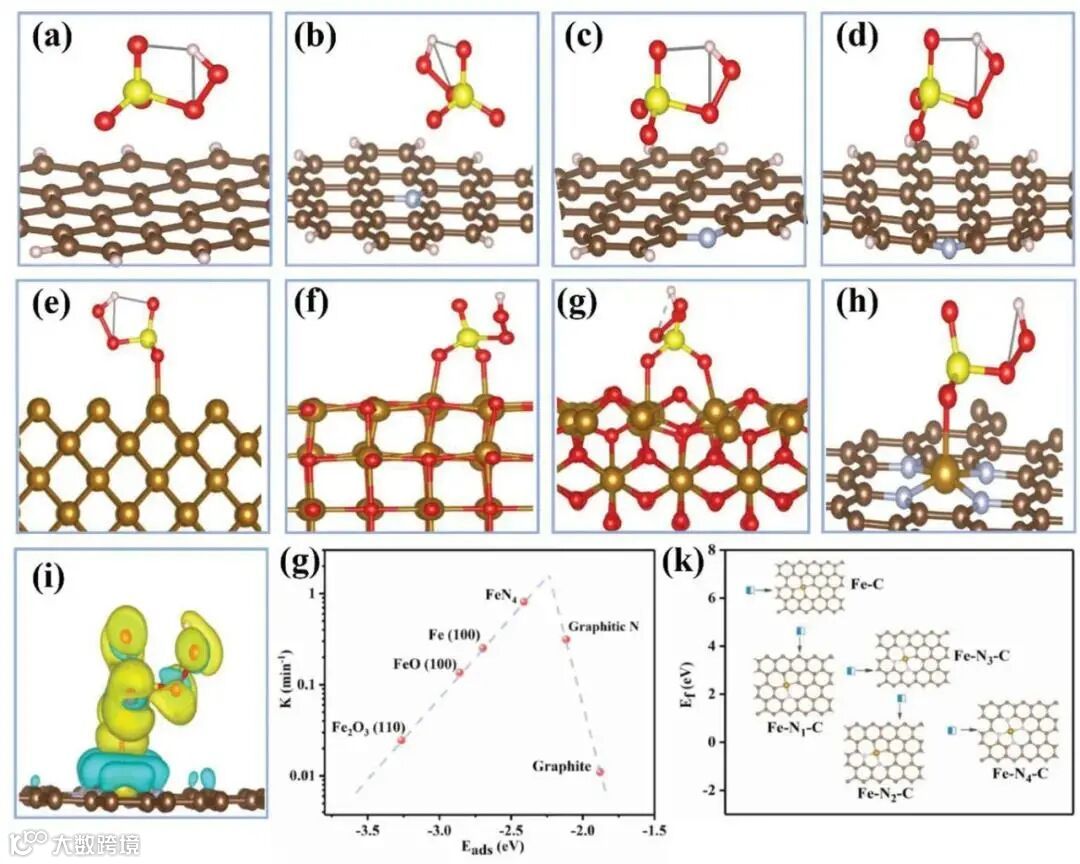
Fig. 5. The activation mechanism of PMS on single-atom Fe-N4-PC-2 catalyst. Optimized configurations of PMS adsorbed on (a) Graphite, (b) Graphitic N, (c) Pyridinic N, (d) Pyrrolic N, (e) Fe (100), (f) FeO (100), (g) Fe2O3 (110) and (h) Fe-N4 -graphene structure, respectively. (i) Charge density distribution of Fe-N4-PC-2/PMS system. (g) Volcano curve. (k) The formation energies of different single-atom Fe coordination models. Copyright 2021, Wiley Inc.
根据DFT理论计算我们全面且系统分析了碳,不同类型氮(石墨N,吡啶N,吡咯氮),不同类型铁(Fe,FeO,Fe2O3),不同类型单原子Fe配位环境(Fe-N1,Fe-N2, Fe-N3,Fe-N4)对PMS的激活效果,我们发现Fe-N4结构对PMS中O-O键的拉长有最显著的作用,这一理论计算结果与实验结果和原位拉曼的结果均保持一致。
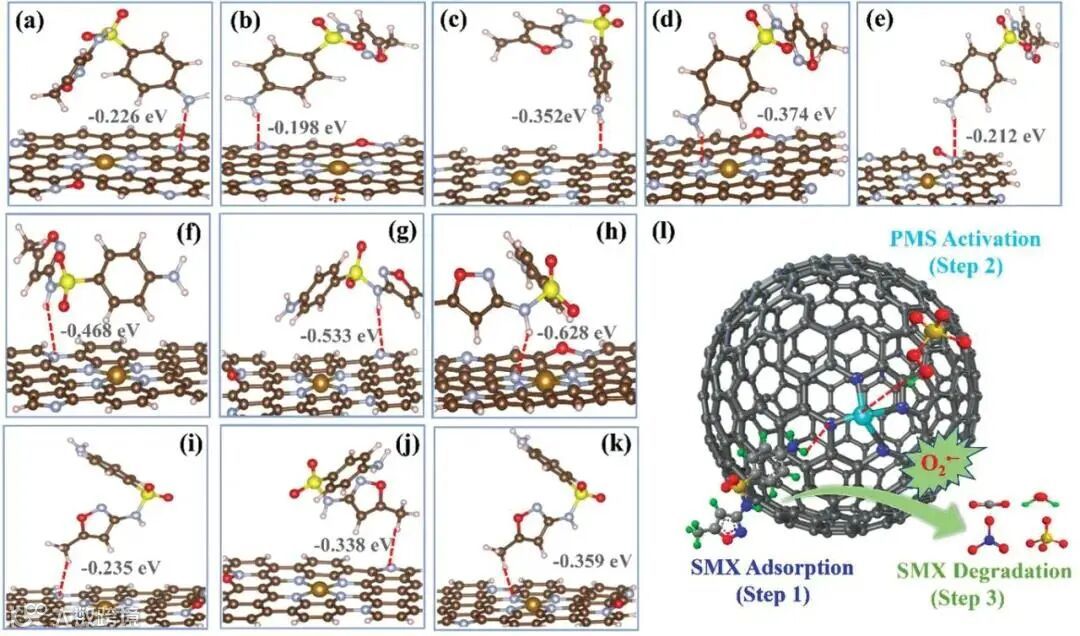
Fig. 6. SMX adsorption and degradation process on single-atom Fe-N4-PC-2 catalyst. Adsorption simulation of amino (-NH2) on (a) Graphitic N, (b) Pyridinic N, (c) Pyrrolic N, (d) Fe-N4-graphene and (e) Oxide N structure. Local adsorption configurations of imino (-NH-) on (f) Graphitic N, (g) Pyrrolic N and (h) Fe-N4-C structure. Local adsorption configurations of methyl (-CH3) on (i) Graphitic N, (j) Pyrrolic N and (k) Fe-N4-C structure. (l) The proposed overall degradation mechanism. Copyright 2021, Wiley Inc.
在实验阶段,我们发现Fe-N4-PC单原子催化材料对SMX污染物具有非常优异的吸附性能,结合SMX的结构,我们对污染物中可能具有吸附较大贡献的-NH2-,-NH-和-CH3进行了吸附性计算。令人惊讶的是,相比于不同类型的N,Fe-N4结构中的N都具有很好的吸附能力。通过这一计算,我们进一步的揭示了Fe-N4-C具有促进抗生素吸附和PMS活化的双重作用。


声明
本文仅供科研分享,不做盈利使用,如有侵权,请联系后台小编删除

“邃瞳科学云”直播服务

“邃瞳科学云"平台正在收集、整理各类学术会议信息,欢迎学会、期刊、会议组织方择优在邃瞳平台上进行线上直播,希望藉此帮助广大科研人员跨越时空的限制,实现自由、畅通地交流互动。欢迎老师同学们提供会议信息(会有礼品赠送),学会、期刊、会议组织方商谈合作,均请联系翟女士:18612651915(微信同)。

扫描二维码下载
邃瞳科学云APP