
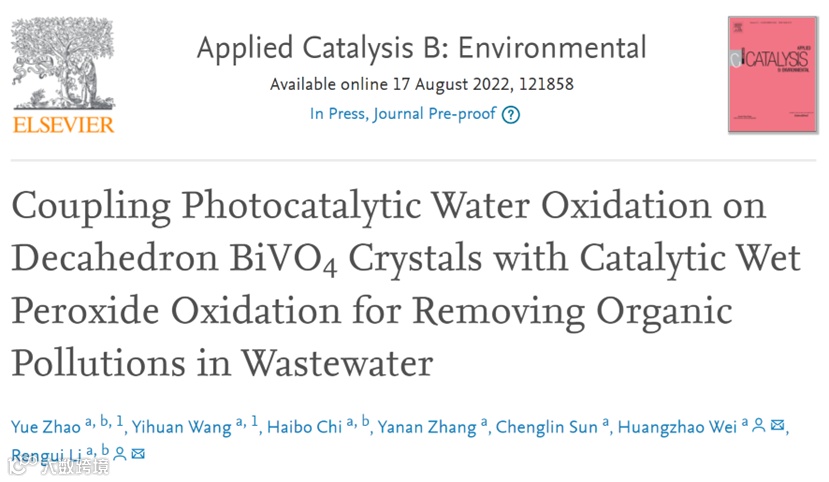
第一作者:赵越、王一睆(中国科学院大连化学物理研究所)
通讯作者:李仁贵研究员、卫皇曌研究员(中国科学院大连化学物理研究所)
论文DOI: 10.1016/j.apcatb.2022.121858

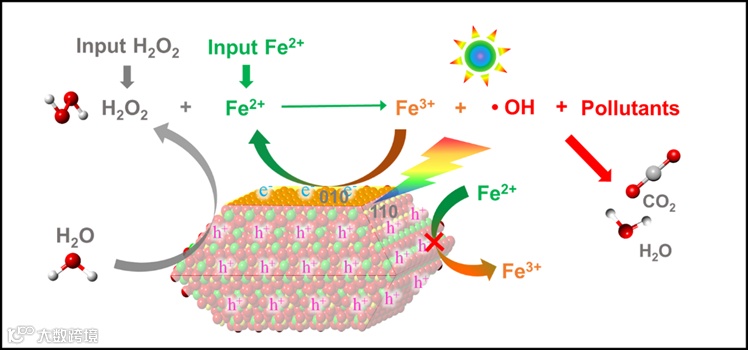


随着有机化学品的空前发展和生产,越来越多的有机化合物未经处理就排入水中,对环境造成极大污染。CWPO技术是一种有效的有机废水处理技术,但是由于Fe3+到Fe2+循环困难,需要消耗H2O2,同时排放大量的铁泥污染物,限制了其大规模的应用。利用十面体BiVO4的晶面间光生电荷分离特性,可实现Fe3+到Fe2+的不可逆转化,将其与CWPO技术耦合后,可实现Fe3+到Fe2+的循环利用,提升降解效率的同时减少Fe2+和H2O2的使用量,减少铁泥排放。此外,BiVO4表面两电子水氧化过程原位生成的H2O2可在Fe2+存在下通过Fenton过程产生·OH,用于有机物降解过程,进一步降低CWPO技术中H2O2的消耗量。该策略在十余种有机污染物分子降解中表现出良好的普适性和稳定性,为有机废水深度矿化处理提供了一条新的高效低成本的耦合路线。

传统CWPO高级氧化技术处理有机污染物具有Fe3+/Fe2+循环困难、H2O2消耗量大及成本过高等劣势,限制了其进一步大规模应用。光催化过程可以有效实现Fe3+的还原过程,可以将其与CWPO技术进行耦合,但是所生成Fe2+会被光催化剂表面光生空穴氧化,因此,抑制Fe2+到Fe3+的逆反应成为该耦合体系的难题。本工作以十面体BiVO4为光催化剂进行耦合研究,探索了其晶面间光生电荷分离特性在Fe2+到Fe3+逆反应抑制作用及对耦合体系降解过程的影响。

光催化水氧化和CWPO耦合体系
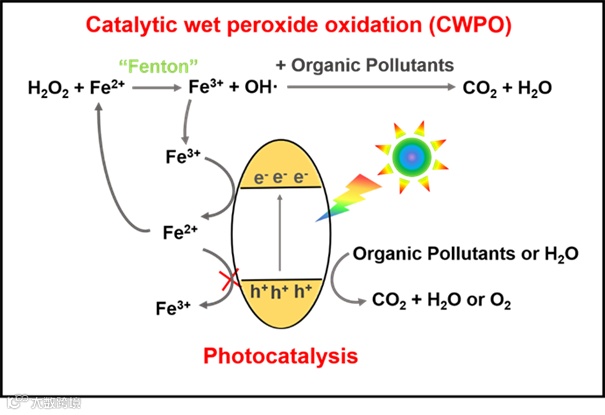
Sch. 1. Coupling scheme of photocatalytic water oxidation and CWPO.
该研究工作提出了光催化水氧化和CWPO耦合技术,用于有机废水处理。该体系中,首先H2O2和Fe2+经由Fenton过程生成·OH用于有机污染物降解,同时生成Fe3+。而后Fe3+在被光生电子不可逆还原成Fe2+,同时光生空穴发生水氧化反应或者有机污染物降解过程。
BiVO4光催化剂结构、性能表征
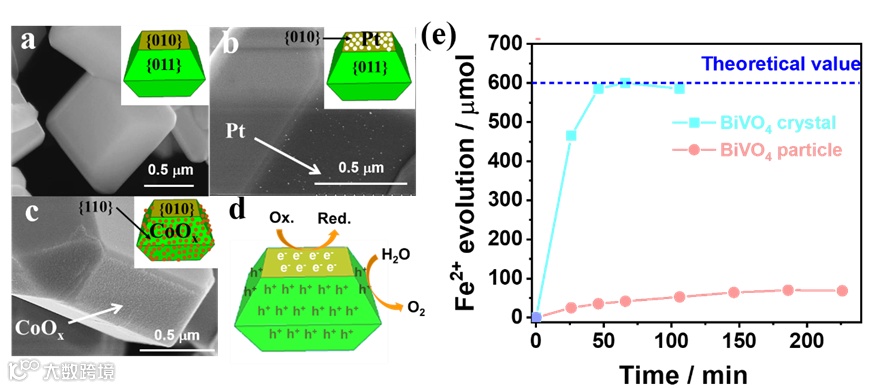
Fig. 1. (a) SEM images of decahedron BiVO4 crystal. (b) SEM image of BiVO4 after photo-reduction deposition of Pt nanoparticles. (c) SEM image of BiVO4after photo-oxidation deposition of CoOx. (d) Diagram for reduction and oxidation reaction sites on decahedron BiVO4 crystals. (e) Time courses of photocatalytic Fe3+ to Fe2+ conversion over decahedron BiVO4 crystals and irregular BiVO4nanoparticles.
BiVO4光催化剂为暴露{010}和{110}晶面的十面体形貌的单斜相结构。原位光沉积结果表明光生电子选择性传输至BiVO4单晶的{010}晶面,光生空穴则选择性传输至BiVO4单晶的{110}晶面。Fe3+存在下光催化水氧化测试显示Fe3+可以被完全转化为Fe2+,说明十面体BiVO4光催化剂{110}晶面上几乎不会发生Fe2+到Fe3+的氧化逆反应过程。
耦合体系有机污染物降解性能
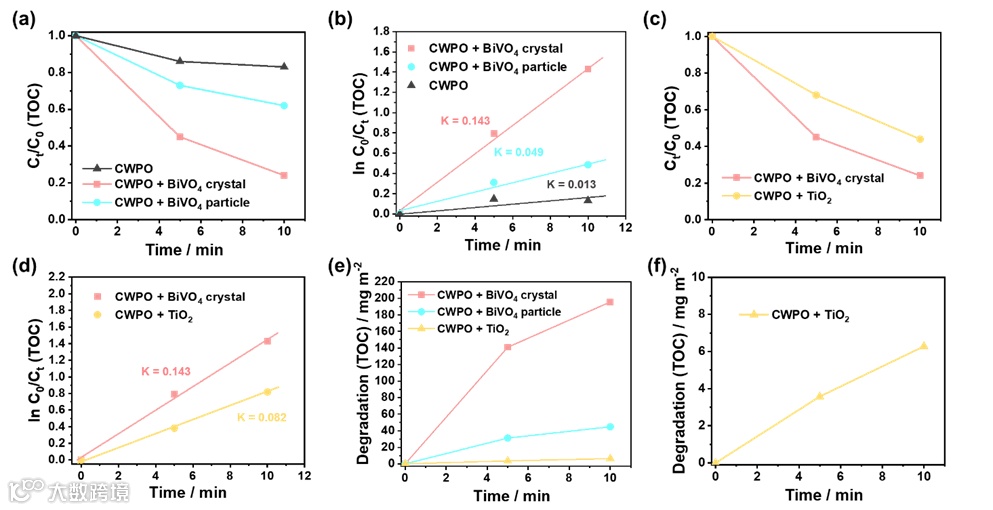
Fig. 2. Degradation performance in the coupling system. (a) TOC removal of m-cresol degradation on the decahedron BiVO4 crystals and BiVO4 nanoparticles. (b) Corresponding rate constants of m-cresol degradation under different conditions from (a). (c) TOC removal of m-cresol degradation on the decahedron BiVO4 crystals and TiO2 coupled CWPO processes. (d) Corresponding rate constants of m-cresol degradation under different conditions from (c). (e-f) Time courses of m-cresol degradation on the decahedron BiVO4crystals, BiVO4 nanoparticles, and TiO2 coupled CWPO process after surface area normalization.
耦合体系普适性和稳定性测试
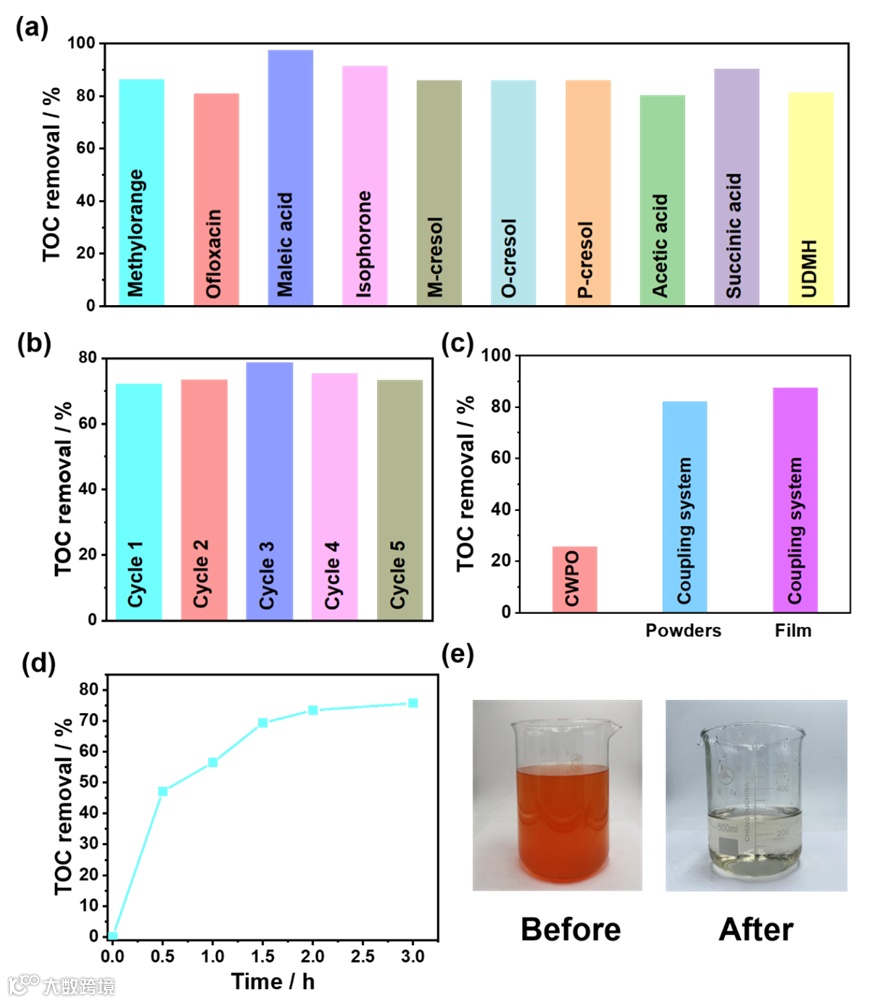
Fig. 3. (a) TOC removal of organic pollutants including succinic acid, acetic acid, p-cresol, o-cresol, m-cresol, isophorone, maleic acid, ofloxacin, methyl orange, and unsym-Dimethylhydrazine (UDMH). (b) Stability of coupling system for m-cresol degradation. (c) Comparison of coupling system using BiVO4 powders and film in the vortex flow reactor. (d) TOC removal of practical wastewater through the coupling system. (e) The apparent colour of wastewater before and after treatment through the coupling system.
直接光催化有机污染物降解
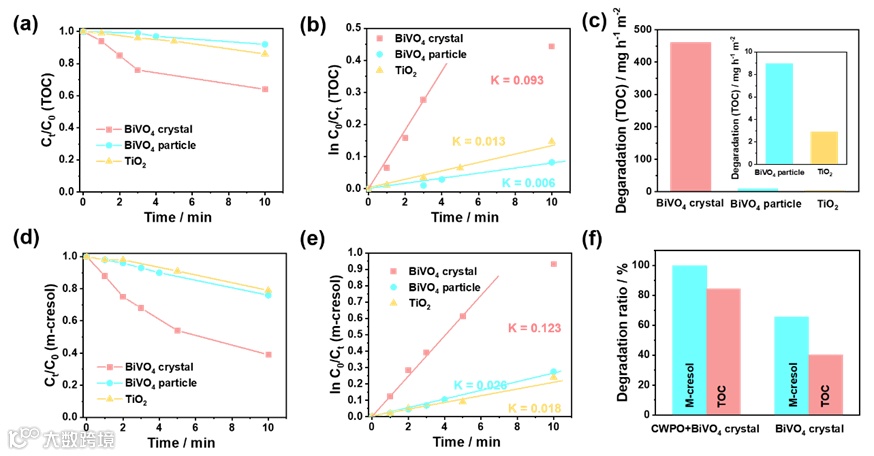
Fig. 4. (a) TOC removal of m-cresol degradation through photocatalytic process over decahedron BiVO4crystals, BiVO4 nanoparticle and TiO2 without coupling with CWPO. (b) Corresponding rate constants of m-cresol degradation under different conditions from (a). (c) Comparison of degradation rate after normalizing with the surface area of different photocatalysts. (d) Time curve of photocatalytic m-cresol degradation by detecting the concentration of m-cresol over decahedron BiVO4 crystals, BiVO4nanoparticles and TiO2. (e) Corresponding rate constants of m-cresol degradation under different conditions from (c). (f) The degradation ratio of m-cresol and TOC through coupling system and photocatalysis process.
研究发现,有机污染物降解过程也可以在单一光催化过程中发生,十面体BiVO4光催化剂表现出高于无规则BiVO4光催化剂和TiO2的降解性能,降解速率常数是无规则BiVO4光催化剂和TiO2的~10倍。
耦合体系机理
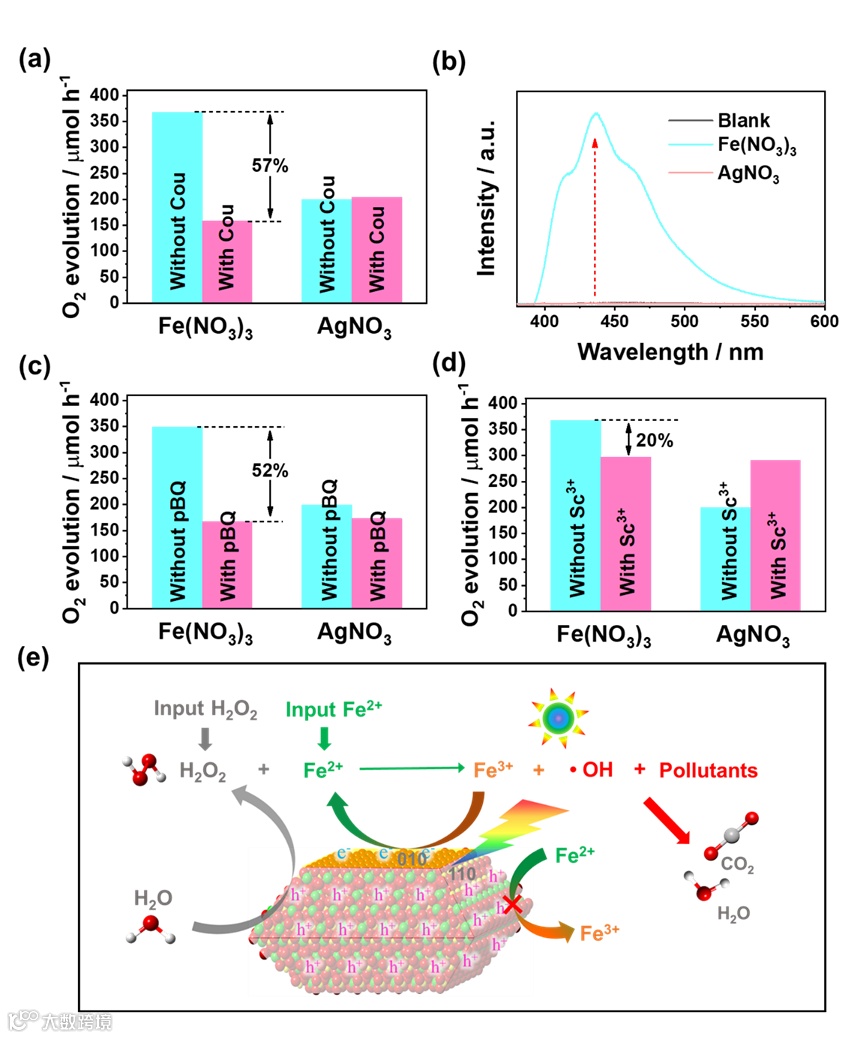
Fig. 5. (a) Photocatalytic water oxidation on decahedron BiVO4 crystals with and without adding coumarin using Fe(NO3)3 and AgNO3 as electron scavengers. (b) Fluorescence spectra after photocatalytic water oxidation reaction of (a). (c) Photocatalytic water oxidation on decahedron BiVO4 crystals with and without adding p-benzoquinone. (d) Photocatalytic water oxidation on decahedron BiVO4 crystals with and without adding Sc3+. (e) The schematic diagram of organic pollutants degradation through the coupling system between CWPO process and photocatalytic water oxidation on the decahedron BiVO4crystals.
·OH和·O2-探针分子对十面体BiVO4表面水氧化过程中活性氧物探测结果揭示了,H2O2会经由BiVO4表面两电子水氧化过程产生,而后与溶液中Fe2+离子发生Fenton过程产生·OH,用于有机污染物分子降解过程。






备注:
Permissions for reuse of all Figures have been obtained from the original publisher. Copyright 2022, Elsevier Inc.
文章链接:
https://www.sciencedirect.com/science/article/pii/S0926337322007998
声明
本文仅供科研分享,不做盈利使用,如有侵权,请联系后台小编删除

“邃瞳科学云”直播服务

“邃瞳科学云"平台正在收集、整理各类学术会议信息,欢迎学会、期刊、会议组织方择优在邃瞳平台上进行线上直播,希望藉此帮助广大科研人员跨越时空的限制,实现自由、畅通地交流互动。欢迎老师同学们提供会议信息(会有礼品赠送),学会、期刊、会议组织方商谈合作,均请联系翟女士:18612651915(微信同)。
投稿、荐稿、爆料:Editor@scisight.cn

扫描二维码下载
邃瞳科学云APP