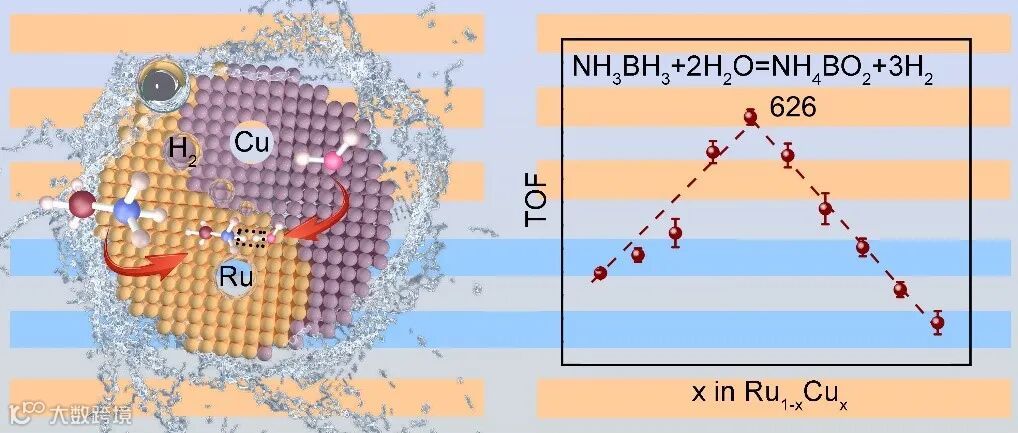
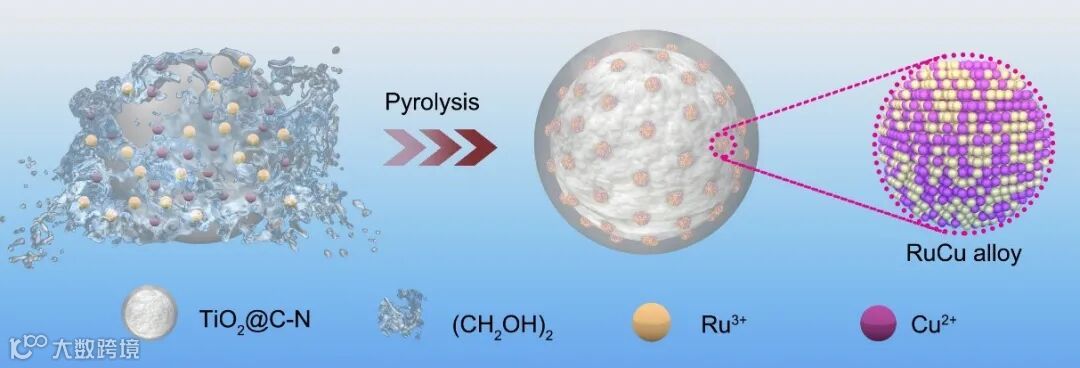
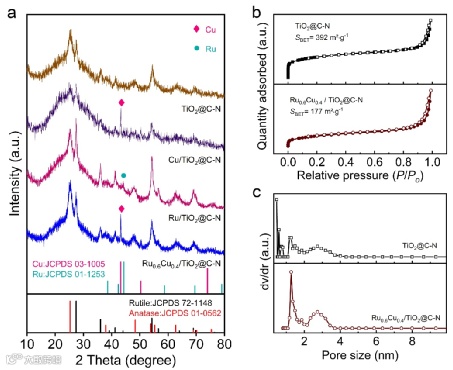
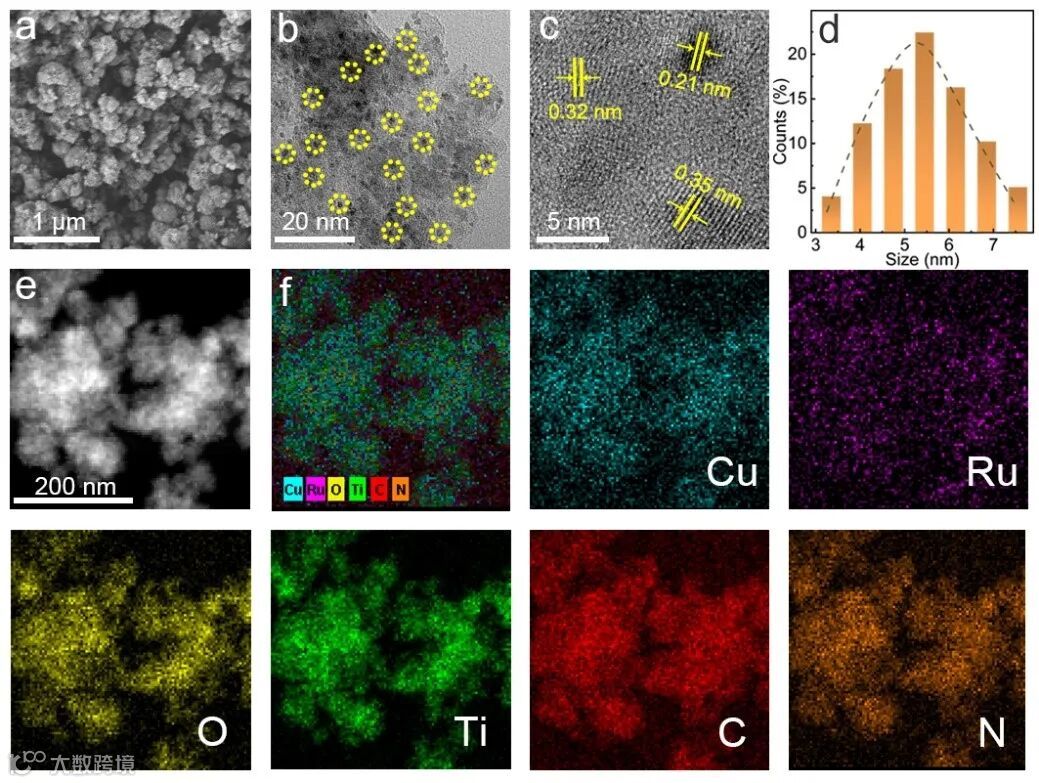
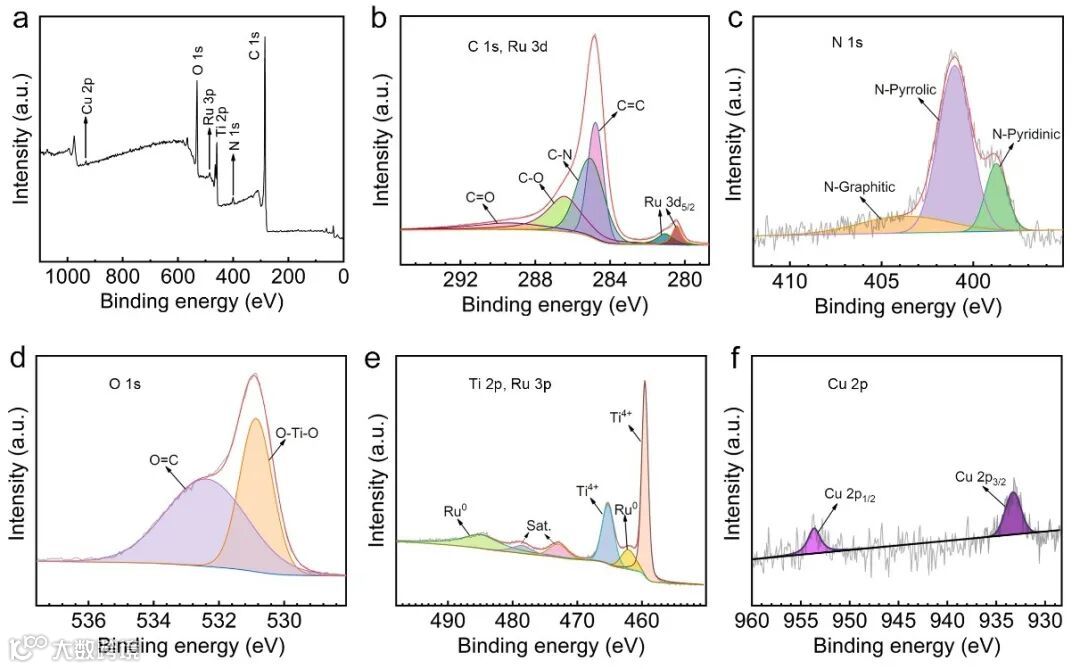
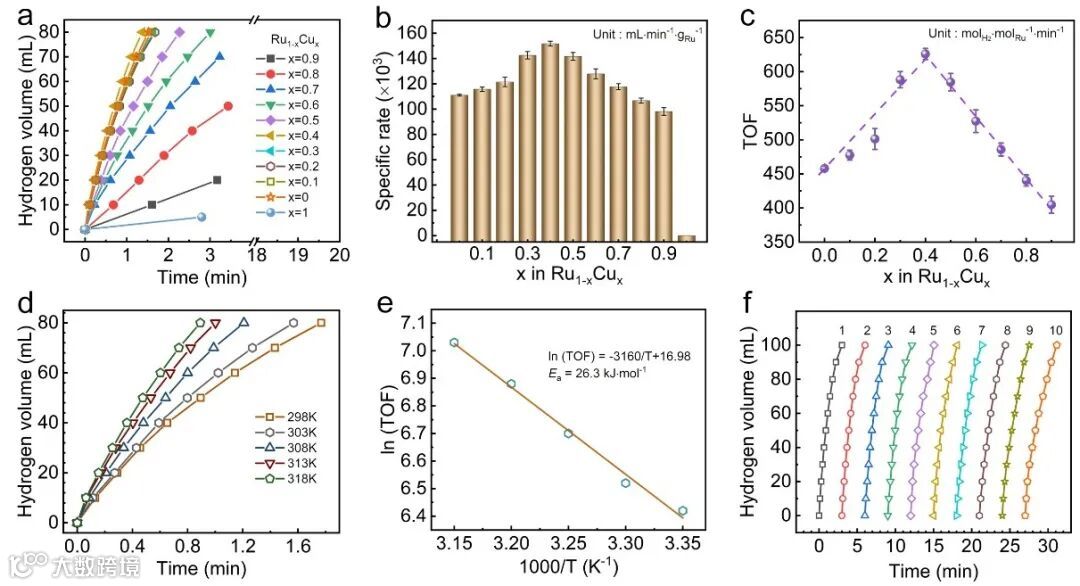
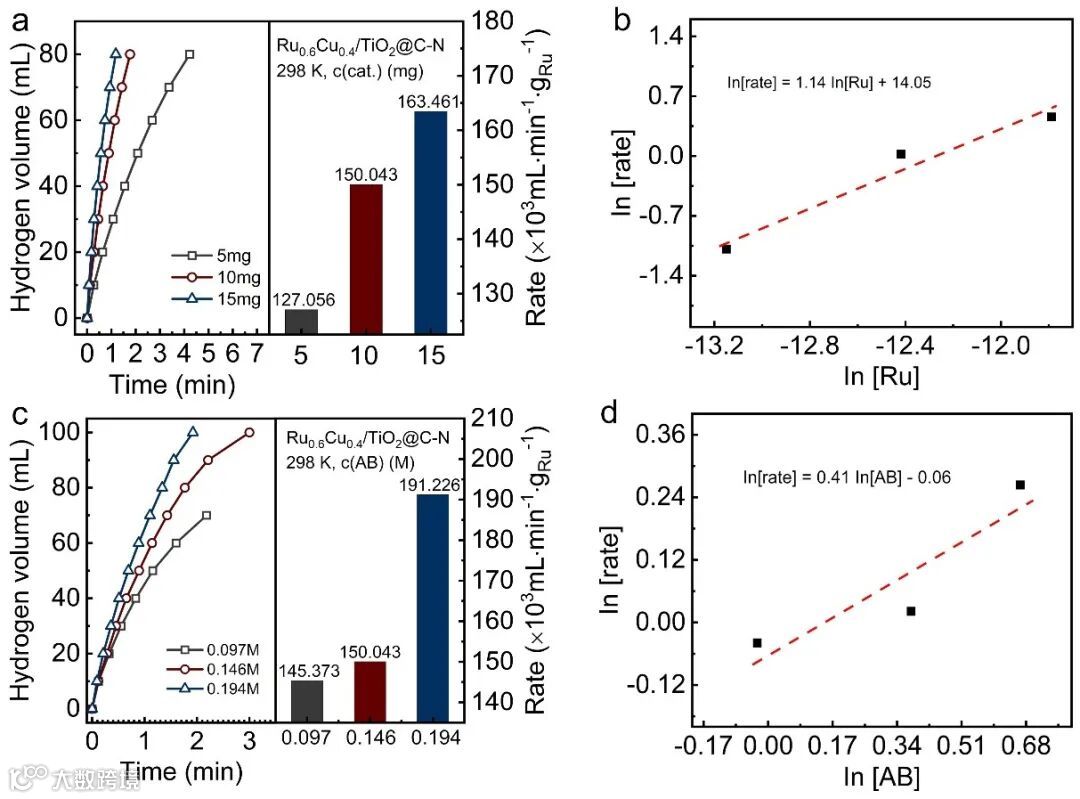
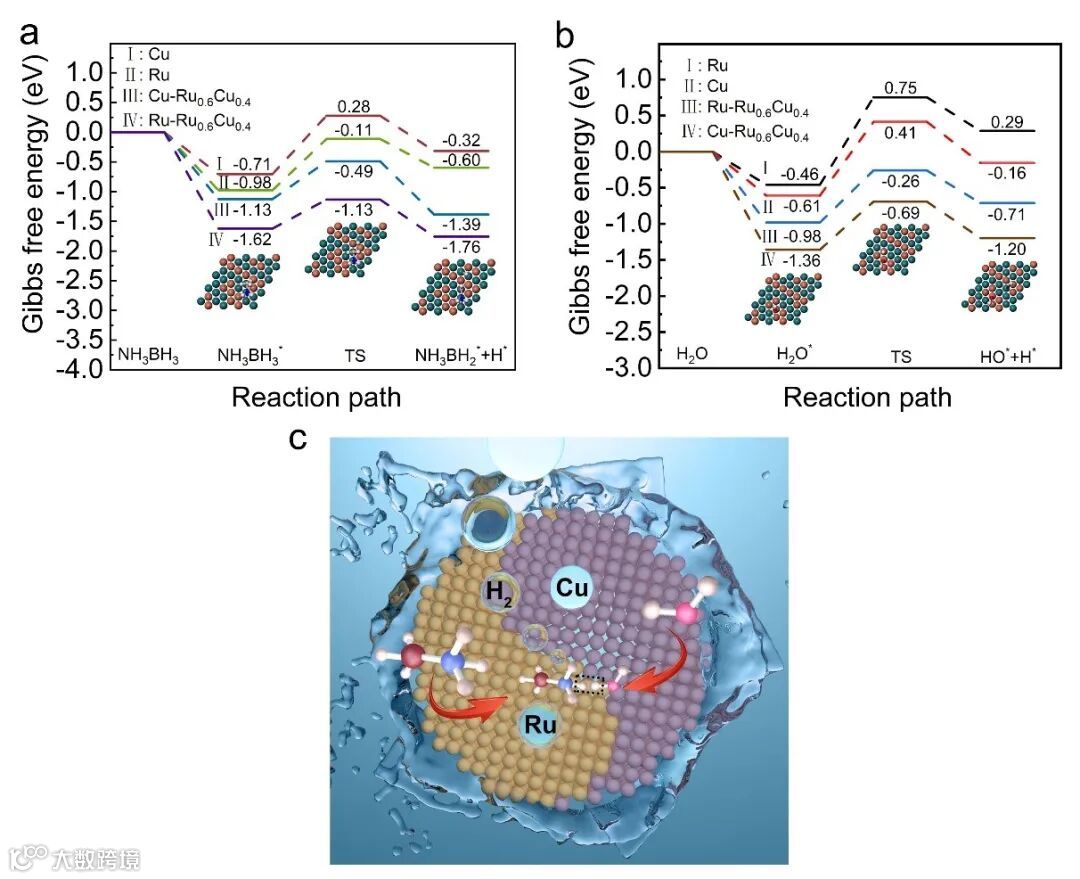
Figure 1.The preparation route of Ru1-xCux/TiO2@C-N supported catalysts. 通过固体表面有机溶剂热解法制备了Ru1-xCux/TiO2@C-N催化剂。Ru(acac)3和Cu(acac)2作为金属前驱体,(CH2OH)2既作溶剂也作还原剂。钌和铜的乙酰丙酮盐在TiO2@C-N表面有机层中185 ℃热解形成高度分散的Ru-Cu合金纳米颗粒。 Figure 2. (a) XRD patterns of Ru0.6Cu0.4/TiO2@C-N, Ru/TiO2@C-N, Cu/TiO2@C-N and TiO2@C-N. (b) N2 adsorption-desorption isotherm of TiO2@C-N and Ru0.6Cu0.4/TiO2@C-N. (c) Pore size distribution curves of TiO2@C-N and Ru0.6Cu0.4/TiO2@C-N. 从图2(a)中XRD结果可以发现,载体为锐钛矿与金红石两相共存TiO2。负载Ru-Cu金属纳米颗粒后,只存在Cu的特征衍射峰而没有Ru的衍射峰,表明钌进入铜的晶格。氮气吸脱附等温线表明,负载金属纳米颗粒后,TiO2@C-N的表面积减小,证明成功制备Ru0.6Cu0.4/TiO2@C-N催化剂,如图2(b)。从孔径分布图2(c)中发现,微孔减少,介孔的存在有利于反应物的扩散和吸附,产物的脱附,从而克服传质障碍。 Figure 3. (a, b) SEM and TEM images of Ru0.6Cu0.4/TiO2@C-N catalyst. (c) HRTEM image and (d) particle size distribution diagram of Ru0.6Cu0.4/TiO2@C-N. (e, f) HAADF-STEM image and the corresponding EDX elemental mappings ofRu0.6Cu0.4/TiO2@C-N. 通过SEM和TEM我们进一步探究了Ru0.6Cu0.4/TiO2@C-N催化剂的微观形貌和颗粒尺寸。如图3(a,b)所示,催化剂呈现球状结构且具有高度分散性。图3(c)HRTEM图展示了锐钛矿、金红石两相TiO2的晶格条纹和Cu(111)晶格条纹,而没有Ru的晶格条纹,表明Ru进入Cu的晶格。图3(d)展示了颗粒呈现窄尺寸分布,平均粒径约为5.4 nm。元素mapping证实Cu、Ru、O、Ti、C、N六种元素共同存在且均匀分布,如图3(e,f)。 Figure 4. (a) Survey XPS spectrum of Ru0.6Cu0.4/TiO2@C-N. (b) Fine XPS spectrum of C 1s and Ru 3d, (c, d) XPS spectra of N 1s, O 1s, and (e, f) XPS spectra of Ti 2p, Ru 3p and Cu 2p of Ru0.6Cu0.4/TiO2@C-N. 通过XPS进一步探究了催化剂的表面化学组成和电子结构。XPS结果再次证实催化剂中存在C、N、O、Ti、Ru、Cu六种元素。Ru和Cu呈现金属态,表明成功制备了Ru-Cu合金。 Figure 5. Hydrogen evolution in NH3BH3 hydrolysis, (a) hydrogen evolution volume diagram catalyzed Ru1-xCux/TiO2@C-N at 298 K, and (b, c) corresponding rB and TOF (three sets of catalytic data were used to calculate the corresponding specific rate and TOF under the same reaction conditions and were used to generate error bars). (d) Hydrogen evolution in NH3BH3 hydrolysis catalyzed Ru0.6Cu0.4/TiO2@C-N at different temperatures. (e) The corresponding Arrhenius plot for Ru0.6Cu0.4/TiO2@C-N catalyst. (f) Stability test of Ru0.6Cu0.4/TiO2@C-N at 298 K. Figure 6. (a) Hydrogen evolution in NH3BH3 hydrolysis over Ru0.6Cu0.4/TiO2@C-N catalyst with different concentrations and corresponding rate values at 298 K, and (b) corresponding logarithmic plot of H2 evolution rate versus the concentration of catalyst. (c) Hydrogen evolution in NH3BH3 hydrolysis with various NH3BH3 concentrations over Ru0.6Cu0.4/TiO2@C-N catalyst at 298 K and (d) the corresponding logarithmic plot of H2 evolution rate versus the concentration of NH3BH3. 如图5所示,在NH3BH3水解反应中,不同摩尔比的Ru-Cu合金催化活性呈现火山型的趋势。优化后的Ru0.6Cu0.4/TiO2@C-N催化剂TOF达到626 molH2molRu−1min−1,表观活化能为26.3 kJ•mol−1,且具有优异的循环稳定性。Ru-Cu合金的形成显著提升了Ru的本征活性,同时降低了贵金属Ru的含量。实验结果表明Ru和Cu之间存在明显的集团促进效应。图(6)中动力学分析结果表明,氨硼烷水解产氢速率随催化剂浓度或氨硼烷浓度的增加而增加。 Figure 7. Gibbs free energy diagrams of (a) NH3BH3 and (b) H2O adsorption and dissociation over Ru (111), Cu (111), Ru site-Ru0.6Cu0.4 (111) and Cu site-Ru0.6Cu0.4 respectively, and the corresponding optimized 3D structural models. (c) Schematic diagram of NH3BH3 hydrolysis over Ru-Cu alloy. 通过DFT计算,探究了NH3BH3和H2O分子分别在Ru位点、Cu位点、Ru0.6Cu0.4合金中Ru位点、Ru0.6Cu0.4合金中Cu位点的活化和解离所需吉布斯自由能。结果表明,NH3BH3在Ru0.6Cu0.4合金中Ru位点具有较低的反应能垒,而H2O分子在Ru0.6Cu0.4合金中Cu位点具有较低的反应能垒。与单金属催化剂相比,Ru-Cu合金中存在明显的集团促进效应。合金中表面Ru原子负责活化NH3BH3中的B-H键,表面Cu原子负责活化H2O中的O-H。合金中多原子活性位点促进了反应物分子的活化和解离,进而提升催化性能。
相关研究成果
C.C. Cui, Y.Y. Liu, S. Mehdi, H. Wen, B.J. Zhou, J.P. Li, B.J. Li, Enhancing effect of Fe-doping on the activity of nano Ni catalyst towards hydrogen evolution from NH3BH3, Appl. Catal. B Environ. 265 (2020) 118612. S.Y. Guan, L.L. An, S. Ashraf, L.N. Zhang, B.Z. Liu, Y.P. Fan, B.J. Li, Oxygen vacancy excites Co3O4 nanocrystals embedded into carbon nitridefor accelerated hydrogen generation, Appl. Catal. B Environ. 269 (2020) 118775.









 邃瞳科学云
邃瞳科学云