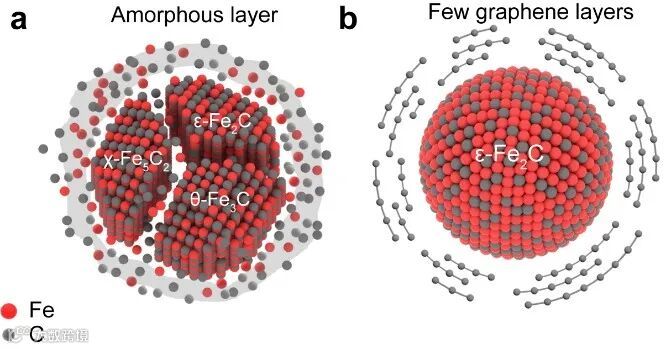
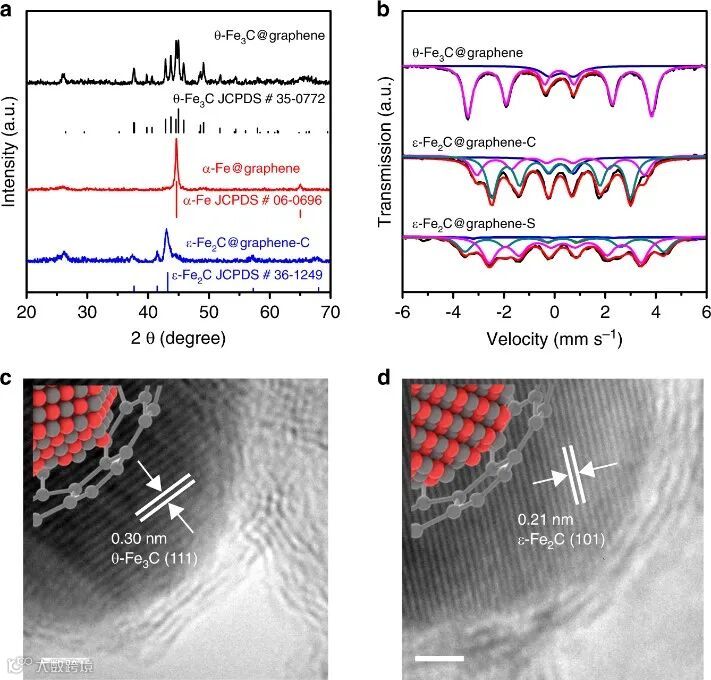
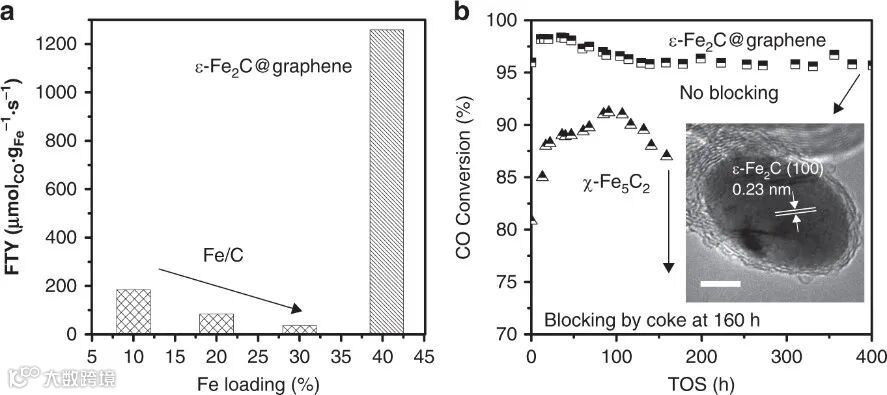
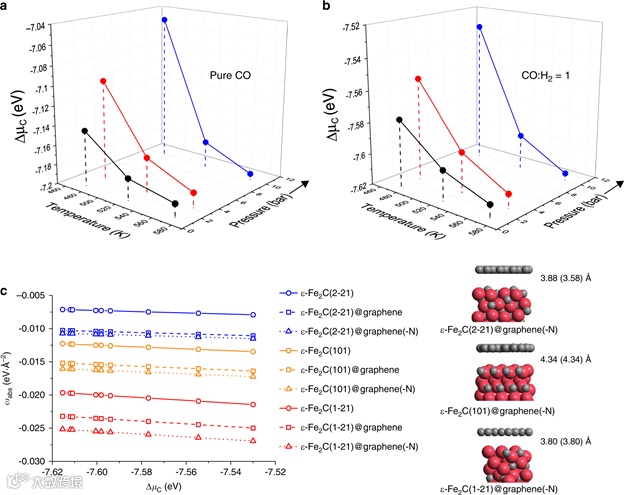
Figure 1. Structureof θ-Fe3C@graphene and ε-Fe2C@graphene samples.(a) XRD diffraction patterns for θ-Fe3C@graphenesample (black line), θ-Fe3C@graphene sample reduction under flowing H2at 623K for 3h (red line), and then carbonization under flowing syngas (H2/CO=1) at 573K for 10h (blue line). (b) 57Fe Mössbauer spectra for θ-Fe3C@graphene, ε-Fe2C@graphene-C, and ε-Fe2C@graphene-S samples. Representative high-resolution TEM micrographsfor (c) θ-Fe3C@graphene and (d) ε-Fe2C@graphene-C. Scale bar, 2nm. 作者采用高温熔融法合成了一种石墨烯层包裹限域的θ-Fe3C纳米材料,进一步将该材料通过氢气还原再合成气碳化的方法成功合成了一种石墨烯层包裹限域的ε-Fe2C纳米材料(Figure1)。 Figure 2. Catalyticperformance of different iron catalysts.(a) Comparison of FTY valuesbetween ε-Fe2C@graphene catalyst and iron catalyst loaded on active carbonwith different iron loadings. (b) Long-term stability of ε-Fe2C@graphene and un-encapsulated χ-Fe5C2catalysts. Reaction conditions: H2/CO=1/1, 573K, p=10bar. The insert shows the high-resolutionTEM micrograph for the spent ε-Fe2C@graphene catalysts after400h reaction. Scale bar, 5nm. 作者发现这种纳米材料在工业费-托合成条件下的活性可达1258 μmolCO gFe−1s−1。此外,该催化剂在300 ℃、64 L gcat-1h-1空速、反应400 h仍然能保持高CO转化率(~95%)(Figure 2)。进一步研究表明这种纳米材料中的ε-Fe2C物相在300 ℃、合成气气氛下能保持稳定存在。 Figure 3. DFTcalculation of graphene confinement on ε-Fe2C.(a) Relative chemical potential of carbon(ΔμC) for carburization by CO (2CO→C+CO2). (b) Relative chemical potential of carbon (ΔμC) for carburization by syngas (4CO+4H2→2C+CO2+2H2O+CH4). (c) Surface-normalized carbon absorption energy (ωabs) of ε-Fe2C surfaces with and withoutgraphene(-N) layers and the most stable structures labeled by the distances betweenε-Fe2C and graphene (data in parenthesis referring to those of graphene-N). 实验和理论计算研究表明,在熔融法合成θ-Fe3C材料过程中,碳源在θ-Fe3C表面首先形成了少量(3-4层)石墨烯覆盖层,θ-Fe3C在氢气气氛下被还原成金属铁、金属铁在合成气碳化条件下继续转变为ε-Fe2C过程中,这种具有刚性几何结构的少量石墨烯层不仅得到了保持,而且稳定了ε-Fe2C物相结构,抑制了高温和合成气气氛下ε-Fe2C继续向其他碳化铁物相的转变和ε-Fe2C表面非晶态无定形碳层的形成(Figure 3)。该研究为阐明纯相碳化铁物种的费-托合成反应构效关系,开发高活性、高稳定性的工业铁基费-托合成催化剂提供了一种行之有效的方法。








 邃瞳科学云
邃瞳科学云