

将清洁太阳能转化为化学燃料是金属有机骨架(MOFs)最有前途的新兴应用领域之一。然而,MOFs中光生载流子的快速复合仍然是其光催化应用的最大障碍。尽管MOF NPs同质结的构建有望有效促进光生电荷的分离,是将MOF应用于其他光催化和电催化反应(如水分解和固氮)的极有前途的途径。但是构筑MOF 同质异相结依然非常具有挑战。
近日,加拿大国立科学研究院(INRS)马冬玲教授, 刘彦男博士等报道了一种“过渡金属NPs导向的MOF生长”过程,以构建具有精准结构的MOF NPs基同质结,用于可见光光催化CO2还原。

同质异相结,是指化学组成相似但晶型和能级不同的结构。相比传统的异质结,同质异相结具有更好的促进电荷分离的能力,这是因为它们具有化学上相似的独特界面,从而可以使得载流子传输速度在界面上更有效。虽然人们已经发展了一些基于有机和无机的同质结,据我们所知,基于MOF的同质异相结还尚未被开发。
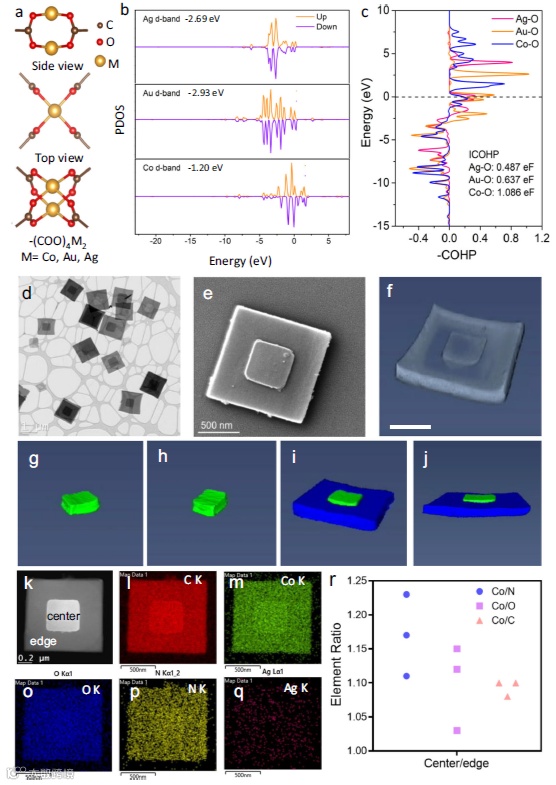
Fig. 1: Structural and elemental analysis of Co-MOF-3 nanostacks. a Schematic illustrations of –(COO)4M2 (M=Co, Au, Ag). b PDOS of d-band of M in –(COO)4M2 (up: spin up, down: spin down) and corresponding caculated d-band center values. Ef = 0. c COHP bonding analysis of M–O interactions in –(COO)4M2. Ef = 0. The unit is eV/f.u.(eF), standing for eV per formula unit. ICOHP represents the intensities of COHP. d A typical TEM image of Co-MOF-3. e The SEM image of Co-MOF-3. f 3D TEM image of Co-MOF-3 nanostack and 3D electron tomography reconstruction model of the small squared plate (g, h) and large squared plate in Co-MOF-3 (i, j) shown in f. Scale bar, 500 nm. k HAADF image of Co-MOF-3 and the corresponding EDS elemental mapping images of l C, m Co, o O, p N and q Ag in Co-MOF-3. r EDS peak-area ratios of K series for Co/N, Co/O, and Co/C between the central (center) and the peripheral area (edge) of Co-MOF-3.
本文作者开发了一种空心过渡金属纳米粒子诱导的一锅合成策略,获得了基于MOFs的结构精确的同质异相结,这主要基于MOF结构中金属团簇中动态配位自组装的特性。此外,这种方法的普适性在文章中也得到了很好的验证。
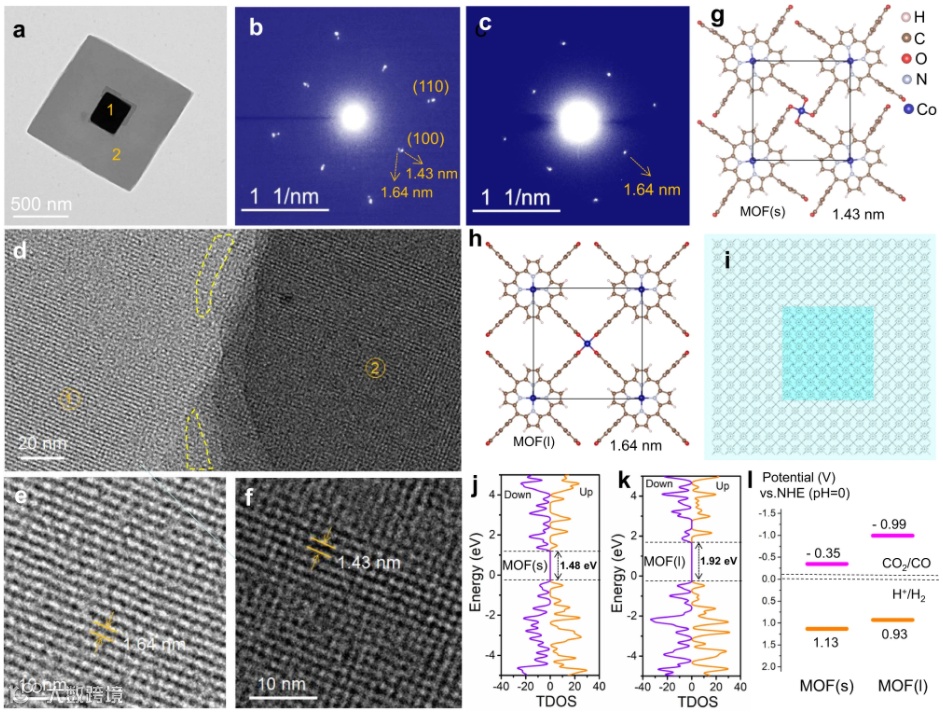
Fig. 2: Crystal structure of Co-MOF-3 nanostacks. a TEM image and b, c the corresponding SAED from the central (position 1 in a) and peripheral (position 2 in a) areas of Co-MOF-3, respectively. d HR-TEM image of the epitaxial inteface between the central and peripheral parts (yellow polygons represent interfacial dislocation). e, f Enlarged lattice image of position 1 in d and position 2 in d, respectively. g Cystal structural model of the smaller MOF, named MOF(s), in nanostacked Co-MOF-3. h Cystal structural model of the larger MOF, named MOF(l). The rectangular boxes in g and h highlight the unit cells. i Proposed top-view structure of Co-MOF-3 nanostacks. j, k TDOS plots of monolayer MOF(s) and MOF(l) in nanostacks, respectively. l Calculated energy levels of monolayer MOF(s) and MOF(l) in nanostacks (Potential vs. NHE (pH = 0)).
这种方法所制备的MOF同质结由两个(001)面堆叠在一起的纳米片组成,较小的纳米片部分嵌入到较大的纳米板中以形成可靠的同质结界面。通过原子显微镜, 高分辨透射电镜(TEM), 三维重构TEM和超高分辨激光共聚焦,low-loss和core loss EELS等的表征以及DFT的模拟计算,证明了这两个大小不同的纳米片具有类似但不同的化学成分和晶体结构,且具有不同的能级,且它们之间形成了很好的type II 半导体相结。通过追踪反应过程,MOF 同质异相结的形成过程也得到了揭示。
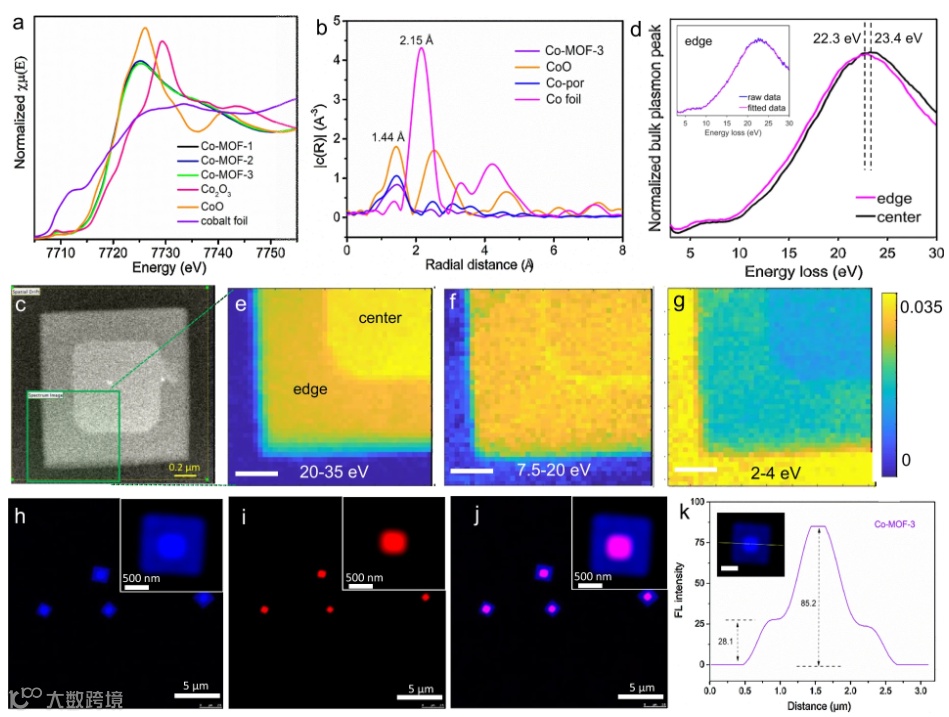
Fig. 3: Elemental analysis of Co-MOF-3 nanostacks. a Normalized XANES spectra at Co K-edge for all the Co-MOFs and references of Co2O3, CoO, and Co foil. b Co K-edge Fourier transform k2-weighted EXAFS (not phase corrected) of Co-MOF-3, CoO, Co foil, and Co-porphyrin (Co-por). c HADDF image of of Co-MOF-3. d The low-loss EELS spectra of edge and center (after Gaussian smoothing). The inset is the raw data and Guassian fitting curve of EELS spectrum of edge. Low-loss EELS mapping in the range of e 20–35 eV, f 7.5–20 eV and g 2–4 eV. The low-loss EELS mapping was normalized by the integral signal, extracted with background removal, and smoothed by the Gaussian fitting model. Non-negative matrix factorization (NMF) was applied to the 41 × 41 pixels low-loss EELS spectra dataset. h–j Super-resolution multiphoton confocal images of Co-MOF-3. The excitation of wavelength is 405 nm and the emission was collected using (h) a 412–472-nm bandpass filter (blue) or (i) a 559–682-nm bandpass filter (red), respectively, and j merged image of h and i. k The FL intensity profile of the inset Co-MOF-3 image; the scale bar is 500 nm.
研究人员利用SPVM原位监测了单个双层MOF纳米片中光生电荷的传输方向,揭示了同质结的形成有利于电荷分离。这是首次把SPVM这个表征技术应用于MOF基的材料。此外,时间分辨FL寿命和电化学阻抗测试也揭示了快速的光生载流子分离。
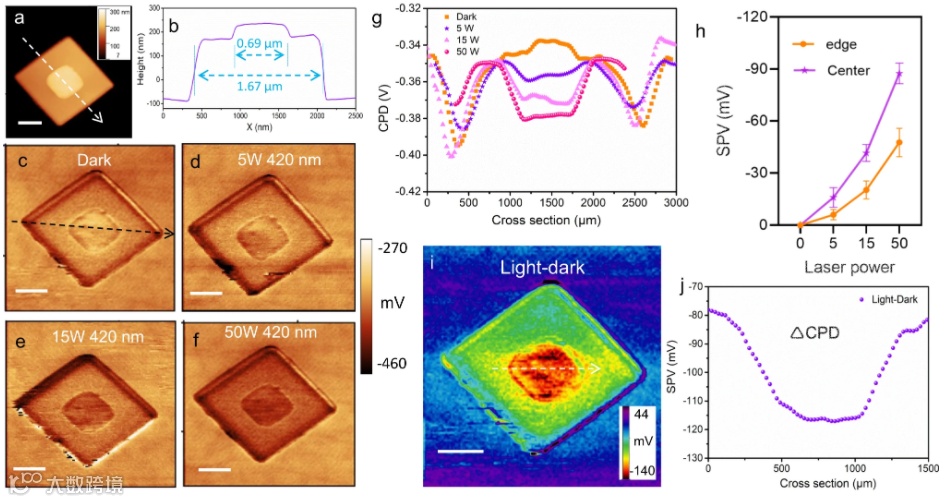
Fig. 5: SPVM analyses of stacked phase-enabled Co-MOF-3 homojunction. a AFM topography image and b the corresponding height profile of Co-MOF-3. c KPFM image of Co-MOF-3 under no illumination (dark condition). KPFM image of Co-MOF-3 under the irradiation of 420-nm LED light with the power of d 5 W, e 15 W, and f 50 W. g The corresponding normalized CPD profiles across the center of Co-MOF-3 (see the arrow line in c) under the dark and irradiation conditions. h The statistical SPV values (n = 5, SPV, ΔCPD = CPDlight − CPDdark) collected from the center (purple) and peripheral (orange) regions, respectively, in the (001) facet of Co-MOF-3 stacked nanoplate under the illumination with various power densities (correction of SPV values was done by subtracting the corresponding CPD vaules of the HOPG support). Data are presented as mean values ±S.D. i SPVM image obtained by subtracting the potential under the dark condition from that under 50-W illumination and j the corresponding SPV profile.
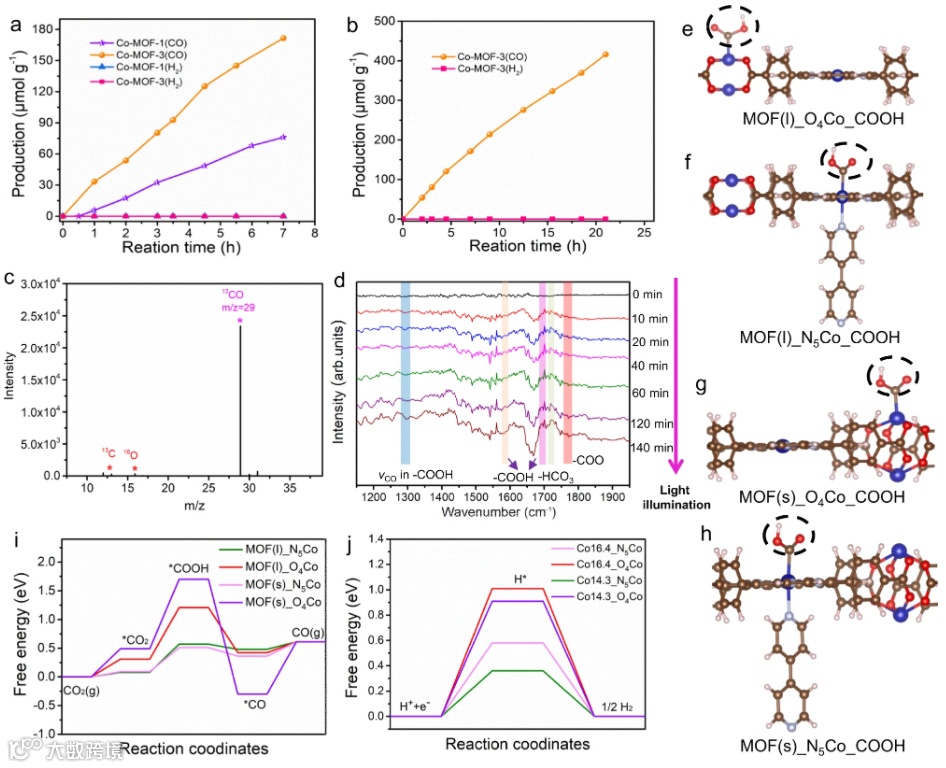
Fig. 6: Photocatalytic CO2 reduction performance of Co-MOF-3 homojunction. a Evolution of CO and H2 as a function of reaction time during the CO2 reduction in aqueous solution under visible-light illumination for the Co-MOF-1 and Co-MOF-3 photocatalysts. b Stability of Co-MOF-3 during the continuous CO2 reduction reaction. c Isotope labeling of Co-MOF-3 system carried out by using 13CO2 gas. d In situ DRIFTS measurement of Co-MOF-3. e–h Schematic illustration of intermediate *COOH adsorbed onto MOF(l)_N5Co, MOF(l)_O4Co, MOF(s)_N5Co, and MOF(s)_O4Co in the Co-MOF-3 homojunction during CO2 reduction, respectively. Calculated free energy (ΔG) diagram of i CO2 reduction to CO and j HER on Co sites in varied units of MOF(l)_N5Co, MOF(l)_O4Co, MOF(s)_N5Co, and MOF(s)_O4Co, respectively (U = 0).

本文通过空心过渡金属纳米粒子诱导的MOF同质异相结具有独特而精确的结构,同时这种MOF异相结具有可见光驱动的二氧化碳还原的能力,也具有非常高的一氧化碳选择性和出色的稳定性。本工作提供了一个普适的方法和理论来指导多级金属-有机框架配合物的合成,并有助于人们理解金属-有机框架的多级结构和功能的关系。

Liu, Y., Chen, C., Valdez, J. et al. Phase-enabled metal-organic framework homojunction for highly selective CO2 photoreduction. Nat. Commun. 12, 1231 (2021). https://doi.org/10.1038/s41467-021-21401-2

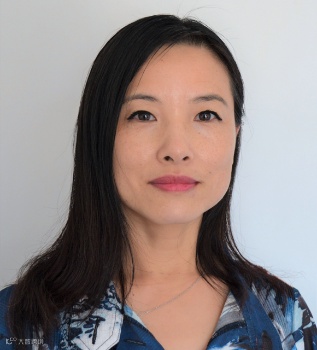
马冬玲教授:加拿大首席科学家,加拿大国立科学研究院终身教授(EMT-INRS)。多年来领导团队从事纳米材料的合成,性能研究及其在能源,环境以及生物医学方面应用的研究,在国际著名期刊J. Am. Chem. Soc., Nat. Commun., ACS Nano, Energy Environ. Sci., Chem. Soc. Rev., Adv. Mater., Sci. Adv., Adv. Funct. Mater.,Small 等发表学术论文150余篇。马冬玲教授也是ACS Energy Lett., ACS Appl. Nano Mater., Sci. Rep.等杂志的(顾问)编委。
课题组主页: https://inrs.ca/en/research/professors/dongling-ma/

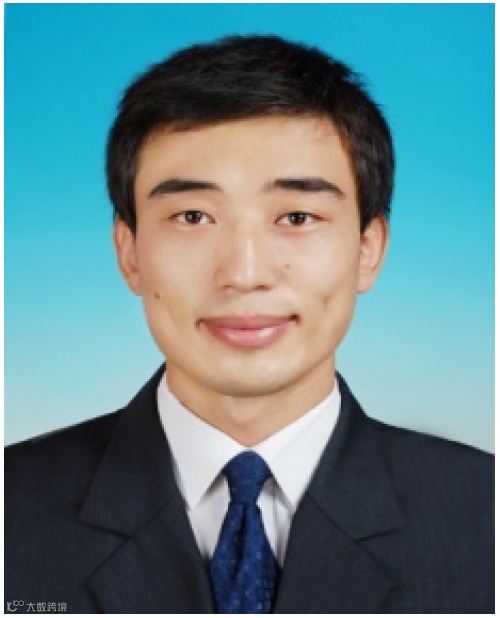
刘彦男博士:上海交通大学博士毕业,加拿大国立科学研究院(EMT-INRS)马冬玲教授组博士后(2018.02-2020.07)。主要研究方向为框架聚合物合成,光能转化等。