

第一作者:郭继睿(山东大学)

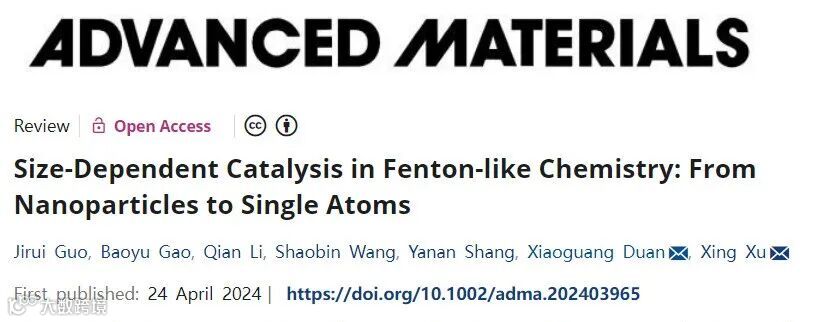
近日,山东大学许醒、澳大利亚阿德莱德大学段晓光副教授等合作在国际顶级期刊Advanced Materials发表了题为“Size-Dependent Catalysis in Fenton-like Chemistry: From Nanoparticles to Single Atoms”的综述论文(DOI:https://doi.org/10.1002/adma.202403965)。2022级硕士研究生郭继睿为第一作者,山东大学许醒副教授、澳大利亚阿德莱德大学段晓光副教授为共同通讯作者。
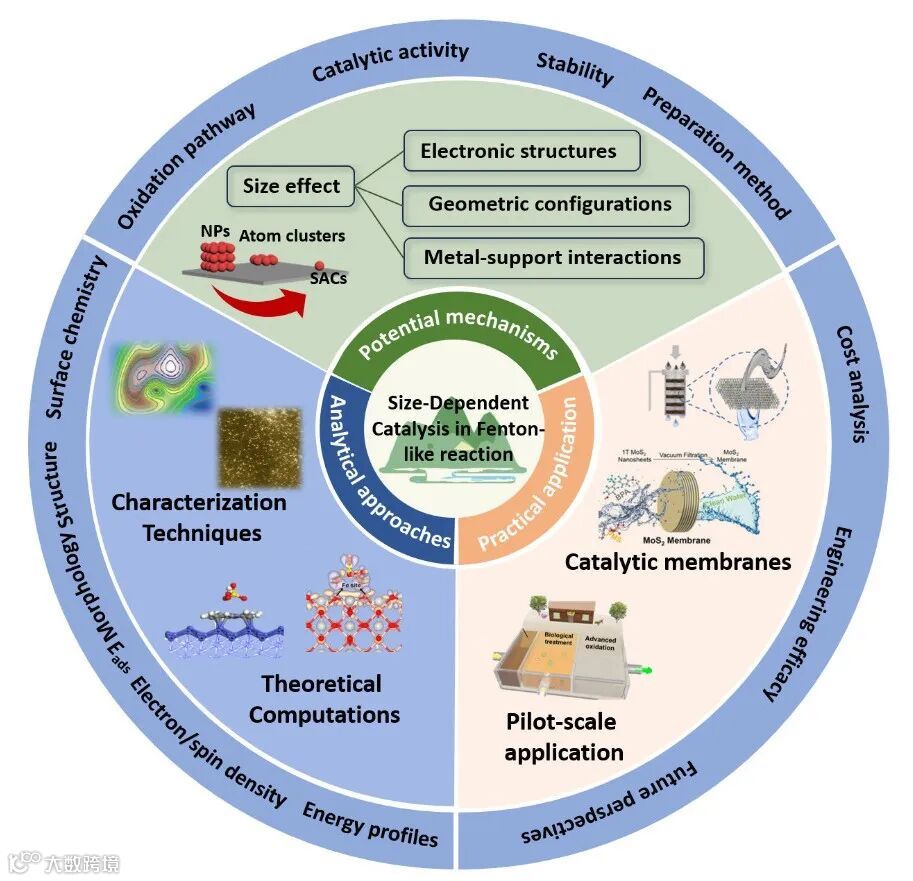
先进的类芬顿反应在用于水净化的高级氧化过程(AOPs)中至关重要。本文综述了AOPs中非均相金属基催化剂的最新进展,包括金属纳米颗粒催化剂(NPs)、单原子催化剂(SACs)和原子团簇催化剂。这些催化剂的物理性质(如金属点位尺寸、不饱和程度、电子结构和氧化态)及其对类芬顿反应的催化行为和效果的影响之间存在显著关系。本文对金属NPs和SACs进行了深入的对比分析,重点研究了金属催化点位的尺寸变化和金属-载体相互作用对活性氧物种种类和氧化途径的影响。此外,该综述强调了将这些催化剂固定在膜表面的创新策略,为粉末状催化剂应用于类芬顿的固有挑战提供了解决方案。本文还首次总结了类芬顿装置/组件在中试规模或工程应用方面的最新进展。最后,该综述强调了催化剂的先进设计、活性氧种类的精确鉴定和机理的深入研究。这些工作的最终目的是提高纳米及单原子AOPs体系在实际废水处理中的应用潜力。

均相催化剂大多由过渡金属原子或由特定配体稳定的含有少量金属原子的团簇组成,对目标有机物表现出高活性和高选择性。然而,均相催化的主要问题包括污泥的产生/结块处理以及均相催化剂与催化体系的分离,这些问题极大地限制了其工业应用。非均相类芬顿催化剂,特别是基于金属纳米颗粒催化剂(NPs)、单原子催化剂(SACs)和原子团簇催化剂的类芬顿催化剂,因其优异的稳定性、易于分离和重复使用而不产生污泥废物而引起了人们对类芬顿反应越来越多的兴趣。
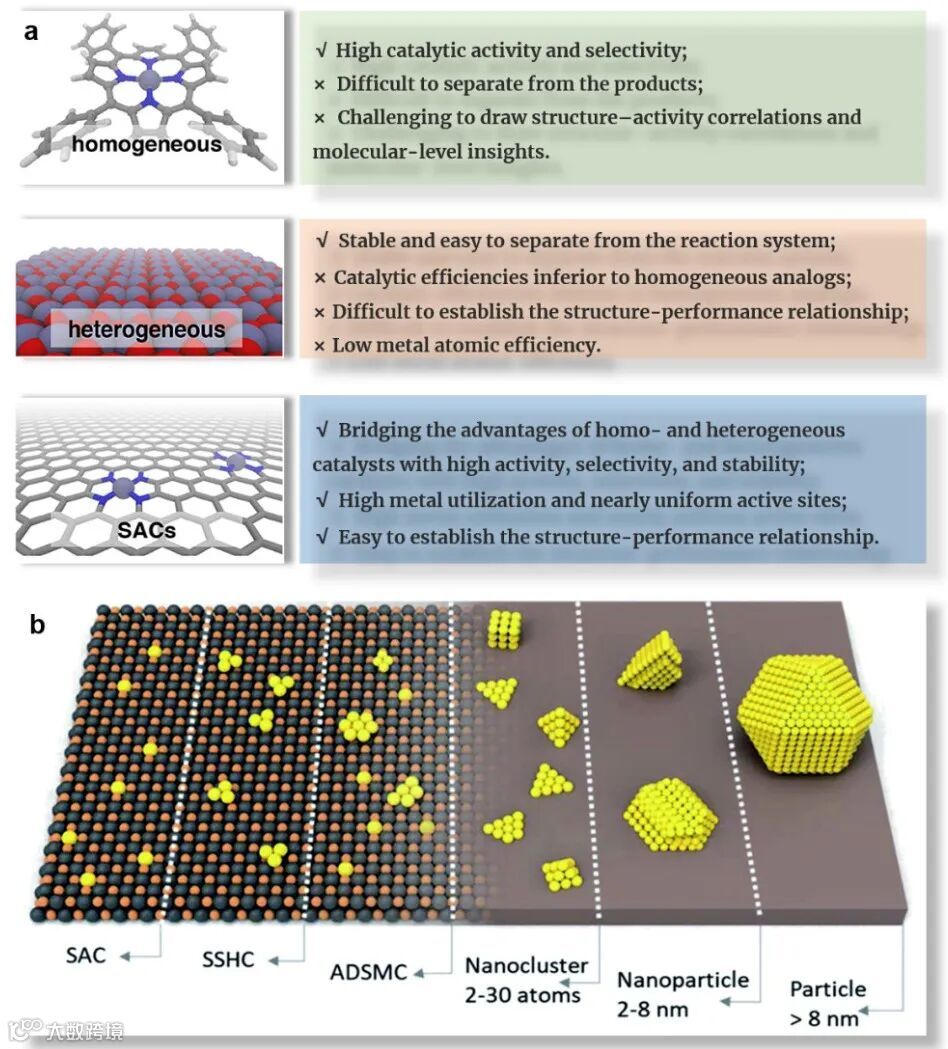
Figure 1. (a) Comparison of properties of homogeneous catalysts, heterogeneous catalysts and SACs; (b) particle sizes for different metal-based catalysts. Copyright 2024, John Wiley and Sons.
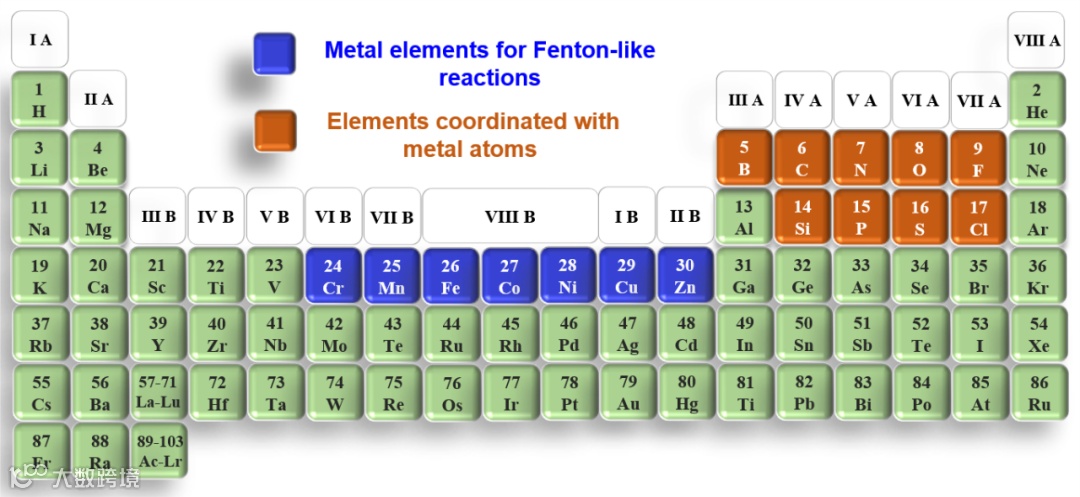
Figure 2. Summary of elements in SACs for Fenton-like reaction. Copyright 2024, John Wiley and Sons.

Figure 3. Timeline of heterogeneous metal NPs and SACs as Fenton-like catalysts. Copyright 2024, John Wiley and Sons.
2. 金属NPs和SACs催化剂活性位点的分析方法
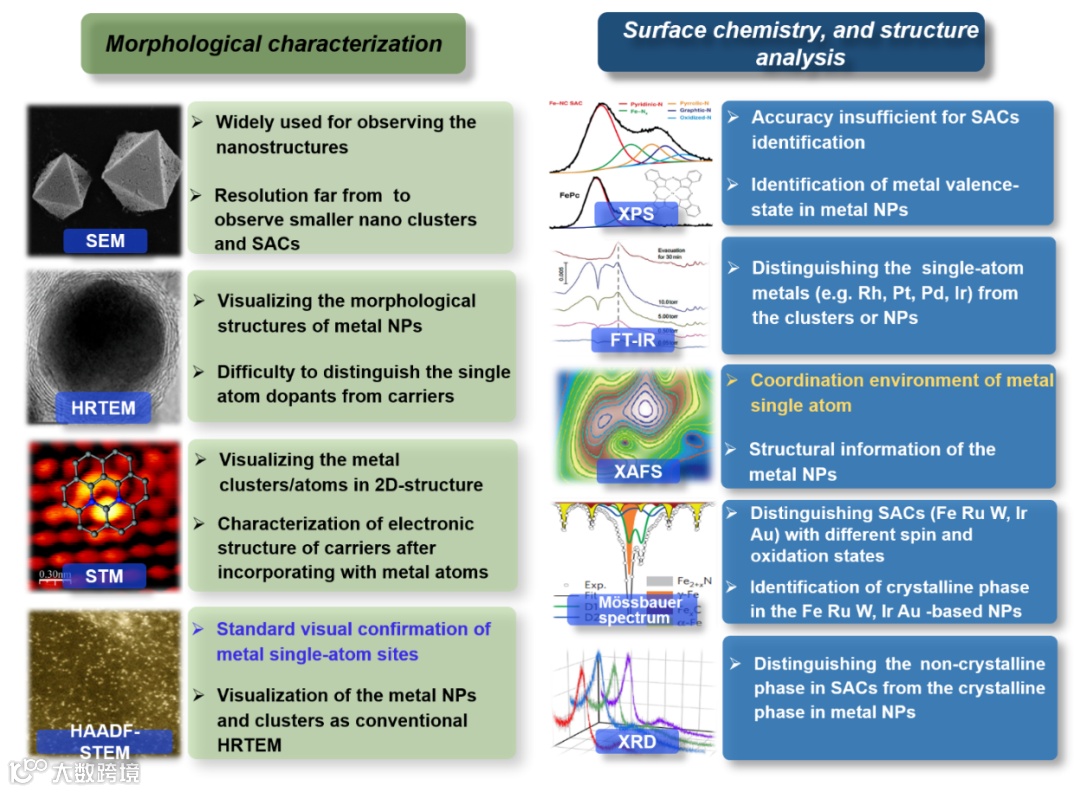
Figure 4. Scheme of morphological characterization, surface chemistry, and structural analysis of metal NPs catalysts and SACs. Copyright 2024, John Wiley and Sons.
3. 类芬顿反应中金属NPs的催化作用
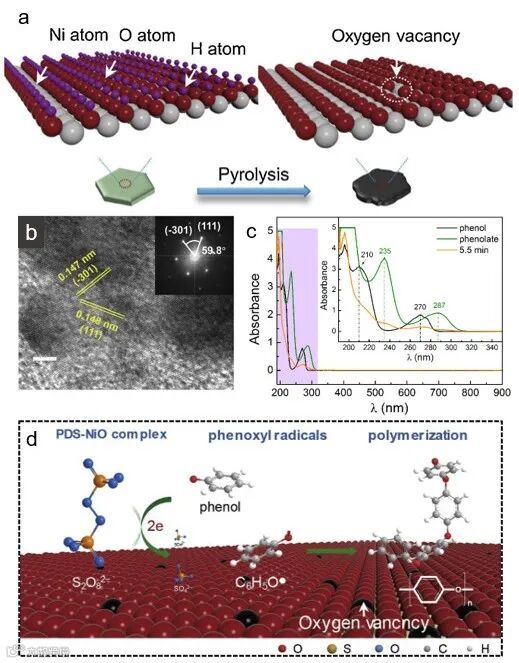
Figure 5. (a) Preparation route of NiO catalysts. (b) HR-TEM image of r-NiO; (c) UV-vis absorbance spectra at 5.5 min (6 times dilution); (d) Fenton-like mechanism between phenol and PDS-NiO complex. Copyright 2024, John Wiley and Sons.
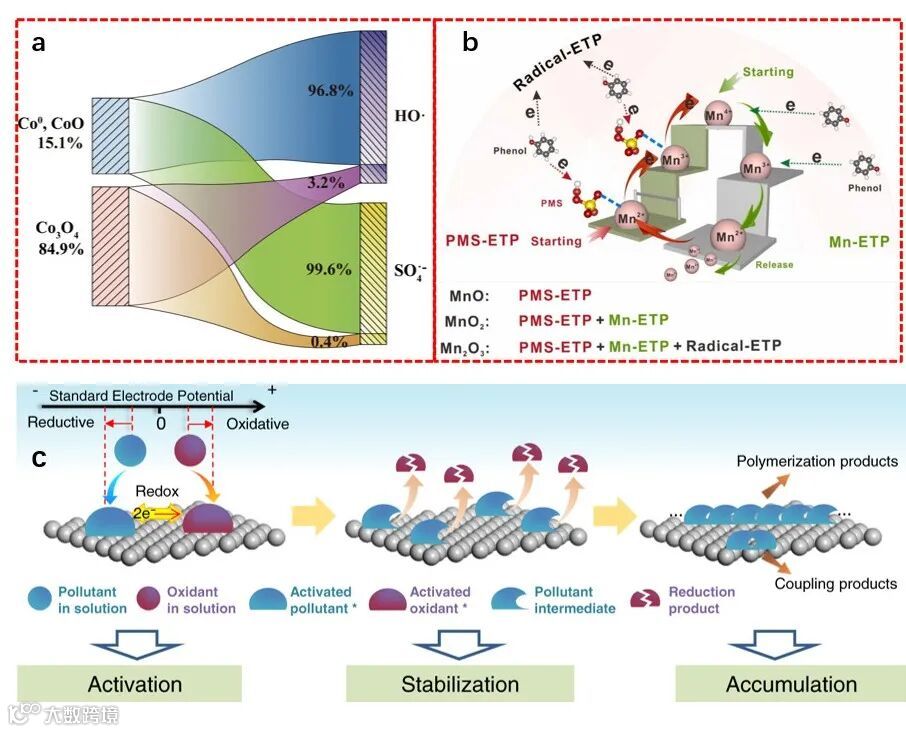
Figure 6. (a) Roles of Co3O4 and low-valent Co NPs to the production of HO• and SO4•−. (b) Mechanism scheme of various MnOx crystals for PMS activation. (c) Schematic illustration of DOTP on surface of Co3O4. Copyright 2024, John Wiley and Sons.

Figure 7. (a) Crystal morphology of ZnFe2-xMnxO4 oxides; (b) HRTEM and SAED images of ZnFeMnO4 catalyst; (c) BPA degradation in terms of different radical scavengers; (d) Nonradical reaction mechanism of PMS activation and BPA oxidation ZnFeMnO4 surface. Copyright 2024, John Wiley and Sons.
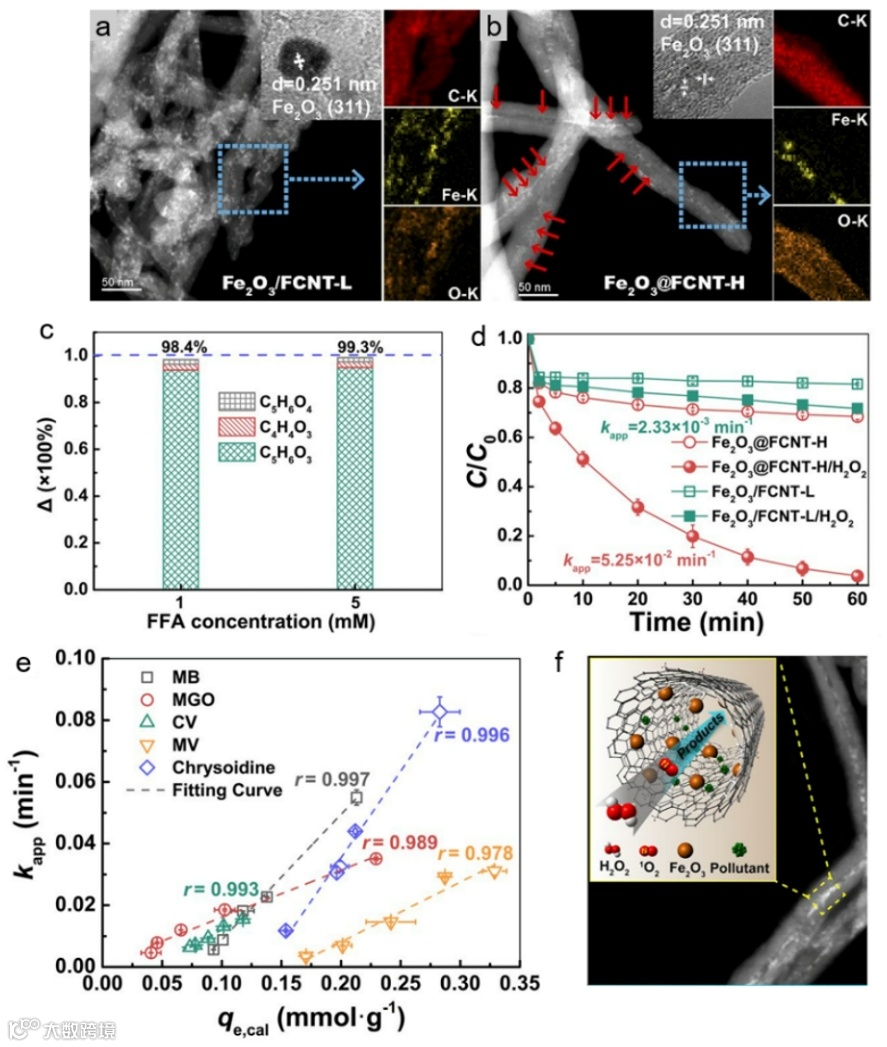
Figure 8. (a) HADDF-STEM images of Fe2O3/FCNT-L; (b) HADDF-STEM images of Fe2O3@FCNT-H; (c) Mass balance of FFA in Fe2O3@FCNT-H/H2O2 system; (d) Mechanic of FeCo@N–C catalyst for PMS activation; (e) MB concentrations versus time of Fe2O3@FCNT-H and Fe2O3/FCNT-L with/ without H2O2; (f) Mechanism scheme of pollutants oxidation in Fe2O3@FCNT-H/H2O2 system. Copyright 2024, John Wiley and Sons.
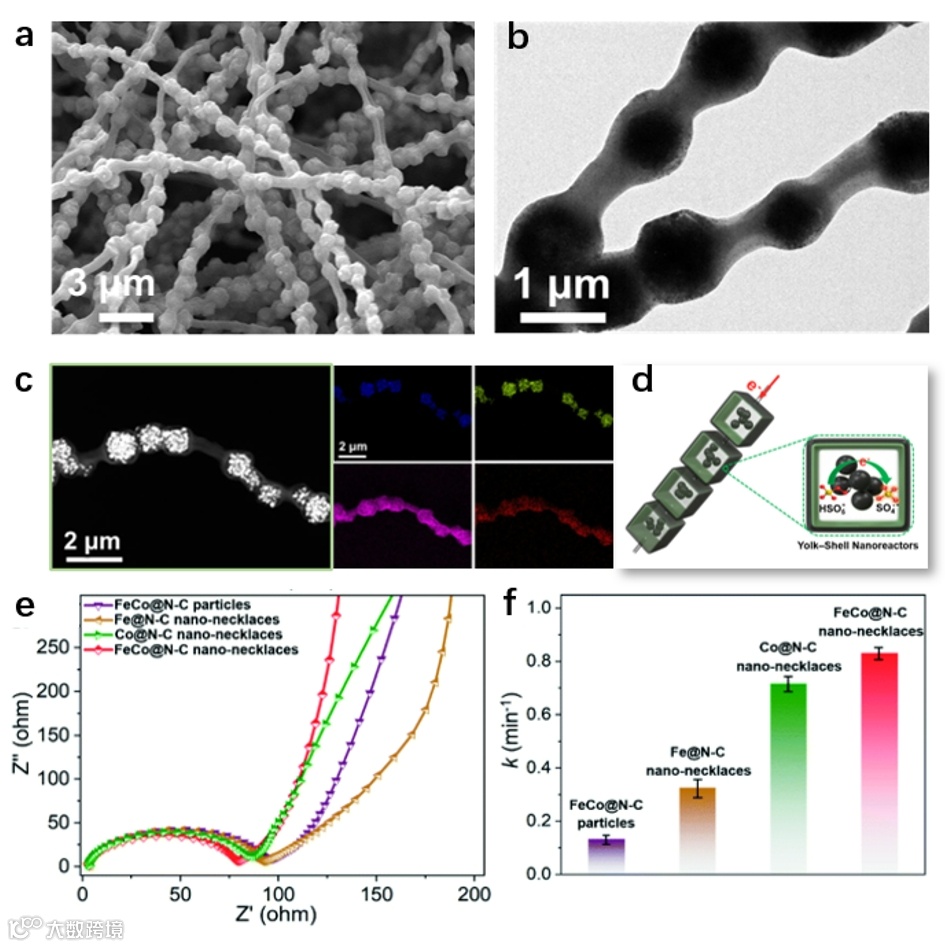
Figure 9. (a) SEM of FeCo@N–C; (b) TEM of FeCo@N–C and (c) Relevant elemental mappings; (d) Mechanic of FeCo@N–C catalyst for PMS activation; (e) Nyquist plots of the different catalysts; (f) BPA degradation rate in different catalytic systems. Copyright 2024, John Wiley and Sons.
4. 类芬顿反应中SACs和原子团簇催化剂的催化作用
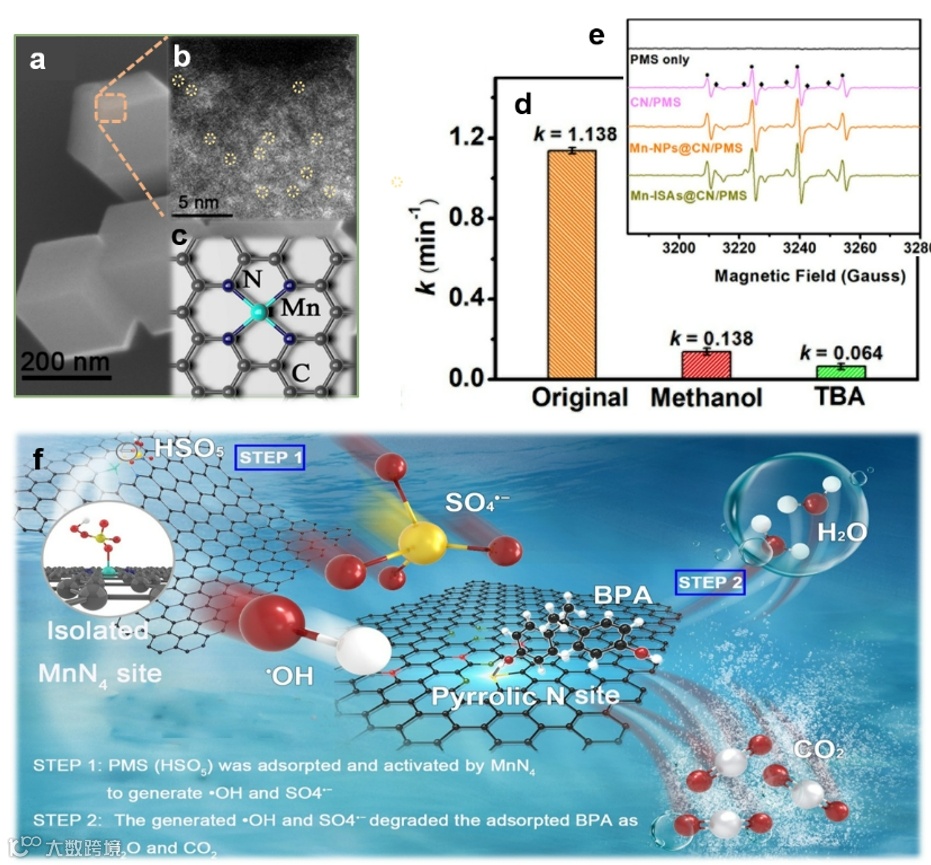
Figure 10. (a) TEM image of Mn-ISAs@CN; (b) HAADF-STEM image of Mn-ISAs@CN; (c) stimulated configuration of the Mn-N4; (d) Quenching experiments in resulting catalytic system; (e) EPR experiments in resulting catalytic system; (f) Dual-reaction scheme for oxidizing the BPA in Mn-ISAs@CN/PMS system (MnN4 and adjacent pyrrolic N atoms as dual sites). Copyright 2024, John Wiley and Sons.
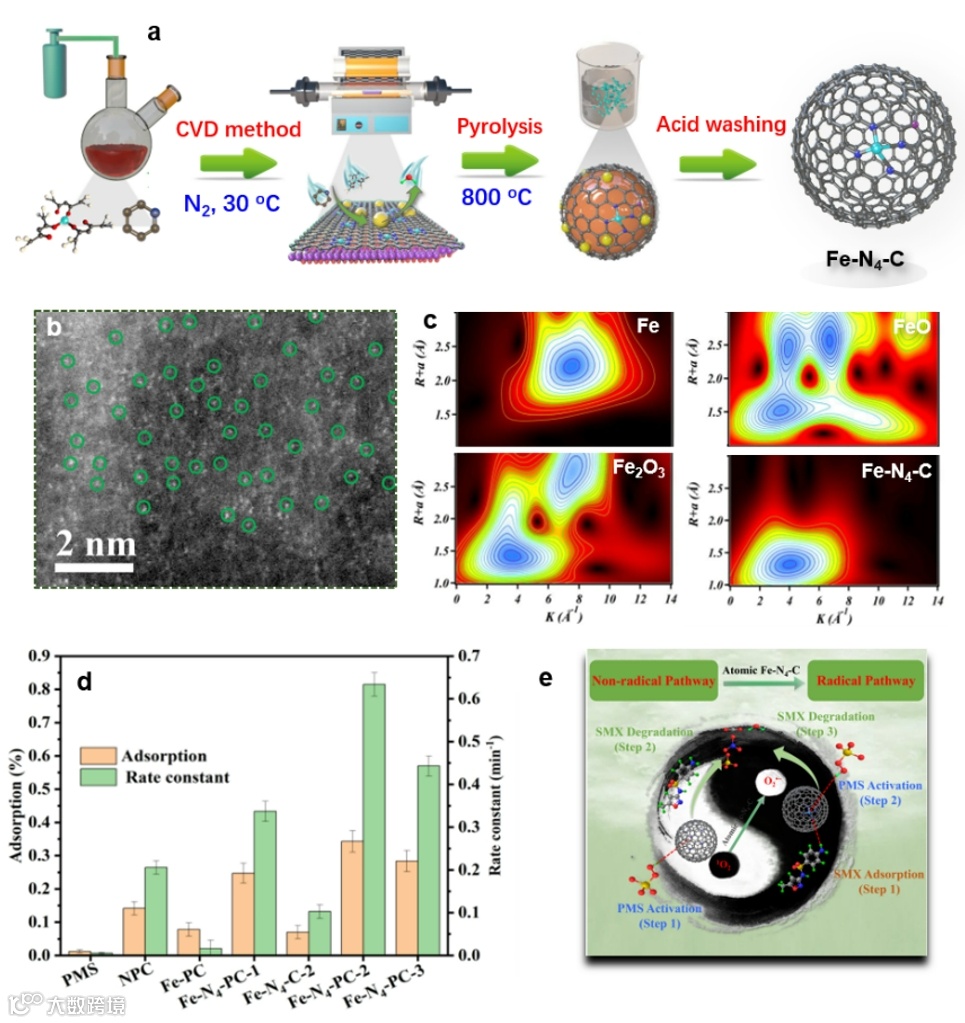
Figure 11. (a) Preparing scheme of as-prepared SACs with Fe-N4 sites; (b) HAADF-STEM image of the as-prepared SACs; (c) WT-XAFS analysis of the catalysts; (d) Adsorption and rate constants of catalysts with different catalytic sites; (e) Mechanism of SMX degradation in as-prepared SACs/PMS system. Copyright 2024, John Wiley and Sons.
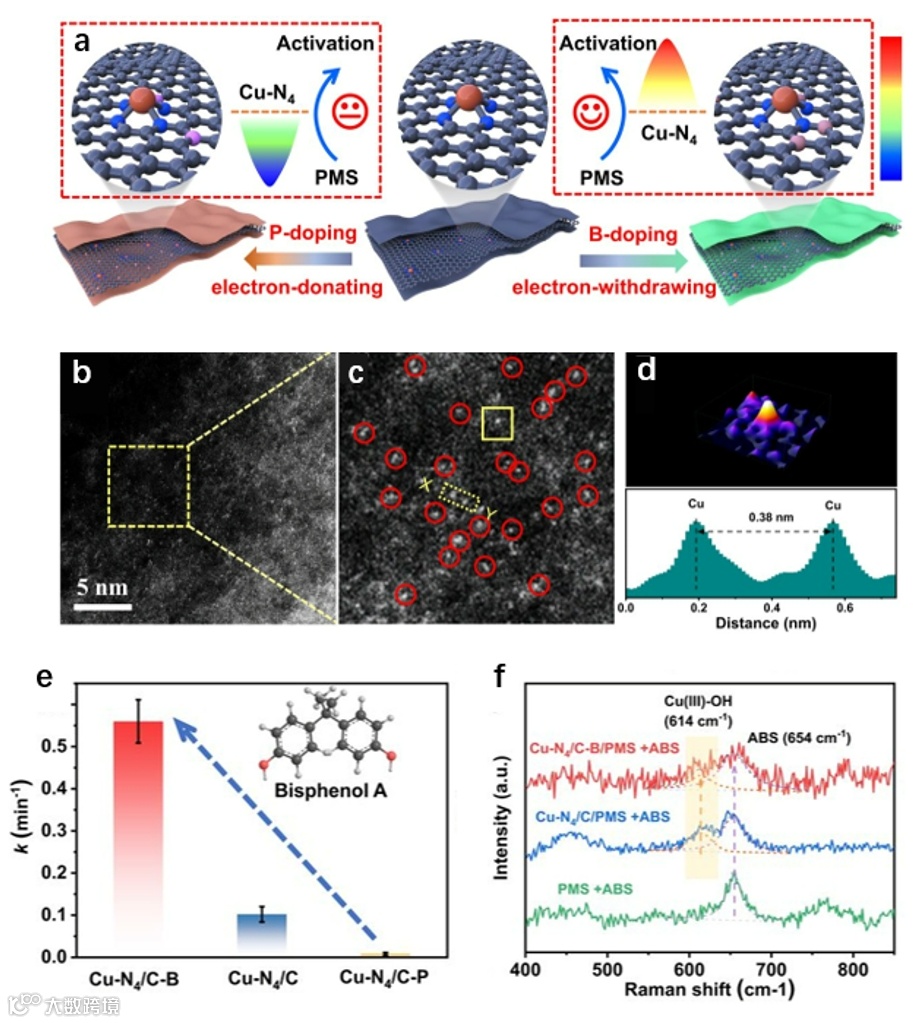
Figure 12. (a) Fabrication scheme for Cu-N4/C-B; (b) HAADF-STEM image of as-prepred catalyst, and (c) its enlarged intensity image; (d) Atom-overlapping mapping and intensity profile from c. (e) Degradation performances of BPA by all Cu-N4catalysts. (f) Raman spectra of the Cu-N4/C-B/PMS. Copyright 2024, John Wiley and Sons.
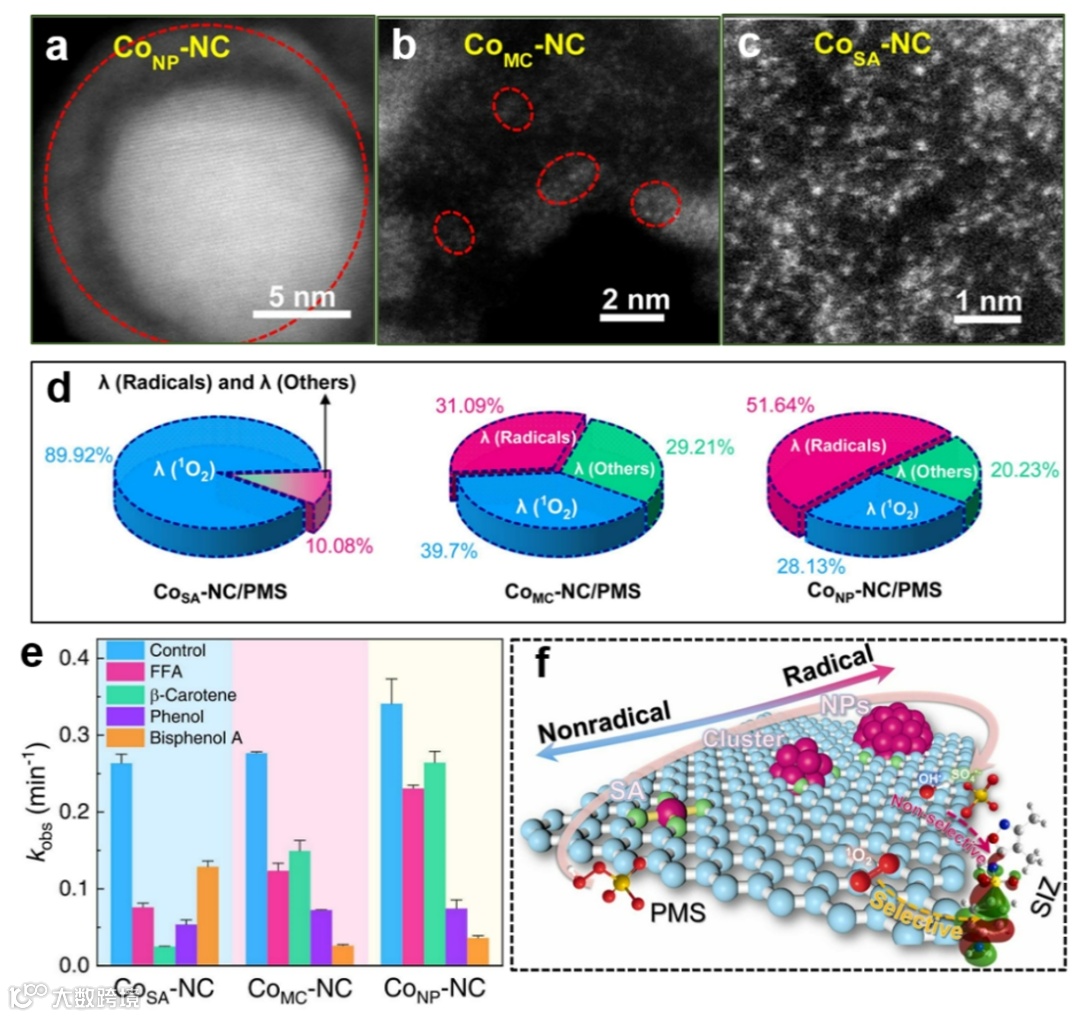
Figure 13. AC-HADDF-STEM of (a) CoNP-NC, (b) CoMC-NC, and (c) CoSA-NC; (d) Contribution of 1O2 for oxidizing organics in different metal-based catalysts/PMS systems; (e) Quenching results for different systems; (f) ROS generation related to the size of active center. Copyright 2024, John Wiley and Sons.
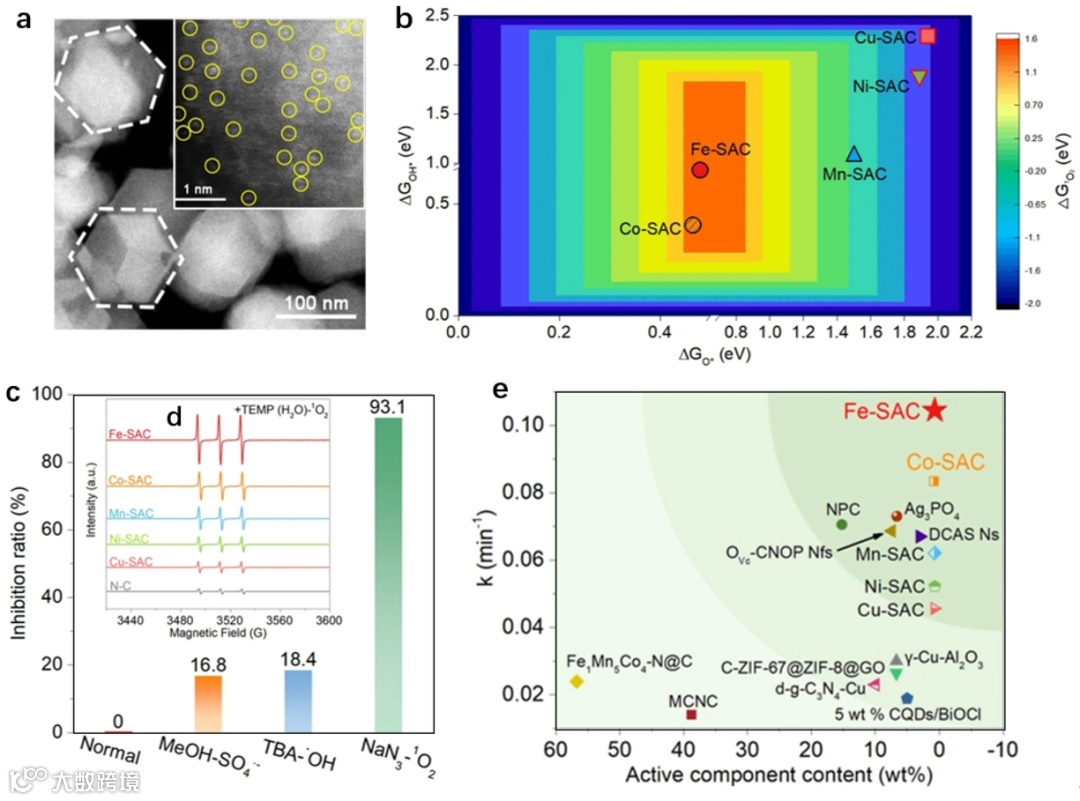
Figure 14. (a) HAADF-STEM of Fe-SAC, (b) The 3D volcano plot of ΔGOH*, ΔGO*, and ΔG1O2 of M-SACs (M: Fe, Co, Mn, Cu, Ni); (c) Quenchering results for BPA degradation in Fe-SAC/PMS system; (d) EPR spectra in M-SACs/PMS systems; (e) Comparison of oxidation rates of M-SACs with other catalysts. Copyright 2024, John Wiley and Sons.
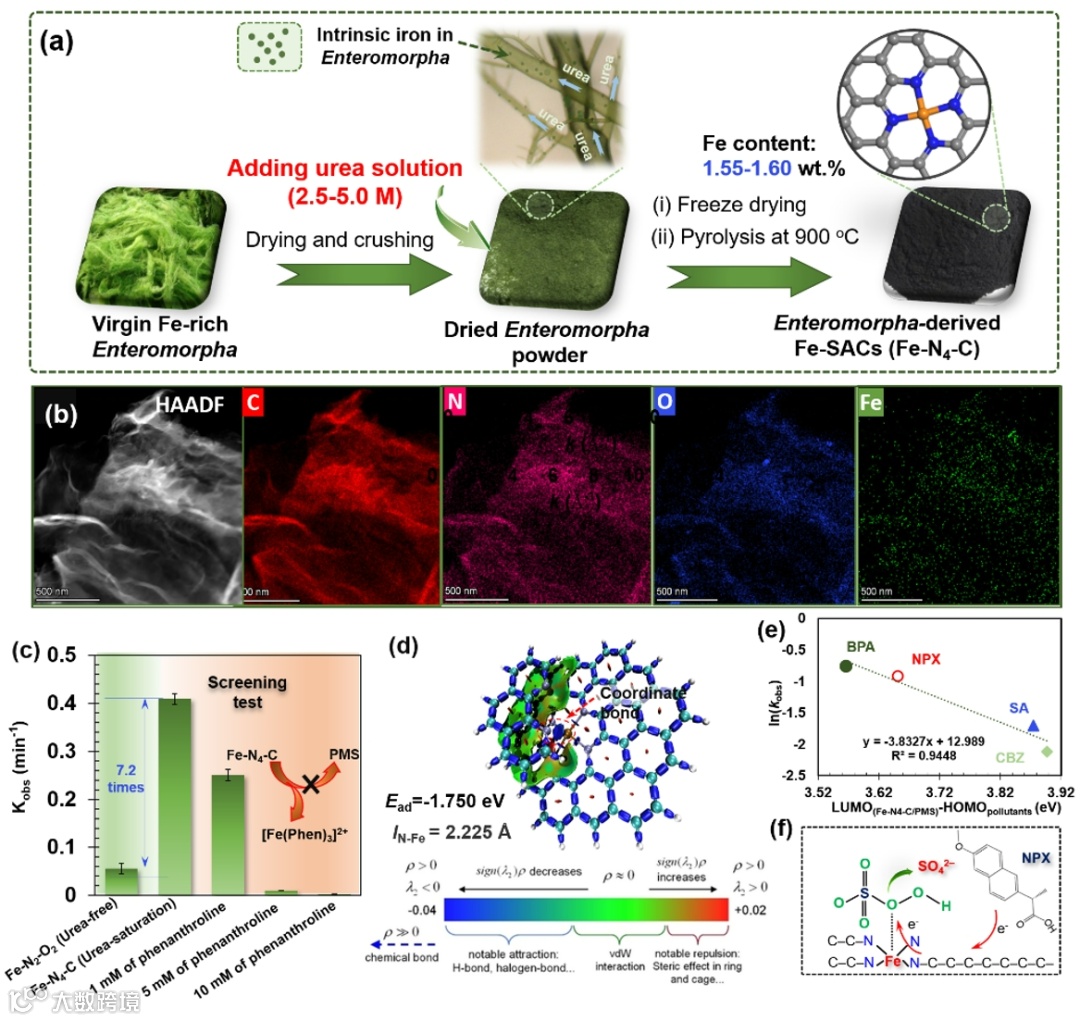
Figure 15. (a) Fabrication of the Fe-SAC from natural Fe-rich Enteromorpha; (b) HAADF-STEM image of Fe-SAC; (c) Activation activity of Fe-SAC based on the iron screening test; (d) The isosurface map of Fe-SAC coordinated with phenanthroline; (e) Linearity between ln(kobs) obtained in Fe-SAC/PMS system and their LUMO-HOMO gaps; (f) ETP mechanism in Fe-N4-C/PMS* system for oxidizing the pollutants. Copyright 2024, John Wiley and Sons.
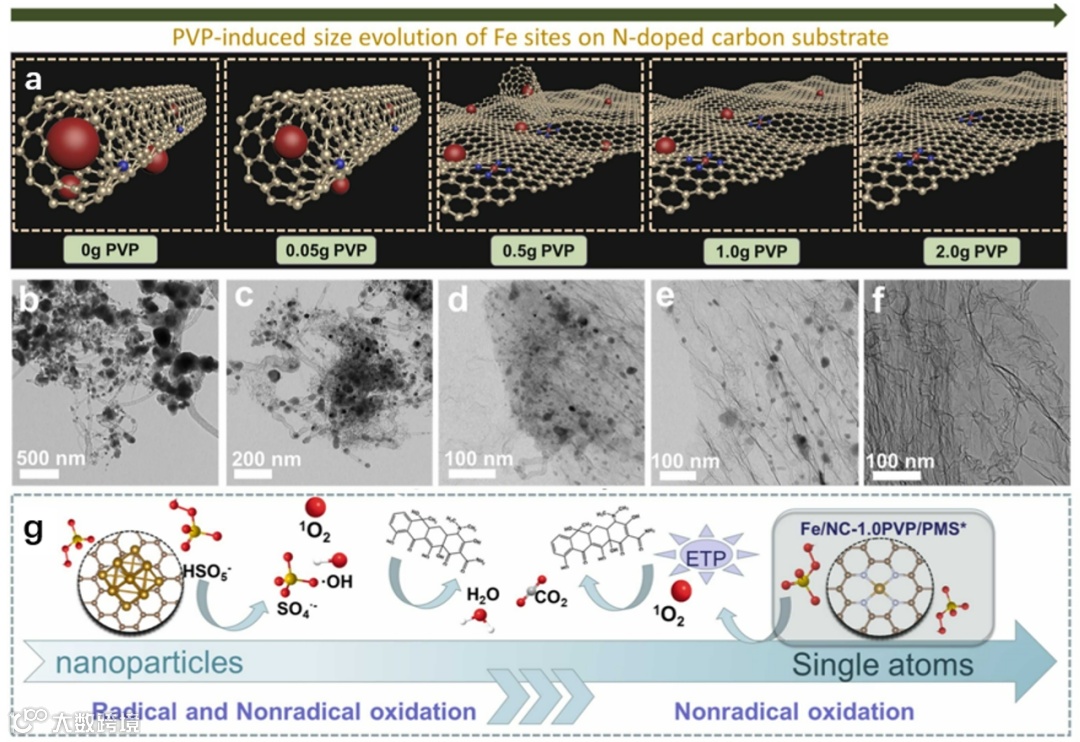
Figure 16. (a) Scheme of the Fe/NC-XPVP; (b-f) TEM images of various Fe/NC-XPVP; (g) Proposed TC degradation mechanism in iron-based catalysts with Fe centers varied from NPs to SACs. Copyright 2024, John Wiley and Sons.
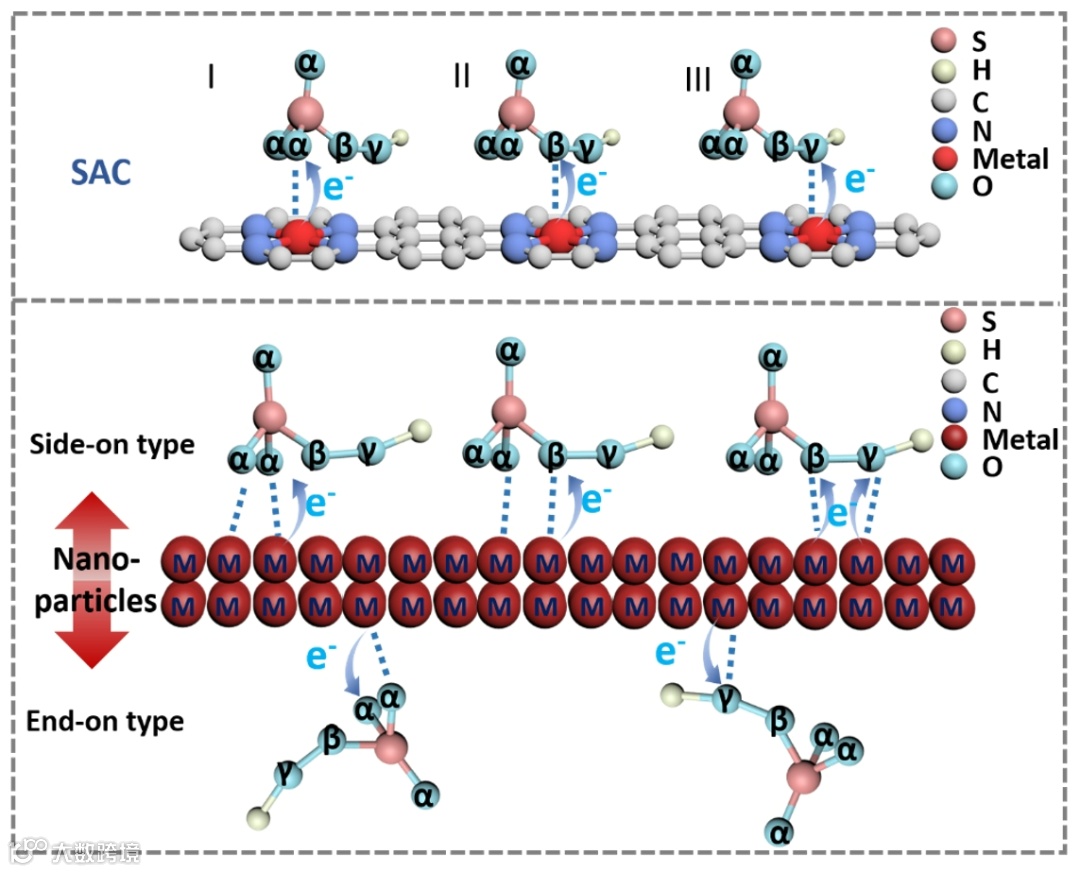
Figure 17. Adsorption configuration of persulfate with SACs and metal NPs based on their coordinations with different types of O atoms in persulfate. Copyright 2024, John Wiley and Sons.
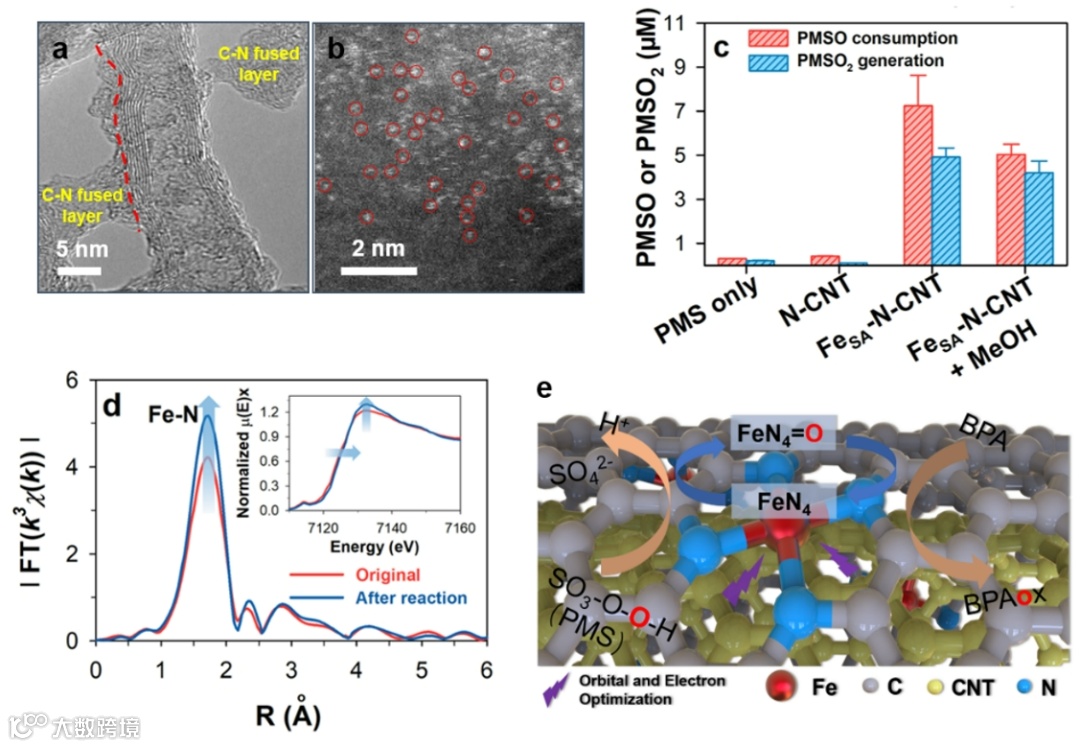
Figure 18. (a) TEM of FeSA-N-CNT; (b) HAADF-STEM of FeSA-N-CNT; (c) The consumption of PMSO and generation of PMSO2 in the catalyst/PMS systems; (d) XAFS of used FeSA-N-CNT catalyst; (e) Mechanism of FeN4=O intermediate generation. Copyright 2024, John Wiley and Sons.
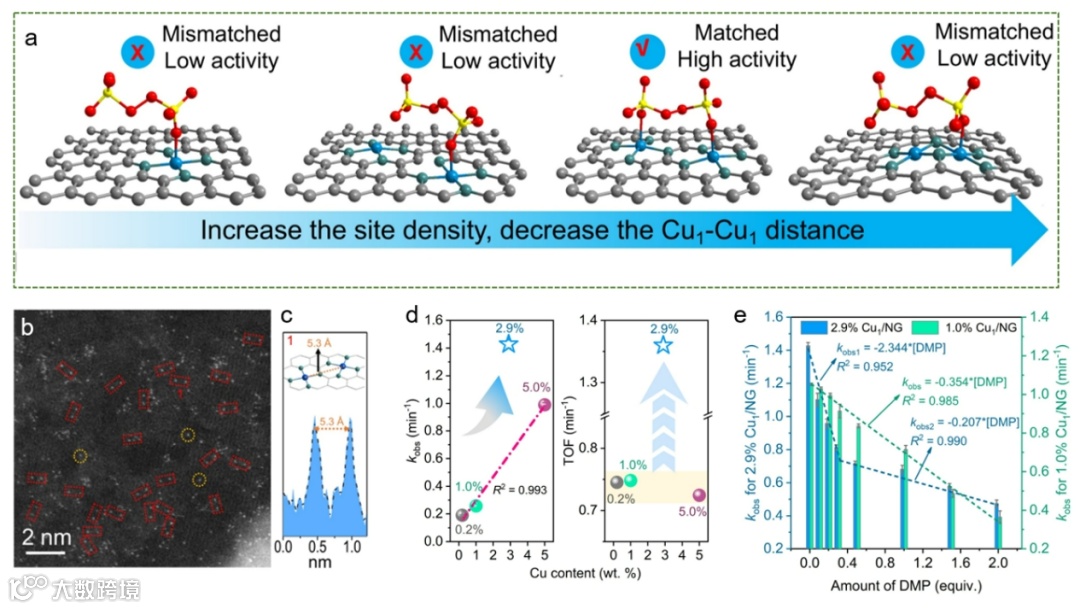
Figure 19. (a) Depiction of Cu1-Cu1 distance for PDS adsorption and activation; (b) HAADF-STEM image of Cu1/NG with 2.9 wt.% of Cu loading; (c) First-order rate constants and TOFs of BPA degradation by different Cu1/NG/PDS sysems; (d) Poisoning Cu atom tests of Cu1/NG catalysts for PDS activation. Copyright 2024, John Wiley and Sons.
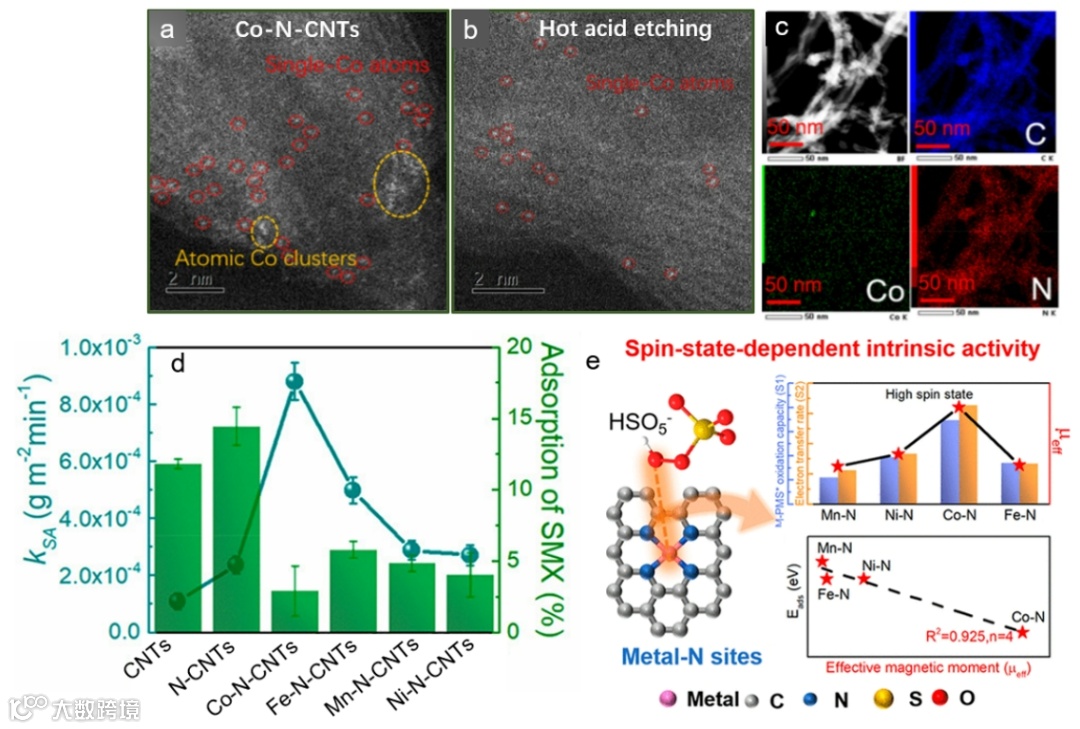
Figure 20. HAADF-STEM image of (a) Co−N−CNTs catalyst, and (b) Co−N−CNTs after hot acid etching; (c) EDS images of as-prepared catalyst; (d) specific activity and adsorption capacity of different catalysts; (e) Spin-state-dependent intrinsic reactivity of different M–N sites for PMS activation. Copyright 2024, John Wiley and Sons.
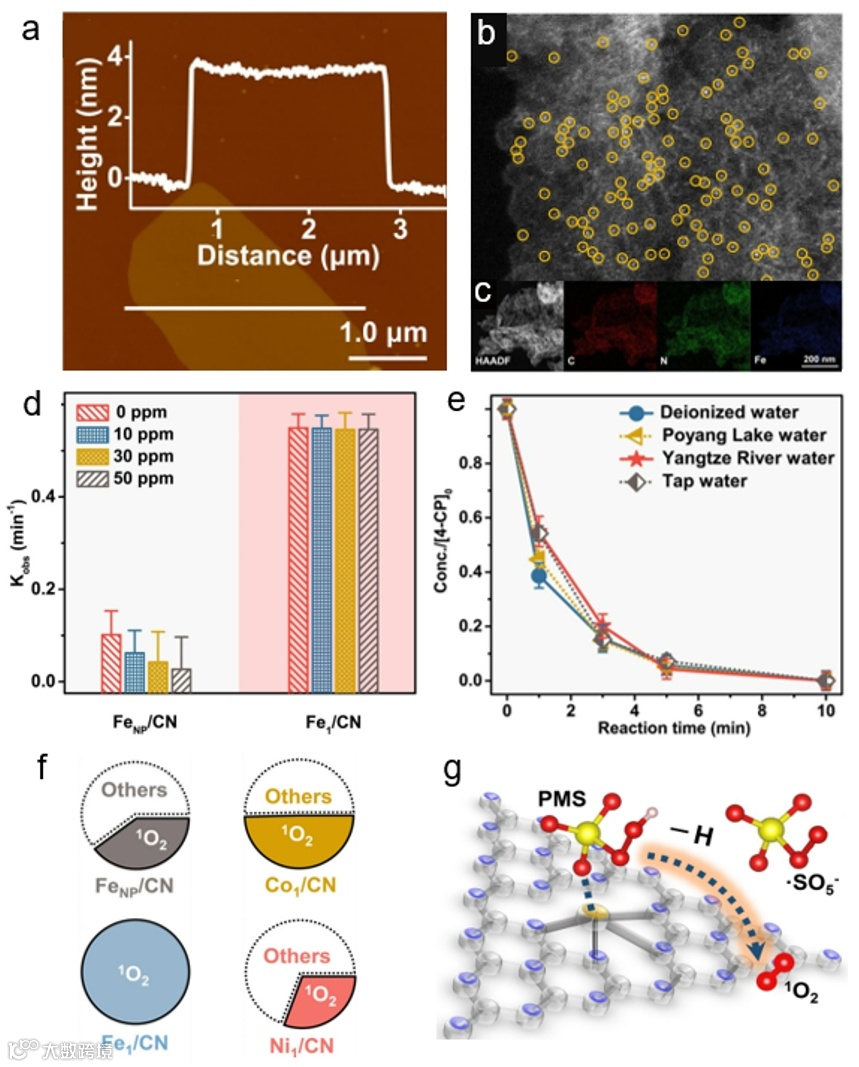
Figure 21. (a) AFM and the height profiles for the SA Fe/CN catalyst; (b) AC-HAADF STEM image of resulting catalyst; (c) EDS of SA Fe/CN; (d) The kobs for 4-CP at different NOM levels; (e) Degradation of 4-CP by Fe/CN activating PMS in versatile natural waters; (f) Proportion of 1O2 generated in different SACs/PMS systems; (g) Mechanism scheme of Fe/CN for PMS activation. Copyright 2024, John Wiley and Sons.
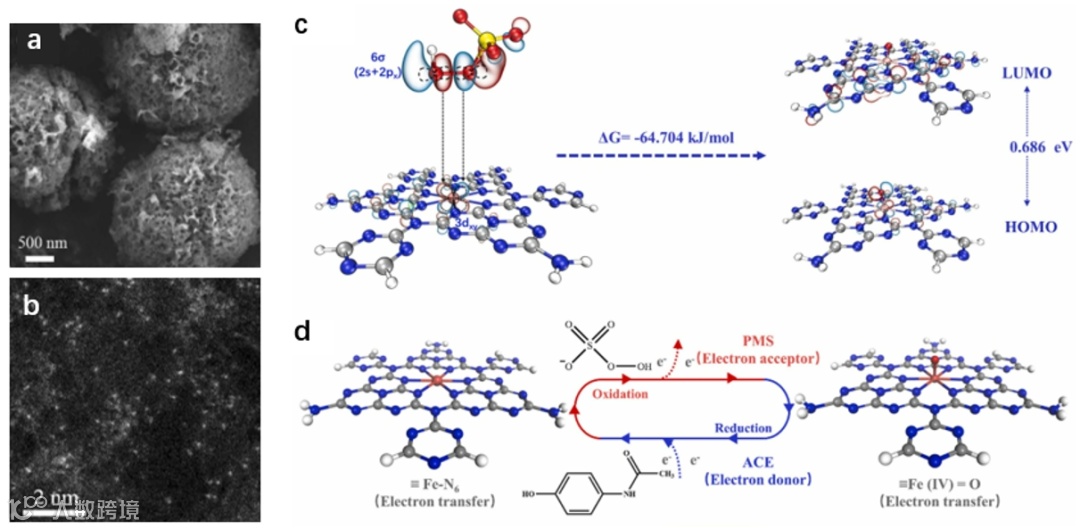
Figure 22. (a) SEM of Fe-SA/PHCNS; (b) HAADF-STEM image of Fe-SA/PHCNS; (c) HOMO of Fe-SA/PHCNS and LUMO of HSO5−; (d) Fe–N6/FeN6=O circular reaction. Copyright 2024, John Wiley and Sons.
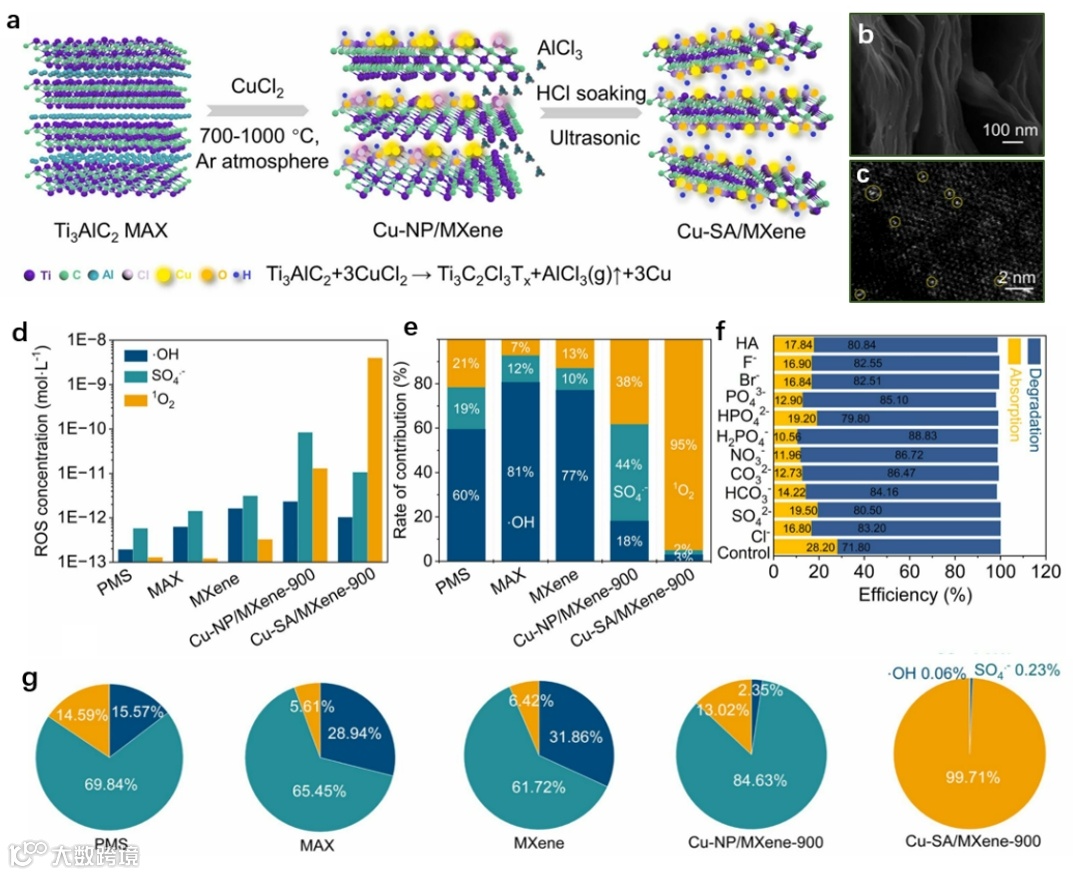
Figure 23. (a) Synthesis scheme of MXene-based Cu-SACs. (b) SEM image of resulting catalysts, (c) HADDF-STEM image of resulting catalysts; Different catalytic systems with (d) different active species concentrations, and (e) ROS proportion. (f) Effect of inorganic ions on the adsorption and degradation efficiency of BPA; (g) ROS contribution for pollutant degradation. Copyright 2024, John Wiley and Sons.
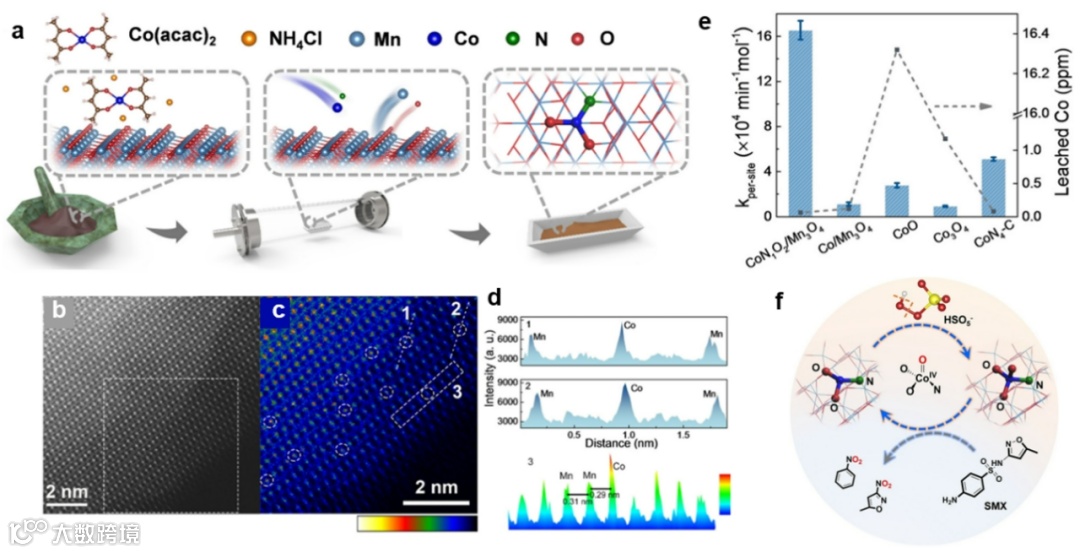
Figure 24. (a) Fabrication scheme of CoN1O2/Mn3O4. (b) HAADF-STEM image of CoN1O2/Mn3O4. (c) Enlarged view of the marked region in (b), and (d) intensity of surface plots; (e) Normalized Co-site activity and leached Co ions for different Co-based catalysts; (f) Proposed mechanism in CoN1O2/Mn3O4/PMS system for SMX oxidation. Copyright 2024, John Wiley and Sons.
5. 金属NPs和SACs催化机理的DFT分析
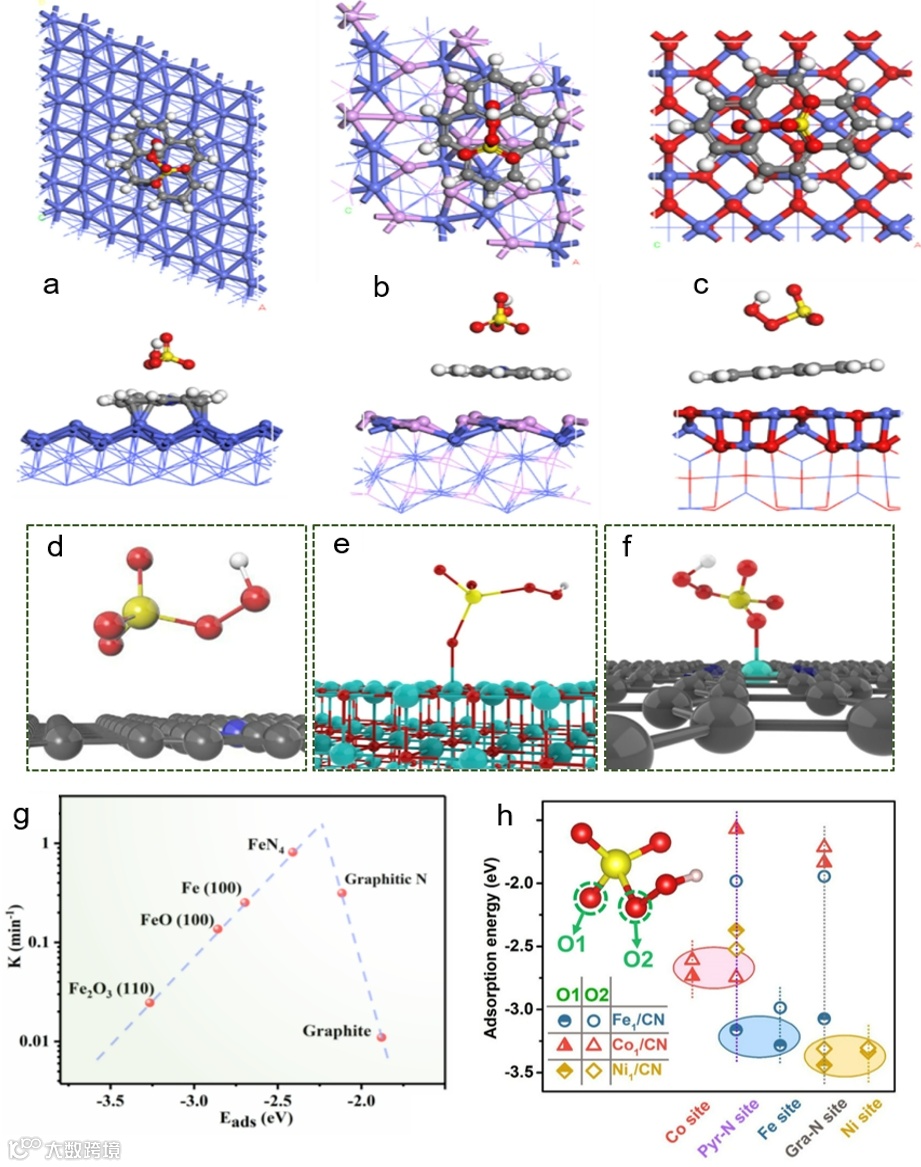
Figure 25. Adsorption models of PMS onto (a) Co@C, (b) CoP@C, and (c) Co3O4@C; Adsorption configurations of PMS with (d) graphitic N/graphene, (e) MnO (100) and (f) Mn-N4/graphene; (g) Volcano plots of FeN4 and other catalytic sites; (h) The Eads values of PMS onto versatile metal single-atom sites. Copyright 2024, John Wiley and Sons.
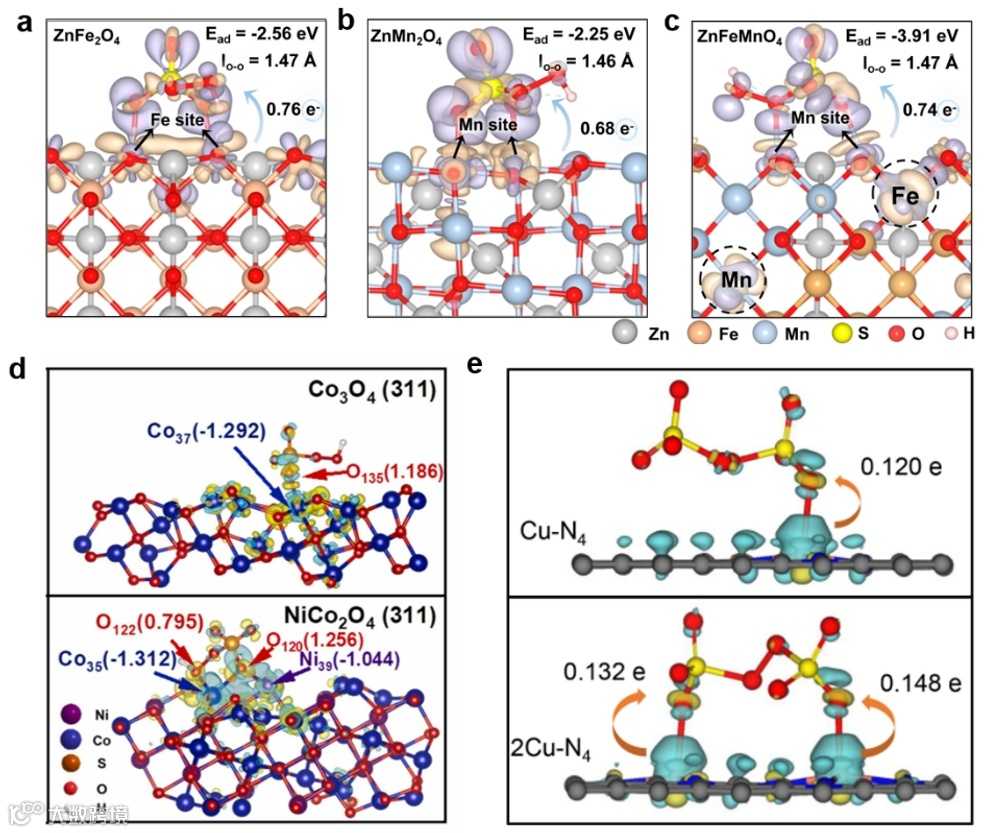
Figure 26. (a-c) Charge density differences of ZnFe2-xMnxO4 configurations. (d) Adsorption energies of PMS onto Co3O4 and NiCo2O4; (e) Electron density differences for binding PDS by different copper atoms sites. Copyright 2024, John Wiley and Sons.
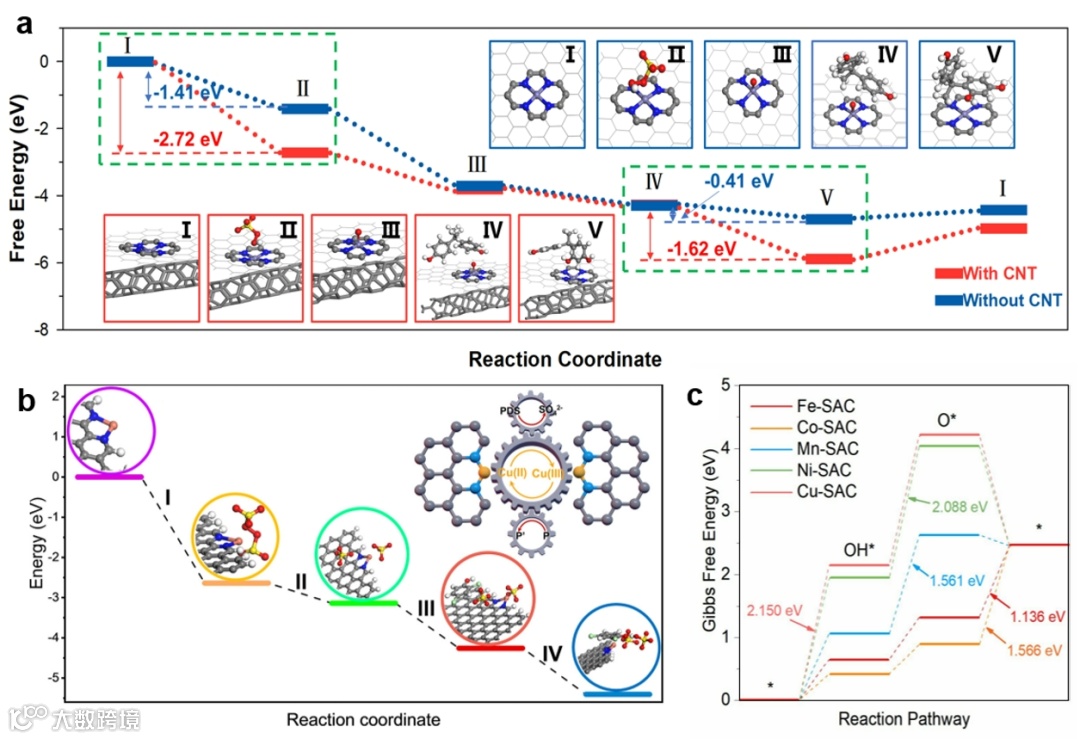
Figure 27. (a) Reaction pathway towards the activation of PMS by the single iron atoms considering the existence of CNT. (b) Reaction pathways towards the activation of PDS and oxidation of 2,4-DCP on a single-atom copper catalyst. (c) Reaction pathways of 1O2 formation at different metal-N-C sites. Copyright 2024, John Wiley and Sons.
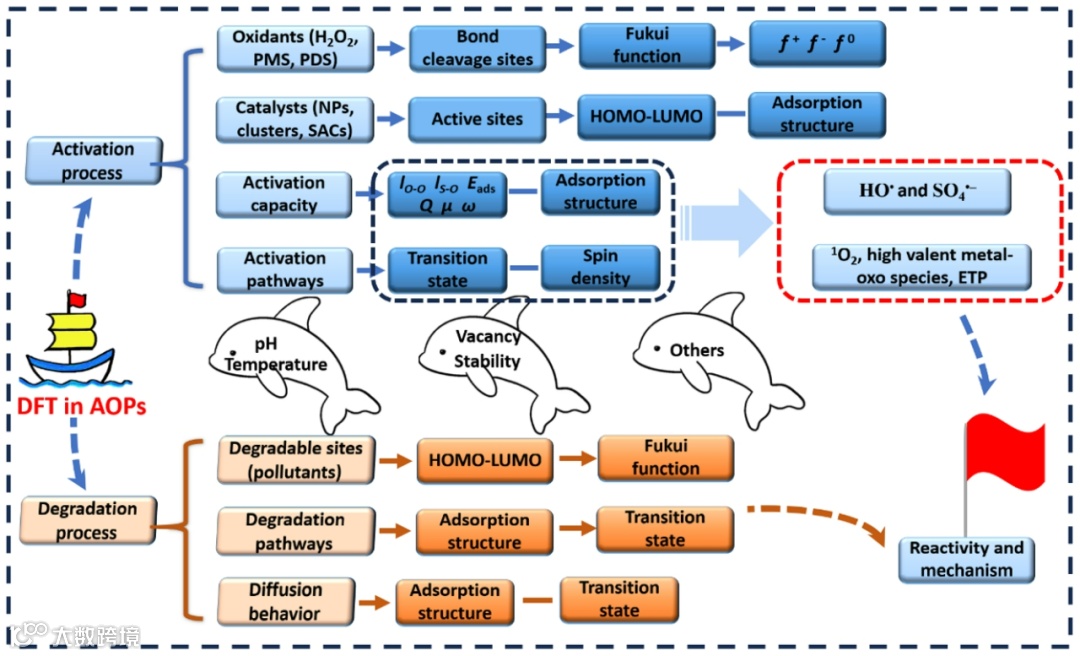
Figure 28. Guideline scheme of DFT calculations in AOPs. Copyright 2024, John Wiley and Sons.
6. 负载金属NPs和SACs的类Fenton催化膜/过滤器
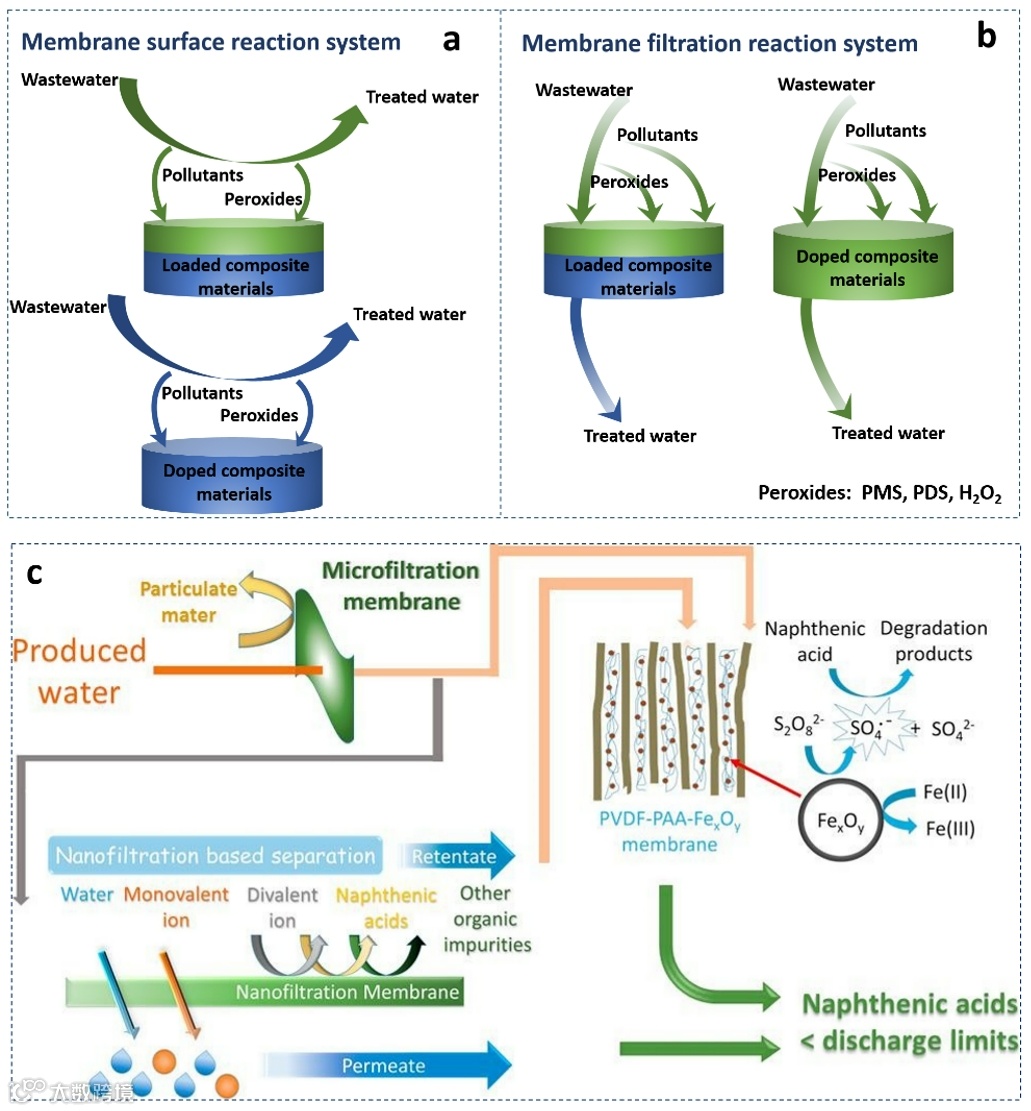
Figure 29. (a) Immersion style, and (b) filtration style for different membrane-based reaction systems; (c) Cross-flow filtration apparatus of iron oxides-based membrane/PDS systems. Copyright 2024, John Wiley and Sons.
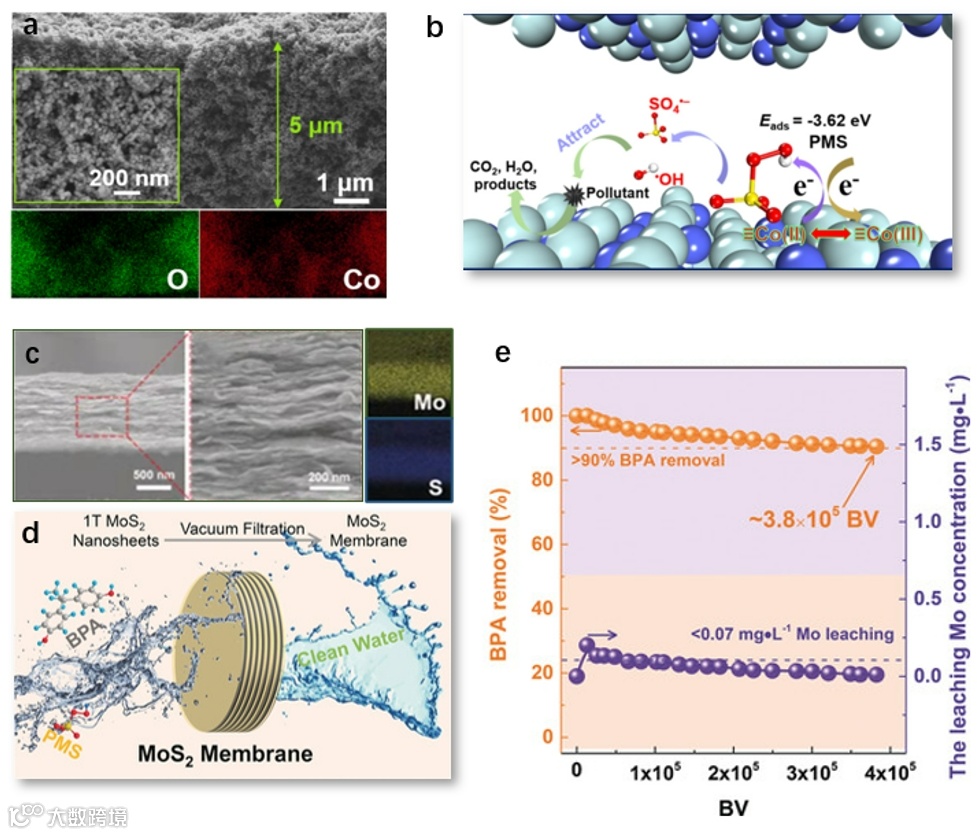
Figure 30. (a) SEM and EDX of Co3O4 membrane; (b) Mechanism of Co3O4 membrane for PMS activation. (c) SEM and EDX of MoS2 membrane; (d) Scheme of the BPA removal by MoS2 membrane; (e) BPA removal efficiency and Mo leaching in a continuous-flow MoS2 membrane system. Copyright 2024, John Wiley and Sons.
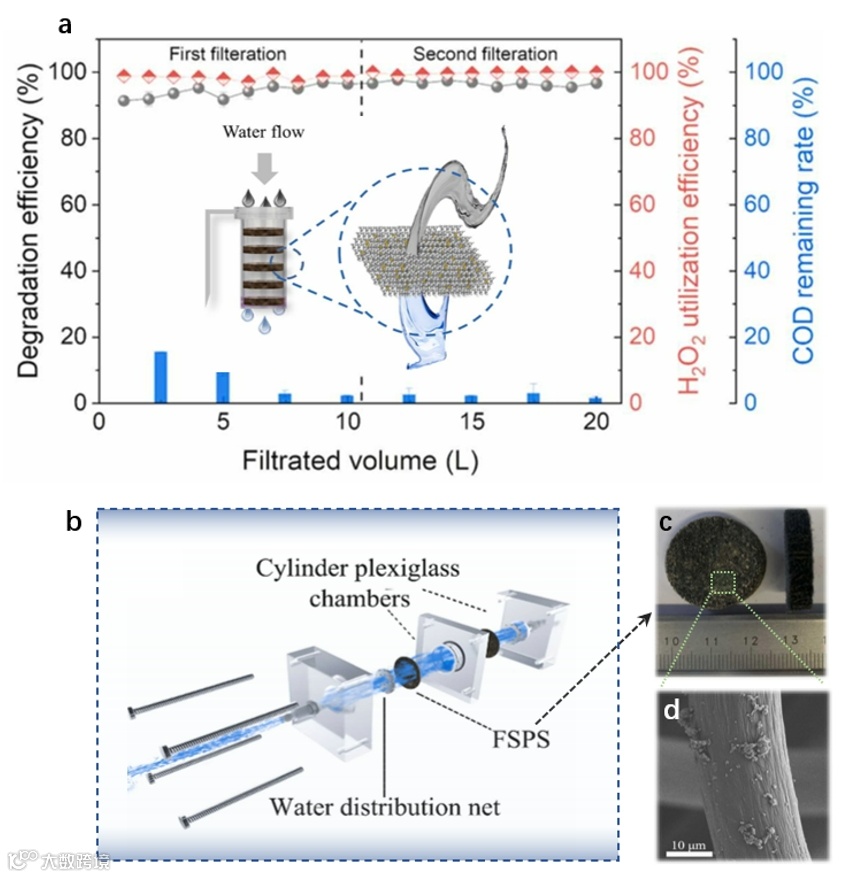
Figure 31. (a) A flow-through filter coating with Fe-g-C3N4 for actual wastewater treatment. (b) Schematic illustration of FSPS packed reactor. (c) Photo of the FSPS. (d) SEM of the FSPS. Copyright 2024, John Wiley and Sons.
7. 类芬顿金属NPs和SACs的中试规模和工程应用
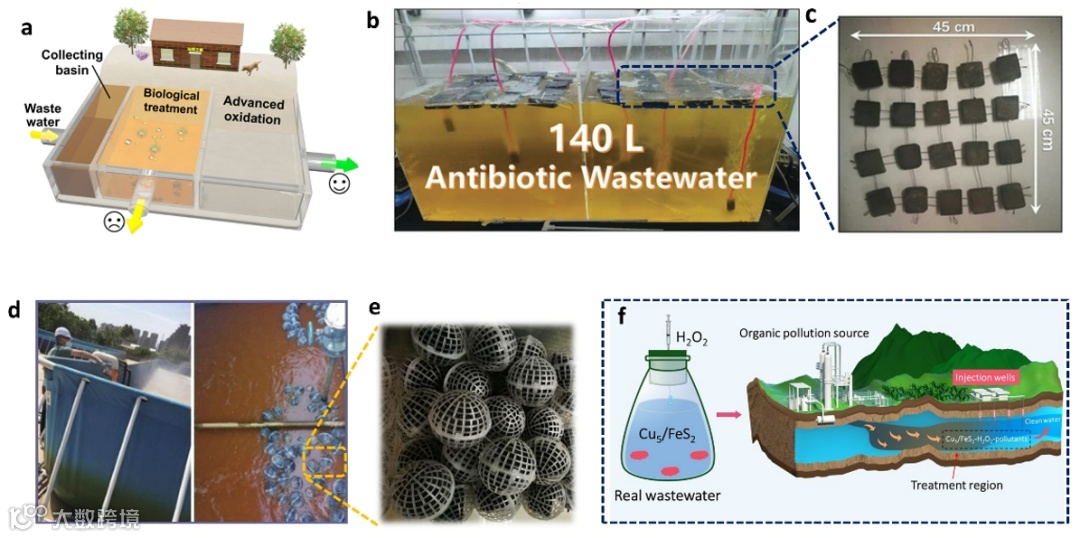
Figure 32. (a) Schematic illustration of treatment technologies for wastewater. (b) Actual photo of the 140 L reaction device; (c) Actual photo of the medium-style enlarged SMG. (d) Field view of the SMG-S in practical application for the treatment of thermal dehydrating wastewater; (e) Real photo of SMG-S in the polypropylene suspension spheres. (f) Conceptual scheme of the treatment of industrial effluents as well as on-site remediation of groundwaters and soils by Cu5/FeS2 and H2O2. Copyright 2024, John Wiley and Sons.
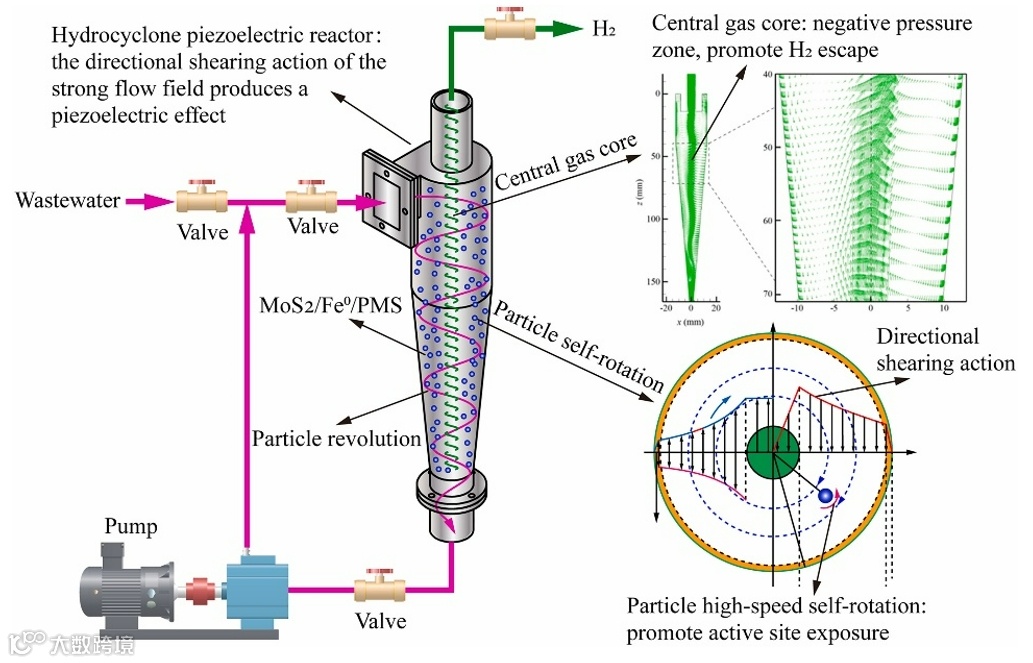
Figure 33. Design drawing of resulting piezoelectric reactor for engineering applications of simultaneous H2 generation and pollutant oxidation. Copyright 2024, John Wiley and Sons.
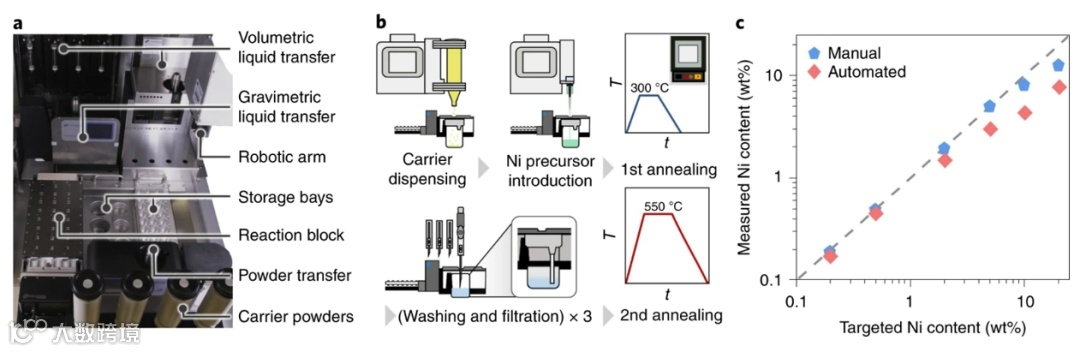
Figure 34. (a) Photo of the automated synthesis scheme using a robotic platform; (b) Flow chart of the synthesis scheme. (c) Comparison of metal contents of Ni-SACs between manual and automated synthesis. Copyright 2024, John Wiley and Sons.
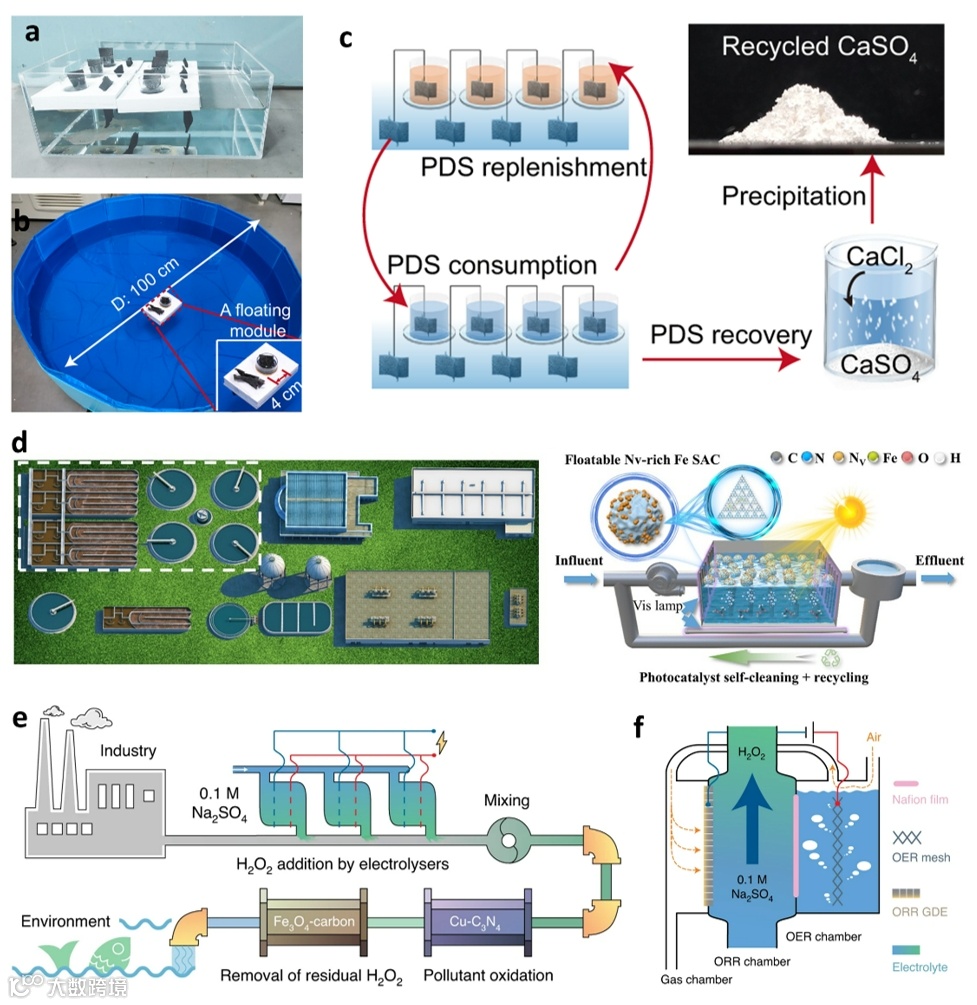
Figure 35. (a) The DOP system with Cu-SACs cooperated graphite felt electrodes; (b) A large scale 200 L of floating water treatment unit of DOP system; (c) Schematic drawing of PDS consumption and replenishment as well as recovery of CaSO4 in the DOP system; (d) Schematic drawing of Nv-rich Fe SACs immobilized in the commercial polystyrene spheres as the three-dimensional floatable macrostructures for sewage treatment; (e) Scheme of a sewage treatment system coupling with the electrolytic H2O2 generator, Cu-SAC filters and residual H2O2 treatment device in series; (f) Scheme of the H2O2 electrolyser. Copyright 2024, John Wiley and Sons.
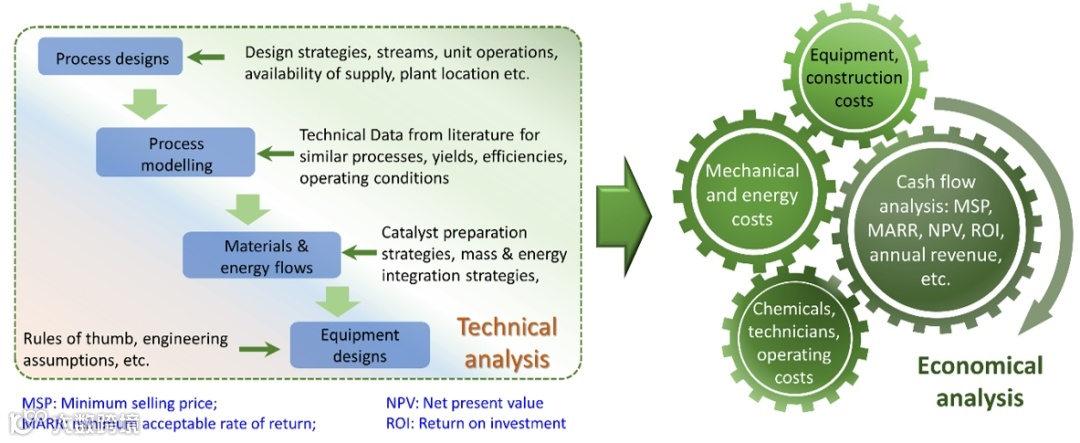
Figure 36. Application of techno-economic analysis for assessment of metal NPs and SACs-based Fenton-like systems. Copyright 2024, John Wiley and Sons.
8. 结论和未来展望




声明

“邃瞳科学云”直播服务

扫描二维码下载
邃瞳科学云APP