

第一作者:袁凯文
通讯作者:陈代梅、朱永法
通讯单位:中国地质大学(北京)、清华大学
论文DOI:10.1002/adfm.202528553

零价铁(ZVI)常应用于过一硫酸盐高级氧化技术(PMS-AOPs)中。然而,ZVI与表面铁氧化壳之间的肖特基势垒阻碍了电子的传输。本研究通过使用金属有机框架(MOFs)作为前驱体的一步碳化法,成功制备了N掺杂的零价铁复合碳材料(N-sZVI@NC)。N元素掺入Fe晶格引起的拉伸应变效应提高了ZVI的费米能级,从而降低了肖特基势垒。势垒的降低使得更多的电子激活PMS,产生·SO4-和·OH自由基。同时,具有强电子传输能力的sp2共轭碳材料促进了电子传输降解过程。N-sZVI@NC/PMS系统通过同时捕获富电子污染物和PMS实现了双途径协同氧化,在持久性有机污染物降解中表现出卓越的效率。其动力学常数和PMS利用率达到0.15 min-1和48.4%,分别是无N掺杂的nZVI@C的7.5倍和3.1倍。N-sZVI@NC-2表现出极好的稳定性,在连续流反应实验的10个周期内保持超过90%的降解效率,展现出处理土壤和工业废水的出色实际能力。总体而言,本研究为开发活性高且稳定的ZVI复合材料提供了新的见解。
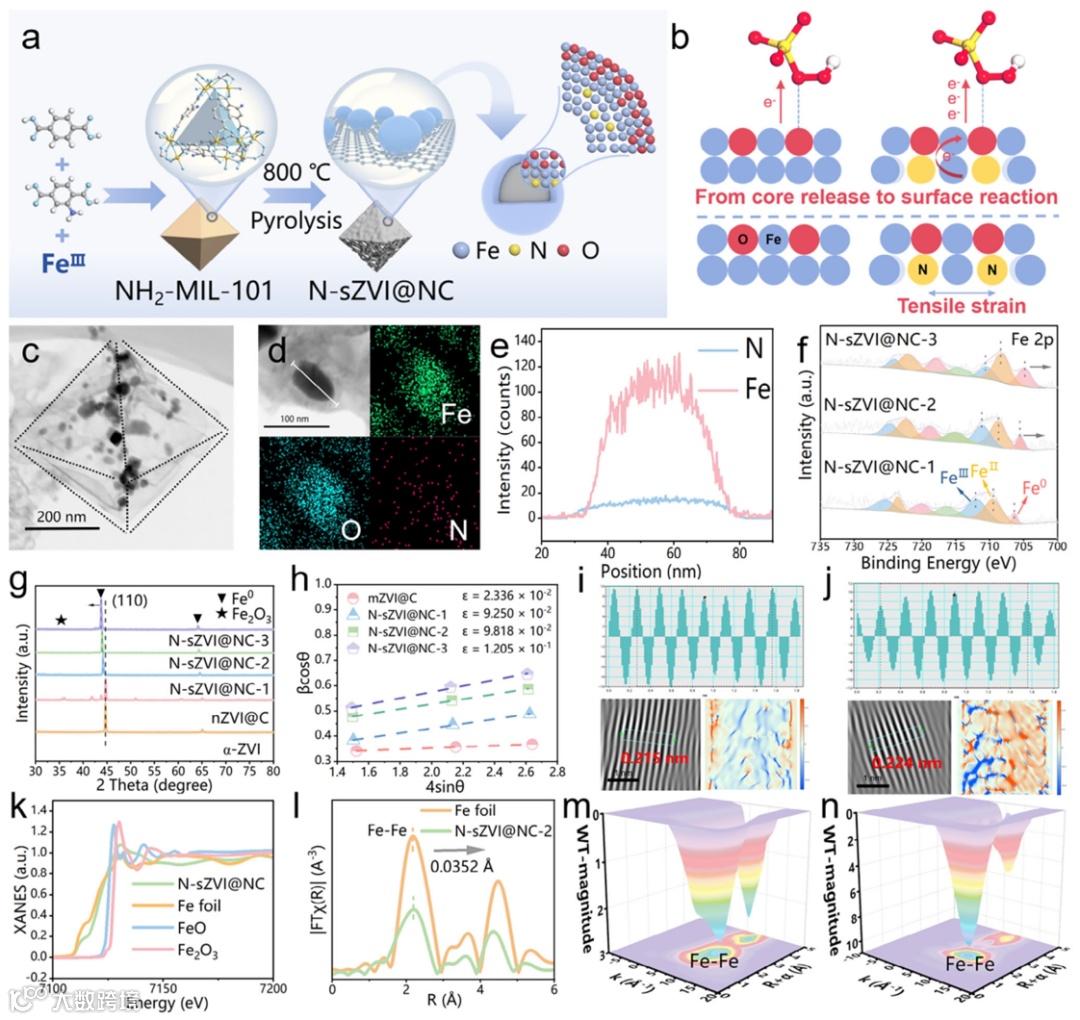
Figure 1. Synthesis and characterization of N-sZVI@NC-x: a) Preparation process of N-sZVI@NC-x. b) The effect of interstitial nitrogen doping on the ZVI scheme on PMS adsorption and activation. c-e) HRTEM and HRTEM-EDS (line profile and mapping) of N-sZVI@NC-2. f) XPS spectra of Fe 2p for N-sZVI@NC-x. g) XRD patterns of ZVI-based materials. h) Corresponding W-H analysis of the N-sZVI@NC-x. i, j) Inverse fast Fourier transformation images and GPA analysis of nZVI@C and N-sZVI@NC-2. k) Fe K-edge XANES spectra of N-sZVI@NC-2. l) Fe K-edge EXAFS spectra of N-sZVI@NC-2. m, n) WT-EXAFS for K-edge for nZVI@C and N-sZVI@NC-2.
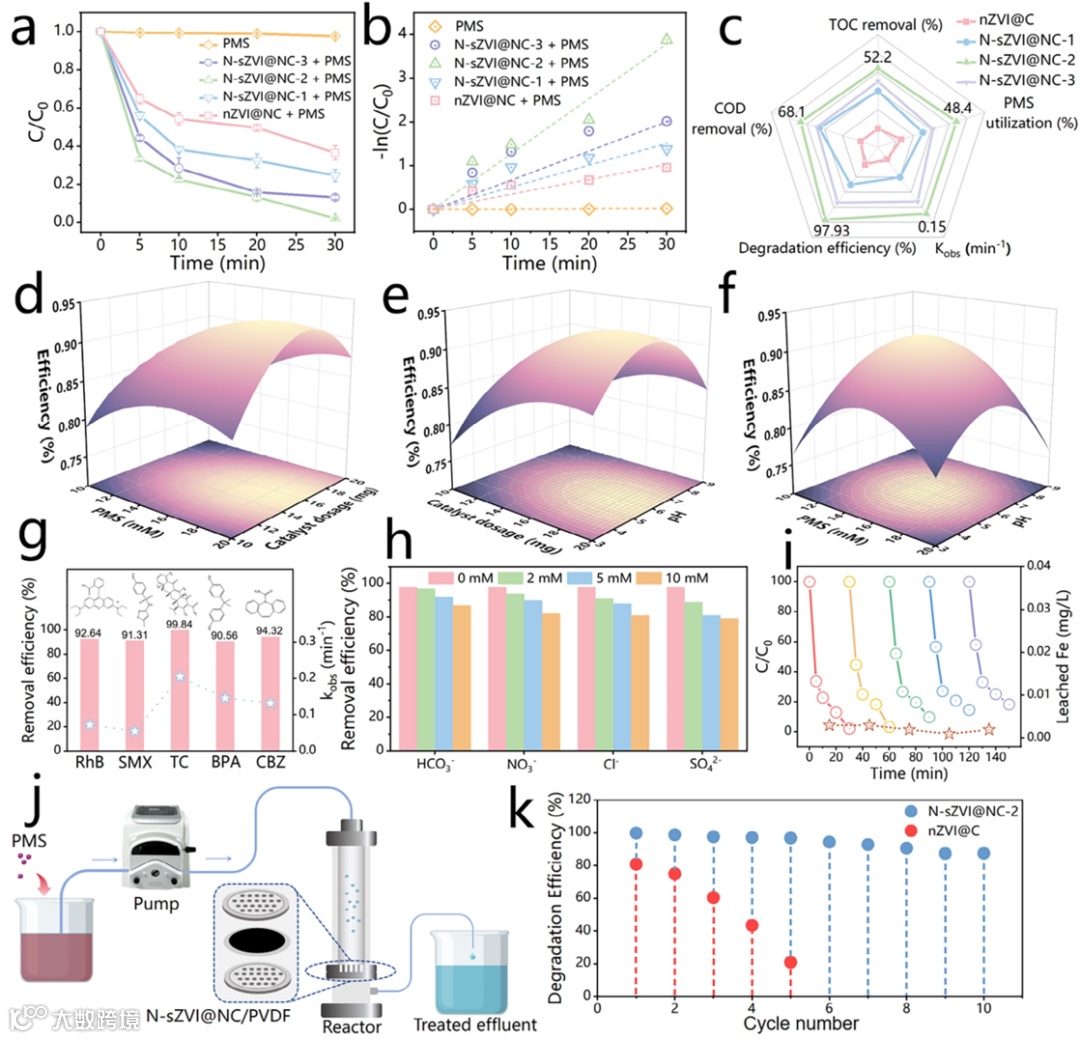
Figure 2. Highly efficient Fenton-like reactivity of N-sZVI@NC-x: a) Degradation rate of CIP in different reaction systems. b) Corresponding reaction rate constants in different reaction systems (Conditions: [catalyst]0 = 0.3 g L-1, [PMS] = 0.3 mm, [pH] = 6.0, [CIP] = 30 mg L-1, [temperature] = 20 ± 2 °C). c) Comparison of parameters for nZVI@C and N-sZVI@NC-x. d-f) 3D surface plot of the effect of PMS dosage, catalyst dosage, and pH value on CIP degradation efficiency. g) Removal of multiple organic pollutants by N-sZVI@NC-2. h) Effects of inorganic anions on the N-sZVI@NC-2/PMS system. i) Cyclic stability of five consecutive cycles in the N-sZVI@NC-x/PMS system. j) Constant flow reactor schematic diagram. k) Continuous removal of CIP in nZVI@C/PMS and N-sZVI@NC-2/PMS systems.
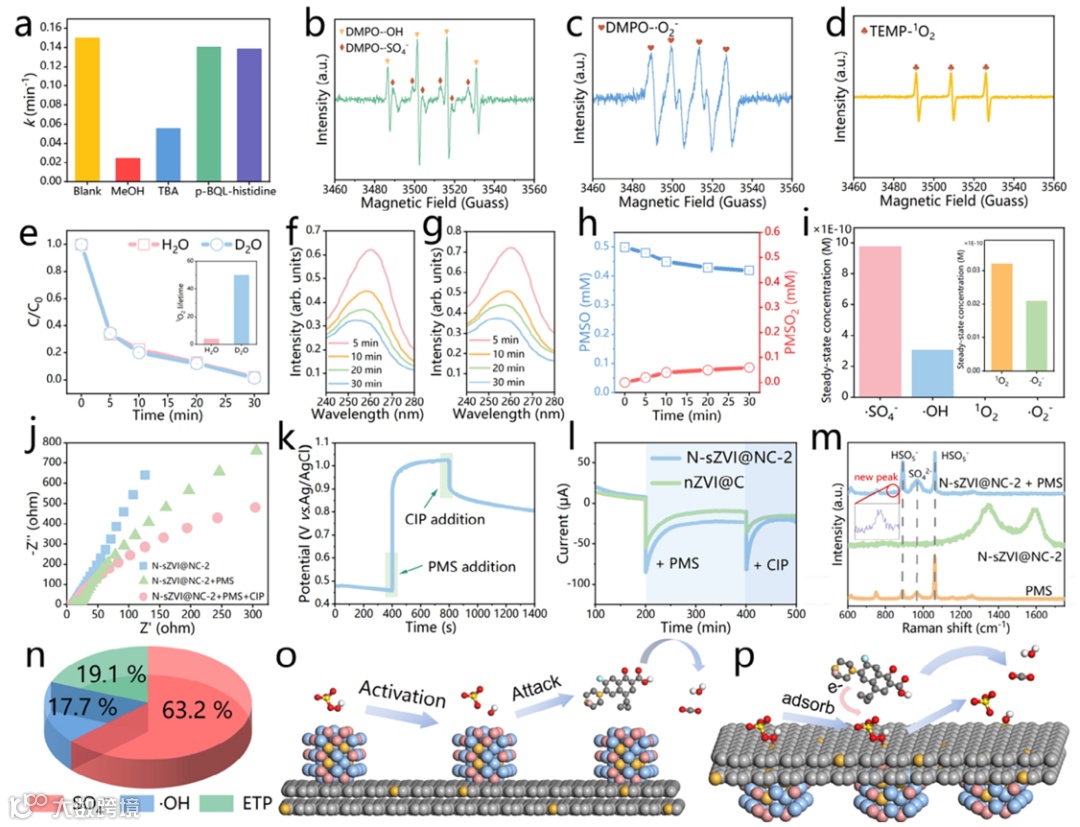
Figure 3. Mechanistic insights into the N-sZVI@NC/PMS system: a) Effect of different quenchers on the first-order rate of the N-sZVI@NC-2/PMS system. b) EPR spectra of DMPO-·SO4- and DMPO-·OH. c) EPR spectra of DMPO-·O2-. d) EPR spectra of TEMP-1O2. e) Degradation rate of CIP in H2O and D2O. UV spectra of NBT transformation for determining ·O2- in the f) N-sZVI@NC-2/PMS system and g) N-sZVI@NC-2/PMS/CIP system. h) PMSO transformation experiment for detecting high-valent Fe species. i) Steady-state concentrations of different ROS. j) Electrochemical impedance spectroscopy analysis in different systems. k) Open-circuit potential of the N-sZVI@NC-2/PMS system. l) Amperometric i-t curves in different systems with nZVI@C and N-sZVI@NC-2 as working electrodes. m) In situ Raman spectroscopy of different reaction systems. n) Contribution of ·SO4-, ·OH and ETP to CIP degradation. o) Diagram of the radical pathway. p) Diagram of the ETP pathway.
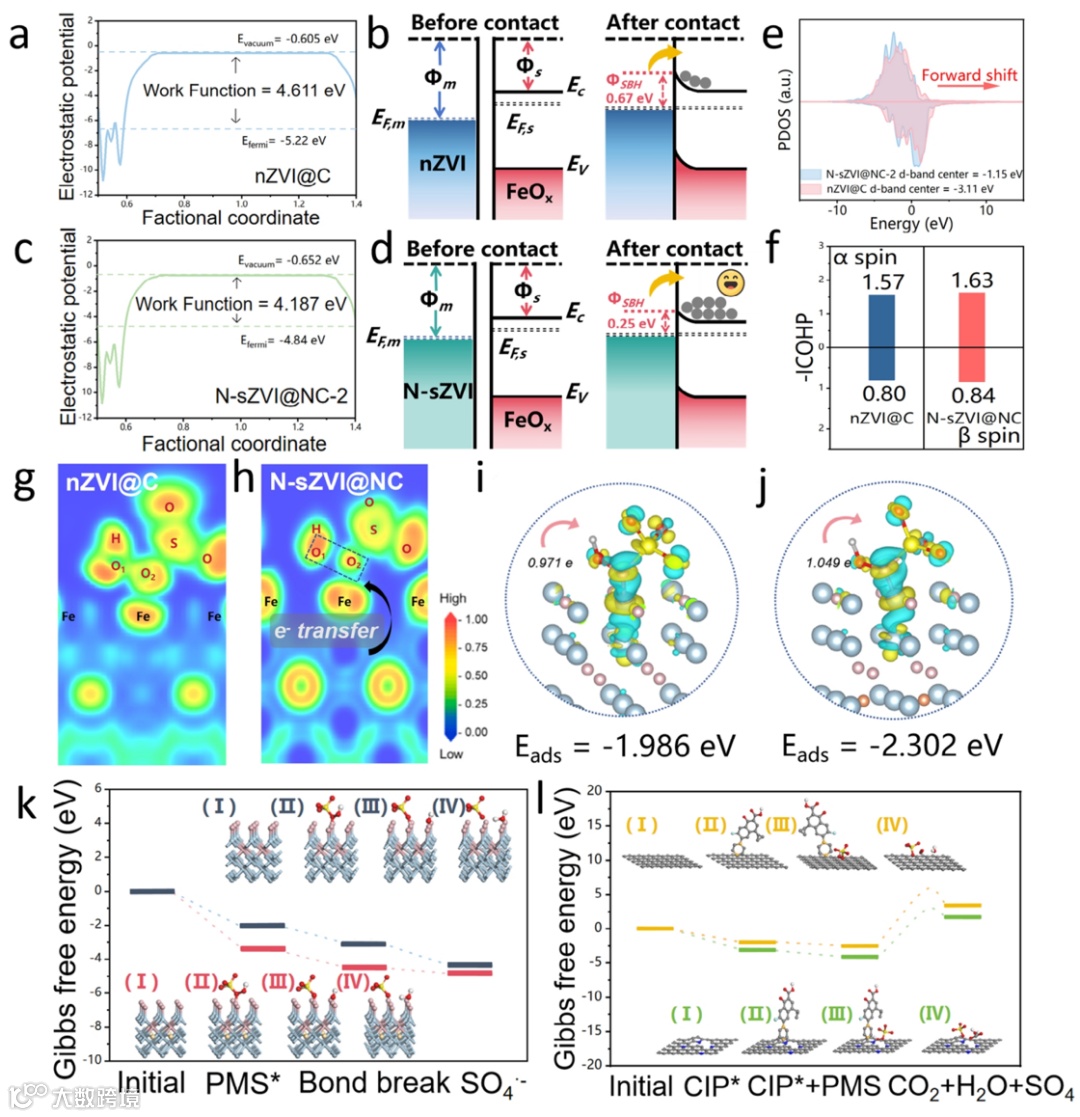
Figure 4. Density functional theory calculations: Work function of a) nZVI@C and c) N-sZVI@NC-2. Schematic of the electron transfer process driven by the Schottky interface between b) nZVI@C, d) N-sZVI@NC-2, and FeOx. e) pDOS of nZVI@C and N-sZVI@NC-2. f) ICOHP values of nZVI@C and NsZVI@NC-2. ELF slices of g) nZVI@C and h) N-sZVI@NC-2. PMS adsorption energy and differential charge density of i) nZVI@C and j) N-sZVI@NC-2. k) Gibbs free energy of free radical process. l) Gibbs free energy of the ETP process.
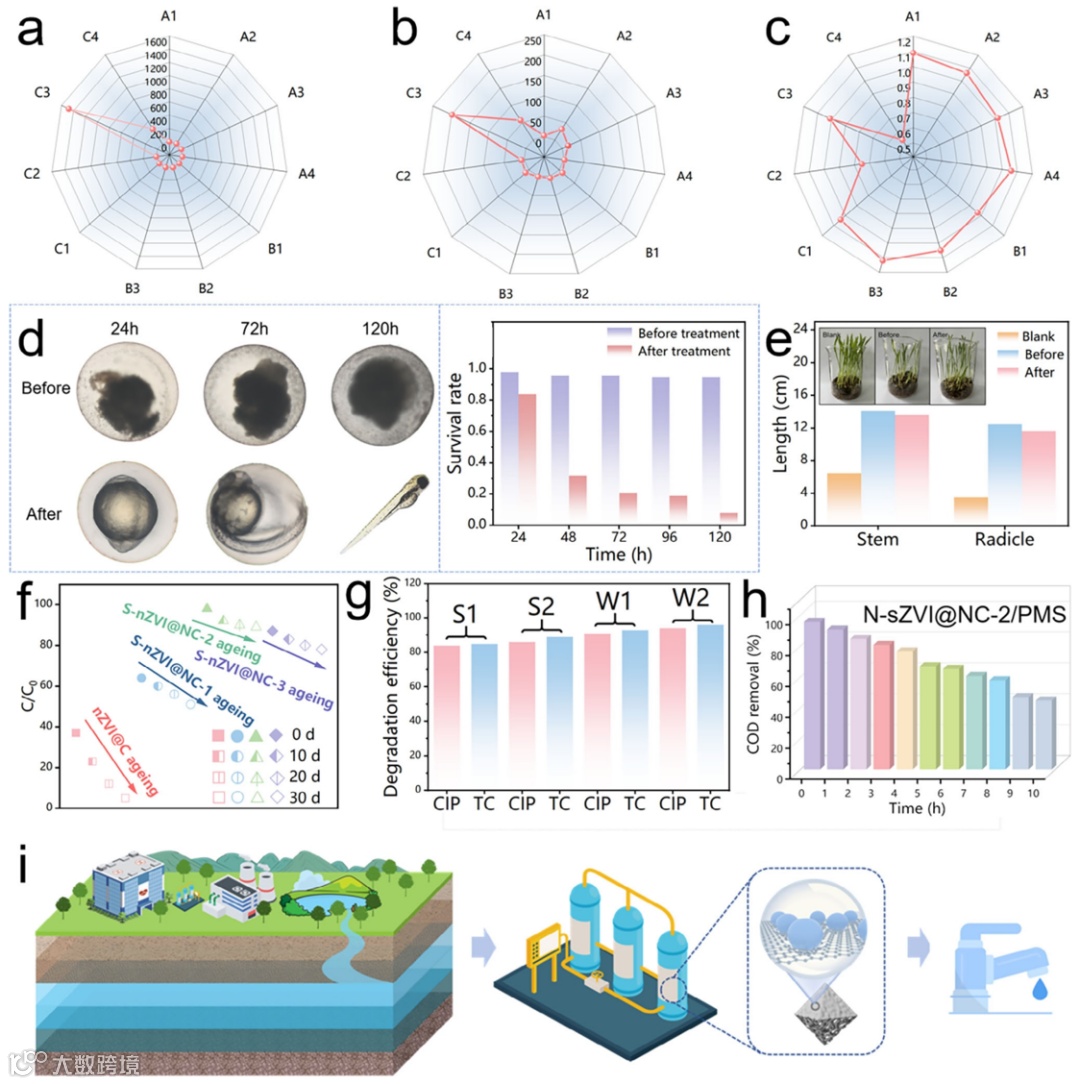
Figure 5. Toxicity and practical application evaluation of the N-sZVI@NC-2/PMS system: a) Fathead minnow LC50 96 h, b) Daphnia magna LC50 48 h, and c) Developmental toxicity of degradation intermediates d) Growth of zebrafish cultured in the solution treated with N-sZVI@NC-2/PMS system and survival rates. e) Wheat growth experiment under different soil conditions. f) Storage stability experiments for different systems. g) Efficiency of antibiotic degradation in different types of groundwater and soil samples. h) COD removal efficiency of the N-sZVI@NC-2/PMS system for actual industrial wastewater. i) Schematic diagram of potential future applications for the N-sZVI@NC-2/PMS system.

1、拉伸应变效应对N掺杂ZVI复合碳材料的影响
本研究通过MOF前驱体(NH2-MIL-101)一步碳化,成功将N原子掺杂进ZVI晶格,引起显著的拉伸应变效应。XRD、HRTEM与EXAFS等表征显示,N掺杂导致Fe-Fe键长增加,晶格畸变达~4.18%,费米能级升高,功函数从4.611 eV降至4.187 eV。这种应变不仅降低了Fe核与FeOx壳之间的肖特基势垒,还提升了ZVI的电子密度与导电性,为高效电子转移和PMS活化奠定了基础。
2、N-sZVI@NC的催化活性与稳定性
N-sZVI@NC-2表现出优异的催化性能:对CIP的降解动力学常数达0.15 min-1,PMS利用率达48.4%,分别是无N掺杂的nZVI@C的7.5倍和3.1倍。系统在宽pH范围、多种无机离子共存下保持高效,且在连续流反应器中10次循环后降解率仍>90%。材料老化一个月后活性仅轻微下降(从97.3%至89.1%),显示出杰出的结构稳定性与循环使用能力。
3、自由基和非自由基路径协同
该体系通过双路径协同机制降解污染物:自由基路径以·SO4-和·OH为主(贡献约80.9%),非自由基路径为电子转移过程(ETP,贡献约19.1%)。EPR、电化学测试及原位拉曼光谱证实,碳载体与N活性位点促进PMS形成表面络合物(PMS*),作为电子桥接污染物与氧化剂,实现“氧化攻击”与“电子直接转移”协同增效。
4、拉伸应变打破电子传输屏障以促进PMS活化机制
DFT计算与电子结构分析表明,拉伸应变使ZVI的d带中心上移,增强了PMS在Fe位点的吸附(吸附能从-1.986 eV降至-2.302 eV)。应变同时降低O-O键强度,促进其均裂生成自由基。电子局域函数分析显示,N-sZVI@NC表面电子转移量提升至1.049 e,显著高于未掺杂体系,从原子尺度揭示了应变降低势垒、加速界面电子传递的微观机制。
5、全面毒性评估与实际应用
通过计算毒性与生物实验评估,CIP降解中间体的鱼类毒性、发育毒性显著降低。斑马鱼胚胎与小株生长实验证实处理出水生物安全性良好。在实际应用中,该系统对地下水与土壤中的抗生素(CIP、TC)30分钟内去除率>90%,对焦化厂工业废水TOC去除率达44.6%,展示了其在复杂实际水体修复与土壤治理中的强大应用潜力。
版权声明
测 试