
第一作者:曹秋燕
通讯作者:陈玥光、汪乐余
通讯单位:北京化工大学
论文DOI:10.1002/smll.202404202


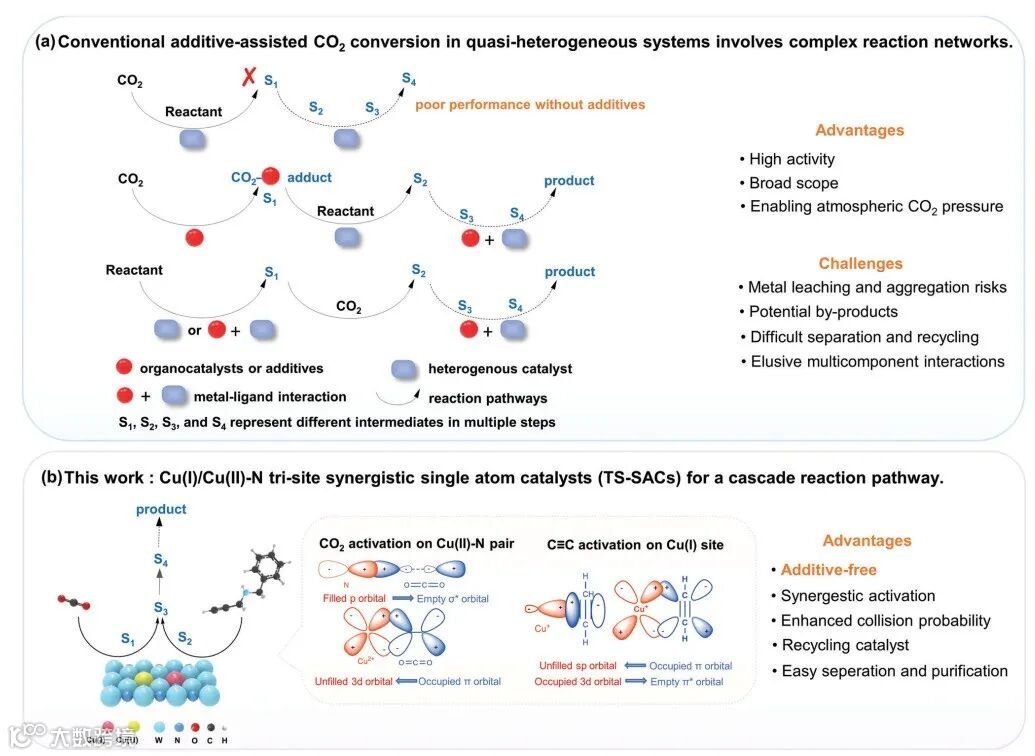
Scheme 1. Various pathways for CO2 conversion into chemicals in cyclization reactions. a) Conventional heterogeneous catalysts rely on organic additives to facilitate CO2 conversion. S1 to S4 refers to the different intermediates in multiple steps. b) A synergy approach utilizing the geometric and electronic structures of spatially proximal Cu(I)/Cu(II)─N tri-site synergistic single-atom catalysts (TS-SACs) designed for cascade conversion.

(1) 发展了一种氧化/还原介质诱导合成法,调控制备了三位点协同催化剂Cu(I)/Cu(II)-N),形成空间邻近的酸、碱活性中心,促进环化反应中多步反应进行。
(2) Cu(I)/Cu(II)-N三位点的空间临近性不仅可以协同活化CO2和炔丙胺,还通过同核异价Cu(I)-Cu(II)双金属锁定几何效应(di-metal locking effect),稳定氨基甲酸酯中间体,降低反应能垒。

1.价态诱导工程制备空间邻近的Cu(I)/Cu(II)─N位点催化剂
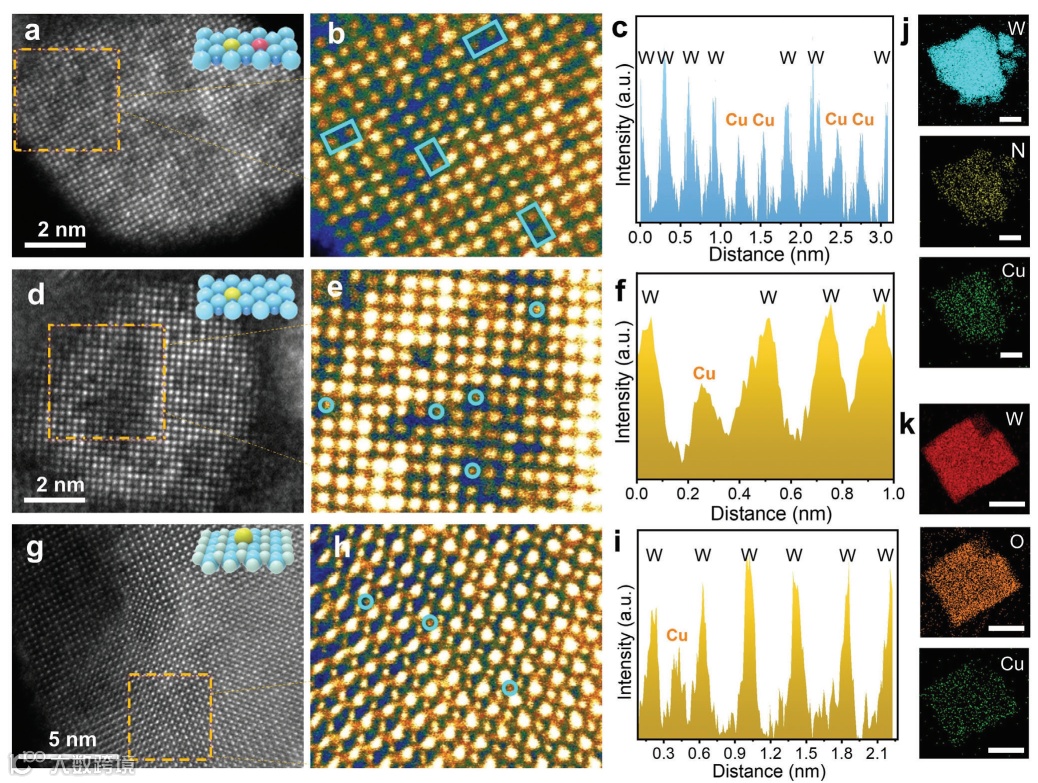
Figure 1. HAADF-STEM images magnified AC-HRTEM images and corresponding intensity profiles of a–c) spatially proximal CuICuII DA/WN [also named Cu(I)/Cu(II)─N TS-SACs; DA: dual atom], d–f) CuII SA/WN and g–i) CuII SA/WO3, respectively. The cyan boxes represent homonuclear dual Cu atoms, and the cyan dots represent the isolated Cu single atom. EDS elemental mapping of j) CuICuII DA/WN and k) CuII SA/WO3.
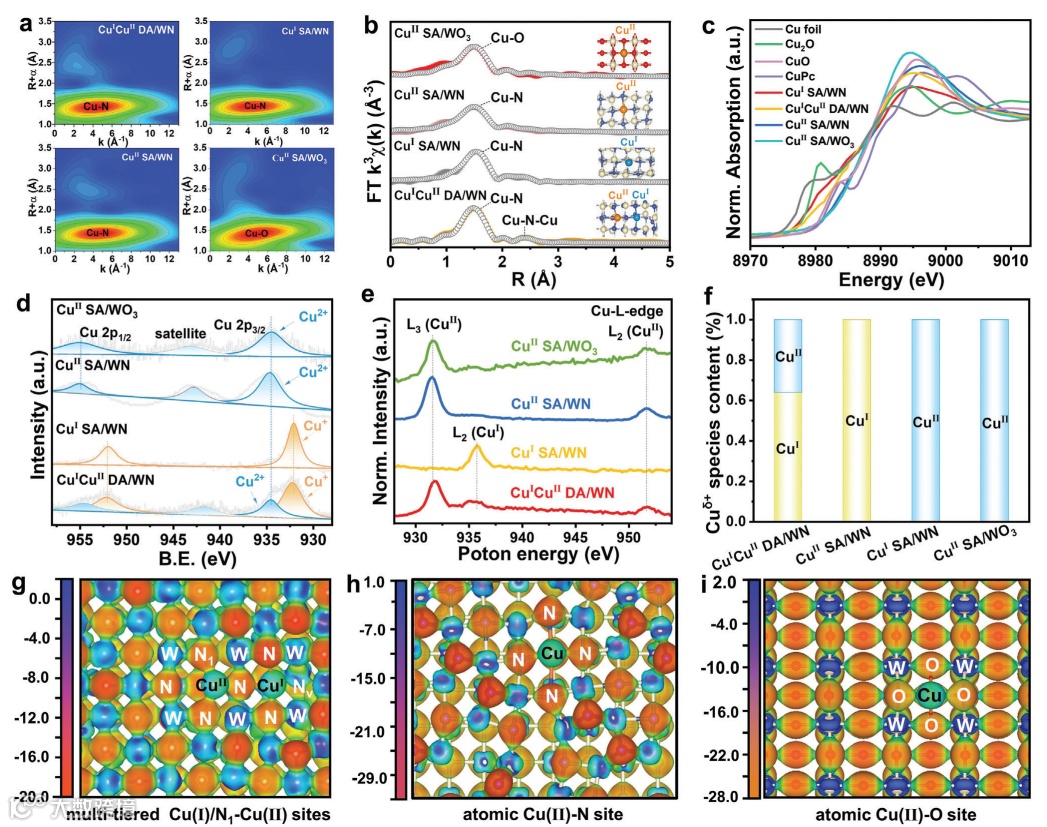
Figure 2. Atomic structure and chemical state of CuICuII DA/WN [also named Cu(I)/Cu(II)─N TS-SACs] and the other Cu SACs. a) The WT-EXAFS contour plots of CuICuII DA/WN, CuI SA/WN, CuII SA/WN, and CuII SA/WO3. b) The R space EXAFS fitting curves. The insets are the optimized structures containing Cu2─N9, Cu─N5, Cu─N4, and Cu─O4 centers. Cu(I), light blue; Cu(II), orange; W, pale yellow; O, red; N, dark blue. c) Cu K-edge XANES spectra of CuICuII DA/WN, Cu SACs, and the standards. d) Cu 2p XPS spectra. e) XAS spectra of Cu L2,3-edge. f) The Cuδ+ (δ = 1 or 2) species distributions of the linear combination fitting results from XANES. Electrostatic potential figures of g) CuICuII DA/WN, h) CuII SA/WN, and i) CuII SA/WO3 surface. The color bar represents the electrostatic potential scale. The multi-sites composed of FLP and classical Lewis acid-base pair (CLP) confer an advantage for cooperative activation.
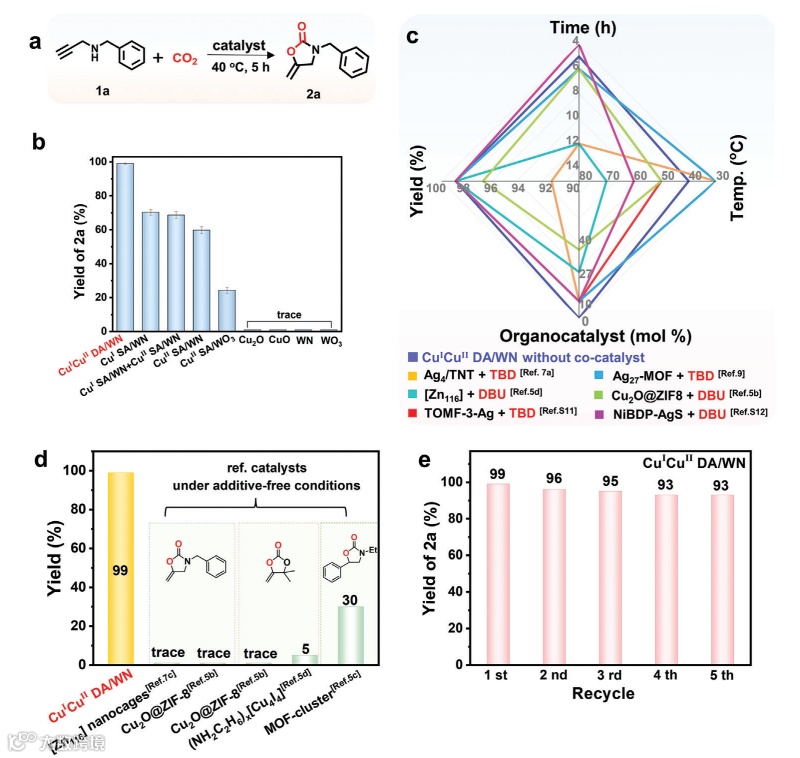
Figure 3. a) Scheme of the additive-free reaction between propargylamine and CO2. b) Catalytic performance over CuICuII DA/WN [also named Cu(I)/Cu(II)─N] TS-SACs, Cu SACs, and other pristine nanocatalysts. Reaction conditions: N-benzylprop-2-yn-1-amine (1 mmol), catalyst (100 mg, 1.25 mol% Cu), CO2 balloon, CH3CN (0.5 mL), 40 °C, 5 h. Additive-free. Determined by 1H NMR with 1,3,5-trimethoxybenzene as an internal standard. c) Performance comparisons between CuICuII DA/WN and previously reported heterogeneous catalysts for the CO2-involved cyclization reaction. d) Yield of product compared with previously reported catalysts without organic additives. e) The catalytic recycle tests.
2. 炔丙胺与CO2环化反应的催化性能评价
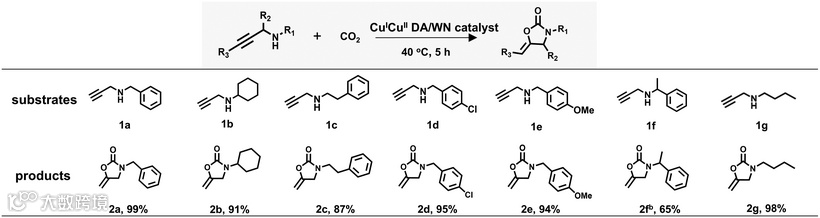
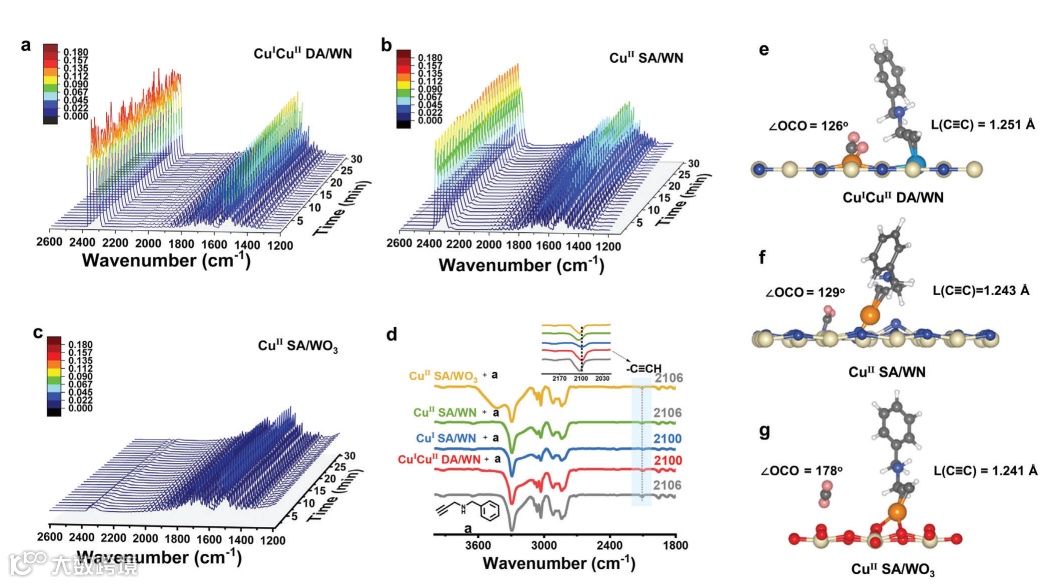
Figure 4. DRIFT spectra collected at 40 °C where the feed gas was switched to Ar after CO2 saturated adsorption: a) CuICuII DA/WN TS-SACs, b) CuII SA/WN, and c) CuII SA/WO3. d) FT-IR spectrum of N-bridged Cu dual atom catalysts (DACs) and the other Cu single-atom catalysts (SACs) mixed with the substrate N-benzylprop-2-yn-1-amine (1a). Optimized calculated models of CO2 and substrate 1a adsorbed on e) CuICuII DA/WN, f) CuII SA/WN, and g) CuII SA/WO3.
3. 双分子底物与多活性位点的相互作用
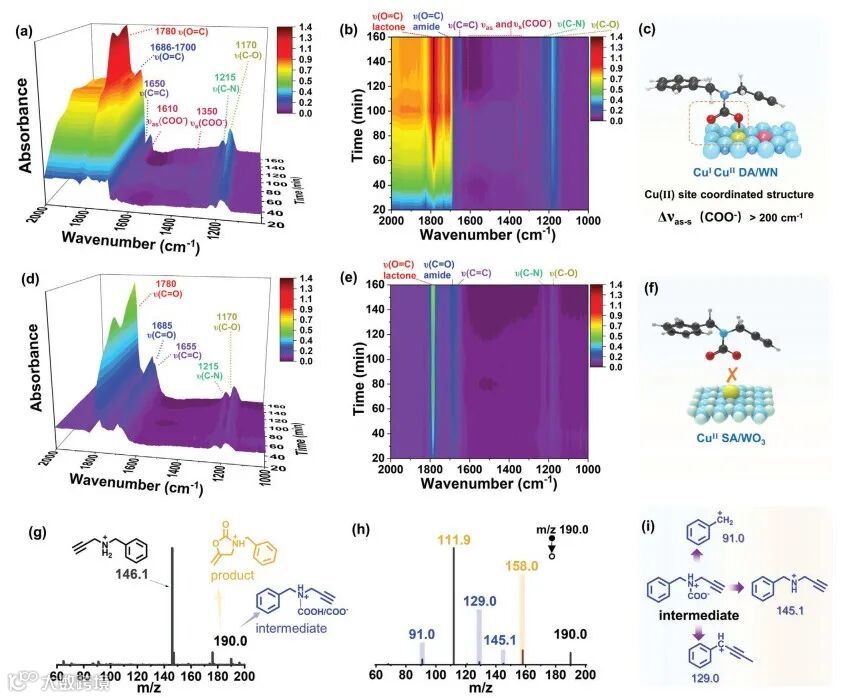
Figure 5. Time-resolved operando FTIR spectra recorded during the gas-liquid-solid multi-phase reaction. a, b) 3D and 2D FTIR profile for CuICuII DA/WN TS-SACs in the cyclization reaction of CO2 (pCO2 of 1 bar) with N-benzylprop-2-yn-1-amine (1a) at 40 °C (Amplified area, 1000–2000 cm-1). c) Models of the carboxylate species on CuICuII DA/WN TS-SACs. d,e) 3D and 2D FTIR profile for CuII SA/WN in the cyclization reaction of CO2 (pCO2 of 1 bar) with N-benzylprop-2-yn-1-amine (1a) at 40 °C (Amplified area, 1000–2000 cm-1). f) Models of carbonylative species on CuII SA/WO3. g) The primary MS analysis, h) the secondary MS analysis of fragment ions focused on m/z at 190.0, and i) the corresponding structures of fragment ions from m/z of 190.0 to 91.0, 129.0, and 145.1. Representative LQIT-MS was measured in positive ion mode after 15 min reaction catalyzed by CuICuII DA/WN TS-SACs.
4. 反应机理探究
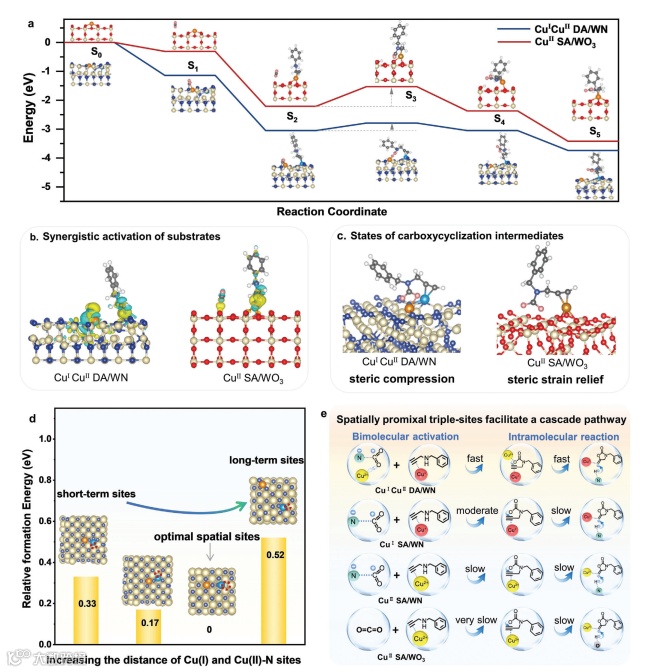
Figure 6. a) The profiles of free energies for the reaction mediated by the CuICuII DA/WN TS-SACs and CuII SA/WO3. b) Charge density differences (δρ = ρtot-ρsub-ρads) of CO2 and propargylamine adsorption on CuICuII DA/WN and CuII SA/WO3 (The yellow and cyan regions represent charge accumulation and depletion). The isovalue is set to be 0.001 eÅ−3. c) Models of key intermediates on CuICuII DA/WN and CuII SA/WO3, respectively. d) Models with diverse Cu(I)─Cu(II) spatial distance and the corresponding relative formation energies. The red circle refers to the location of the N vacancy. e) The schemes of the determined factor for the oxazolidinone synthesis. Atom color: light blue, Cu(I); orange, Cu(II); pale yellow, W; dark blue, N; red, O in WO3; pink, O in CO2; gray, C; white, H.


声明

“邃瞳科学云”直播服务

扫描二维码下载
邃瞳科学云APP