

第一作者:薛飞
通讯作者:刘茂昌教授,黄小青教授,徐勇研究员
通讯单位:中国科学院苏州纳米技术与纳米仿生研究所
论文DOI:10.1038/s41467-024-54835-5



(1) 通过引入窄带隙半导体Cu9S5同时作为光热转化组分和光催化组分,成功实现光热效应与光化学催化的整合,从而充分利用太阳能光谱,提升催化剂局域温度,显著促进光驱动CH4转化为乙醇。
(2) 通过在催化剂体系中同时引入Cu9S5和Cu单原子,实现光还原反应位点和光氧化反应位点的空间分离,促进光生电子-空穴对的可持续迁移和分离。
(3) 原位试验和理论研究表明Cu9S5/Cu-CCN不仅可以优化CH4吸附/活化和乙醇脱附,还可以通过稳定∙CH3和∙CH2O中间体降低C-C偶联能垒。

(1) 催化剂合成及结构表征
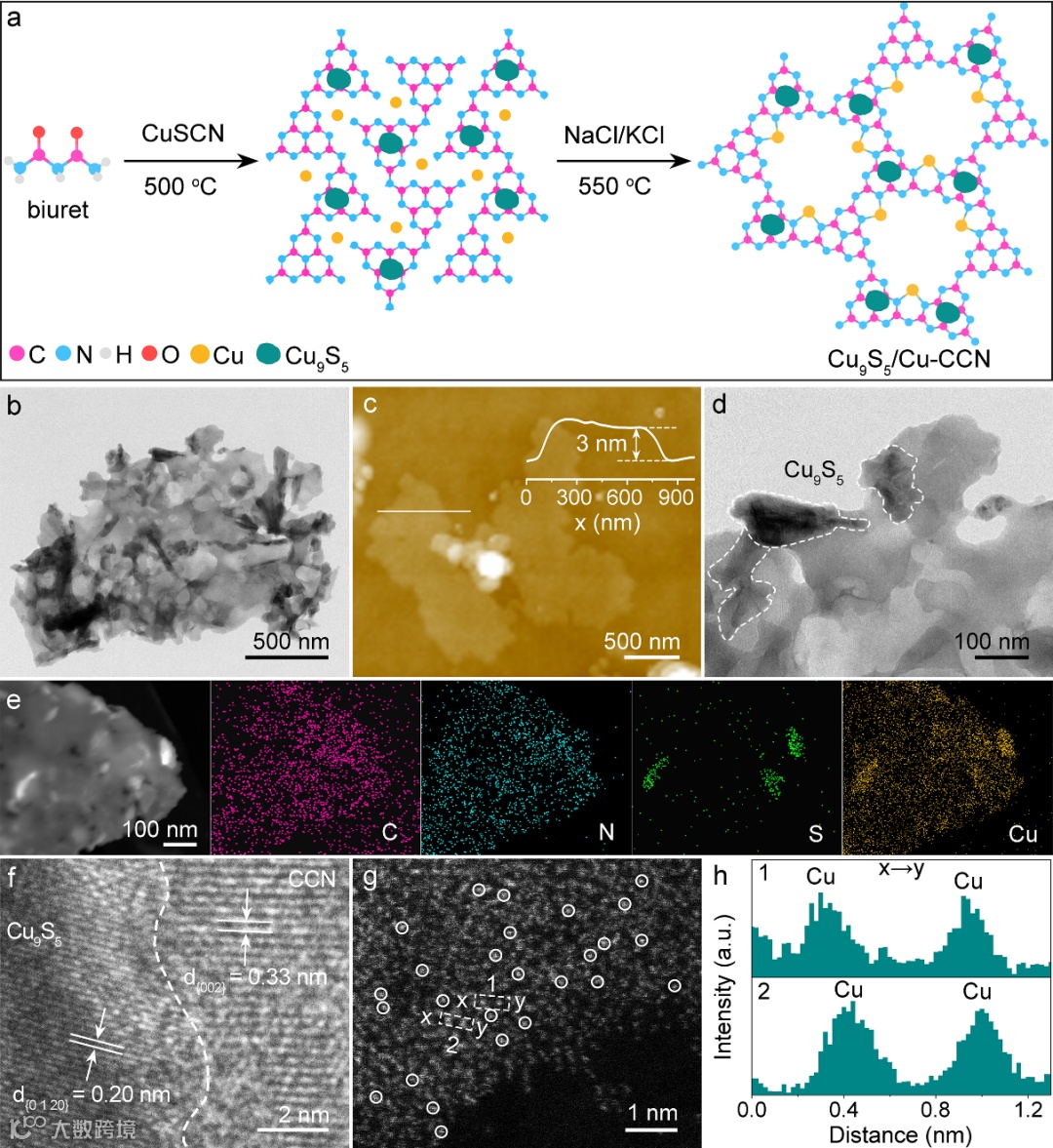
Fig. 1. Synthesis and electron microscopy characterization of Cu9S5/Cu-CCN. a, Schematic illustrating the preparation of Cu9S5/Cu-CCN. b-g, TEM image (b), AFM profile (c), TEM image with high magnification (d), STEM image with elemental mappings (e), HRTEM (f) and aberration corrected HAADF-STEM images (g) of Cu9S5/Cu-CCN. h, Intensity profiles along the x→y at positions 1 and 2 in (g).
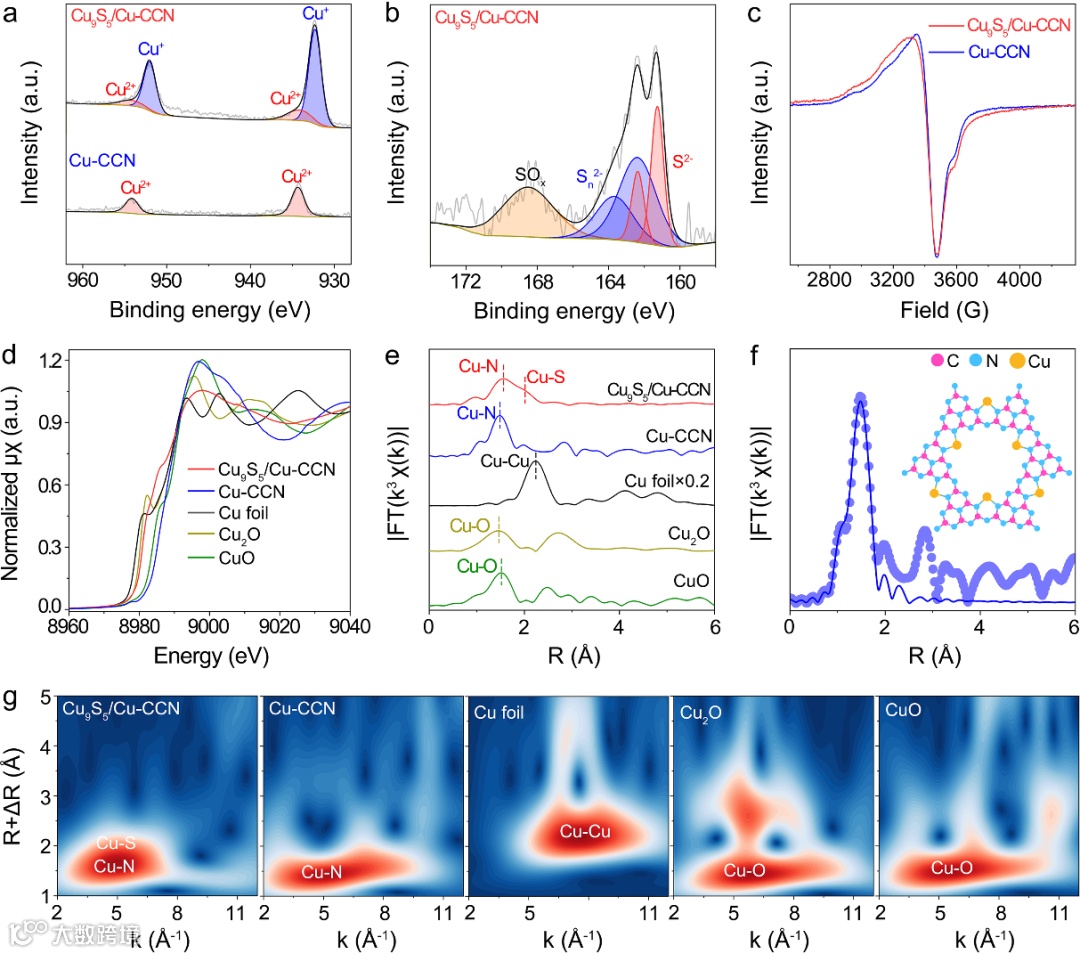
Fig. 2. Structural characterizations. a, High-resolution Cu 2p spectra of Cu9S5/Cu-CCN and Cu-CCN. b, S 2p spectrum of Cu9S5/Cu-CCN. c, EPR spectra over Cu9S5/Cu-CCN and Cu-CCN. d, e, XANES (d) and EXAFS (e) spectra at Cu K-edge of Cu9S5/Cu-CCN and Cu-CCN. f, The corresponding EXAFS fitting curves of Cu-CCN at R space. Inset is the structure of Cu-CCN. g, Wavelet transform EXAFS spectra of Cu9S5/Cu-CCN, Cu-CCN, Cu foil, Cu2O and CuO at Cu K-edge.
(2) 光驱动CH4氧化性能研究
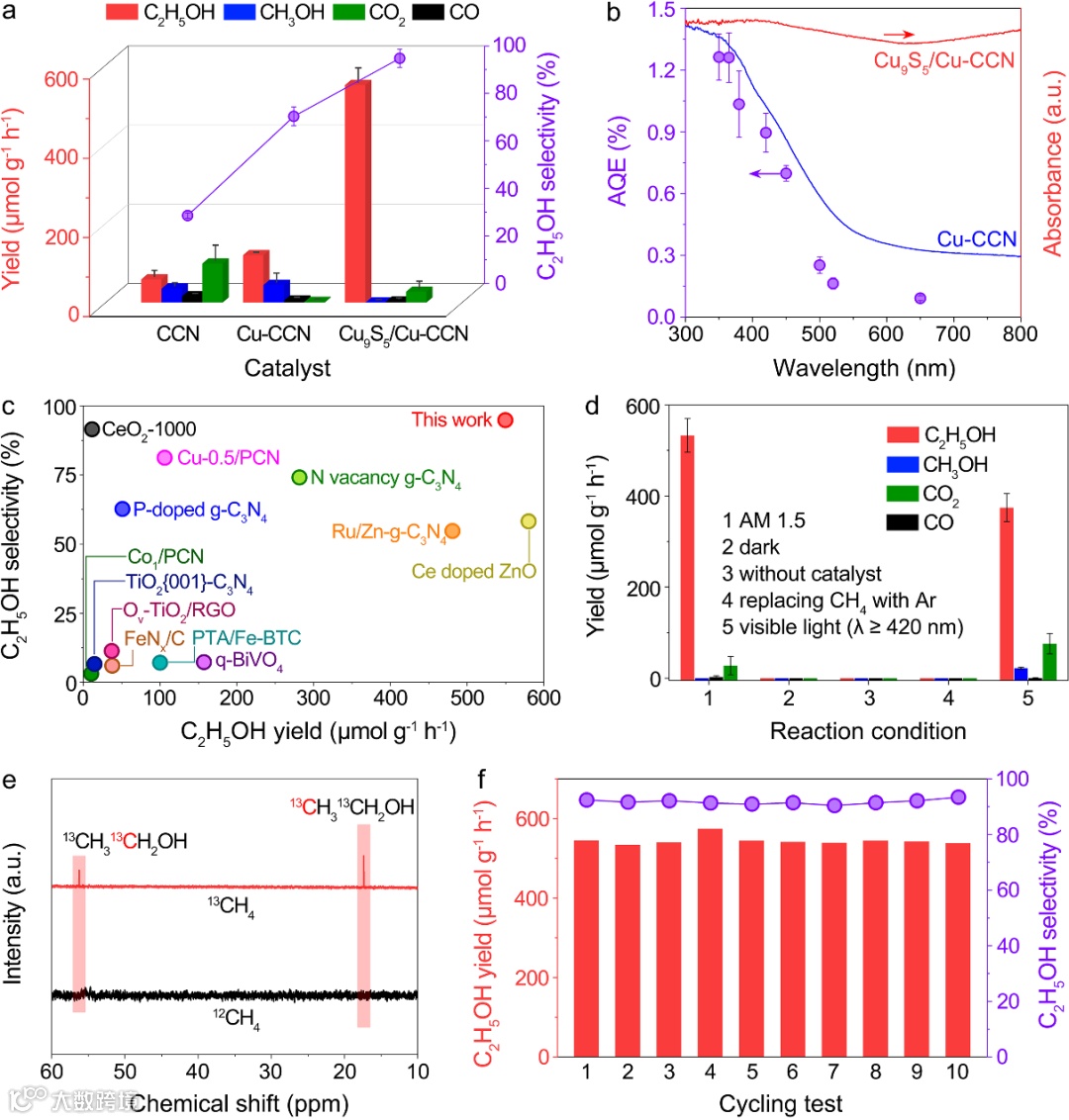
Fig. 3. Performance towards CH4 oxidation. a, Yield and C2H5OH selectivity of Cu9S5/Cu-CCN, Cu-CCN and CCN. Reaction conditions: Wcat. = 10 mg, VH2O= 100 mL, PCH4 = 1.9 MPa, PO2 = 0.1 MPa, t= 1 h, light source: 300 W Xe lamp (full spectrum), light intensity: 400 mW cm−2. b, AQEs for C2H5OH production of Cu9S5/Cu-CCN on various incident light wavelengths. Reaction conditions: Wcat.= 10 mg, VH2O = 100 mL, PCH4 = 1.9 MPa, PO2= 0.1 MPa, t = 1 h, light source: 300 W Xe lamp. c, Comparison between Cu9S5/Cu-CCN and other catalysts for CH4 light-driven oxidation to C2H5OH. d, CH4 oxidation under various reaction conditions. Reaction conditions: Wcat. = 10 mg, VH2O = 100 mL, PCH4= 1.9 MPa, PO2 = 0.1 MPa, t = 1 h, light source: 300 W Xe lamp (full spectrum or visible light λ ≥ 400 nm), light intensity: 400 mW cm−2 in conditions 1−4, 320 mW cm−2 in condition 5. e, f, 13C and 12C NMR spectra of liquid products from 13CH4 and 12CH4 light-driven oxidation (e), and cyclic test (f) over Cu9S5/Cu-CCN.
(3) 光驱动CH4氧化生成C2H5OH的机理研究
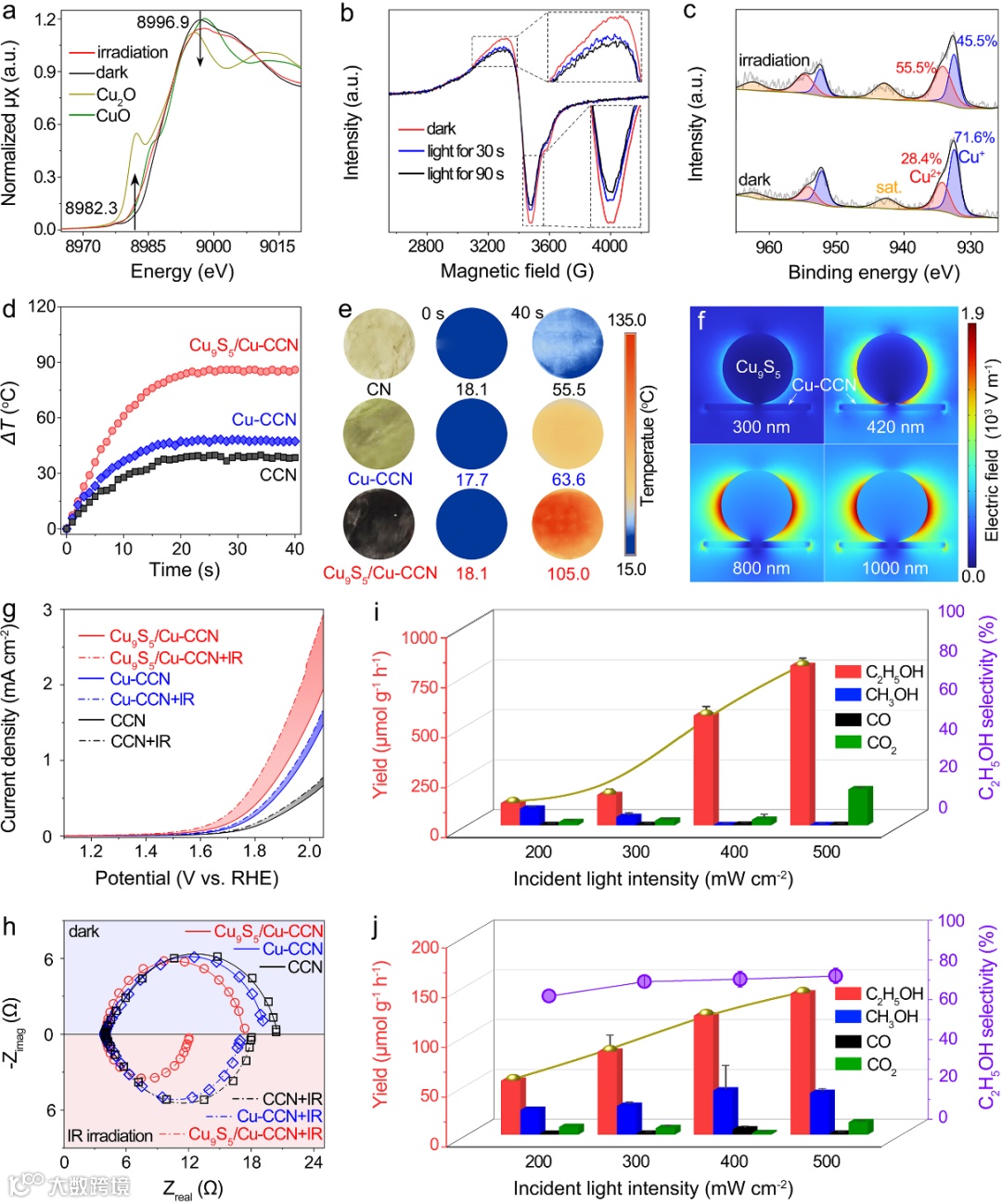
Fig. 4. Mechanism investigation for light-driven CH4 oxidation. a, In-situ XANES spectra at Cu K-edge of Cu-CCN with and without light irradiation. b, c, Solid-state in-situ EPR spectra (b) and in-situ Cu 2p NAP-XPS spectra (c) of Cu9S5/Cu-CCN with and without light irradiation. d, e, Photothermal temperature curves (d) and corresponding IR thermal images (e) over Cu9S5/Cu-CCN, Cu-CCN and CCN. f, Electric field distribution of Cu9S5 and Cu-CCN in Cu9S5/Cu-CCN irradiated at different wavelengths. g, h, Polarization curves (g) and EIS Nyquist plots (h) of CH4 electrooxidation over Cu9S5/Cu-CCN in the dark and under IR irradiation. i, j, Performance towards CH4 oxidation over Cu9S5/Cu-CCN (i) and Cu-CCN (j) at different incident light intensities. Reaction conditions in (i) and (j): Wcat. = 10 mg, VH2O = 100 mL, PCH4 = 1.9 MPa, PO2 = 0.1 MPa, t= 1 h, light source: 300 W Xe lamp (full spectrum), light intensity: 200−500 mW cm−2.
(4) 理论计算
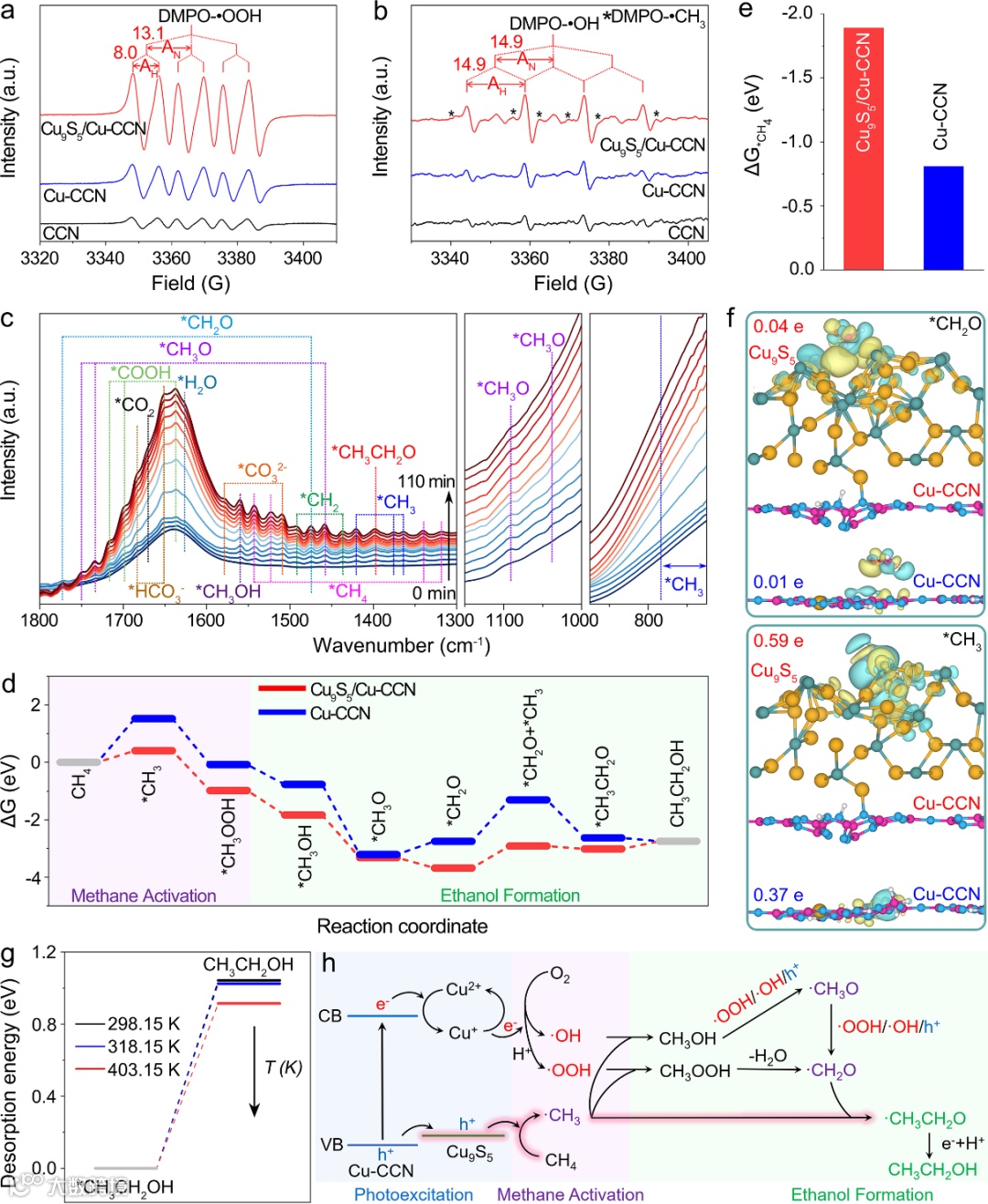
Figure 5. Mechanism investigation and DFT calculation.a, b, In-situ EPR spectra of∙OOH (a) and ∙OH (b) radicals trapped by DMPO over Cu9S5/Cu-CCN, Cu-CCN and CCN under light irradiation. c, In-situ ATR-FTIR spectra of photocatalytic CH4 oxidation over Cu9S5/Cu-CCN during light irradiation from 0 to 110 min. d, Free energy diagrams for reaction pathways of CH4 oxidation to C2H5OH and corresponding energy profiles on Cu9S5/Cu-CCN and Cu-CCN. e, CH4 adsorption energy on Cu9S5/Cu-CCN and Cu-CCN. f, Differential charge difference of *CH2O (top) and *CH3 (bottom) absorbed on Cu9S5/Cu-CCN (red) and Cu-CCN (blue). The balls in pink, blue, aurantia, dark green and white represent C, N, Cu, S and H atoms, respectively. The cyan and yellow regions represent electron depletion and electron accumulation, respectively. The isosurface value is 0.004 e Å−3. g, Desorption energy of C2H5OH on Cu9S5/Cu-CCN at different temperatures. h, Schematic of the proposed reaction mechanism for photocatalytic CH4 oxidation to C2H5OH.


声明

“邃瞳科学云”直播服务

扫描二维码下载
邃瞳科学云APP