

 第一作者:刘倩倩
通讯作者:吴浩斌
通讯单位:浙江大学
DOI: https://doi.org/10.1007/s40820-020-00514-1
全文速览

本文亮点

背景介绍

图文解析

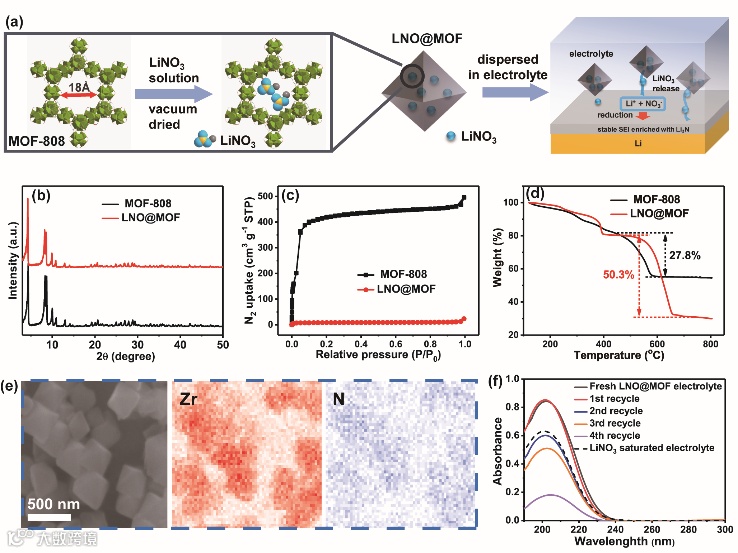 Fig. 1 a Schematic illustration of LiNO3 encapsulated into MOF-808 and its sustained release in electrolyte. b XRD patterns, c N2 adsorption–desorption isotherms, and d TGA of MOF-808 and LNO@MOF. e SEM image and elemental mappings of LNO@MOF. f UV absorption spectra of NO3− in electrolyte released from LNO@MOF
基于LNO@MOF电解液的锂金属负极的电化学性能
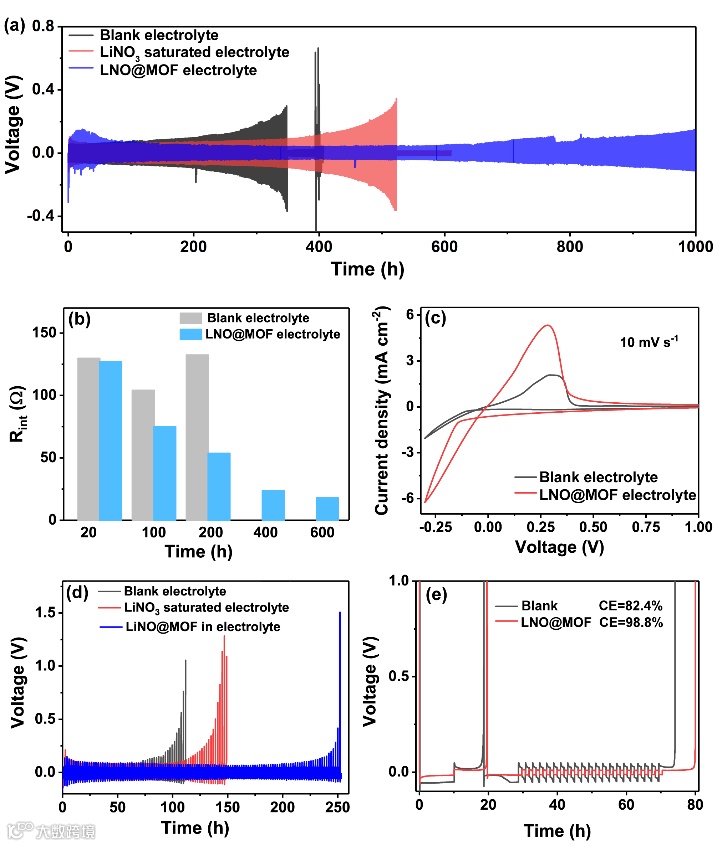
Fig. 2 a Voltage profiles of Li|Li symmetric cells at 1.0 mA cm−2 to a capacity depth of 1.0 mAh cm−2 and b Rint of Li|Li symmetric cells during cycling obtained from Nyquist plot. c CVs of Cu|Li cells with blank and LNO@MOF electrolytes at a scan rate of 10 mV s−1. d Voltage profles of asymmetric 50 μm-Li|Li cells at 1.0 mA cm−2 with a cycled capacity of 1.0 mAh cm−2. e Voltage–time profiles to calculate the average Coulombic efciency of LMA at 0.5 mA cm-2
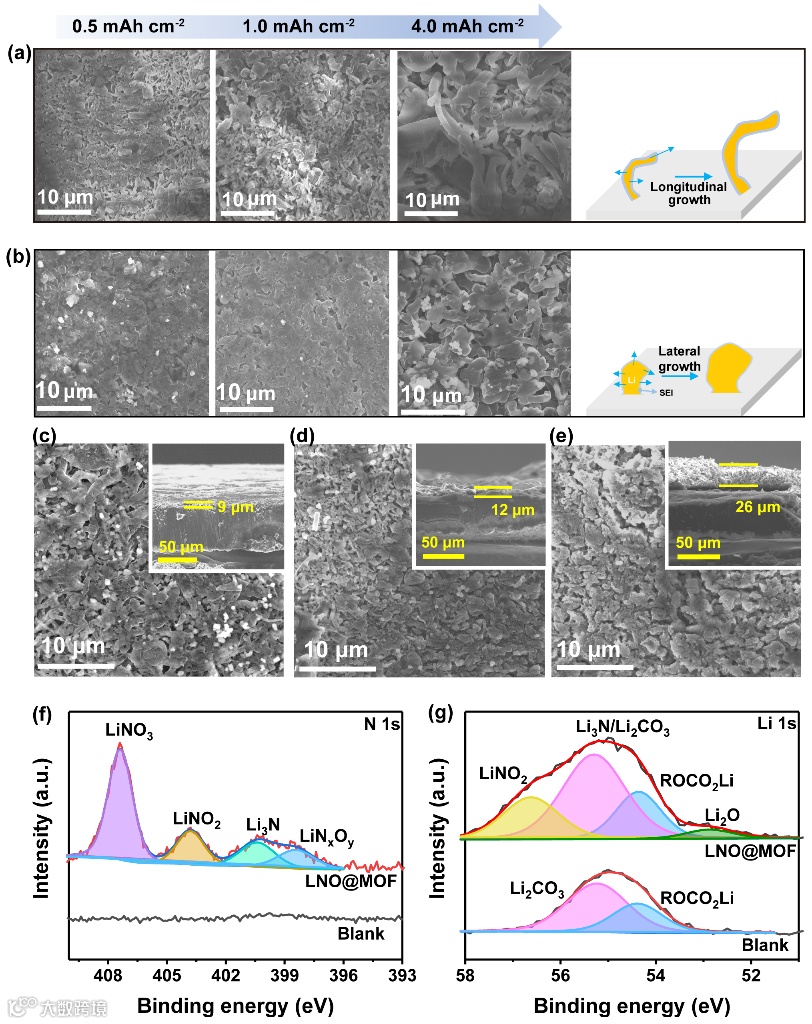
Fig. 3 SEM images of LMA after deposition of 0.5, 1 and 4.0 mAh cm−2 at 1 mA cm−2 with a blank electrolyte and b LNO@MOF electrolyte. The surface and cross section images of the cycled LMA in LNO@MOF electrolyte after c10 cycles, d 50 cycles, and e 100 cycles at 1 mA cm−2 and a capacity 1.0 mAh cm−2 (inset is the cross-section view). XPS spectra of f N 1s, g Li 1s of the LMA with blank and LNO@MOF
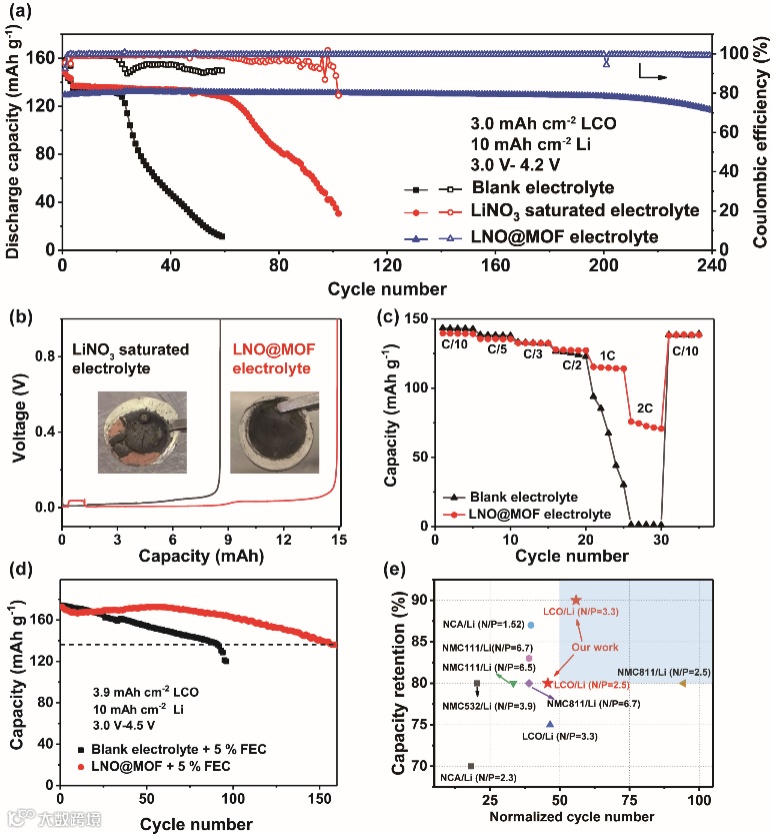
Fig. 4 a Long-term cycling performance of a practical LCO|Li full cell with a N/P ratio of 3.3, cycled at 0.2 C charge/0.5 C discharge. b Quantification of remaining active Li after cycling. Inset: optical images of the Li anode disassembled from the cycled LCO|Li cell in (a). c Rate performance of LCO|Li full cell in different electrolytes. d Long-term cycling performance of LCO|Li full cell with a N/P ratio of 2.5, cycled at 0.2 C charge/0.5 C discharge with 5% FEC additive. e Summary of capacity retention of practical high-voltage LMBs shown in Table S2. The normalized cycle number refers to the total cycle number divided by the equivalents of total active Li with respect to cathode (i.e., N/P ratio plus one). The shadow region indicates a capacity retention higher than 80% after 200 cycles with a N/P ratio below 3.
总结与展望

课题组介绍


论文不是工作的结束,而是一个新阶段的开始。欢迎大家在邃瞳科学云平台上分享论文解读,为自己的学术代言。投稿请添加以下微信:


邃瞳科学云APP实验室板块以文字、影像资料等方式多维展示实验室的实力和风采。一方面宣传推广实验室,一方面为实验室提供直播工具,方便线上组会、跨组跨区域互动。同时为实验室招生、招聘、匹配资源,实验室、课题组间互动提供方便。实验室入驻咨询请添加以下微信: