

第一作者:刘思碧,张由子,王茂槐,魏彦平
通讯作者:李炫华
通讯单位:西北工业大学材料学院
论文 DOI:https://doi.org/10.1002/adma.202508693

(1) 负载助催化剂,例如Pt,是一种提高光催化分解水活性的有效策略。其中,金属态Pt0能够促进质子还原,而正价态Pt2+能够抑制H2/O2复合。然而,同时利用Pt0和Pt2+在Pt基光催化剂中的优势进行光催化分解水,仍然具有挑战性。
(2) 本研究提出一种用于调控Pt价态的通用策略,获得空间定向分布的Pt2+/Pt0,实现接近零的质子还原势垒,以及隔绝的O2吸附。
(3) 通过在ZnIn2S4中引入缺电子中心V掺杂和S空位(V-Sv-ZIS),Pt表面的电子转移到ZIS,诱导Pt0部分氧化为Pt2+。反向电子转移导致Pt-Sv-ZIS界面附近83%的区域以Pt2+为主,在Pt团簇中心附近17%的区域以Pt0为主,并能够扩展到其他Pt基催化剂体系。
(4) 含量占优的Pt2+有效抑制氧气吸附,并实现最低4%的H2/O2复合;含量最低的Pt0诱导光生电子密度152.2倍的增加,最终实现光催化活性45.4倍提升。为验证其实际应用价值,制作了10 m2漂浮式大面积光催化系统,在自然光下日产6.4 L H2。

光催化分解水产生H2和O2是缓解能源危机的关键技术,然而设计高效光催化剂仍面临重要挑战。贵金属Pt助催化剂由于较低的质子还原势垒和有效的电荷分离效率而表现出优异的太阳能-氢能的转化效率(STH)。然而,金属态Pt0表面具有强的O2吸附(吸附能:-1.67 eV),引发严重的H2/O2复合;正价态Pt2+虽能有效抑制H2/O2逆反应,但是其质子还原势垒较高,导致析氢动力学受限。因此,亟需设计开发新型Pt助催化剂,兼具低析氢势垒和高效抑制逆反应的优势。

(1) 创新性设计Pt2+/Pt0空间定向分布的Pt助催化剂
通过在ZnIn2S4中构建缺电子中心V掺杂和S空位,促使Pt表面电子回流到基体,诱导Pt0部分氧化为Pt2+,获得Pt-Sv-ZIS界面附近83%的区域以Pt2+为主,剩余17%主要以Pt0为主的Pt助催化剂,首次实现Pt2+/Pt0在空间定向分布的Pt助催化剂。
(2) 深入揭示Pt2+/Pt0的形成机理与空间分布规律
揭示了Pt与ZnIn2S4间的静电势能差诱导电子转移的机制;并可视化观测Pt2+/Pt0在空间的定向分布规律。
(3)普适性与大面积应用示范
通过普适性合成策略验证其结构可扩展性;并基于10 m2漂浮式大面积光催化系统实现稳定日产6.4 L H2。

团队在这项工作中提出一种具有接近零的质子还原势垒和隔绝O2吸附的空间定向分布的Pt助催化剂设计策略。作为概念验证,ZnIn2S4因其合适的能带结构和优异的光吸收能力而作为模型光催化剂。通过引入高价态V掺杂或S空位来构建缺电子中心,调控ZIS的静电势能,从Pt中提取电子并将Pt0氧化为Pt2+,促使Pt/V-Sv-ZIS界面附近83%的区域以Pt2+为主,其余17%主要是Pt0,从而实现Pt2+/Pt0的空间定向分布。本工作强调了Pt价态的空间定向分布对于同时抑制H2/O2复合和提高光催化活性的重要性,这一点可以推广到其他Pt基催化剂体系,例如Pt/TiO2、Pt/C3N4等。
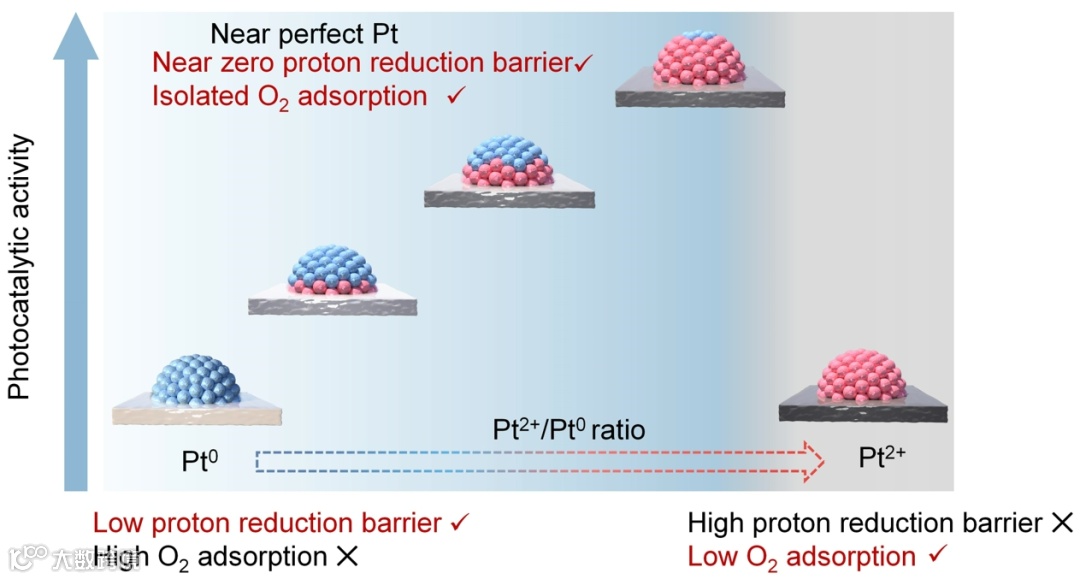
Scheme 1. A schematic diagram for a near-perfect Pt cocatalyst with a near-zero proton reduction barrier and isolated O2 adsorption by accurately regulating the Pt2+/Pt0 ratio. The gray substrates represent the photocatalysts, i.e., ZnIn2S4 with different structures, the spheres represent the Pt cocatalysts, the blue and pink regions in the spheres are metallic states Pt0 and positive valence states Pt2+, respectively. The long arrow at the bottom indicates the Pt2+/Pt0 ratio.
通过水热法和光沉积法成功构建Pt/V-Sv-ZIS结构。HAADF-STEM、EPR光谱、XANES结果表明了缺电子中心V掺杂与S空位的成功构筑(图2,S4-11)。其中,V掺入后取代Zn的位置,并通过V-S键与S原子键合,并且V-Sv-ZIS具有最强的EPR信号,表明其最强的电子捕获能力。Pt L3边XANES光谱表明,随着V掺杂和S空位的引入,白线峰强度逐渐上升并正移,表明由于Pt和ZnIn2S4之间相互作用增加,Pt表面电子密度降低,从而增加了Pt的价态。更有趣的是,EXAFS光谱中的Pt-Pt和Pt-S配位状态证明了金属态Pt和正价态Pt的共存。随着V掺杂和S空位的引入,相应的Pt-S配位数从2.2增加至2.6,意味着正价态Pt含量的增加。
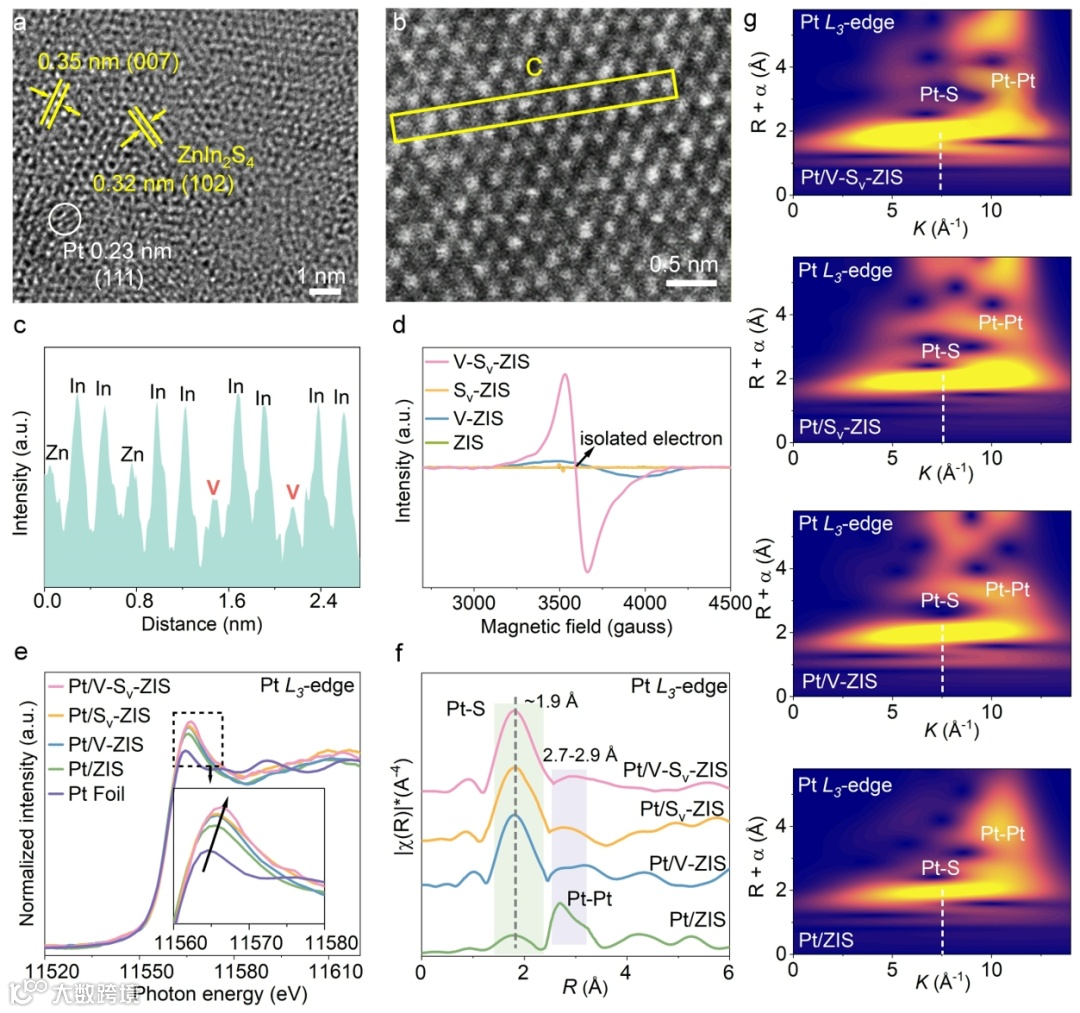
Figure 1. Structure characterization. a HRTEM image of Pt/V-Sv-ZIS, the area marked in white circle is Pt cluster; b HAADF-STEM image of Pt/V-Sv-ZIS; c The line profiles measuring the atom intensity variations in the selected rectangular region of Figure 1b; d EPR spectra of ZIS, V-ZIS, Sv-ZIS, and V-Sv-ZIS; e Normalized XANES spectra in the Pt L3-edge of Pt/ZIS, Pt/V-ZIS, Pt/Sv-ZIS, Pt/V-Sv-ZIS, and Pt Foil, the enlarge region reflect the transition of the core electron from the occupied Pt 2p3/2 orbital to the empty 5d orbital; f Pt L3-edge EXAFS spectra of Pt/ZIS, Pt/V-ZIS, Pt/Sv-ZIS, and Pt/V-Sv-ZIS in R space, the Pt-S and Pt-Pt coordination states are highlighted by green and purple boxes; g Wavelet transforms of k3-weighted EXAFS spectra in the Pt L3-edge for Pt/V-Sv-ZIS, Pt/Sv-ZIS, Pt/V-ZIS, and Pt/ZIS, the white dashed line guide to Pt-S coordination states.
Pt 4f XPS光谱和CO-FTIR光谱结果进一步证明Pt-ZnIn2S4中的Pt以Pt2+和Pt0的形式存在。随着V掺杂和S空位的引入,Pt0含量从88.5%逐步下降至8.5%,而Pt2+含量从11.5%上升至91.5%。随后进一步阐明了Pt2+/Pt0含量的调控机制。Pt2+/Pt0的形成过程可分为两部分:1)在光沉积过程中,PtCl62-通过不同结构ZnIn2S4导带中的光生电子还原为Pt0;2)Pt-ZnIn2S4之间的静电势能差诱导界面电子交换。通过在ZnIn2S4中构建缺电子中心,其静电势能逐渐降低,负的静电势能差诱导反向电子转移。当V掺杂和S空位同时存在时,Pt和V-Sv-ZIS之间最负的静电位能差(-22.7 eV)导致从Pt0提取最多数量的电子(0.260 |e|),导致最高的Pt2+含量。
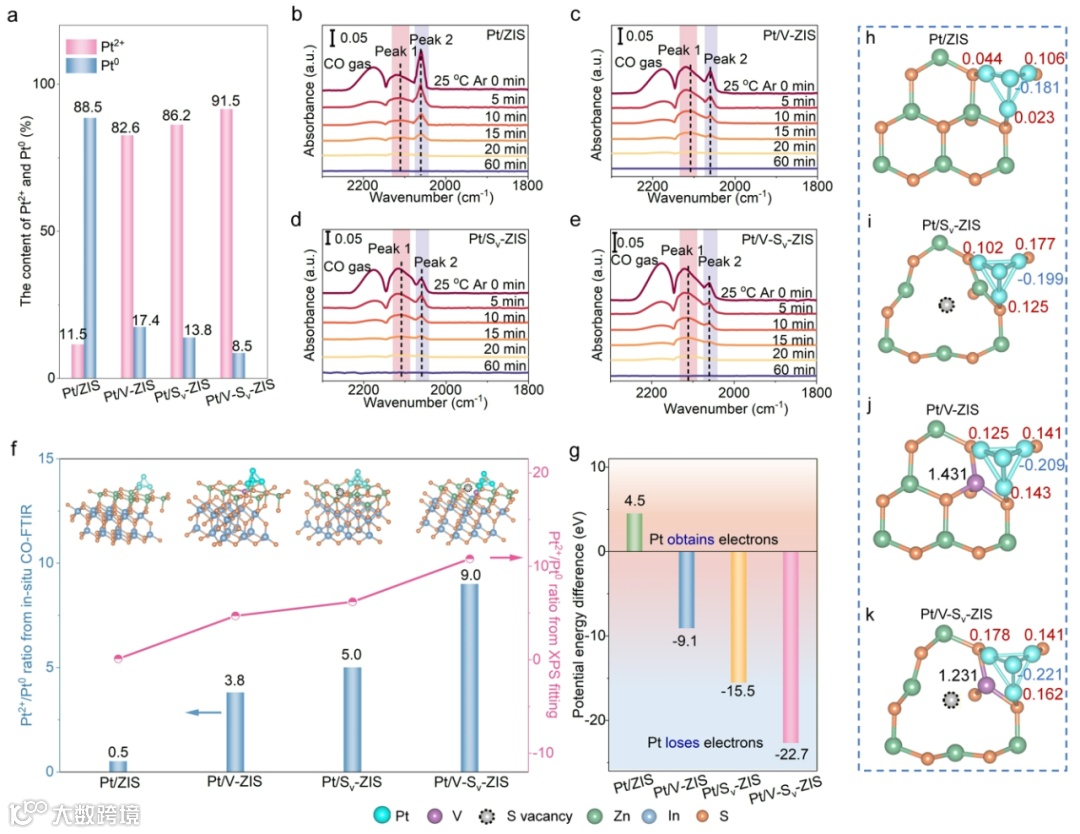
Figure 2. Pt valence state modulation. a The content of Pt2+ and Pt0 in Pt/ZIS, Pt/V-ZIS, Pt/Sv-ZIS, and Pt/V-Sv-ZIS obtained through fitting the Pt 4f XPS spectra (date sources: Figure S14 and Table S5); In-situ CO-FTIR spectra of b Pt/ZIS, c Pt/V-ZIS, d Pt/Sv-ZIS, and e Pt/V-Sv-ZIS after the desorption process, the bands around 2115~2200 cm−1 can be attributed to gas-phase CO molecules, which disappeared after CO was flushed away for the Pt-ZnIn2S4 hybrid; f The Pt2+/Pt2+ ratio calculated via the in-situ CO-FTIR results and XPS spectra (red dotted line, date source: Figure 2a) of Pt/ZIS, Pt/V-ZIS, Pt/Sv-ZIS, and Pt/V-Sv-ZIS, the insert images are corresponding atomic configurations calculated from DFT; g Electrostatic potential energy difference between Pt and ZnIn2S4 along the x-axis for Pt/ZIS, Pt/V-ZIS, Pt/Sv-ZIS, and Pt/V-Sv-ZIS, the value is calculated by the electrostatic potential energy of Pt minus the electrostatic potential energy of ZnIn2S4, Pt obtains electrons when the electrostatic potential energy difference exhibits a positive value, Pt loses electrons when it is a negative value; The Bader charges of h Pt/ZIS, i Pt/Sv-ZIS, j Pt/V-ZIS, and k Pt/V-Sv-ZIS (the cyan, blue, green, orange, purple, and gray balls represent the Pt, In, Zn, S, V atoms, and S vacancy, respectively).
EELS光谱进一步阐明了不同Pt-ZnIn2S4杂化材料中Pt2+/Pt0的空间分布。沿着从Pt团簇中心到Pt-ZnIn2S4界面测量了Pt M4,5边EELS光谱。Pt M4,5边EELS光谱表现出从低能量损失向高能量损失的变化,表明Pt价态逐渐增加,对应于Pt2+浓度的升高(图3)。随着缺电子中心V掺杂和S空位的引入,Pt M4,5边的能量偏移区域从18%、45%和56%增加到83%,这表明由于反向界面电子交换,Pt2+区域的扩大(图3)。值得注意的是,Pt/V-Sv-ZIS表现出最大的能量转移区域,其界面附近83%的区域主要由Pt2+组成,而Pt簇中心附近17%的区域主要由Pt0组成,进一步证实缺电子中心的引入有效调控了Pt簇中Pt2+/Pt0的空间分布,导致Pt2+浓度最高,Pt0浓度最低。
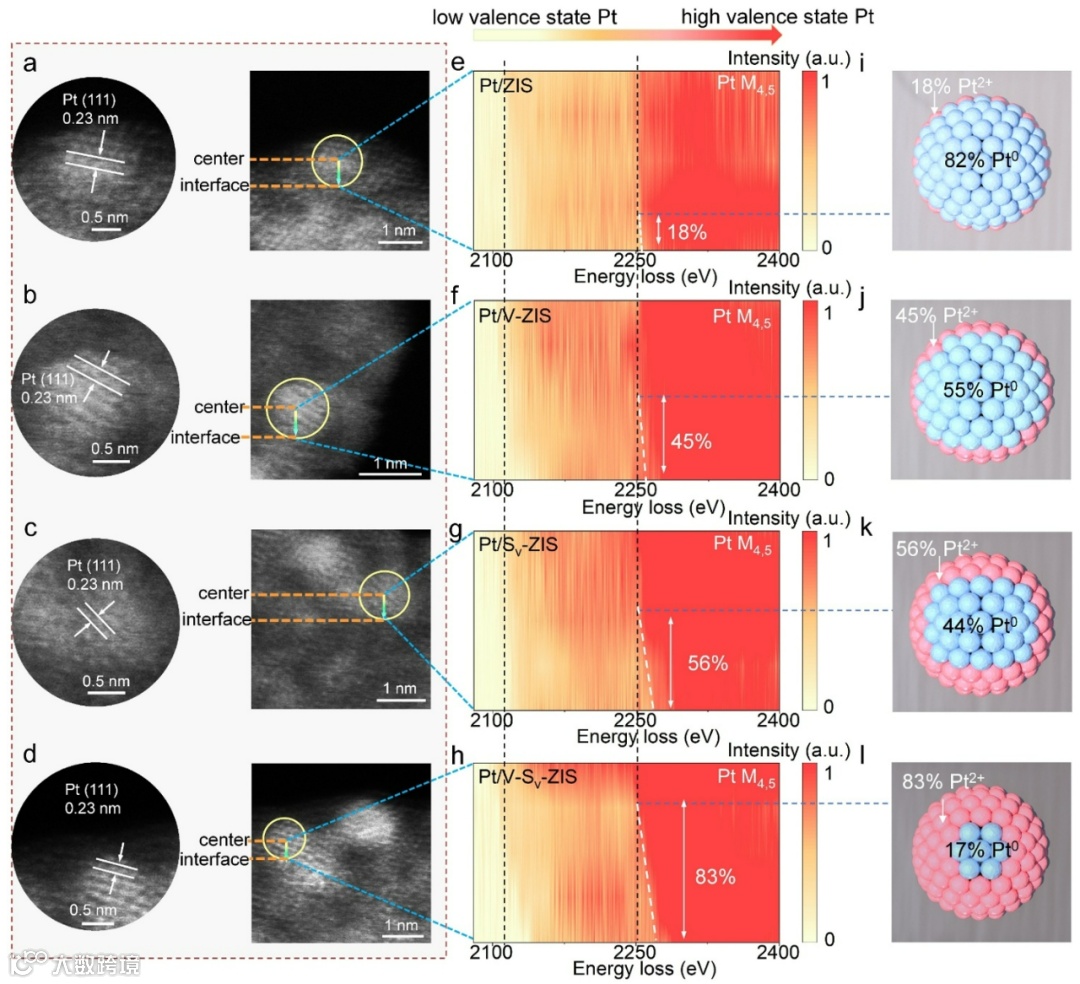
Figure 3. The spatial distribution of Pt2+/Pt0 by HAADF-STEM. a–d HAADF-STEM images of Pt/ZIS, Pt/V-ZIS, Pt/Sv-ZIS, and Pt/V-Sv-ZIS, the yellow circles are the Pt clusters, the circled images are the enlarged images of the Pt clusters, the orange dashed lines represent the center of the Pt cluster and the interface between Pt and different ZIS structures, the downward arrows indicate the selected path for measuring the EELS spectra; e–h EELS spectra of Pt M4,5 in Pt/ZIS, Pt/V-ZIS, Pt/Sv-ZIS, and Pt/V-Sv-ZIS, the blue dashed lines represent the EELS spectra along the paths in Figures 3a–d, the white slash lines indicate the energy shift regions of the Pt M4,5 edge from the lower energy loss to higher energy loss, and the white long arrows represent the energy shift regions of the Pt M4,5 edge; i–l Schematic diagram of Pt clusters in Pt/ZIS, Pt/V-ZIS, Pt/Sv-ZIS, and Pt/V-Sv-ZIS, the gray squares represent the ZnIn2S4 with different structures, the pink region represent the area dominated by Pt2+ near the Pt-ZnIn2S4 interface, the blue region represent the area dominated by Pt0 near the Pt cluster center, the white short arrows indicate the area dominated by Pt2+ near the Pt-ZnIn2S4 interface.
优化的Pt/V-Sv-ZIS显示出光催化全解水活性,产生40.9 μmol h−1的H2和19.0 μmol h-1的O2,随后在黑暗中观察到H2/O2气体以2:1的比例减少,表明存在水形成反应(图4)。接着,以有效抑制H2/O2复合的PtO/V-Sv-ZIS(逆反应速率为3%)为对照组,进行了光催化性能测试并发现,Pt/V-Sv-ZIS具有最优异的光催化活性,是Pt/ZIS和PtO/V-Sv-ZIS的5.5倍和2.0倍,且其逆反应速率仅为4%。在380 nm处的表观量子效率为18.15%,性能优于多数报道的材料。团队进一步扩大反应器规模,构建的10 m2漂浮式光催化系统日平均产生285.8 mmol H2(6.4 L),展现出实际应用潜力。
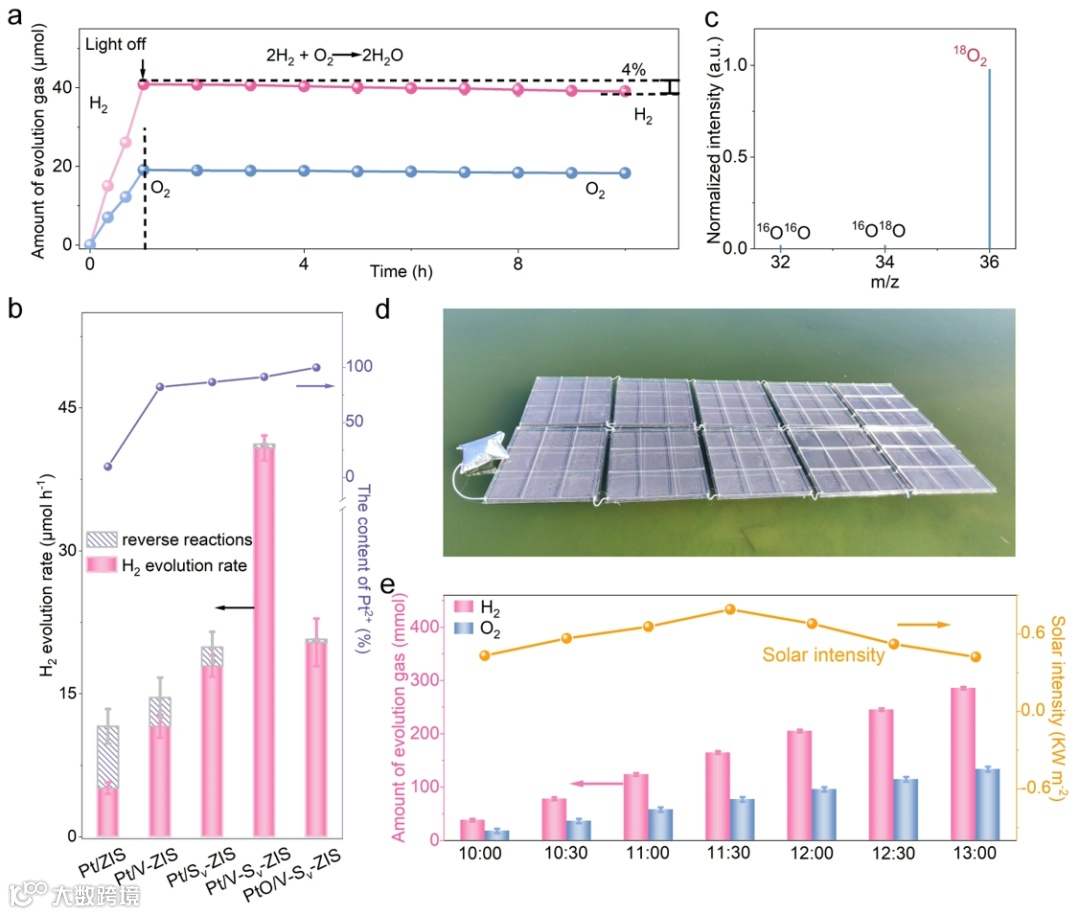
Figure 4. Photocatalytic performance and large area application. a Time-dependent photocatalytic overall water splitting in pure water under AM 1.5 G illumination (100 mW cm-2) and H2/O2 recombination profiles measured by removing light irradiation on Pt/V-Sv-ZIS, the black dashed line is the initial H2 amount without decay, test condition: 20 mg of photocatalysts; Pt and CoOx as cocatalysts; 50 mL of water, error bars represent the standard deviations from the statistical results of five tests; b The photocatalytic H2 evolution rates and the content of Pt2+ in Pt/ZIS, Pt/V-ZIS, Pt/Sv-ZIS, Pt/V-Sv-ZIS, and PtO/V-Sv-ZIS (date sources: Figures S14, 31, and Table S5), the gray boxes represent the H2evolution rate lost due to H2/O2 recombination (date sources: Figure S32), the H2/O2 recombination rates of Pt/ZIS, Pt/V-ZIS, Pt/Sv-ZIS, Pt/V-Sv-ZIS, and PtO/V-Sv-ZIS are 78%, 36%, 24%, 4%, and 3%, error bars represent the standard deviations from the statistical results of five tests; c The mass spectrum of O2 evolved during the photocatalytic splitting of H218O splitting over Pt/V-Sv-ZIS; d An overhead view of the large area photocatalytic reactor using the Pt/V-Sv-ZIS as photocatalyst (catalyst mass: 20 g; system area: 10 m2); e H2 and O2 evolutions of Pt/V-Sv-ZIS in the large area system under the natural sunlight condition from 10:00 to 16:00 on June. 22, 2024, at Northwestern Polytechnical University of Xi’an, China. The pink and orange arrows show the amount of generated H2/O2 and the change in sunlight intensity, error bars of large-area photocatalytic H2/O2 evolution represent the standard deviations from the statistical results of five tests.
Pt-ZnIn2S4杂化材料的原位XPS光谱和光电流测试揭示了ZnIn2S4到Pt的光生电子转移规律。Pt/V-Sv-ZIS在Pt0区域表现出最高的局域光生电子密度,其值为54.8 μA cm−2,是Pt/ZIS、Pt/V-ZIS和Pt/Sv-ZIS的152.2、3.0和1.6倍(图5)。较高的局域光生电子密度有利于在光催化水分解过程中产生Pt-H中间体,并使Pt/V-Sv-ZIS中的Pt-H中间体浓度提高3.6倍,相应的析氢势垒低至-0.1 eV。此外,随着Pt2+含量增加,~804 cm-1处的O2*振动峰强度在Pt/V-Sv-ZIS处几乎消失,相应的ORR电流密度在0.1 V从-0.3降低至-0.01 mA cm-2,证明Pt位点隔绝的O2吸附。
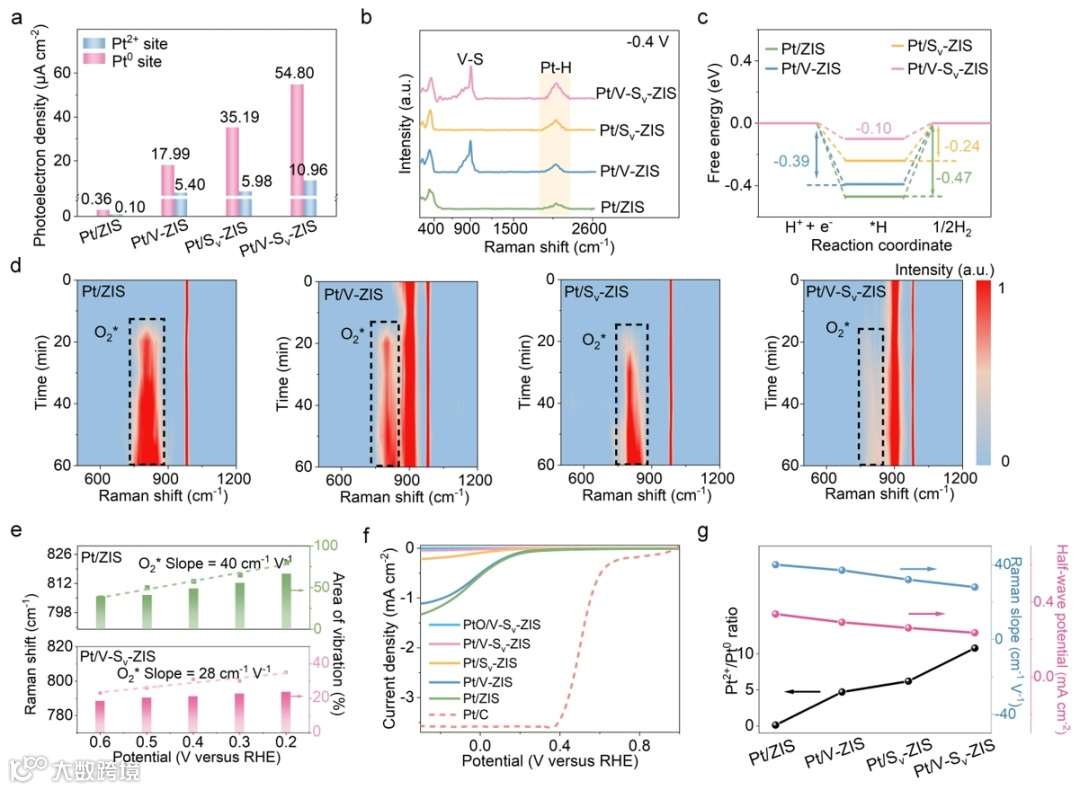
Figure 5. Near-zero proton reduction barrier and isolated oxygen adsorption. a Photogenerated electron density at Pt0 and Pt2+ regions of Pt/ZIS, Pt/V-ZIS, Pt/Sv-ZIS, and Pt/V-Sv-ZIS under AM 1.5 G illumination (100 mW cm-2) (date sources: Figures S45, 46 and Table S21); b In-situ Raman spectra of Pt/ZIS, Pt/V-ZIS, Pt/Sv-ZIS, and Pt/V-Sv-ZIS during simulated hydrogen evolution processes (potential: -0.4 V versus RHE; electrolyte: 0.5 M of Na2SO4), the Raman vibration of Pt-H intermediate is highlighted by a faint yellow box; c The proton reduction barriers of Pt/ZIS (-0.47 eV), Pt/V-ZIS (-0.39 eV), Pt/Sv-ZIS (-0.24 eV), and Pt/V-Sv-ZIS (-0.10 eV); d Two-dimensional contour maps of Raman spectra during the reverse reaction in Pt/ZIS, Pt/Sv-ZIS,Pt/V-ZIS, and Pt/V-Sv-ZIS (electrolyte: O2-saturated 0.5 M Na2SO4; potential: 1–0.2 V versus RHE), the O2* intermediate is highlighted by a black dashed box; e Stark shift for O2* inPt/ZIS and Pt/V-Sv-ZIS (electrolyte: O2-saturated 0.5 M Na2SO4; potentials: 1–0.2 V versus RHE); f Electrochemical linear sweep voltammetry (LSV) polarization curves of Pt/ZIS, Pt/V-ZIS, Pt/Sv-ZIS, and Pt/V-Sv-ZIS in a 0.5 M Na2SO4 electrolyte saturated with O2 atmospheres at 1600 rpm, catalysts molar: 0.2 μmol, counter electrode: graphite rod; g The Pt2+/Pt0ratio (date source: Figure S14), Raman slopes (date source: Figure S48), and half-wave potentials (date source: Figure S51) in Pt/ZIS, Pt/V-ZIS, Pt/Sv-ZIS, and Pt/V-Sv-ZIS.
并且,DFT计算表明,随着Pt2+浓度增加,Pt/V-Sv-ZIS的O2吸附自由能降低了96%,与Pt/ZIS相比,其O2解离势垒从0.91 eV上升到1.26 eV,从而阻止了O2的吸附和活化。此外,Pt/V-Sv-ZIS吸附H2甚至需要0.98 eV的能量,上升的能量势垒突显了H2吸附过程的困难。

Figure 6. Gibbs free energy of H2/O2 recombination for Pt-ZnIn2S4 hybrids and photocatalytic H2/O2 evolution and block recombination working principle. a Gibbs free energy of H2/O2 recombination for Pt/ZIS, Pt/V-ZIS, Pt/Sv-ZIS, and Pt/V-Sv-ZIS at U=0 V versus RHE. The O2 adsorption and dissociation barriers are highlighted by red and blue dashed boxes; the H2 adsorption barrier is highlighted by a gray dashed box, the insert images are transition state structures of reaction steps in H2/O2 recombination on the Pt/V-Sv-ZIS, the purple, gray, green, blue, orange, cyan, red, and pink balls represent V, S vacancy, Zn, In, S, Pt, O, and H atoms, respectively; b Photocatalytic H2/O2 evolution and block recombination working principle. Photoinduced electrons/holes generation and separation processes of Pt/V-Sv-ZIS, the conduction band and valence band are abbreviated as CB and VB, respectively; H2/O2 evolution and inhibited recombination process of Pt/V-Sv-ZIS.

本研究提出一个空间定向分布的Pt助催化剂通用设计标准,能够同时实现降低质子还原势垒和抑制H2/O2复合。该设计策略通过在ZnIn2S4中引入缺电子中心,实现了Pt和ZnIn2S4之间的反向界面电子转移,获得空间定向分布的Pt2+/Pt0,其中Pt2+在Pt/V-Sv-ZIS界面附近83%的区域占主导,抑制了O2吸附,并且剩余的最小Pt0增强了局部光生电子密度,显著增强了光催化活性。这一近乎完美的铂助催化剂H2/O2复合速率仅为4%,质子还原能垒为-0.10 eV,光催化OWS提高了45.4倍。研究证明了铂价态调控在光催化反应中的关键作用,潜在的适用性可扩展到各种催化体系,包括光电催化、有机催化和环境催化。

S. Liu, Y. Zhang, M. Wang, Y. Wei, Y. Wang, W. Chen, S. Mao, P. Guo, J. B. Ghasemi, J. Zhou, S. Zhang, X. Li*. A Near-Perfect Pt Cocatalyst with a Spatially Oriented Distribution of Pt2+/Pt0 for Photocatalytic Water Splitting, Adv. Mater. 2025, e08693.
https://doi.org/10.1002/adma.202508693
声明