第一作者:赵圣希(华中师范大学)
通讯作者:李浩(上海交通大学)、孙红卫(华中师范大学)、张礼知(华中师范大学、上海交通大学)
论文DOI:10.1038/s41893-023-01265-8
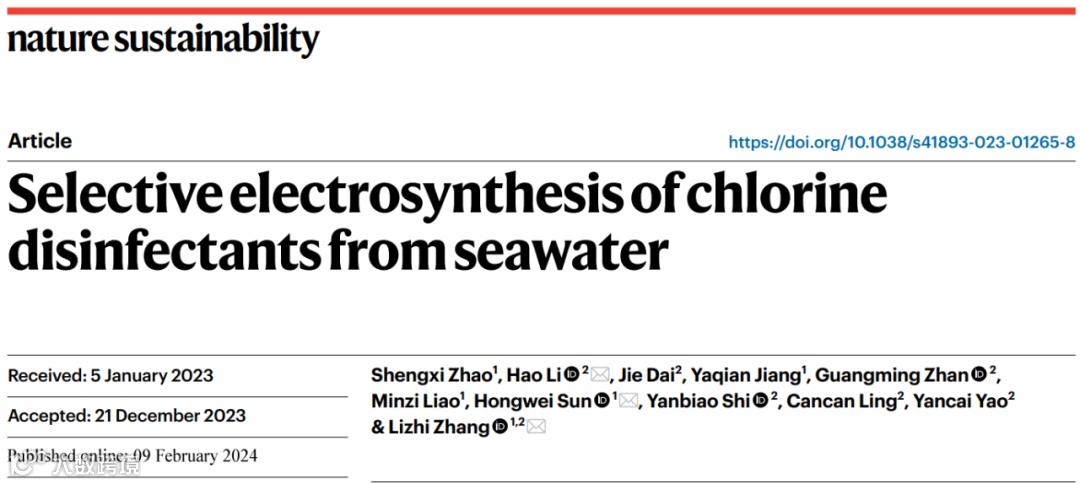
近日,张礼知教授课题组在Nature sustainability上发表了题为“Selective electrosynthesis of chlorine disinfectants from seawater”的研究论文(DIO: 10.1038/s41893-023-01265-8)。该研究报道了一种从天然海水中高效并持续合成活性氯消毒剂的新方法,为可持续发展提供了新思路。作者采用机械化学法制备了Fe掺杂Ti4O7电极(Fe-Ti4O7)。Fe掺杂增强了Ti4O7表面晶格氧活性位点的亲电性,显著提高了表面晶格氧的选择性,选择性活化天然海水中低浓度氯离子,抑制了碱土金属离子在电极表面的沉积。Fe-Ti4O7在天然海水电合成活性氯消毒反应中展现出远超传统商业DSA的高活性和稳定性以及低成本优势。该团队正在进行相关电极的产业化生产和应用开发。
活性氯是最有效的污水和压载水处理消毒剂之一。目前,活性氯的生产主要依靠于氯碱工艺。该工艺使用贵金属氧化物(RuO2, Rh2O3, IrO2)涂覆的钛金属板(DSA)为阳极,浓度为5 – 6 mol L–1的饱和食盐为电解质,先在酸性条件下(pH < 4)电解生成氯气,氯气随后在纯水或碱溶液中通过歧化反应生成活性氯。在当前纯水资源日趋稀缺和双碳背景下,该工艺受到的制约越来越多。相较于淡水,盐度为3.5 wt.%的海水占地球总水量的约96.5%,是理想的活性氯电化学合成资源。然而,海水Cl–浓度较低(< 0.5 mol L–1)且组成复杂(含Br−, SO42−, NO3−, Na+, K+, Mg2+, Ca2+等),给海水直接电化学合成活性氯带来了极大挑战,尤其是在电极的选择上。这是因为析氧反应和析氯反应(CER)会在DSA电极表面竞争活性位点,在低氯浓度、近中性海水中和工业高电流密度下,析氧副反应尤为严重;而海水中的碱土金属离子在电解过程中会沉积在DSA电极表面导致电极失活。此外,DSA阳极还会持续溶出贵金属离子,导致电极失效并造成二次污染风险。因此,开发能够高效和高选择性海水直接电化学合成活性氯的非贵金属电极具有重要学术意义和应用前景。
针对这一挑战,该团队发展了Fe掺杂Ti4O7电极(Fe-Ti4O7)的机械化学合成策略。Fe掺杂增强了Ti4O7表面晶格氧这一活性位点的亲电性,显著提高了表面晶格氧选择性氧化天然海水中低浓度氯离子,有效抑制了碱土金属离子在电极表面的沉积。Fe-Ti4O7电极天然海水合成活性氯的选择性达到75%,显著优于传统商业DSA的选择性(45%),其固有周转频率和质量活性均比DSA高两个数量级,且在实验室条件下能稳定运行10天,展现出了卓越的稳定性。该海水电解系统可用商业硅光伏电池驱动,其活性氯合成速率高达3.15 mg min−1,能够在五分钟内有效灭活远洋轮船压载水中常见的细菌。此项研究不仅为活性氯合成提供了一种创新的能源保护和资源优化方案,还为可持续发展提供了新思路。
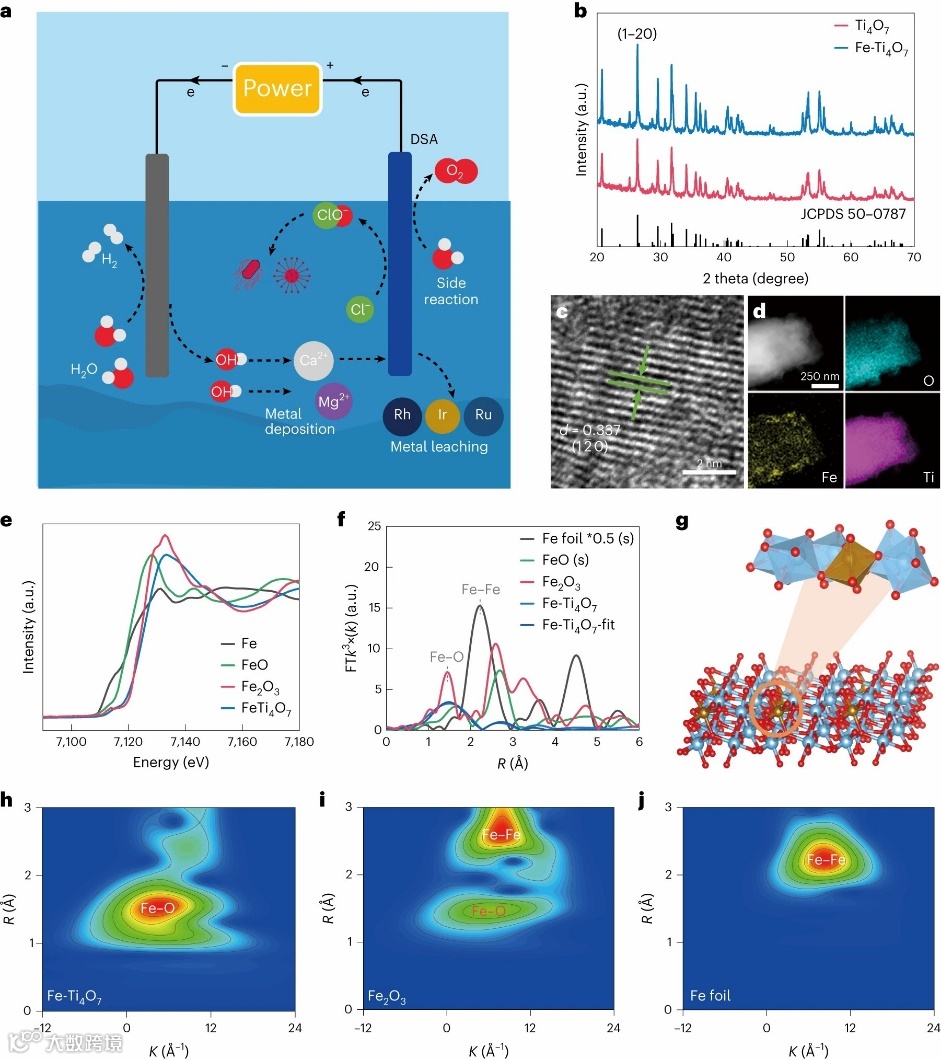
Fig. 1 | Fine-structure characterizations. a, Schematic illustration of the challenges associated with AC synthesis in seawater. b, XRD patterns of Ti4O7 and Fe-Ti4O7. c, HRTEM images of Fe-Ti4O7. d, The energy-dispersive X-ray elemental mapping images of O, Fe and Ti of Fe-Ti4O7. The same experimental results were obtained in three independent experiments. e, f, Normalized X-ray absorption near-edge structure spectra (e) and Fourier-transform K-edge EXAFS spectra (f) of Fe in Fe-Ti4O7 and Ti4O7. g, Atomic structure model of Fe-Ti4O7. h–j, WT plots of Fe-Ti4O7(h), Fe2O3 (i) and Fe foil (j). a.u., arbitrary unit.
通过机械化学法成功合成了Fe掺杂Ti4O7(Fe-Ti4O7)电极。XRD、HRTEM、XANES和EXAFS的分析结果发现,Fe原子以替代Ti原子的方式被掺杂进入了Ti4O7的晶格中。
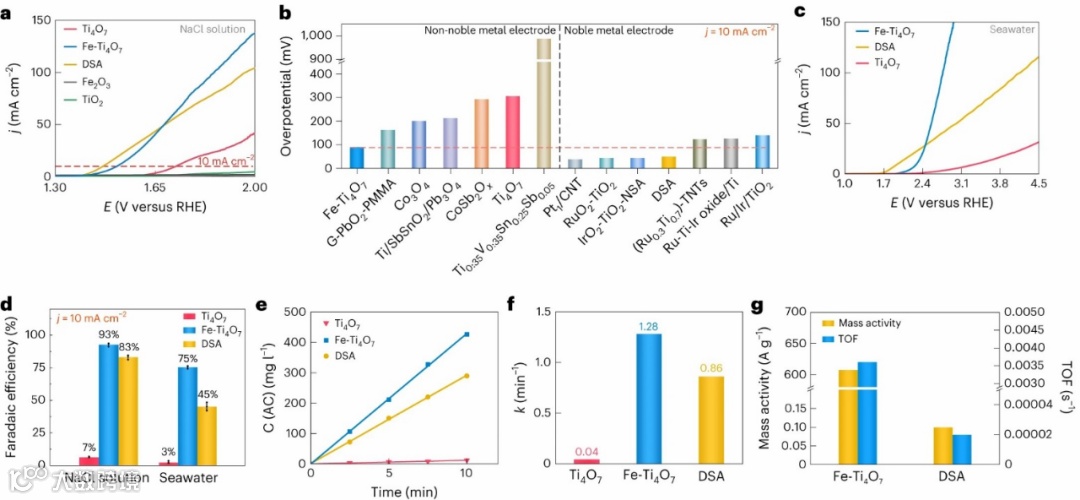
Fig. 2 | Electrochemical performance. a, Linear sweep voltammetry (LSV) polarization curves of Ti4O7, Fe-Ti4O7, DSA, Fe2O3 and TiO2 in 4.0 mol L−1 NaCl solution at pH = 1. Commercial Ni foam was used as a cathode. b, Comparison of overpotentials among Fe-Ti4O7 anode, non-noble metal-based electrodes and noble metal-based electrodes at a current density of 10 mA cm−2. c, LSV polarization curves of Ti4O7 and Fe-Ti4O7 anodes in unbuffered seawater. d, Faradaic efficiency of the Ti4O7 and Fe-Ti4O7 anodes, and DSA. The bar represents the mean value for n = 3 experiments and data distribution is represented by the black dots. e, f, Electrochemical AC synthesis by the Ti4O7 and Fe-Ti4O7 anodes, and DSA in unbuffered seawater (e), and the corresponding synthetic rate (f). g, Mass activity and TOFs of the Fe-Ti4O7 anode and DSA. The error bars represent the s.d. values derived from three distinct samples.
电化学活性测试的结果表明,Fe掺杂显著提高了Ti4O7阳极的CER活性。其中,在氯碱工业的标准条件下,Fe-Ti4O7阳极的CER活性不仅优于当前最先进的非贵金属电极,而且接近大多数的贵金属电极。在天然海水条件下,Fe-Ti4O7阳极的法拉第效率、活性氯合成速率、固有周转频率以及质量活性均显著高于传统DSA,彰显了其在实际应用中的优越性能和潜力。
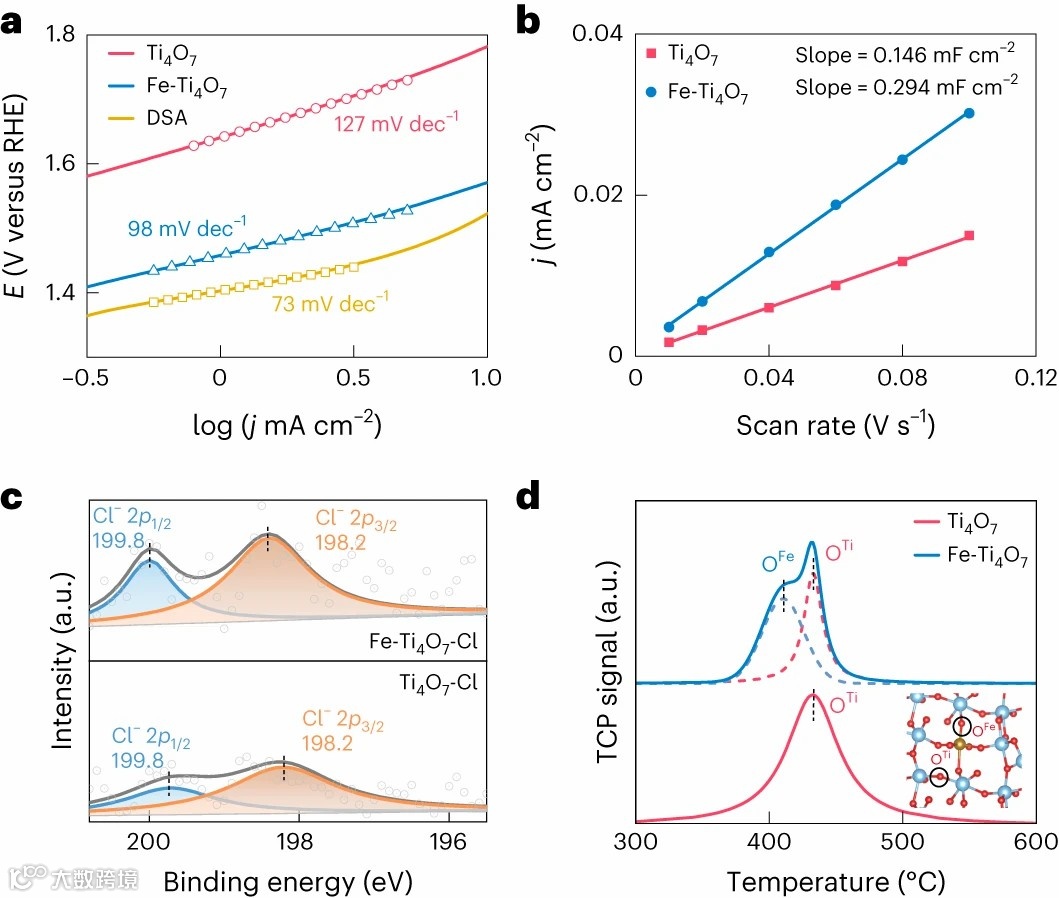
Fig. 3 | Reaction mechanism study. a, Tafel plots calculated from the CER polarization curves of the Ti4O7 and Fe-Ti4O7 anodes, and the DSA. The linear segment data ranging from −0.25 to 0.75 were extracted for the purpose of fitting and calculating the Tafel slope. b, Cdl estimated from the CV curves of the Ti4O7 and Fe-Ti4O7anodes. c, Cl 2p XPS spectra of the Fe-Ti4O7 and Ti4O7 anodes after Cl− absorption. d, H2-TPR of the Fe-Ti4O7 and Ti4O7 anodes.
Tafel斜率分析发现,Fe-Ti4O7的CER反应机理可能为Volmer–Heyrovský或Volmer–Tafel机理。结合电化学活性面积的测试结果、对Cl−的吸附性能评估,以及H2-TPR实验的数据,我们推测Fe的掺杂优化了Ti4O7表面晶格氧的活性,引入了具有更高反应活性的OFe位点。这一变化不仅增大了Ti4O7电极的电化学活性面积,还提高了其对Cl−的吸附能力。
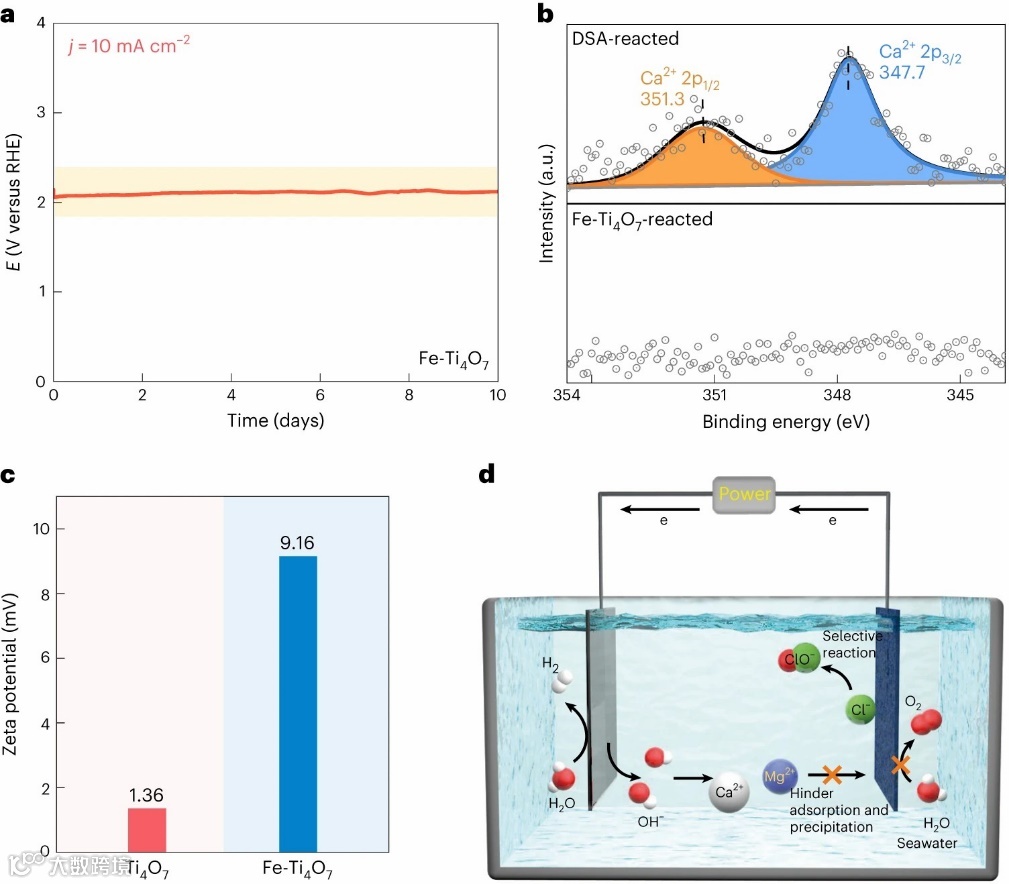
Fig. 4 | Electrochemical stability. a, Chronopotentiometric curve of the Fe-Ti4O7 anode at 10 mA cm−2. b, Ca2+ 2p XPS of the DSA and Fe-Ti4O7 anode after extended seawater electrolysis. c, Zeta potential of the Ti4O7 and Fe-Ti4O7 anodes. d, Schematic illustration of seawater electrolysis mediated by the Fe-Ti4O7 anode.
Fe-Ti4O7阳极展示了优异的稳定性,在实验室中稳定运行10天活性无明显衰减。相较于Ti4O7,Fe-Ti4O7阳极具有更高的Zeta电位,且长期反应后其表面没有碱金属离子沉积,显示出Fe掺杂有效抑制了碱金属离子的沉积。
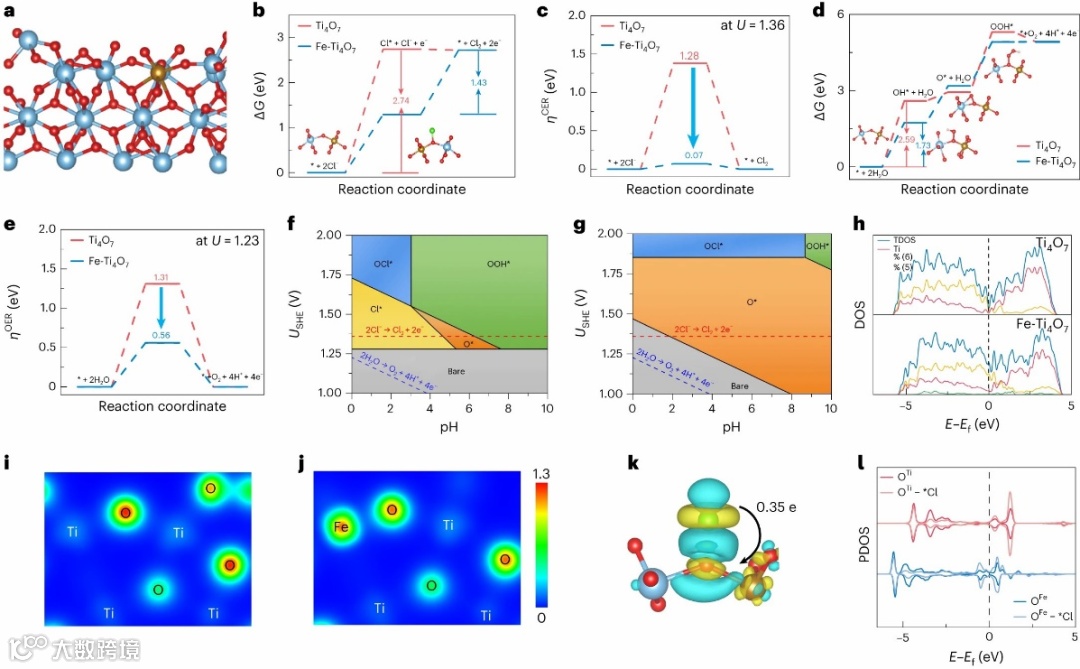
Fig. 5 | DFT calculations of CER and AC synthesis. a, Structural model of Fe-Ti4O7. The blue, yellow and red colours represent the Ti, Fe and O atoms, respectively. b, Gibbs energy diagrams of CER on Fe-Ti4O7 and Ti4O7. c, Theoretical overpotential of CER on Fe-Ti4O7 and Ti4O7. d, Gibbs energy diagrams of OER on Fe-Ti4O7 and Ti4O7. e, Theoretical overpotential of OER on Fe-Ti4O7 and Ti4O7. f, g, Theoretical Pourbaix diagram for the Ti4O7 (f) and Fe-Ti4O7 (g) of the theoretical standard hydrogen electrode potential (USHE) versus pH in equilibrium with H+, Cl− and H2O at T = 298 K. The red dashed lines represent the equilibrium potential of CER (Ueq = 1.36 V) and the blue dashed lines represent the equilibrium potential of OER (Ueq = 1.23 V − 0.059 pH) in the SHE scales, respectively. The black solid lines define the surface phase boundary where two adsorbate species exist in equilibrium. h, Total density of state (TDOS) and PDOS of Fe-Ti4O7 and Ti4O7. i, j, Electron density contour maps for Ti4O7 (i) and Fe-Ti4O7 (j). k, Electron density difference of Cl* adsorption on Fe-Ti4O7. l, PDOS of surface lattice O of Fe-Ti4O7 and Ti4O7 before and after adsorption of Cl−.
DFT计算发现,Fe-Ti4O7的CER反应遵循Volmer–Heyrovský机理,并且Fe掺杂能够选择性地降低CER的理论过电位,对OER这一竞争反应的理论过电位影响较小。在天然海水的pH条件下,*O是Ti4O7上的主要稳定中间体,而*Cl和*OCl则是Fe-Ti4O7上的稳定中间体,说明在海水环境中Fe-Ti4O7电极表面主要发生CER。Bader电荷分析发现Fe掺杂提升了Ti4O7表面晶格氧活性位点的亲电性,进一步的DOS和差分电荷分析证实OFe位点具有更强的Cl−吸附与活化能力。
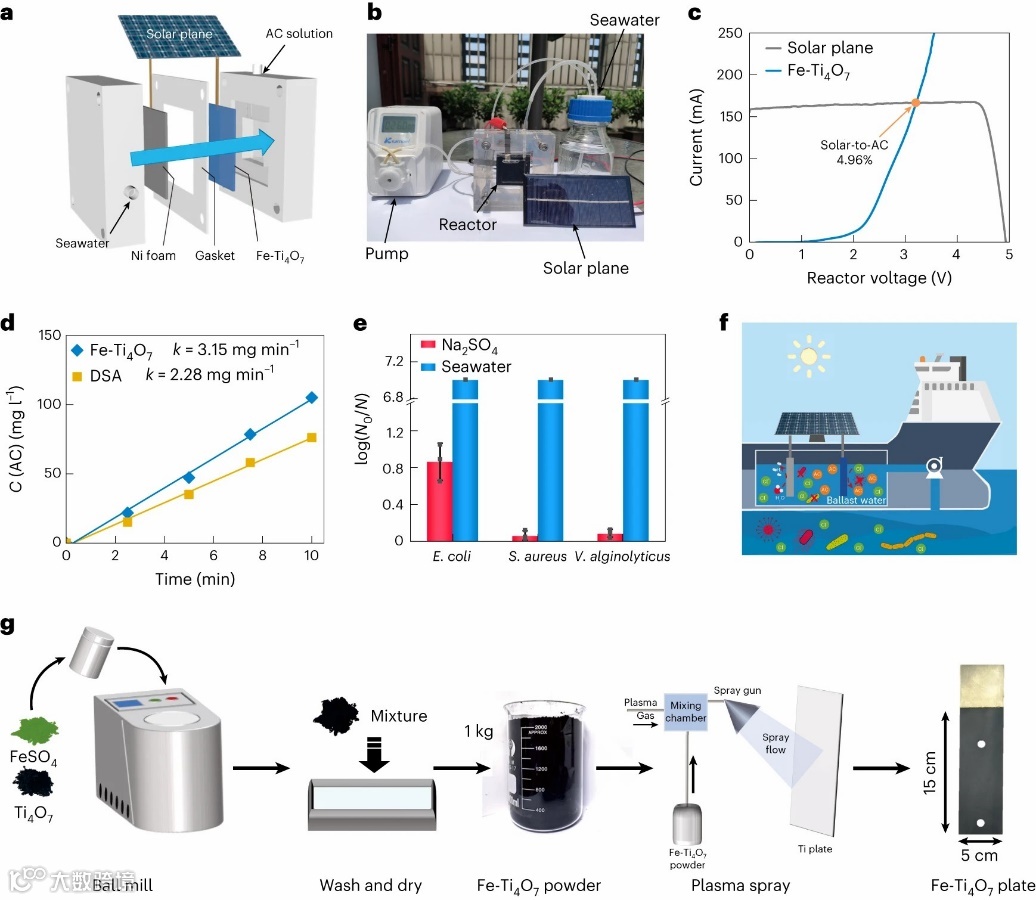
Fig. 6 | Reactor design and performance. a, b, Schematic illustration (a) and digital image (b) of the solar cell-driven reactor for AC electrosynthesis. c, J–V curve of the solar plane and CER polarization curves with Fe-Ti4O7 and DSA as the anodes. d, AC electrochemical synthesis from the solar cell-driven reactor with Fe-Ti4O7 and DSA as the anodes. e, Sterilization of the solar cell-driven reactor. For comparison, 0.5 mol L−1 Na2SO4 was used as the electrolyte. The bar represents the mean value for n = 3 experiments; data distribution is represented by the black dots. f, Schematic illustration of ballast water treatment using our designed solar cell-driven reactor. g, Large-scale preparation of Fe-Ti4O7 on a kilogram scale for plasma spraying preparation of the Fe-Ti4O7 anode. The error bars represent the s.d. values derived from three distinct samples.
团队组建出一个商业硅光伏电池驱动的Fe-Ti4O7海水电解系统,该系统的活性氯合成速率高达3.15 mg min−1,能够在五分钟内有效灭活远洋轮船压载水中常见的细菌,包括大肠杆菌、金黄色葡萄球菌和溶藻弧菌。此外,该Fe-Ti4O7电极的制造成本低廉,仅为$68.78 m−2,远低于传统的商业DSA(约$1900 m−2)。
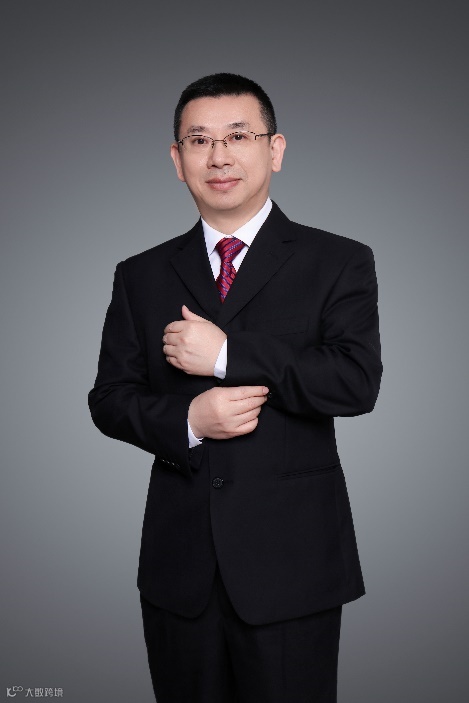
张礼知,上海交通大学环境科学与工程学院特聘教授,国家杰出青年科学基金获得者,科技部中青年科技创新领军人才计划,教育部长江学者特聘教授,中组部万人计划科技创新领军人才。已获授权中国发明专利50余项,其中授权美国专利2项。在Nature Sustainability、 Nature Communications、Chem、 PNAS、 AM、 ES&T、 WR 等国际学术期刊发表论文390余篇,其中34篇入选ESI高被引论文,1篇入选ESI热点论文。论文已被引用44200多次,其中他引42980多次,H因子116。担任中国可再生能源学会太阳光化学专业委员会委员、IOP英国物理学会出版社旗下期刊Sustainability Science and Technology执行编委,Applied Catalysis B Environmental、化学学报、化学进展、环境化学、环境科学等杂志编委。2008年获得湖北省自然科学二等奖(第一完成人),2011年获湖北省青年科技奖,并入选湖北省自主创新“双百计划”,2012年入选湖北省高端人才引领培养计划和湖北省高层次人才工程,2014年起连续入选Elsevier发布“化学领域中国高被引学者榜单”,2015年获教育部高等学校科学研究优秀成果奖(科学技术)自然科学二等奖(第一完成人),2018年起连续入选 Clarivate(Web of Science)交叉领域全球高被引科学家榜单,2019年获湖北省自然科学一等奖(第一完成人)。
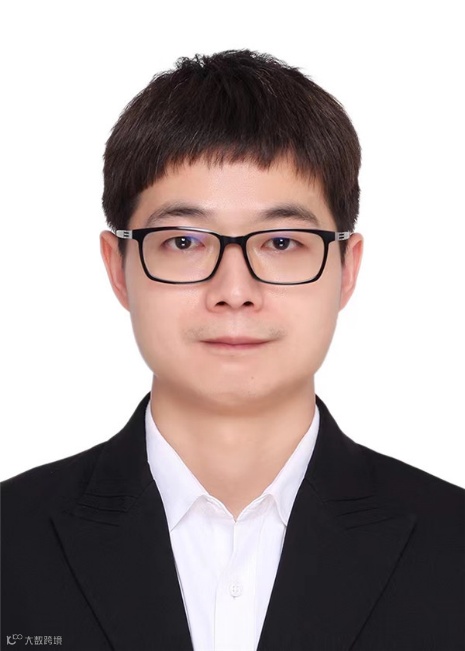 李浩,上海交通大学环境科学与工程学院长聘教轨副教授,博士生导师,优秀青年科学基金项目(海外)获得者。本科、博士毕业于华中师范大学,瑞典林雪平大学、瑞士联邦材料科学与技术研究所、苏黎世联邦理工学院博士后。从事污染控制化学、光/电催化和纳米环境材料等领域的研究,负责和主持国家重点研发计划、国家自然科学基金、上海市科技创新计划等项目。以第一作者和通讯作者在Nat. Sustain.、PNAS、JACS、Angew. Chem.、ES&T等化学、环境学术期刊发表论文30余篇,其中11篇入选ESI高被引论文,论文累被引用7500余次,相关工作入选ES&T年度最佳论文和ACS Editors' Choice。目前担任Sustainability Science and Technology编委,Nano-Micro Letters青年编委。2019年获湖北省自然科学一等奖。

孙红卫,华中师范大学化学学院副教授,硕士生导师。研究方向为铁环境化学,高级氧化技术,有机物、微生物等水污染的控制技术等,主持国家自然科学基金、中国博士后科学基金、湖北省自然科学基金等8项,在Environ. Sci. Technol. Water Res.和Appl. Catal., B等环境领域著名期刊发表学术论文30余篇,参与撰写出版英文专著1部,获国家发明专利授权3项。
赵圣希,博士研究生,现就读于华中师范大学,目前主要研究电化学污染控制。
课题组主页:http://www.irongroup.cn/
本文仅用于学术分享,不做盈利使用,如有侵权,请联系后台小编删除
欢迎关注我们,订阅更多最新消息 “邃瞳科学云”推出专业的自然科学直播服务啦!不仅直播团队专业,直播画面出色,而且传播渠道多,宣传效果佳。
“邃瞳科学云"平台正在收集、整理各类学术会议信息,欢迎学会、期刊、会议组织方择优在邃瞳平台上进行线上直播,希望藉此帮助广大科研人员跨越时空的限制,实现自由、畅通地交流互动。欢迎老师同学们提供会议信息(会有礼品赠送),学会、期刊、会议组织方商谈合作,均请联系王女士:18612651915(微信同)。
投稿、荐稿、爆料:Editor@scisight.cn
“邃瞳科学云”推出专业的自然科学直播服务啦!不仅直播团队专业,直播画面出色,而且传播渠道多,宣传效果佳。
“邃瞳科学云"平台正在收集、整理各类学术会议信息,欢迎学会、期刊、会议组织方择优在邃瞳平台上进行线上直播,希望藉此帮助广大科研人员跨越时空的限制,实现自由、畅通地交流互动。欢迎老师同学们提供会议信息(会有礼品赠送),学会、期刊、会议组织方商谈合作,均请联系王女士:18612651915(微信同)。
投稿、荐稿、爆料:Editor@scisight.cn












 邃瞳科学云
邃瞳科学云