

第一作者:李文峰
通讯作者:陈代梅,吕国诚
通讯单位:中国地质大学(北京)
DOI: 10.1002/adfm.202523344

光电化学水分解已成为一种可持续的太阳能-燃料转换策略,以应对全球能源挑战。发展光电极材料,特别是高性能光阳极,是决定光电化学系统效率的关键因素。单斜晶系BiVO4因其适宜的带隙(≈2.4 eV)、匹配的能带排列及成本效益,已成为一种极具前景的光阳极材料。然而,其较差的载流子迁移率会导致复合损失,限制了其实际光电化学应用。BiVO4中的载流子传输可由小极化子跳变模型描述,其中过多的载流子会引起晶格畸变并形成局域极化,进而阻碍载流子传输并最终导致迁移率下降。因此,迫切需要寻找合适的方法来降低极化子跳变能垒来提升光电化学性能。

本研究采用了元素掺杂和光热效应来刺激极化子跳变,以增强载流子传输。Mo掺杂可以钝化BiVO4中的浅层和深层陷阱态,从而提高载流子浓度并降低极化子跃迁的能垒。光热材料Ni2P的修饰不仅可以进一步热活化极化子,还能有效地将空穴从Mo:BiVO4中提取出来用于表面反应。此外,Ni2P在808 nm近红外光(NIR)(3 W cm-2)照射下诱导的光热效应降低了析氧反应中速率决定步骤的能垒,加速了电极界面的O2析出,并使活性位点得以更快地重新暴露。因此,改性BiVO4光阳极的陷阱限制模式电子扩散系数(Dn-L)大幅提高至5.8×10⁻⁸ cm2s-1,在AM 1.5G + 808 nm NIR光照下于1.23 VRHE处实现了92.2%的高分离效率和6.38 mA cm-2的显著光电流密度。
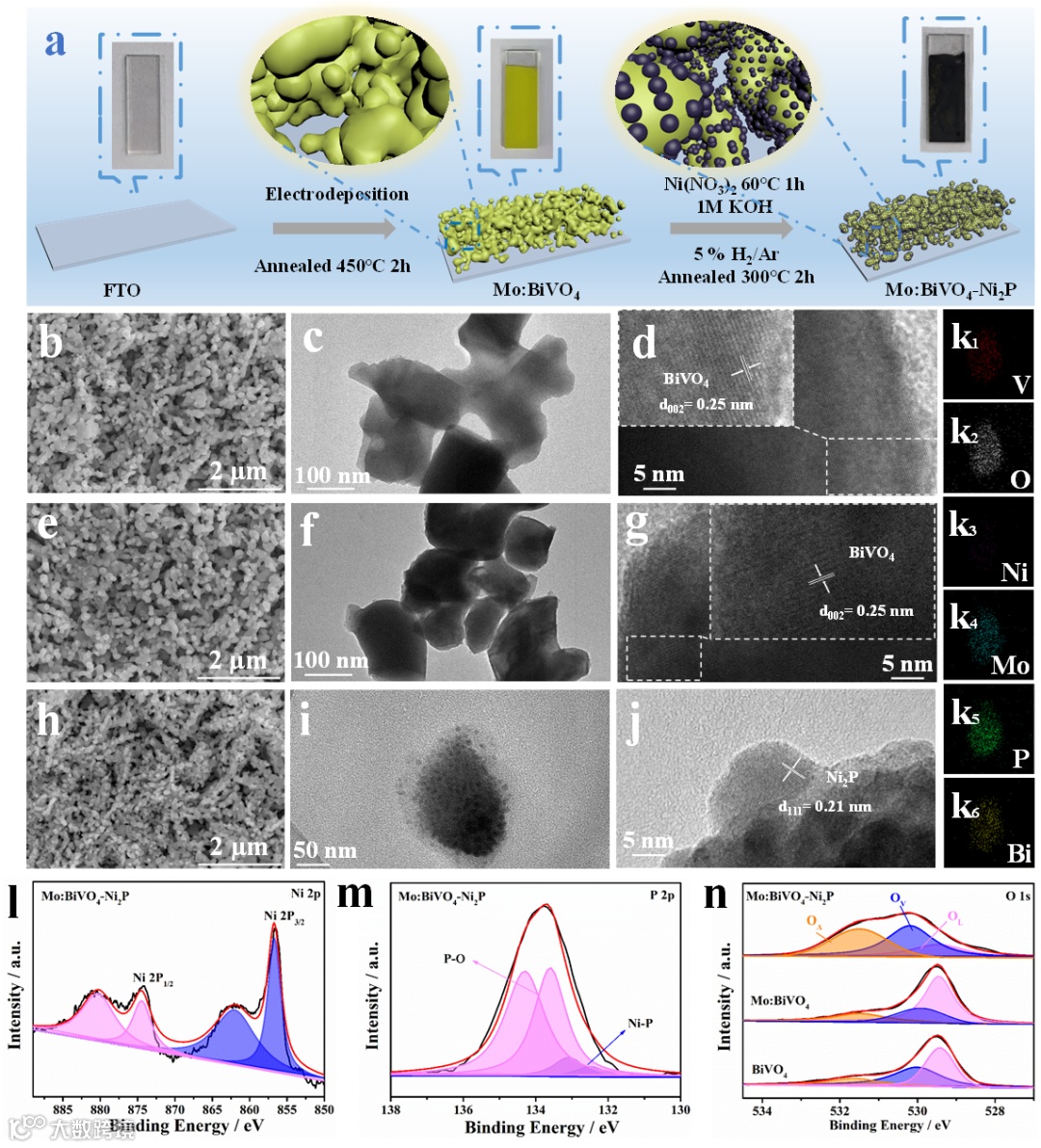
Morphological and structural characterization. a) Scheme for the illustration of the fabrication process of Mo:BiVO4-Ni2P on FTO. SEM, TEM, and HRTEM image of b-d) BiVO4. e-g) Mo:BiVO4. h-j) Mo:BiVO4-Ni2P. k) EDS Mapping images of Mo:BiVO4-Ni2P. XPS spectra of l) Ni 2p spectra. m) P 2p spectra. n) O 1s spectra.
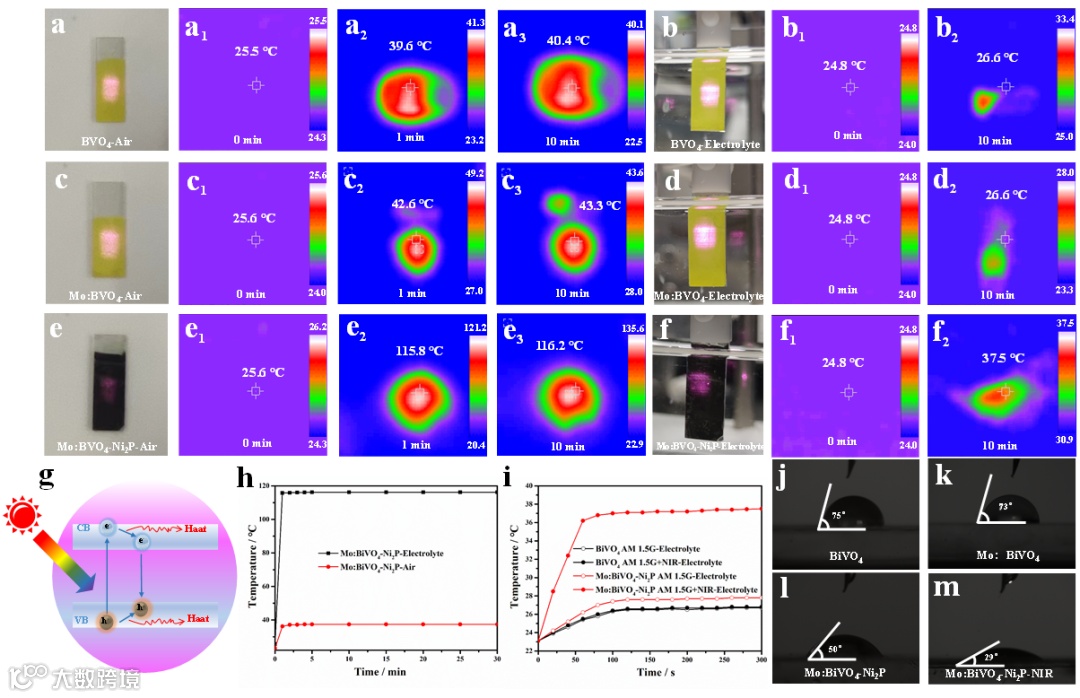
Infrared images of electrodes in air or electrolyte under 808 nm IR irradiation. a) BiVO4-air. b) BiVO4-electrolyte. c) Mo:BiVO4-air. d) Mo:BiVO4-electrolyte. e) Mo:BiVO4-Ni2P-air. f) Mo:BiVO4-Ni2P-electrolyte. g) Ni2P non-radiative relaxation heat production maps. h) Temperature versus time curves of Mo:BiVO4-Ni2P electrode in air and electrolyte solution under infrared light irradiation. i) Temperature-time plots of BiVO4 and Mo:BiVO4-Ni2P photoanodes with or without NIR light irradiation under AM1.5 G light. j-m) Contact angle images of photoanodes.
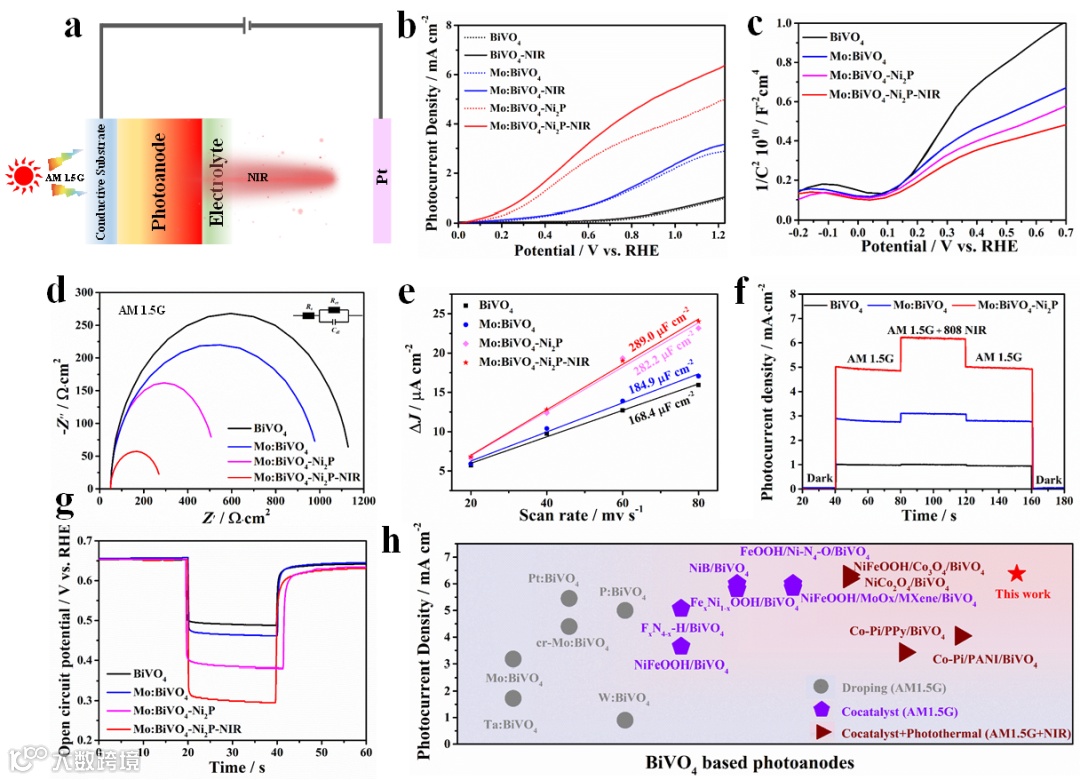
Photoelectrochemical water splitting performances. a) Schematic of PEC test under AM 1.5G and NIR irradiation. b) Photocurrent potential curves of BiVO4, Mo:BiVO4, and Mo:BiVO4-Ni2P photoanodes under AM 1.5G illumination with or without NIR. c) Mott-Schottky plots. d) EIS spectra under AM 1.5G illumination with or without NIR. e) Linear fitting of capacitive currents versus scan rates. f) transient photocurrent density response under under AM 1.5G illumination with or without NIR. g) OCP plots of photoanodes. h) comparison of photocurrent densities at 1.23 VRHE for BiVO4-based photoanodes in different studies.
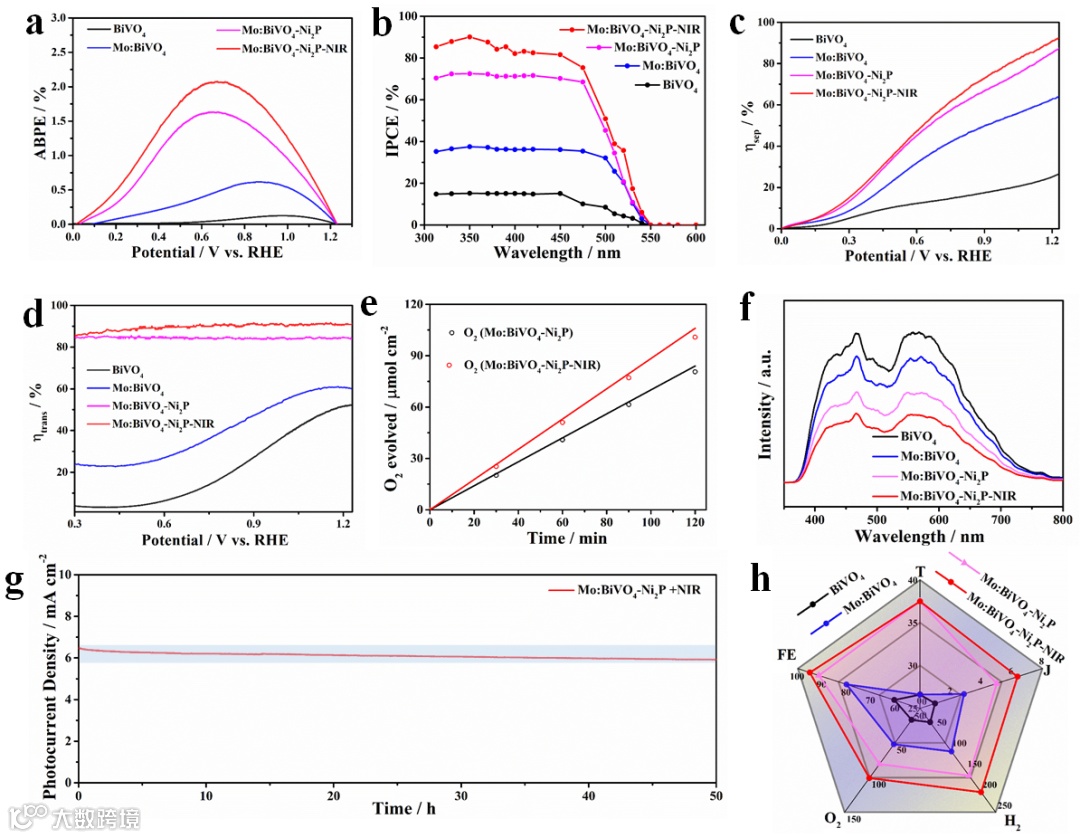
Photoelectrochemical water splitting performances. a) ABPE curves. b) IPCE curves. c) charge separation efficiencies. d) surface charge transfer efficiencies of prepared electrodes. e) O2 evolution performance of Mo:BiVO4-Ni2P photoanode with and without NIR light irradiation. f) Photoluminescence spectra of prepared electrodes. g) Stability for Mo:BiVO4-Ni2P-NIR photoanodes at 1.23 VRHE for 50 h. h) Comparison of J, T, H2, O2 yields and Faraday efficiencies of BiVO4, and modified by Mo doping, Ni2P loading and its NIR irradiation.
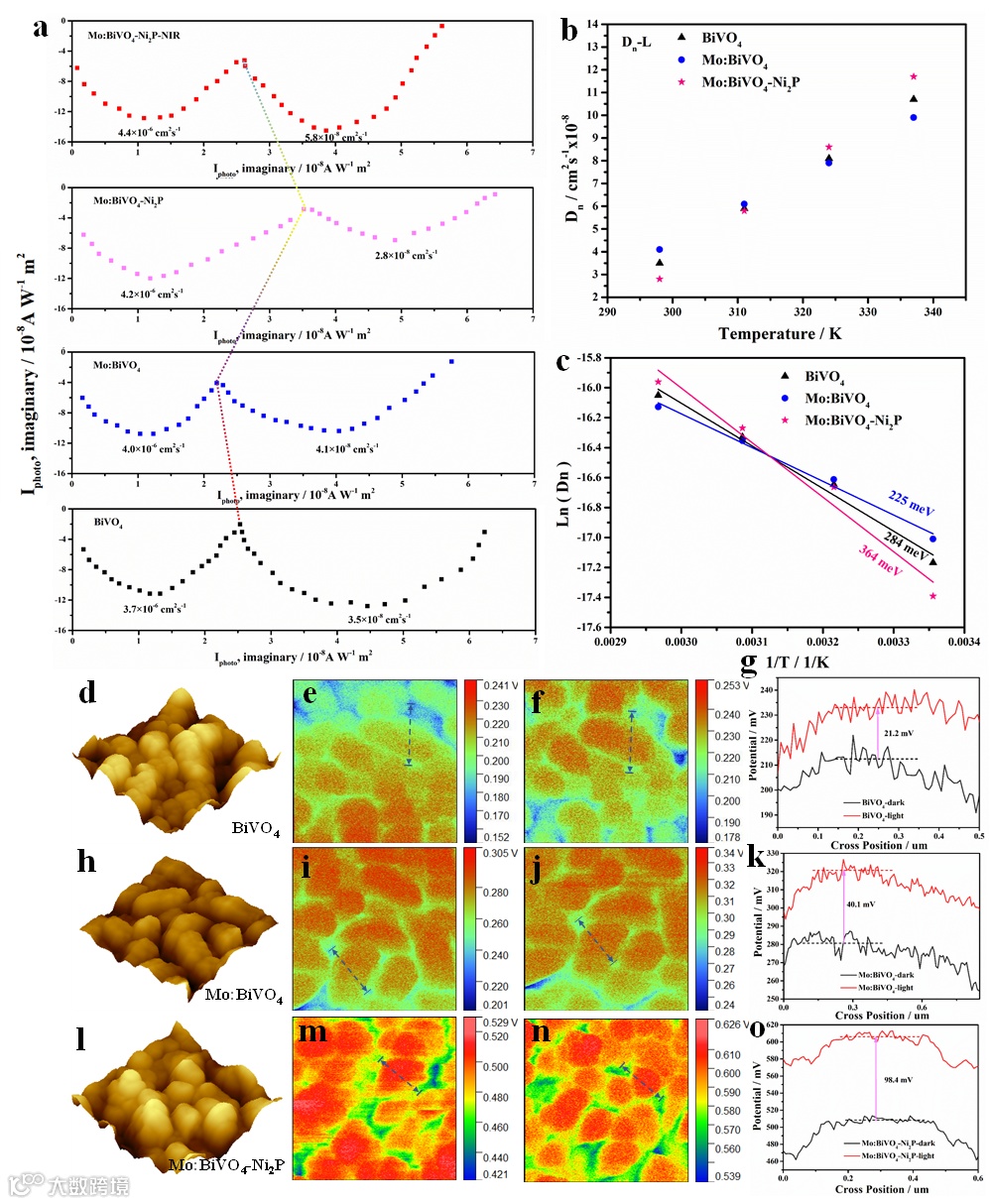
IMPS and KPFM characterization. a) IMPS Nyquist plots of BiVO4, modified by Mo doping, Ni2P loading and NIR irradiation samples. b) Temperature-dependent Dn-L of samples. c) Activation energy of Dn-L. KPFM images under dark and light conditions, and CPD maps of specific labeled positions of d-g) BiVO4. h-k) Mo:BiVO4. l-o) Mo:BiVO4-Ni2P.
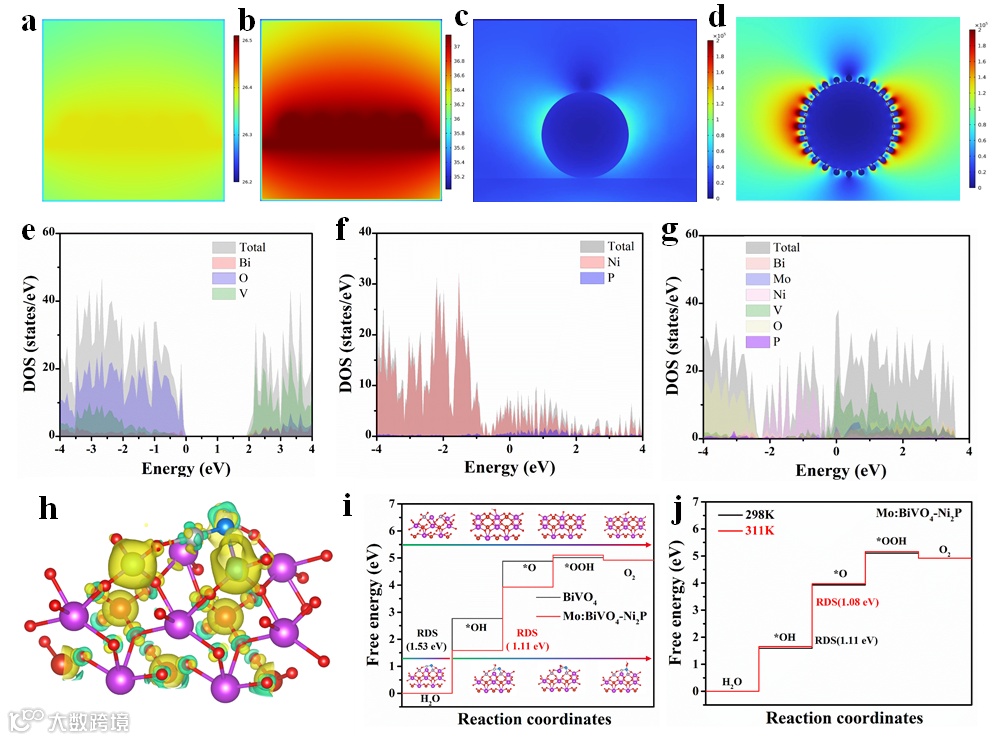
Finite element simulations and theoretical calculations. Simulated BiVO4 and Mo:BiVO4-Ni2P simplified models a, b) temperature field distribution and c, d) Electric field distribution. e-g) Density of states of BiVO4, Ni2P and Mo:BiVO4-Ni2P. h) Differential charge density of BiVO4-Ni2P. i) Gibbs free energy for OER of the BiVO4 and Mo:BiVO4-Ni2P. j) Gibbs free energy for OER of the Mo:BiVO4-Ni2P with different temperatures (298 and 311 K).
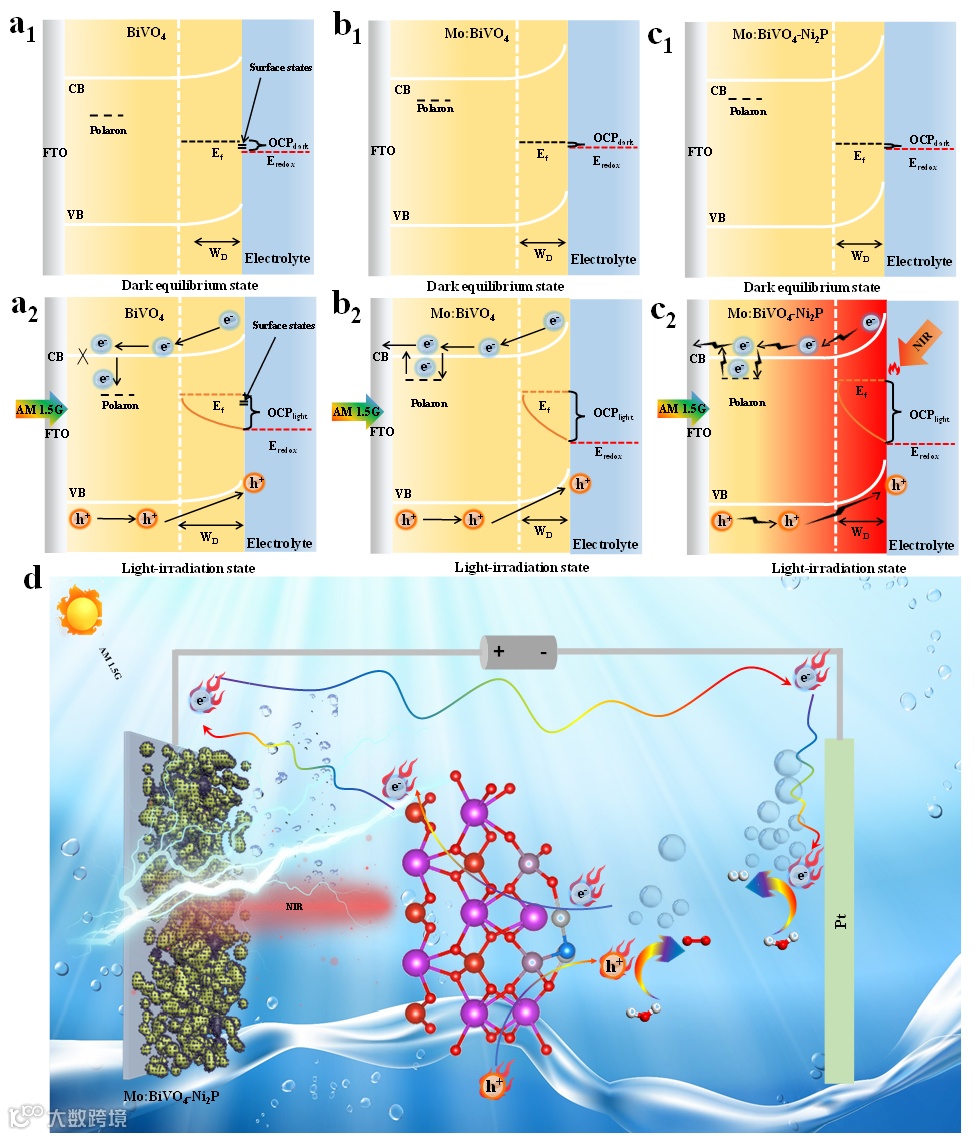
Mechanism of carrier transport driven by elemental doping and photothermal effects of co-catalysts. Schematic energy band structure and energy band bending of a) BiVO4. b) Mo:BiVO4 and c) Mo:BiVO4-Ni2P in a1-c1) dark equilibrium and a2-c2) light irradiated states. d) Mechanistic diagram of photothermal effect to enhance the PEC performance of Mo:BiVO4-Ni2P photoanode.

1. Mo掺杂钝化陷阱态并降低极化子跳变势垒
电子结构调整与载流子增强:Mo掺杂进入BiVO4晶格,有效钝化其表面与体相中的浅层和深层陷阱态,从而提升载流子浓度(Nd从0.90×10²⁰增至1.60×1020 cm−3),并降低极化子跳变的活化能(从284 meV降至225 meV)。
结构影响:掺杂未改变BiVO4的晶相结构,但通过Mo-O键的形成调节了局域电子环境,促进了小极化子的跳变与迁移。
2. Ni2P光热材料实现局部加热与空穴提取
光热转换机制:Ni2P作为窄带隙半导体,在808 nm近红外光照射下通过非辐射弛豫产生显著局部热效应(电极在空气中1 min内从25.6°C升至115.8°C),热激活被束缚的极化子。
助催化作用:Ni2P同时作为空穴提取助催化剂,在Mo:BiVO4表面形成Ni2P/BiVO4异质结,促进光生空穴向表面迁移并参与水氧化反应,抑制电子-空穴复合。
3. 光热效应提升氧析出反应动力学
降低反应能垒:局部升温(如从298 K升至311 K)显著降低氧析出反应中*OH → *O步骤的吉布斯自由能势垒(从1.11 eV降至1.08 eV),加速O2生成与气泡脱附。
表面亲水性增强:光热作用使电极表面水接触角从50°降至29°,促进水分子吸附与气泡快速脱离,活性位点得以快速再暴露。
4. 双驱动策略协同增强载流子传输与分离效率
协同机制:Mo掺杂通过电子结构调整降低极化子跳跃势垒,Ni2P 通过光热效应进一步释放被氧空位(Oᵥ)束缚的极化子,二者协同显著提升电子扩散系数(Dn−L从3.5×10⁻⁸增至5.8×10⁻⁸cm2⋅s-1)。
性能提升:Mo:BiVO4-Ni2P在AM 1.5G + 808 nm NIR光照下,实现92.2%的电荷分离效率、6.38 mA·cm-2的高光电流密度及100.8 μmol·cm-2的O2析出量,表现出优异的PEC水分解性能。
版权声明
测 试