


Tire Sales Failed to Meet Expectations

The weak demand was still the main constraint on the tire market. Distributors adopted a variety of sales promotion strategies to ease the inventory pressure.
1. Sample Selection
As for the domestic sales status of all-steel tires this month, SCI surveyed a total of 62 domestic first and second-tier distributors, including 39 first-tier distributors and 23 second-tier distributors. The survey area covers Shandong, East China (Jiangsu, Shanghai, Fujian and Anhui), Northeast (Liaoning, Jilin and Heilongjiang), North China (Shanxi, Hebei and Inner Mongolia), South China (Guangxi and Guangdong) and Central China (Hunan and Henan).
Brand hierarchy of products sampled in the survey was different, due to the different geographical regions, different load conditions and different public acceptance degree. The proportion of foreign brands and domestic brands (including three-guaranteed brand and third-party warranty brand) accounted for 83% and 17% of the total respectively. Among them, foreign brands include Goodyear, Bridgestone, Michelin, etc. Three-guaranteed brands include CELIMO, West Lake, YARTU, CHAO YANG, etc. Third-party warranty brands include Santai, Hengfeng, Huasheng, etc.
2. Tire Sale Volume M-O-M Change
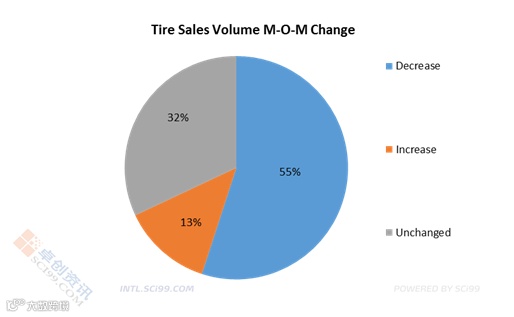
As can be seen from the above chart, the sales volume of all-steel tires that declined from last month accounted for 55% of the total. The proportion of the sales volume that increased and stayed unchanged from last month occupied 13% and 32% of the total respectively.
a. Reasons for M-O-M decreases
First, due to the SCO summit in early June, the logistics industry in Qingdao and its surrounding areas was restricted, which dampened the sales volume to some extent. Second, the rainy season in southern China affected the circulation of tire products, thereby affecting the sales volume of tires. Third, the pressure of environmental protection was not eased in some areas, so the transportation of chemicals and other products was reduced. This impacted the use rate of vehicles, leading to a prolonged replacement cycle of tires.
b. Reasons for M-O-M increases
First, the seasonal demand was healthy, as the temperature was getting higher. The high temperature weather quickened tire wear, thus the changing frequency of tires accelerated. Second, distributors increased tire promotion efforts, which stimulated the increase in sales volume to a certain extent.
3. Forecast
SCI holds that the seasonal demand will continue to support the tire market next month. Besides, the tire plants may face power rationing on the high temperature, thus the operating rates at plants in Shandong will see no improvement. Prices of feedstock fluctuate at lows, reducing the production cost. It is predicted that some producers may lower the price of tire by 3% next month.

For more information please contact us at
overseas.sales@sci99.com
overseas.info@sci99.com
+86-533-6296499