


CNPC Pushing Gas Reserve Institutional Reform

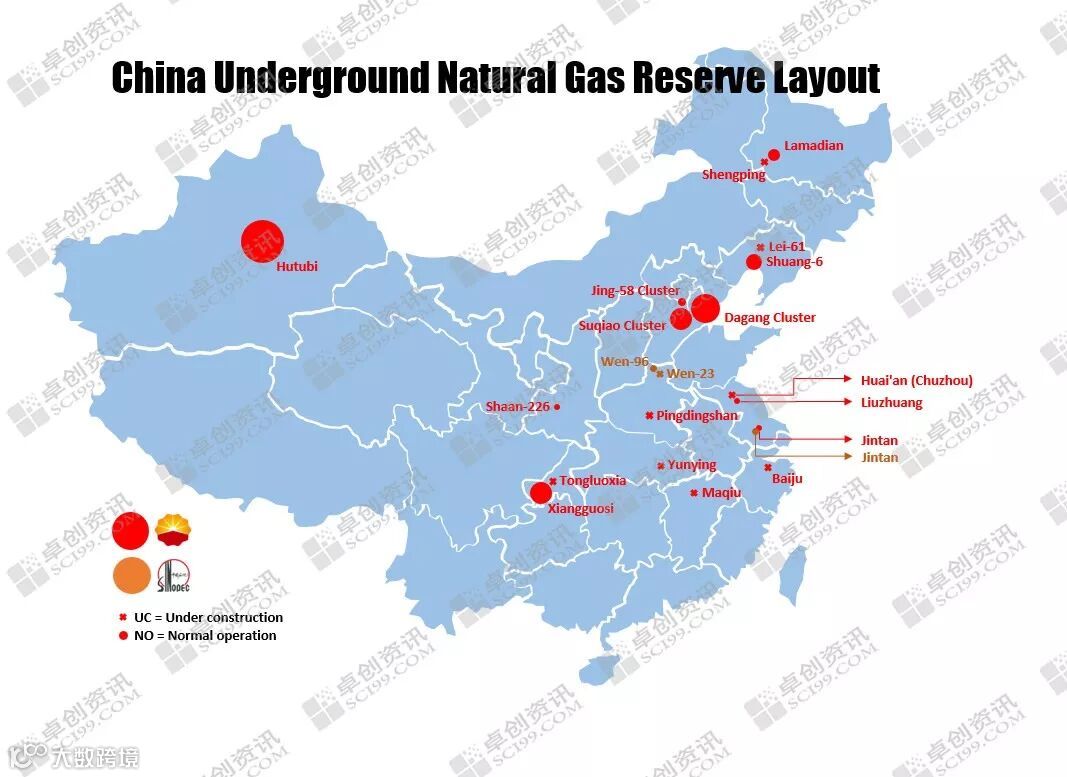
By July 1, 2018, CNPC has transferred all of its owned underground natural gas reserve depots from its natural gas pipeline arm to its oil and gas field arm, indicating CNPC’s institutional reform in the natural gas reserve and storage sector has gained the first touchdown.
According to CNPC, the institutional reform included three major tasks. First, to transfer the planning and operating management of natural gas strategic reserve to exploitation and producing arm of CNPC. Second, to build a more specified management system for gas storage companies. Third, to transfer all underground reserve depots owned by pipeline subsidiaries to oil and gas field subsidiaries. Herein, Dagang and Jing-58 reserve clusters were transferred from CNPC Beijing PNG Company to CNPC Dagang Oil Field and Huabei Oil Field separately, and Jintan and Liuzhuang reserve depots were transferred from CNPC West-East Pipeline Company to CNPC Huabei Oil Field Company.
Those transfer had been completed by July 1, 2018, and the rest six reserve depots or clusters owned by oil field subsidiaries already remained unchanged, including Huabei (North China) Oil Field’s Suqiao Cluster, Dagang Oil Field’s Dazhangtuo Depot and Bannan Depot, Xi’nan (Southwest China) Oil Field’s Xiangguosi Depot, Xinjiang Oil Field’s Hutubi Depot, Liaohe Oil Field’s Shuang-6 Depot, and Changqing Oil Field’s Shaan-224 Depot.
China’s natural gas sector witnessed a significant advancing, driven by Beijing’s coal-to-gas ambition. However, when the country cannot make progress in the domestic production or piped gas import, the LNG import becomes the only way to fix the gap between the supply and demand. As a matter of fact, China’s LNG imports reached a 46.42 percent annual growth rate in 2017, and the first five months of 2018 also achieved an even larger number at 55.40 percent compared with the same period from 2017. At the meantime, the import dependence rate of natural gas increased from 2017’s 39.60 percent to 2018 Jan-May’s 42.43 percent, and that of LNG also increased from 22.06 percent to 24.27 percent.
Against the increasing import dependence rate, China’s natural gas storage capacity was far behind the actual needs. The totaled underground reserve capacity was only 10 bcm (total) or 8 bcm (working), and that of the LNG import terminals was only 4.6 bcm. Overall, China’s natural gas storage capacity only took up around 6 percent of its annual consumption, far behind the ideal level at over 20 percent.
In the wake of this, China’s top economic planning authority NDRC gave China’s three oil giants a mandatory request to build up a storage capacity at 10 percent of their annual natural gas sales, and as China’s largest natural gas producer and piped gas distributor, CNPC is facing great challenges. CNPC has implemented a bunch of new policies and measures to deal with this matter, including tens of new underground reserves in planning, institutional reforms in natural gas grid system, natural gas pricing mechanism as well as the gas reserve system.
In a long-term future, CNPC plans to build four regional interconnected natural gas reserve complexes in Northeast China, North China, Yangtze River Delta and Southwest China, so as to fulfill the expected significance in natural gas development, which is believed to reach 500 bcma by 2030.

For more information please contact us at
overseas.sales@sci99.com
overseas.info@sci99.com
+86-533-6296499