Light Ends Utilization at Refineries
Light ends are the light hydrocarbon gases and liquids that come off the top of distillation towers and fractionators. The light ends usually include refinery gas and some C3s and C4s.
Some gasoil and naphtha are sent to conversion units to produce ethylene and aromatics at China’s refineries, in order to meet the market demand for chemicals and requirements from fuel quality upgrades. Refineries produce a large amount of light ends in the conversion of heavy products, gasoil and naphtha. A fuel-oriented refinery with CDUs capacity at 10 million mt/a can produce around 1 million mt of light ends every year. The output of light ends takes up around 10% of crude oil processing volume. Those refining and chemical integration refineries and chemical-oriented refineries have higher yield rates of light ends, because of those refineries’ deep utilization of crude oil.
Therefore, refineries are finding how to make more values from such a large amount of light ends to raise their profit rates. In this article, how refineries are using light ends and other possible directions of the light ends utilization are introduced. The introduction and outlook can be benefits which guide refineries’ transformation and development.
Part 1 Light Ends at Refineries
1.1 Sources of Light Ends
Refineries’ light ends are mainly from CDUs, FCC units, delayed cokers, hydrotreaters, hydrocrackers and reformers. According to statistics, Sinopec’s light ends output was over 26 million mt in 2017, covering around 11% of Sinopec’s crude oil processing volume.
FCC units are not only key units in fuel production but also main sources of light ends at refineries. Some light ends fractionation technologies and conversion technologies were developed and adopted in the past years, in order to utilize FCC dry gas and FCC LPG. The second biggest sources of light ends at refineries are residue processing units and gasoil processing units, such as delayed cokers, hydrocrackers and hydrotreaters. Cokers’ processing volume will slip gradually, due to China’s environmental protection regulations and refineries’ transformation. But the feedstock processing volume at hydrocrackers and hydrotreaters will increase. Meanwhile, reformers also produce light ends, and the light ends output from reformers takes up 9%-10% of total output at refineries. For the refineries which are designed to mainly produce aromatics, the light ends output from reformers can cover 30%-40% of the total output.
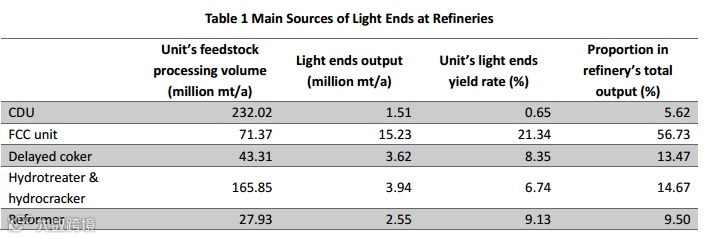
The market demand for aromatics is increasing, and refineries’ demand for hydrogen is climbing. Therefore, the light ends output from reformers and isomerization units will continue rising. CDUs have large feedstock processing volume, but crude distillation is mainly a physical reaction process, and the yield rate of light ends at CDUs is less than 1% of all products’ output. Meanwhile, the light ends yield rates at CDUs is influenced by the specifications of crude oil.
1.2 Components of Light Ends
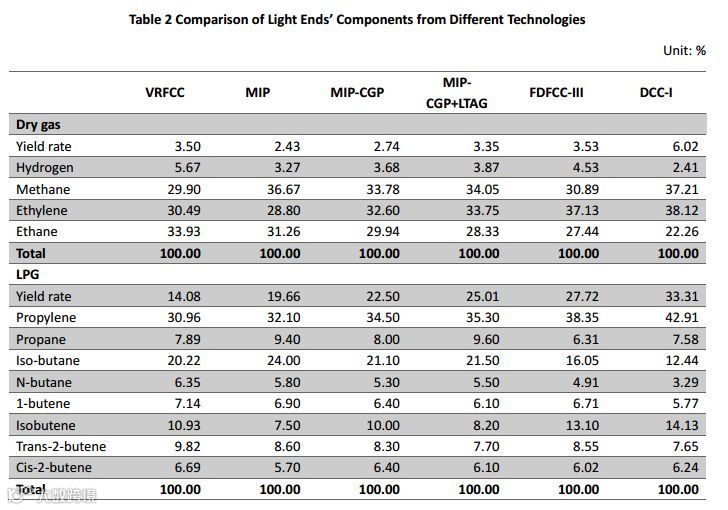
The components of light ends which are produced by FCC units are influenced by technologies.
FCC dry gas consists a large proportion of C2s, and the proportion of ethylene and ethane is around 60%. In particular, the proportion of ethylene is around 40% in DCC dry gas. Therefore, refineries often make full use of their dry gas. For LPG, propylene and isobutene take up a large proportion in DCC LPG, and iso-butane takes up a large proportion in MIP dry gas and MIP-CGP dry gas. The difference is mainly caused by differences among the technologies’ hydrogen transfer reaction. The LPG yield rate is high, and LPG consists many types of light ends. Therefore, refineries pay a lot of attention to the utilization of LPG.
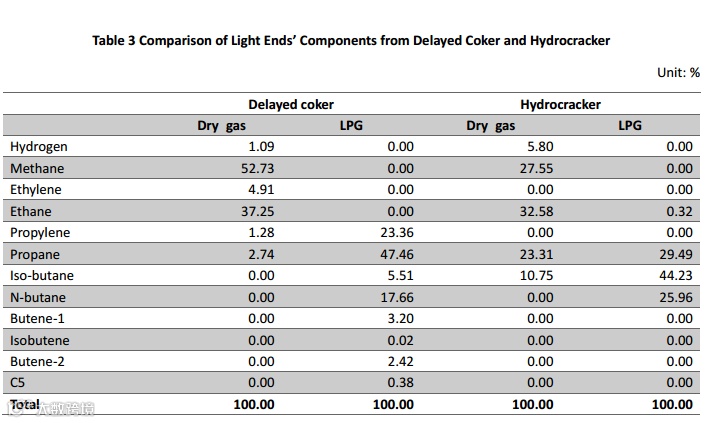
But technologies do not influence light ends’ components at delayed cokers and hydrocrackers. The dry gas from delayed cokers consists a large proportion of methane and ethane, and the proportion of propane and butane in LPG is higher than that of propylene and butene. This is mainly influenced by the proportion of light ends in FCC gas. The light ends in hydrocrackers’ gas is saturated light ends, and the iso-butane proportion in LPG from hydrocrackers is a little higher than the n-butane proportion. Components of delayed coker gas are different from hydrocracker gas, so the utilizations of the two types of gas are different.
Part 2 Light Ends Utilization at Refineries
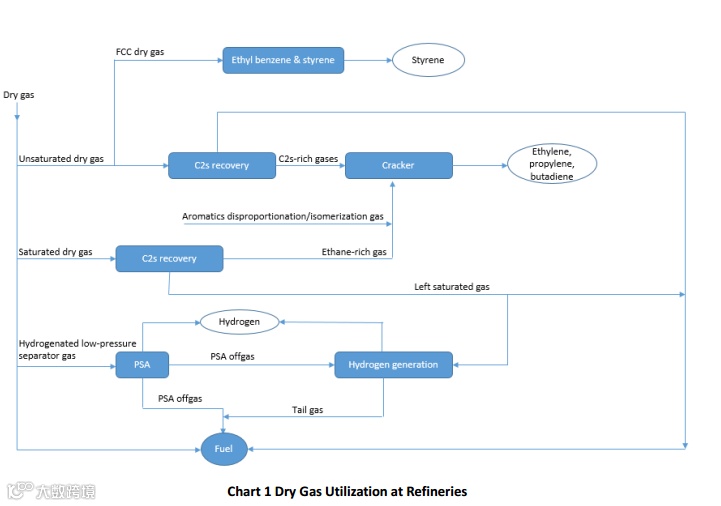
Refinery dry gas consists saturated gas and unsaturated gas, and the yield rate of dry gas covers 3%-5% of crude oil processing volume. Therein, the yield rate of saturated gas at CDUs and hydrotreaters is at a low level, so the dry gas from CDUs and hydrotreaters is mainly used as fuel at refineries. But with growth of crude oil processing volume and hydrogenation capacity, the output of dry gas from CDUs and hydrotreaters is increasing. Therefore, most large refineries and newly added refineries have light ends recovery units to recover high-valued saturated light ends, and the left dry gas is used as fuel and feedstock to produce hydrogen. But traditional refineries and small refineries use their unsaturated dry gas from delayed cokers and FCC units as fuel. With stronger integration among units at refineries, some gas with a large proportion of C2s is recovered or used as feedstock to produce ethylene.
Sinopec produced 2.5 million mt of FCC dry gas in 2017, and therein, 1.1 million mt of FCC dry gas was sent to C2s upgrading units. The recovered gas with C2s was 444.8kt which equaled to 337kt of ethylene gas.
Meanwhile, some refineries use the diluted ethylene to ethyl-benzene technology to recover and utilize the FCC dry gas. Sinopec produced 759.4kt of styrene in 2017 using the diluted ethylene to ethyl-benzene technology, and the consumption volume of FCC dry gas was 781.9kt. The FCC dry gas utilization rates of the above two solutions are over 75%. Refineries will continue raising the utilization rates of FCC dry gas and C2s.
With stricter environmental protection policies in China, refineries are building more and more hydrogenation units, which pushes up the demand for hydrogen. Therefore, refineries are focusing on the recovery and utilization of low-pressure separator gas and hydrogen-rich gases.
The proportion of hydrogen in low-pressure separator gas is around 70%, and the consumption of hydrogen from low-pressure separator gas takes up 10%-20% of a refinery’s total consumption of hydrogen. In addition, refineries’ hydrogen-rich gases also include reformer hydrogen, ethylene hydrogen, hydrogenation units’ offgas, etc. Refineries often purify these hydrogen-rich gases and sent the gases to absorption units to produce hydrogen, and the offgas from absorption units is treated with high pressure and then used as feedstock of hydrogen to refineries’ fuel.
China’s refineries produce a large amount of LPG, and the yield rate of LPG is 8%-10% of a refinery’s crude oil processing volume. For most refineries, the yield rate of FCC LPG is 12%-22%, and the yield rates of DCC LPG and CPP LPG are 30%-40%. FCC LPG consists a large proportion of olefins and isomerized hydrocarbons.
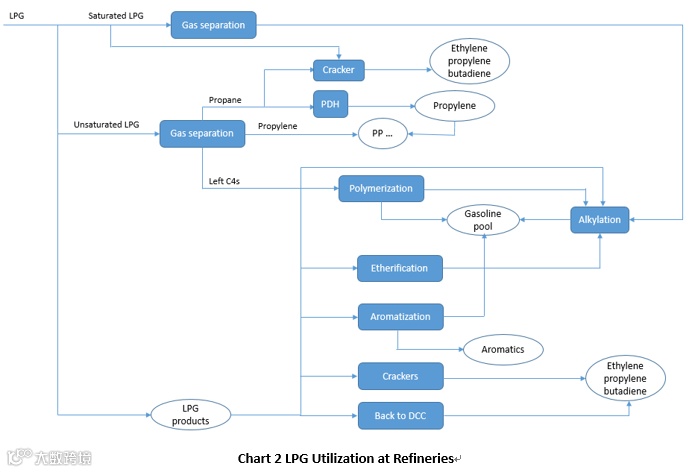
At present, most refineries do not use their LPG as fuel or sell LPG but use the LPG to produce propylene and propane. The utilization of the separated C4 from LPG is different at refineries. The fuel-oriented refineries use C4 to produce gasoline blendstocks with high octane values, such as alkylate and etherified gasoline. The chemical-oriented refineries can use olefin cracking technologies to produce ethylene and propylene or recovery high-valued C4. The refineries which have DCC units send some C4 to DCC units to raise the output of olefins.
But China started to promote the ethanol gasoline in 2017, and this restricted the isobutene’s way to etherified gasoline. Some organizations develop the C4 polymerization technology which allows refineries adjust their MTBE units to produce gasoline blendstocks with high octane values.
Most fuel-oriented refineries use their LPG to produce hydrogen or sell their LPG, but some refineries use all of their LPG as fuel. The refining and chemical integration refineries use their saturated LPG as feedstock to produce ethylene.
Part 3 Light Ends Utilization at Fuel-Oriented Refineries
Gasoline, kerosene and diesel are main products at refineries, and the yield rate of these three products is around 65%. In addition, the heavy products are used as feedstock of delayed cokers, hydrotreaters and FCC units. Therefore, light ends at refineries mainly include the LPG from FCC units and delayed cokers, saturated light ends and naphtha from CDUs, reformers, hydrocrackers and hydrotreaters and hydrogen-rich gases from reformers and hydrocrackers.
The fuel-oriented refineries often have large FCC units, so those refineries’ FCC dry gas and FCC LPG output is high, covering around 45% of the total light ends output at the refineries. For the utilization of FCC dry gas, refineries use the diluted ethylene to ethyl-benzene technology to produce styrene and recover hydrogen from tail gases via PSA units. For FCC LPG, refineries use gas separation units to get propane and propylene, and the propane is sold and the propylene is used to produce PP.
For the unsaturated light ends from delayed cokers, refineries use the purified coking gas as fuel, and the purified LPG is sold. Meanwhile, refineries use light ends recovery units to process saturated hydrocarbons, straight-run crude naphtha and hydrogenated crude naphtha. The recovered C3 and C4 are sold and the recovered light naphtha is sold as chemical light products, and the recovered heavy naphtha is sent to reformers to produce gasoline blendstocks and aromatics after hydrogenation. The left dry gas is used as fuel or feedstock to produce hydrogen.
Reformers and hydrocrackers produce a large amount of hydrogen-rich gases, so refineries use PSA units to purify reformer gases and low pressure separator gases. In the meantime, the tail gas from PSA units consists a large proportion of methane and some other light ends with small carbon atoms, so refineries often use the tail gas from PSA units as feedstock to produce hydrogen. The integration of PSA units, hydrogen generation units and hydrogenation units increases the utilization of the gases.
......
Please click "Read more" for more information

For more information please contact us at
overseas.sales@sci99.com
overseas.info@sci99.com
+86-533-6090596



 SCI99
SCI99