New Characteristics of China's Pulp Market in 2019
As 2019 draws close to an end, new changes occurred in China’s pulp market. In this year, the pulp market in China is characterized by High inventory, frequent turnarounds, low price and low gross profit.
Pulp Inventory Decreased Slowly
In 2019, the pulp inventory in major regions fluctuated at an abnormal high level, and high pulp inventory has become the new normal.
According to data from PPPC, the highest pulp shipment in the past 6 years occurred in December 2017 at 4.82 million mt, and the second highest occurred in March 2019 at 4.77mt. As the economic growth and consumption slowing down in general, the increasing pulp shipment has caused the inventory in days to surge. The monthly average inventory in days from January to August, 2019, was at 51 days, 15 days higher compare to last year. Therein, the average SWP inventory in days was 64, up 9 days Y-O-Y, and the average HWP inventory in days was 39, up 21 days Y-O-Y.
The pulp inventory in China’s main regions and ports remained constantly high. In the past 6 years, the pulp inventory was usually managed at around 1 million mt. However, since Q4 2018, the pulp inventory passively building up due to market oversupply. Although Chinese buyers deduct high priced import orders in an attempt the reduce their inventory, imported pulp still crammed port warehouses as overseas pulp producers secured pulp shipments to China by stocking up in the bonded warehouses first before the sales take place. Data from the customs indicates that in the first 8 months of 2019, the SWP import volume via supervised bonded warehouses was 460kt, up 54%; the HWP imported via such method was 1,950kt, up 103%. In spite of the inventory decrease in September, the inventory rebounded at China’s main regions and ports in October due to sluggish demand and normal shipments from overseas pulp producers, but the inventory pressure is expected to improve in November.
According to SCI, the high inventory level is directly related to the insipid domestic demand and participants’ bearish anticipation. The fact that some pulp resources were left at ports and remained to be picked up has further strengthened the bearish sentiment.
Limited New HWP Capacity in 2020
In 2020, the scheduled new capacity both in China and overseas is totaled at 2,563kt. Therein, the projects at Ilim’s subsidiary Brask pulp mill, MetsäFibre and Kaicell in Finland are SWP units, and these account for 57% of the total new capacity in 2020. Only the project at Naini in India is HWP capacity, but its output will be mainly for captive use.
According to SCI, in the first 9 months of 2019, the HWP export volume form Brazil to China was 4,766kt, up 425.9kt or 9.81% Y-O-Y. The average import price for the first 9 months was RMB 4,825/mt, down RMB 982/mt or 17% Y-O-Y. After the merger of two Brazilian pulp and paper giant Suzano and Fibria, the industry concentration rate has increased in Brazil. The increase in pulp shipment from Brazil to China has led to a decrease in imported wood pulp price in China due to market oversupply. Considering the balance of HWP supply and demand, there is few newly planned HWP capacity.
The Wood Pulp Import Price and Spot Price Continued to Drop.
In contrast to 2018, the SWP and HWP import price continued to trend down after trending flat. In October, the SWP import price has dropped $90/mt compare to that at the start of the year, down 13.24%; the HWP import price went down by RMB $260/mt compare to that at the start of the year, down 36.11%.3.3.2 Impact of Pulp Import Volume Changes on China Market
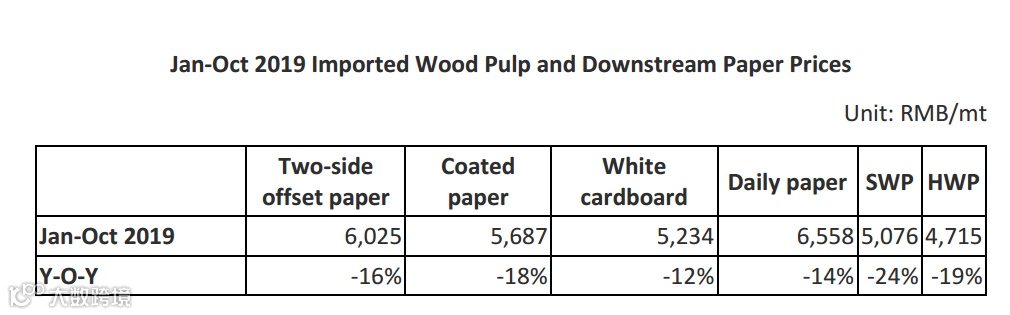 The operating pressure is high for the imported wood pulp trading section this year, and operating at a loss has become a new normal for many pulp import traders. During most of the months in 2019, the profit fluctuated below the breakeven point due to market oversupply and higher import cost than spot market price. In the short term, the SWP import price will remain firm, but its spot market price in China will trend low. Thus the gross profit rate is not expected to improve. As for downstream paper producers, the low pulp prices is beneficial for the paper profit to recover. However, the decreasing pulp price is negative for the paper prices to stabilized and rebound in the long run.
Please click "Read more" for more information
The operating pressure is high for the imported wood pulp trading section this year, and operating at a loss has become a new normal for many pulp import traders. During most of the months in 2019, the profit fluctuated below the breakeven point due to market oversupply and higher import cost than spot market price. In the short term, the SWP import price will remain firm, but its spot market price in China will trend low. Thus the gross profit rate is not expected to improve. As for downstream paper producers, the low pulp prices is beneficial for the paper profit to recover. However, the decreasing pulp price is negative for the paper prices to stabilized and rebound in the long run.
Please click "Read more" for more information

For more information please contact us at
overseas.sales@sci99.com
overseas.info@sci99.com
+86-533-6090596



 SCI99
SCI99