

In 2020, the COVID-19 outbreak has led to strong uncertainties in the global pulp market. By analyzing the export data from Chilean customs, SCI has spotted some new trends in the pulp export and trade flow of Chile.
HWP export proportion is on the rise affected by both supply and demand factors
According to the Chilean customs, during the first 5 months of 2020, Chile exports 650kt of SWP, down 25% Y-O-Y. In contrast, its HWP export is 940kt, down roughly 3% Y-O-Y. It is clear that Chile’s SWP export slips notably while its HWP export remains relatively stable. SCI reckons the reasons can be found in both the supply and the demand sides.
On the supply side, the HWP cost is relatively lower, and pulp mills are active in scheduling production. Chile is rich in forest resources, and benefited from the vast latitude coverage of its territory, both eucalyptus and radiate pine for HWP and SWP production can be farmed in Chile. However, eucalyptus grows notably faster, and the circulating period of eucalyptus farming is only 3-4 years. In contrast, the circulating period of radiate pine is around 20-25 years, leading to a much higher cost. According to data published by Chilean pulp producers, in Q1 of 2020, the cash cost of HWP production is $120/mt lower than its softwood counterpart, and the profit ratio is also high. Therefore, pulp producers in Chile are more motivated in producing HWP.
On the demand side, the SWP demand decreases as the price spread between SWP and HWP expands. In the past three years, the average export price of Chie’s bleached chemical pulp decreased constantly, and the HWP price drop was especially noticeable, resulting in a nearly $95/mt price spread between SWP and HWP in 2020. Paper mills in China have toggled the proportion of SWP in the mix constantly due to the comparatively lower HWP price.
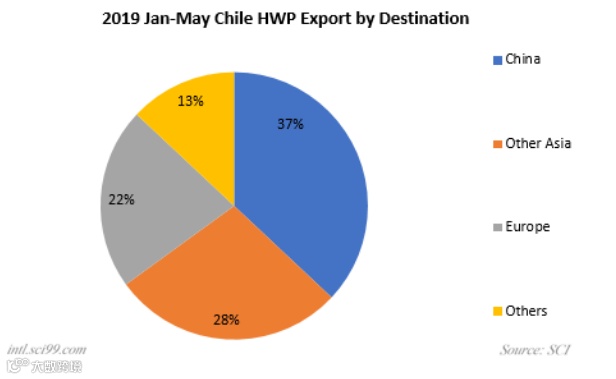
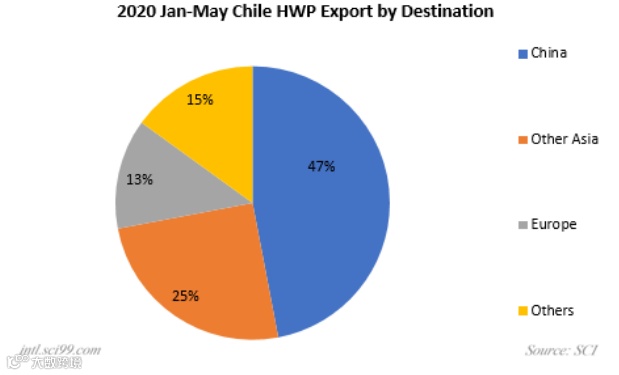
In the first 5 months of 2020, the largest SWP export destination of Chile is still China, but China’s proportion has gone down by 4%. With more SWP being shipped to Europe, Chile’s pulp export to Asia goes down by 7% in general. In contrast, the HWP export to China has increased by 10% during the same period, and China remains as the largest HWP export destination of China. The main reasons behind this change are as follows. First, the COVID-19 situation is contained well in East Asian countries, and paper mills has actively restock for future production. Second, the price spread between SWP and HWP has become fairly significant, Chinese paper producers tend to increase the purchase of the much cheaper HWP.
Outlook:
Supply: In the short term, some Canadian SWP producers have announced turnaround plans, while Suzano in Brazil has decided to defer the turnaround schedule to H2 of 2020. Chilean producers may face higher competition from fellow HWP producers, but its SWP output may increase. In the long term, after the MAPA project goes into operation, the HWP supply of Arauco will increase significantly, and the HWP export volume will start to increase. Also, the cash cost of SWP produced in Chile is still lower than that produced in Europe and North America, and its SWP supply will be stable.
Demand: In the short term, the turning point of the COVID-19 outbreak in major European paper producers such as Italy and Germany has appeared. It is estimated that the local paper mills will gradually resume production and start to restock. In China, although the recovery in the industrial sector is decent, paper mills are now facing the conventional slack season between April and July, and the feedstock consumption will be relatively slow. Therefore, the focus of Chilean pulp producers may shift. In the long term, the HWP import dependence degree is expected to go down as more integrated projects are mounted for the next five-year period. But China’s pulp consumption will also increase as the policy ban on plastic will push up the demand for ivory board. In Europe and North America, the release of newly added capacity may be delayed by the COVID-19 pandemic, and SCI estimates that the pulp sales pressure at Chilean pulp mills will increase.
SCI reckons that Chile is one of the most important pulp import origins, and the pulp produced in Chile is highly recognized and adapted to the Chinese market. Besides, Chilean brands are also designated for the BSK futures delivery at SHFE. In the short term, the purchase of Chilean pulp will remain at the ordinary level.