

2011-2020: Three Ups and Downs in China BD Price
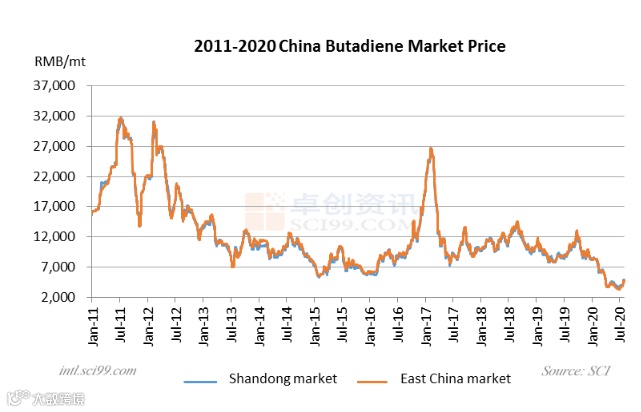
China’s butadiene price once soared to over RMB 30,000/mt, attracting most market players’ attention. However, affected by the Covid-19 in 2020, the butadiene price slumped to RMB 3,350/mt. In the past 10 years, China’s butadiene price mainly experienced three sharp ups and downs. The detailed stages are as follows.
I. In 2011, the butadiene price fluctuated within RMB 13,000/mt to RMB 31,000/mt.
From the beginning of 2011, China’s butadiene market price surged from RMB 17,000/mt in early 2011 to the highest of RMB 31,750/mt in mid-July. However, after one month, the market price of butadiene began to drop. In early November, the butadiene price crashed to an annual low of RMB 13,750/mt, down 56.7% from mid-July. China’s butadiene market witnessed sharp ups and downs in 2011, based on the following factors.
Factors regarding butadiene price increase:
1. At the beginning of 2011, the international investors hyped the price of natural rubber to a historical high of RMB 42,000/mt, which provided an opportunity for the dramatic increase in butadiene price.
2. Affected by the slow recovery of the global economy, the tire industry in the U.S. warmed up, driving up the development of the synthetic rubber industry. At the same time, as some butadiene units in the U.S. were shut down, the purchase volume of butadiene from Asian market enlarged, which pushed up the butadiene price constantly.
3. In the Asian market, the routine maintenance or unexpected shutdown of some ethylene cracking units at YNCC, Shell Singapore and FPCC led to a certain shrink in the spot supply of butadiene in Asia.
4. From 2011, the resources of C3 and C4 at home and abroad were obviously insufficient. In order to reduce the production cost of ethylene, some producers chose other cracking materials instead of naphtha, such as LPG. Thus, the yield coefficient of butadiene declined.
The tight supply at home and abroad both contributed to the broad rise in the butadiene market.
Factors regarding butadiene price decrease:
1. The upsurging butadiene price was beyond downstream users’ acceptance ability. In Asian region and China, the synthetic rubber and ABS units began to be overhauled or cut the operating rate, so the demand for butadiene moved down.
2. In early August 2011, the U.S. raised the debt ceiling and lowered its credit rating for the first time, triggering a global panic. The demand for butadiene in the U.S. turned weak, and end users mainly withdrew from the market and adopted a wait-and-see stance. The butadiene market slumped and the butadiene price dropped to an annual low.
In early 2012, the butadiene market saw sharp ups and downs again. However, the increase in the butadiene market was mainly due to artificial speculation in the maintenance market. The supply was less than the demand, which led to the market surge again. In the hype, the butadiene market price obviously exceeded the synthetic rubber price. As a result, there was a price but no sales in the market. The high-priced hype lasted for a short time, so the butadiene price fell back quickly.
II. The outbreak of silence at the end of 2016
After 2011 and 2012, China’s butadiene market returned to normal. The changes in butadiene prices were related to those in naphtha prices. After a 4-year stable operation from H2, 2012 to H1, 2016, China’s butadiene market soared again from H2, 2016.
From Q4, 2016, China’s butadiene market price saw constant increases until February 2017, hitting a 5-year high. The market price of butadiene reached the highest of RMB 26,700/mt. However, the highest price didn’t last for a long time. For this price adjustment, the following factors were summarized
Factors regarding butadiene price upsurge are as follows:
1. In August 2016, the five national ministries and commissions jointly formulated the Special Action Plan for Rectifying Illegal Overloading of Highway Trucks. From September 21, provinces and cities across the country started to strictly implement the Regulations on the Management of Road Driving of Overrun Transport Vehicles. The new regulations changed the original truck load quality and vehicle size. In addition, the overload law enforcement strictly reduced the load capacity of existing heavy trucks. The demand for new vehicles increased obviously. Thus, the demand for all-steel tire warmed up quickly. The increase in the operating rate of the tire industry drove up the synthetic rubber market obviously. The operating rate of SBR and PBR industries was at a high level in 2016, so the consumption volume of butadiene increased notably from the early days.
2. In the past two years, the market price of butadiene was at a low level for a long period. The commissioning time of newly added butadiene units was expected to be delayed, and the growth rate of butadiene capacity slowed down obviously. Besides, in Q3, 2016, accidents occurred frequently in butadiene units at home and abroad. As a result, the butadiene supply was tight. Especially, the butadiene unit at Shell Singapore was shut down temporarily, stimulating the bullish sentiment in the market. What’s more, the butadiene units would take turnarounds intensively in 2017. The hype atmosphere ramped up in the market, pushing up the butadiene market price to a high level. The highest price of butadiene even exceeded the price of synthetic rubber and natural rubber in the same period.