

RCEP Agreement to Affect Global Styrenics Trade Flows
[Introduction] The RCEP agreement was signed on November 15 among its 15 participating countries, including the 10 member countries of the Association of Southeast Asian Nations (Thailand, Singapore, the Philippines, Myanmar, Malaysia, Laos, Indonesia, Cambodia, Brunei, Vietnam) and China, Japan, South Korea, Australia and New Zealand. The signing came after 31 rounds of negotiations, which was launched in November 2012, as well as a number of specific leaders and ministerial meetings between the participating countries. The RCEP aims to break down trade barriers and promote investment. RCEP will progressively lower tariffs to zero within 10 years for above 90% of trades in goods, boost investment and allow freer movement of goods within the region. Thereinto, many chemical feedstock and plastic producers of the styrene industry chain are covered.
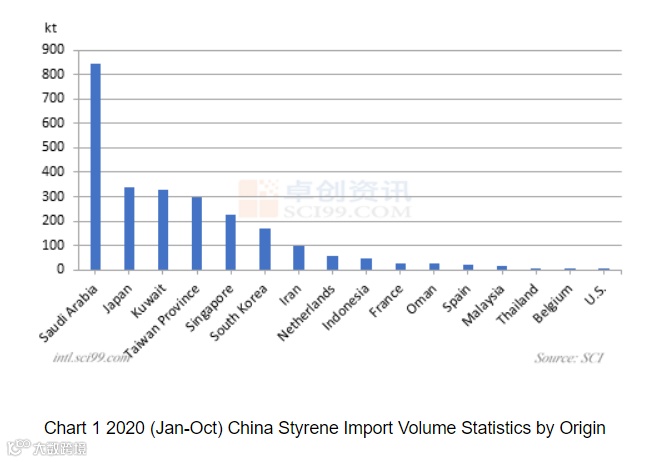
From January to October 2020, China’s styrene import volume recorded at 2,508.1kt, down 3.55% Y-O-Y. The import volume from Japan, Singapore, South Korea, Indonesia, Malaysia and Thailand, among RCEP members, took up 32% of the total.
China’s styrene import volume from South Korea showed large fluctuations from H2, 2018, after the result announcement of styrene anti-dumping investigation on imported styrene originating in South Korea, Taiwan Province and the U.S. on June 22, 2018. Before 2018, China’s styrene import volume from South Korea took up as high as 33%-35% of the total. After the implementation of the RCEP agreement, the changes in the anti-dumping tariffs will greatly affect China’s styrene import origins.