

PP Regional Price Spread Changes amid Struggle Between Supply and Demand
Preamble: Soft demand dragged PP mainstream prices down, even though supply and demand didn’t represent a noticeable imbalance. Various regions showed differences in supply and demand patterns, leading to notable changes in regional price spread.
PP supply and consumption are both high at present. In recent years, the circulation of PP has become frequent among regions because of imbalanced output and consumption in each region. North China, East China and South China are major consuming regions where price spread is obvious and relatively stationary.
Regional Price Spread Registered a Remarkable Change
China’s PP prices dropped at first in the second half of 2022. Generally, PP market prices in various regions showed a similar trend, but the downward range was different in each region. That resulted in a large change in regional price spread.
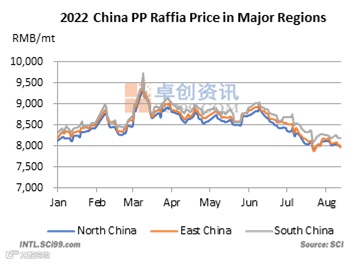
Taking PP raffia as an example, its prices in South China were higher than those in North China and East China, with the price spread widening gradually. The price spread between East China and North China was narrowed step by step, which even stayed at RMB 0/mt in late July. East China was confronted with softened price advantages. Comparatively, the price advantage in South China kept ongoing in July.
Jun-Jul PP Raffia Regional Average Price Spread
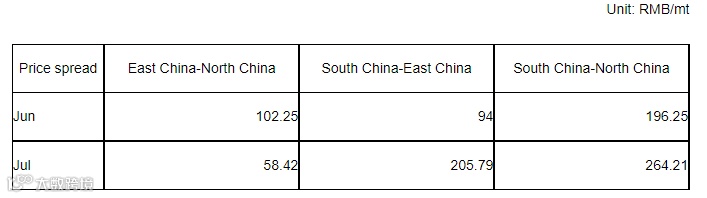
As seen from the monthly average price of PP raffia in various regions, the price spread between South China and East China increased from RMB 94/mt in June to RMB 205.79/mt in July with South China’s price advantage mounting. The price spread between South China and North China rose from RMB 196.25/mt to RMB 264.21/mt. Meanwhile, East China saw a weakening advantage in price, which made the price spread between East China and North China diminish from RMB 102.25/mt to RMB 58.42/mt.
Limited Changes in China’s Domestic Supply
China’s PP supply saw an uptick in July. According to SCI, China’s PP output was 2,512kt in July, up 4.22% M-O-M and 28.9kt Y-O-Y. A lot of new units were put into use in end-June, which resulted in an output increase in July, despite relatively intensive maintenance.
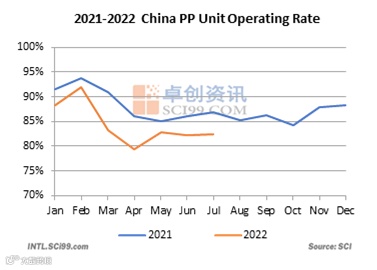
In terms of resource circulation, PP outflow from Northwest China to other regions didn’t change a lot. PP supply was not tight in each region because of largely stable output. In July, the supply in each region stayed immobile and was slightly ample.
Imports Inflow Impacted Regional Supply Significantly
A spike in China’s PP imports broke the supply stability in July. PP demand at home and abroad kept tepid for a long time. Overseas PP prices registered a notable decline in July, which gave wings to China’s PP import business. Large quantities of cargo flowed into China, especially in late July. PP import volume achieved 243.7kt in July after an M-O-M increase of 17.39%, but it dropped by 11.73% Y-O-Y.
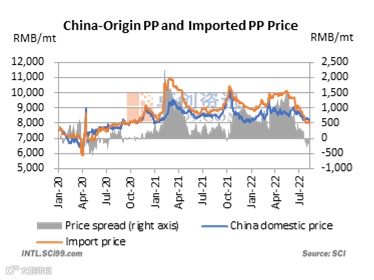
For imports sources, most of the PP imports were from South Korea and Oman by ships. Therein, low-end raffia cargoes took a majority. East China was a main destination of imports because it possessed two major ports and had price advantages. Thus, the inflow of low-priced imports became the main reason for the price decrease in East China.
Downstream Demand Partly Revived
Compared with East China and North China, South China saw higher raffia prices on the back of improvement in downstream demand. According to SCI’s research, orders at injection product and BOPP enterprises trended flat-to-up since mid-July. In the meantime, the national stimulus policy facilitated the orders from the home appliance and automobile modification industries to increase. Home appliance and automobile modification industries were mainly distributed in South China, where orders from the automobile modification field in H2 July rose by nearly 20% more than before.
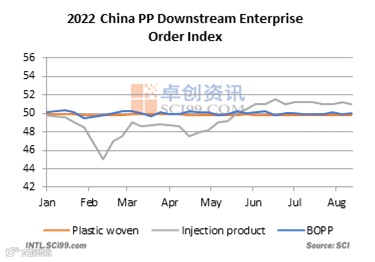
The upturn of some downstream industries buoyed South China PP prices notably in July.
Upcoming Demand Peak Season Brings Bullish Expectation for PP Domestic Demand
SCI estimates that overall PP supply will grow marginally as the import arbitrate window will keep open in the short run, even if there will be limited fresh capacity in the long term and maintenance will be intensive. September and October belong to the traditional demand peak season, during which downstream industries of PP copolymer will see gradual increases in operating rates. PP demand is supposed to pick up initiatively in East China and South China, and then those two regions will meet price advantages again.
All information provided by SCI is for reference only, which shall not be reproduced without permission.
Please click "Read more" for the full article.