

2022 China PX Imports Dropped by 22.49% Y-O-Y
China’s PX import volume has shown a downward trend in recent years. In 2022, China's total PX import volume was 10.58 million mt, accounting for 29.74% of the total domestic supply. The import trading partners, receiving places and trading methods were relatively stable. At present, China's PX dependence on imports has gradually decreased.
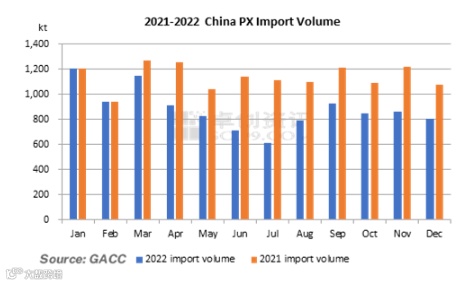
Influenced by the production mode of the whole industrial chain of “refining-chemical-polyester” in China, a number of production enterprises with relatively complete supporting facilities have emerged in China, and the competition between domestic and imported resources has continued to strengthen. In 2022, China's total PX imports reached 10.58 million mt, down 22.49% Y-O-Y. However, due to the mismatch between the growth of China's PX supply and the growth of downstream PTA demand, the fluctuation of monthly import volume increased.
The monthly import volume of PX in 2022 declined first and then rose, with the lowest value and highest value in July and January respectively. In July, the PX import volume fell to 615.4kt. From June to August, the low inventory of gasoline in the U.S., combined with the travel peak season, caused the tension of MX supply in some regions. Therefore, the arbitrage between the U.S. and Asia opened. MX and PX from Japan, South Korea and other countries flooded into the U.S., and the corresponding share of exports to China decreased, resulting in the domestic PX import volume falling back to an all-time low.
From the perspective of import structure, China's import trading partners are concentrated in Asia. Compared with previous years, the top four import trading partners remain unchanged. PX imports from South Korea, Japan, Brunei and Taiwan of China accounted for 42%, 16%, 12% and 11% respectively. China is the largest producer of PTA and the largest consumer of PX in the world, while PX enterprises located in South Korea, Japan, Brunei and Taiwan of China, give priority to seize the market by virtue of their convenient geographical location and cost advantages.
From the perspective of import receiving places, Zhejiang, Liaoning, Jiangsu, Guangdong and Hainan receive 92% of China's PX imports. Because the above five regions have a distance advantage from the downstream PTA production area, which can save a considerable part of the transportation costs, and the above regions are the main distribution centers of PTA. Compared with previous years, the receiving proportion of Zhejiang Province has significantly increased in 2022, mainly due to the release of the 3.3 million mt/a PTA capacity at Zhejiang Yisheng Petrochemical.
China's PX import mode is relatively single, 76% of which is general trade mode, and the proportion of traditional trade mode has declined. Processing with imported materials accounted for 17%, and import and export goods from bonded supervision sites accounted for 7%. Due to the continuous development and improvement of China's free trade zone, the proportion of warehousing in bonded areas increased.
In 2023, only Saudi Arabia's Gizan has a 600kt/a unit (delayed for many times) which is expected to be released on the foreign market. At the same time, the modern integrated enterprise with the comprehensive layout of “oil products-aromatics-olefins-polyester” in China will still have an impact on the imported supply of goods. However, in the context of China's huge PTA market, in order to meet the market stability and actual demand, it is estimated that China will still need to import 700-800kt of PX per month to ensure the supply. As far as the latest news is concerned, South Korea's export data in January 2023 (375.440kt exported to China, 44.493kt exported to Taiwan of China, and 30.501kt exported to the U.S.) also confirms the above inference.
All information provided by SCI is for reference only, which shall not be reproduced without permission.
Please click "Read more" for the full article.