

How Will South Korean Freight Issue Affect PP Market?
Preface: Recently in South Korea, Cargo Truckers Solidarity refused to carry out cargo transportation, resulting in the paralysis of South Korean logistics and the saturation of producer inventory. South Korea is an important PP origin for China. After exports were blocked in South Korea, the delivery of some orders to China was delayed.
Cargo Truckers Solidarity started to launch protests on June 7 and were on strike for several days. About 32% of the Cargo Truckers Solidarity members participated in the protest, according to estimates by the South Korean Ministry of Land, Infrastructure and Transport. According to SCI’s research, this move seriously affected the normal transportation in South Korea, where the goods’ delivery and express delivery industry were disturbed, and the prices of some commodities began to rise. As the situation intensified, the scope of influence expanded to South Korea’s automobile, steel, petrochemical, cement and other industries, and the export of multiple industrial chains was hit.
According to the research, SCI learned that some South Korean PP producers, such as Hyosung, LG Chemical, Lotte Chemical and Hanwha Total Petrochemical, saw inventory accumulation to varying degrees due to the lack of trucks. Some producers said that they would reduce operating rates to alleviate their inventories if protested activities continue, and customers would be notified about supply postponement. As of June 12, the overall transport volume via containers at twelve major ports in South Korea dropped by 87% compared with the average level in May, as reported by the South Korean Ministry of Land, Infrastructure and Transport. What was the specific impact on China’s PP market?
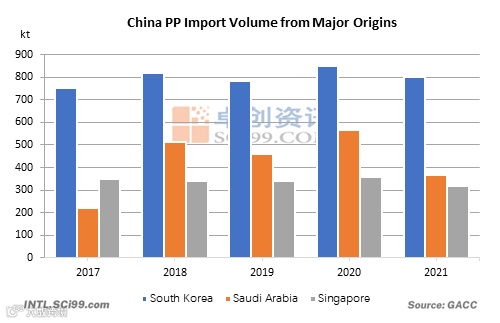
China is a large PP producer and consumer in the world, but China has high import dependence on high-end specific-purpose materials restricted by the immature production process. Comparatively, South Korea has mature production process and is not far from China, so it remains as an important trade partner for China. Its products are of high quality, and South Korea is also a prominent supplier of specific-purpose materials for China. According to GACC, South Korea-origin PP imports totaled 4 million mt in China between 2017 and 2021, and the annual average import volume hovered above 750kt.
In South Korea, PP capacity totals around 6 million mt, and major producers include Lotte Chemical, Hyosung, SK and LG Chemical. From the perspective of geographical distribution, PP production plants are mainly distributed in three major industrial production areas, involving Daesan, Ulsan and Yeosu. South Korean PP industry has developed earlier, the production process is relatively mature. In South Korea, the distribution of plants is concentrated, and the supply self-sufficiency rate is relatively strong. Advantages in geographical location and product quality make South Korea a crucial supplier of specific-purpose PP materials for China.
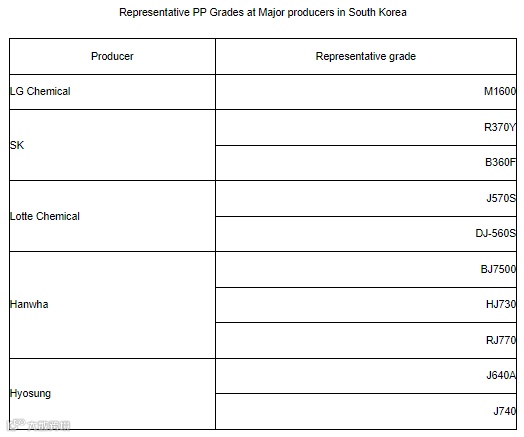
It can also be seen from the above table that China’s imports of PP from South Korea are mainly concentrated in high-impact copolymer PP, random copolymer PP and transparent PP, filling the vacancy of high-value-added products in China’s market. Therefore, the relationship between South Korea’s PP export situation is closely related to China’s market. A few of China’s trading companies indicated that the shipping date of South Korea-origin cargoes was delayed for a short period. To sum up, the blockage of South Korea’s logistics produced a certain impact on the supply of imported PP in China.
According to the latest report from the Financial Associated Press, Cargo Truckers Solidarity and the South Korean Ministry of Land, Infrastructure and Transport reached a tentative agreement on Tuesday (June 14) on minimum wage guarantees for workers. The eight-day protests of truck drivers came to an end, and Cargo Truckers Solidarity also decided to return to the front line of logistics from June 15. SCI believes that the paralysis of South Korean ports and industrial hubs is expected to be eased, and the delay time of shipping is expected to be shortened. However, the specific development in the future is full of uncertainties, although the agreement has been reached temporarily. After the recovery of the logistics, the first task is to neaten the overall transportation in South Korea. It still takes time to solve the problems such as postponed export of goods and plentiful inventories at PP producers.
All information provided by SCI is for reference only, which shall not be reproduced without permission.
Please click "Read more" for the full article.