

Overseas PP Prices Stayed High amid Supply Dearth (Demand)
Highlights: Overseas PP supply was tight because of the extensive unit maintenance in the Middle East and the shutdown of some units affected by the weather in North America. Overseas suppliers reduced the number of quotations, and PP USD-denominated prices increased notably, so imports produced a small impact on China’s domestic PP market.
Overseas PP demand has warmed up gradually since the end of 2022, especially in India. Meanwhile, there was intensive maintenance of PP units in Q1, so the supply-demand fundamentals improved a lot, which pushed up PP USD-denominated prices.
In January, PP USD-denominated prices mounted up under the support of the costs and the futures market, but deals were muted during the Spring Festival holiday. After the holiday, PP prices were still underpinned by the 8-day consecutive rises in futures prices. At the same time, the overall overseas supply tightened to support the price. In February, PP USD-denominated prices rose and then trended sideways. In H1 February, the prices stayed high on the back of firm futures prices and feedstock costs, while the prices dipped in H2 February amid lower costs and limited improvement in demand.
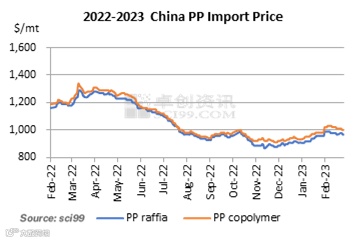
Orders for PP perked up in Southeast Asian and India, suggesting revived demand.
PP demand in Southeast Asia resurged after the Spring Festival holiday with enterprises resuming production. There was a lack of low-end offers because of short supply, which propelled the increase in PP prices. PP demand also performed well in India. In recent years, orders for labor-intensive consumer goods have gradually shifted from China to India, Vietnam, etc. In addition, India’s orders for PP were favorable, influenced by the China Plus One strategy. Downstream plastic woven and non-woven fabrics enterprises also enjoyed improved orders. According to the data released by the Society of Indian Automobile Manufacturers (SIAM) on February 13, India’s passenger car sales in January increased by 17% Y-O-Y. It can also be seen that passenger car demand performance was relatively strong, which buoyed the demand for PP injection and copolymer materials. Local supply in India was limited due to the delay of the new units and low operating rates of existing units, so PP offers were kept firm.
Higher international propane prices bolstered PP prices strongly.
Since the end of January, the shortage of international propane resources has led to the price rise of propane, and the CP in February exceeded that in January, which promoted PDH-based PP production costs. In addition, crude oil prices lingered at a medium-to-high level amid the continuous support of the supply side, and this also bolstered PP prices remarkably from the cost side. Besides, a lot of units were shut down accidentally because of poor profits, which aroused players’ concerns about further declines in PP supply.
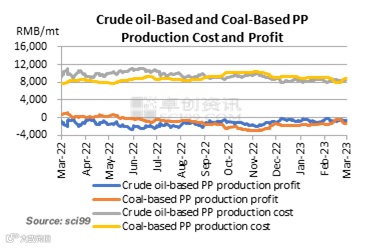
Lots of PP units are planned to remain in downtime in the Middle East and Northeast Asia, and newly constructed units in India and China have not been operated steadily, reflecting snug supply. Overseas polyolefin prices remain high at present and exceed China’s domestic prices, so China’s PP import arbitrage window stays closed. SCI predicts that limited PP imports will arrive at China’s ports. The two sets of units at Sinopec Hainan Refining & Chemical Phase II (with capacity of 500kt/a) and 500kt/a unit at PetroChina Guangdong Petrochemical have been officially put into production, which will impact the PP supply in China. In particular, homo PP prices may be dampened. For demand, it is hard for China’s domestic demand to become strong in the short run, as the export demand for end products is insipid and demand in Southeast Asia weakens. If China’s newly added units run steadily in the future, PP prices may be further pressured. The spread between China-origin PP prices and overseas PP prices will probably widen, further enlarging the export arbitrage window.
All information provided by SCI is for reference only, which shall not be reproduced without permission.
Please click "Read more" for the full article.