

Reasons Behind Continuous Declines in Methanol Port Inventory
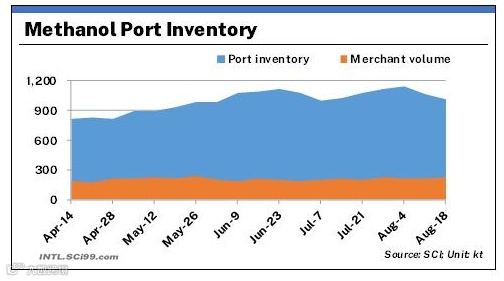
In H1 August, the four coastal MTO units had production reduction or outages to different extents, but the port inventory slid for two successive weeks. The weekly average decline in port inventory reached 66.4kt, which aroused high attention of market players. Theoretically speaking, the port inventory was supposed to build up with the decreasing operating rate at MTO plants consuming over 50% of methanol resources in East China. However, the opposite was true. What are the reasons behind this situation? And how will the market perform in the later period?
From January to July, the port inventory fluctuated upwards and hit a new high of 1,143kt at the end of July, up 40.29% Y-O-Y. Afterwards, the port inventory dropped quickly in H1 August. At the same time, the feedstock inventory at the important downstream plants in East China also went down. On the one hand, the decrease in supply was larger than that in demand in August. On the other hand, the import volume dropped, while downstream plants restocked steadily.
Jul 29 - Aug 18 Weekly Methanol Delivery Volume in Taicang

Stable rigid demand pushed up the delivery volume in Jiangsu.
As shown in the above table, the weekly methanol delivery volume in Taicang kept increasing, especially from August 12 to August 18 when the daily delivery volume reached 8,000-10,000mt at a few storage areas, a medium-to-high level. From August 12 to August 18, the volume of delivery by ship in Taicang climbed to 25,800mt, up 148.08% W-O-W. Besides the traditional users in surrounding areas of Jiangsu (Nanjing, Zhenjiang and Nantong), some downstream plants from Shanghai, Anhui and Dalian also came to Taicang to pick up goods. Moreover, the delivery in Taicang, Changzhou, Jinjiang, etc. was all relatively stable. Thus, the inventory in Jiangsu decreased repeatedly in the past two weeks.
The supply and demand got relatively balanced in East China due to an obvious decline in supply.
As for supply, the overseas methanol units took maintenance intensively in end-July, leading to a noticeable decline in output. Meanwhile, the transport capacity was tight. It is estimated that the import volume in August may decline to below 1 million tons, down 320kt from July. Moreover, the resources from the inland market and the output in East China also declined somewhat. As for demand, In H1 August, two MTO units with the total capacity of 985kt/a in East China were shut down for maintenance, and the operating rates of other MTO units were cut by different extents. In addition, some downstream DMF and chloride units also ran at lower loads. However, compared with the decrease in demand, the supply reduction was larger. Consequently, the supply and demand in East China came to a relative balance again in August, and downstream users restocked steadily, followed by smooth destocking in East China.
The feedstock inventory at downstream plants dropped persistently.
In August, the feedstock at the MTO plants in East China kept sliding. There were several reasons. First, the cargoes from certain country in the Middle East to coastal MTO plants fell notably in August, influenced by the continuous delay in the shipment of the contract and bidding cargoes from certain country in the Middle East. Thus, the downstream plants had to purchase some non-Iranian cargoes in advance. Second, the delivered prices of inland resources were higher than the import cost, so most coastal downstream plants actively purchased imported cargoes and spot cargoes at ports to reduce feedstock cost. Third, some cargoes (the volume is estimated at 65kt.) were originally scheduled to be delivered to downstream plants flowed into the public storage areas in Jiangsu. Later, with the supply of imported cargoes to rally again, it is predicted that the feedstock inventory at coastal MTO plants may rise in late September.
On the whole, relative to the decline in import volume, the influences of the intensive production reduction or outages of MTO units on market mentality were more direct and stronger. Market players held strong risk-aversion and wait-and-see attitudes and ignored the actual adjustment in supply and demand. In the near term, it is projected that the coastal methanol market prices may fluctuate in the range of RMB 2,400-2,500/mt. With the inventory at ports further dropping, the prices may have a rebound temporarily. It is suggested to pay attention to the shipment speed of cargoes from certain country in the Middle East, the actual trade flow of cargoes from South America as well as the changes in overseas ocean freight.
……
All information provided by SCI is for reference only, which shall not be reproduced without permission.
Please click "Read more" for the full article.