

PBR Price Stopped Falling and Trended Sideways
Snapshot: In June, the PBR market price halted its fall and was range-bound. The cost continued to slide, and fundamentals improved limitedly. Thus, the PBR price trended sideways.
In June, the PBR market price trended sideways.
In June, the PBR market price trended sideways. Up to June 16, the HCBR 9000 market price in North China was around RMB 10,050/mt, down RMB 50/mt or 0.5% from end-May. The PBR market price halted its fall and trended sideways. As the PBR price hit an annual low, buyers began to stock up for bargain hunting. The negotiation atmosphere warmed up. The PBR price stopped falling at this stage.
The main driver of the previous fall in the price was the sliding cost, which curbed players’ sentiment in the market. Besides, the tire inventory piled up. In June, the butadiene price at Sinopec in East China decreased by RMB 800/mt in total, weakening the support for the PBR price. Meanwhile, the inventory at tire enterprises continued to move up. As it was the in the consumption slack season, the operating rate of the tire industry faced pressure. The PBR units under maintenance were restarted constantly and ran at higher loads, leading to an expected increase in the PBR supply. As seen from the main drivers of the PBR price, the main bearish factors didn’t change in June. Thus, why did the PBR price stop falling?
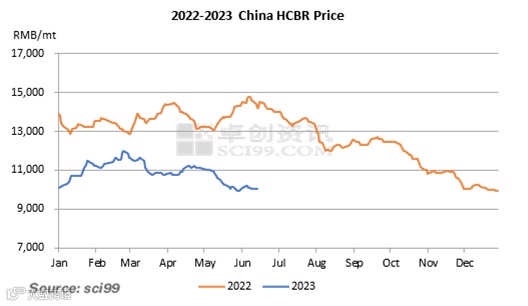
The “support level” was crucial.
According to the PBR price data distribution in the past 12 years, the price of HCBR 9000 lingered at RMB 10,000-13,000/mt for over 80% of the time. Despite the influence of special factors, the highest price was in the range of RMB 13,000-14,000/mt. Therefore, the PBR price fell to the “support level” in the price history at the price of RMB 10,000/mt, despite the influence of cost and fundamentals. Players widely believe that they should begin to replenish the inventory with the price falling to a low level. As the cost declined and fundamentals lacked strong support, the PBR price faced headwinds in rebounding and mainly trended sideways.
Forecast: Will the PBR price continue to fall?
Demand: According to SCI, the domestic tire market remains weak currently. The tepid end demand is expected to stunt the circulation of tire resources. Replenishment and sales at traders may both slow down, leading to higher pressure on the sales at tire enterprises. The inventory is likely to rise. Curbed by the rise in inventory and the decrease in sales volume, the operating rate of the tire industry is predicted to be stable-to-decreasing in the short term.
Supply: The PBR units at Nanjing Yangzi Petrochemical and Rubber and PetroChina Daqing Petrochemical are likely to remain offline. The units at Hipro New Material Technology and Zhenhua New Materials may run normally. The newly added unit at Zhejiang Petroleum & Chemical is under normal production at present. The PBR unit at Shandong Yihua Plastic and Rubber has produced high-quality products. SCI reckons that the operating rate of China’s HCBR units is predicted to be 63% - 65%. The PBR supply is expected to be ample.
Cost: The butadiene market price is likely to fluctuate upwards within a narrow range in the short term, but the increment may be minor. As seen from the supply, sales at most butadiene enterprises for merchant sales may be fairish. As there may be limited low-priced butadiene resources in East China, traders are likely to show thin interest in selling goods at low prices, further reducing the low-priced resources in the market. Most downstream industries gain fairish profit at present. Downstream enterprises are likely to purchase a reasonable amount of butadiene resources. However, downstream players may be also cautious about high-priced resources without bullish factors in end demand.
Natural rubber: In the short term, the natural rubber market price may be mainly range-bound. Although new field latex will possibly be released in domestic and overseas production areas, weather factors including rain may affect the release. The supply of new field latex may face limited pressure in the short term. However, the feedstock is likely to be consumed slowly due to the tepid demand in the spot natural rubber market. Thus, the high inventory may remain, putting pressure on the rise in the natural rubber price. In the short term, news and the external macro environment are likely to be the main drivers of the fluctuation in the natural rubber price. Yet, the overall price change may not register a certain trend from the perspective of fundamentals.
In the coming days, the butadiene price is predicted to stay low despite the fluctuation, further dragging down the PBR market. Driven by fairish profit, PBR enterprises will possibly show higher interest in production. Besides, with the demand slack season approaching, the operating rate at major downstream tire enterprises is expected to face pressure. There may be no bullish factor in the PBR market in the short term. Buyers are expected to stock up more slowly. In the short run, the PBR market price may mainly hover at lows and not fall below the “support level”. In the long term, the PBR price is predicted to remain below RMB 10,000/mt with the release of PBR resources at private enterprises.
All information provided by SCI is for reference only, which shall not be reproduced without permission.
Please click "Read more" for the full article.