

2022 China PP Prices Lost Ground After Growth
Preamble: China’s PP price showed a topsy-turvy V-shaped trend in 2022, mainly affected by supply-demand fundamentals. Crude oil values mainly affected the sentiment of market players.
The major price drivers were as follows: First, changes in supply and demand, involving PP capacity growth rate, product supply structure, downstream industry concentration, profit, the development of traditional and emerging fields, etc. Second, feedstock price changes. Constant rises or declines of feedstock prices will impact market mentality and PP cost greatly, and then affect the PP price movement. Third, the capital inflow & outflow in the commodity market and the introduction of policies will also have a phased impact on PP prices, considering the financial attributes of PP and its complex downstream fields.
In 2022, China’s PP price showed an inverted “V”-shaped trend, with the highest price of RMB 9,500/mt occurring in early March and the lowest price of RMB 7,650/mt occurring in late December. From January to early March, the PP price climbed to a yearly high level supported by the constant crude oil price rises aroused by the international event. From March to August, crude oil prices fluctuated at highs, which mainly influenced the market mentality. However, downstream demand remained weak, dragging down the PP price. From September to October, the PP price rebounded in the traditional demand peak season. However, from the middle of October, PP prices began to pull back. The positive effect of the demand peak season on the market was limited. Then, PP prices kept sliding and fell to a yearly low between November and December because of insipid downstream demand.
In terms of PP grade, the price spread between PP raffia and low-MFR copo PP was RMB -180/mt to RMB 350/mt, and the largest spread was in mid-October. The smallest spread was in early March, as the production switch of some units after the Spring Festival holiday and the release of newly added capacity lifted the supply proportion of low-MFR copo PP, and the price of PP raffia was lower than that of low-MFR copo PP. In terms of region, the PP price spread between East China and North China was RMB -50/mt to RMB 200/mt, and the largest spread was in late May. The smallest spread was in mid-August, as the open of import arbitrage window brought more August arrival low-priced imported PP raffia materials, and the newly added capacity release also dragged down the PP raffia price in East China.
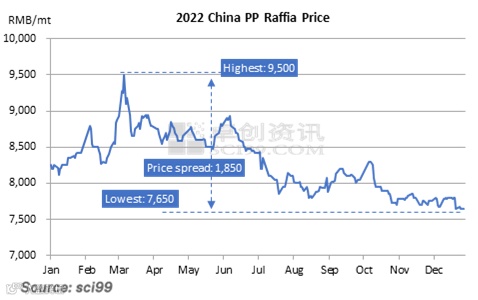
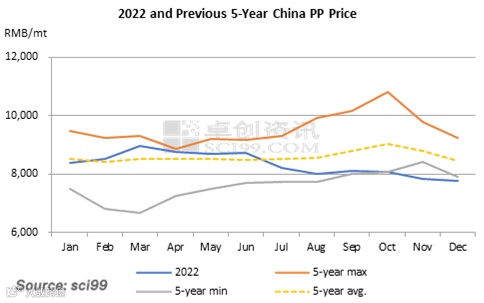
China’s PP prices mounted up but then trended downwards in 2022, and the price fluctuation range was narrower than that in 2021. The largest fluctuation range of PP prices was RMB 2,150/mt in 2021. In terms of annual average price, it was RMB 8,335/mt in 2022, falling by nearly RMB 400/mt or 4.33% Y-O-Y. PP prices in H1, 2022 basically hovered around the previous 5-year average level, but the prices in H2, 2022 slid to the previous 5-year low level.
Although the feedstock of PP diversified in recent years, crude oil remained the major feedstock. Therefore, the crude oil price exerted great impacts on the PP value chain.
From the long-term trend, the international crude oil price affected the PP price trend notably. As for the price trend in recent five years, the crude oil price was mainly affected by the OPEC production reduction and production increase of the U.S. before 2020, while the overall price fluctuation was limited. From 2020, the price war of Saudi Arabia and declined global demand dragged the crude oil price down to a record low. With the easing of global monetary policy and the improvement of supply and demand, crude oil prices increased slowly in the past two years. In 2022, crude oil prices stayed at highs caused by geopolitical risks, and the yearly high reached around $130/bbl.
In 2022, the co-movement between PP price and crude oil price weakened. Although high crude oil price gave strong support to PP price from the cost side, the downstream operating rate was lowered from previous years as the downstream demand remained sluggish in the year, offsetting the impacts of high cost. Therefore, the co-movement between PP price and crude oil price was also affected by the high cost and weak demand. However, as crude oil was the main feedstock of PP, the price of crude oil gave strong support to the PP price, curbing the decline in the PP price to some extent.
From 2023 to 2025, the PP market will be affected by many factors, such as the economic growth rate, macro environment, feedstock prices, price co-movement with related products and policies, while supply-demand fundamentals will be the main price driver.
In the past five years, the PP industry saw a tight balance between supply and demand, but in 2022, the balance gradually became loose, and industry profits turned negative. The capacity expansion starting from 2019 to 2020 continues, and it is expected that the newly added capacity will be put into production intensively from 2023 to 2024. Accordingly, the output in 2025 will increase. Meanwhile, with the release of newly added capacity, the PP market will see a new round of capacity optimization via the elimination of backward PP units. The demand starts to weaken from 2022, and the demand will not improve much in 2023. It’s estimated that the demand may ramp up in 2024 affected by the macro environment and continue to improve in 2025. Therefore, SCI reckons that the supply-demand pressure will grow in 2023, while it may be eased from 2024 to 2025.
All information provided by SCI is for reference only, which shall not be reproduced without permission.
Please click "Read more" for the full article.