

Global Methanol Trade Flow Shifts Follow Supply-Demand Changes
From 2015 to 2021, the U.S. ushed in a round of methanol capacity expansion, but local demand didn’t increase at the same time, resulting in an imbalance between supply and demand. With more methanol resources exported, the U.S. has become a net exporter from a net importer gradually. Accordingly, the cargoes flowing from South America and the Middle East to the U.S. have decreased, followed by a re-layout of their sales regions. Besides, the resources from a certain country in Europe are also aiming at Asian market. The competition in the global methanol market is increasingly fierce.
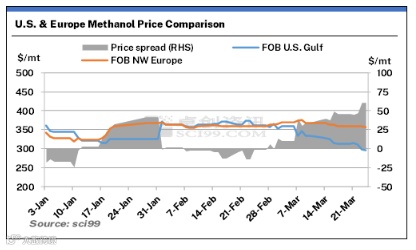
With the natural gas prices in the U.S. sliding in Q1, 2023, the operating rates of local methanol units recovered to a high level in early March. However, the flat demand weighed down methanol prices. In addition, Silicon Valley Bank collapsed on March 10, and the uncertainty of financial risks aroused market risk aversion. Against such a background, methanol prices further declined. Up to March 24, the FOB U.S. Gulf price closed at ¢ 88-90/USG, down 17.21% from end-February. The price spread between the U.S. and Europe was enlarged to $60.83/mt, and more cargoes were exported from the U.S. to Europe.
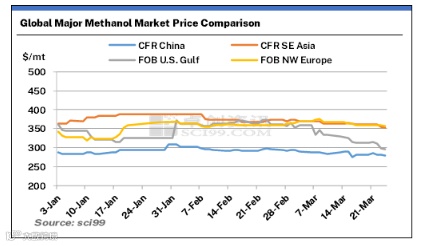
In early March, European methanol prices stood on the highest level in the global market, widening the price spread with the U.S., China and Southeast Asia. Therefore, the global major methanol suppliers intended to sell cargoes to Europe for arbitrage, especially the cargoes from South America and non-Iranian cargoes from the Middle East. However, influenced by actual demand, transport distance and long-term contract proportion, the resources from South America have more advantages, while the non-Iranian cargoes from the Middle East still need to search other sales regions. According to the import data in recent years, the non-Iranian cargoes from the Middle East have gradually stepped out the European and American markets and aimed at the Asian market.
After mid-January, many non-Iranian methanol units in the Middle East resumed stable operation, and their cargoes were intensively destined for Southeast Asia, India, South Korea and China. In recent years, the methanol demand from the biodiesel and traditional fields has been growing steadily in Southeast Asia and India which have become an important market for the methanol resources from the Middle East. Influenced by geopolitics, a certain country in Europe also exported more cargoes to Asia from June 2022. In addition, a few non-Iranian methanol plants in the Middle East reduced the proportion of long-term contracts for Southeast Asia and India, bringing more merchantable resources to the market. On the whole, with the competition intensifying in the Asian market, local methanol prices dropped by a large margin.
As seen from the recent trade flow changes in the global methanol market, supply gap and high prices are still the key influencing factors. Once resources flow into a market intensively, the consequent supply-demand imbalance will drag down prices. But on the other hand, this will accelerate the destocking in consumption markets. As for China, it is predicted that the methanol import volume in Q2 may increase gradually. In the future, the operation of overseas methanol units and regional trade flows are still the focus of our attention.
All information provided by SCI is for reference only, which shall not be reproduced without permission.
Please click "Read more" for the full article.