

Weak in H1, Benzene Market to Bottom Out in H2, 2023
In the first half of the year, the benzene market first fluctuated higher, then began to trend downward. The falling energy prices and weak supply and demand fundamentals jointly exerted pressure on the market. In the second half of the year, with the further recovery of the domestic economy and improvement in marginal demand for benzene, benzene prices are anticipated to rebound after reaching a bottom in the third quarter.
H1 Review:
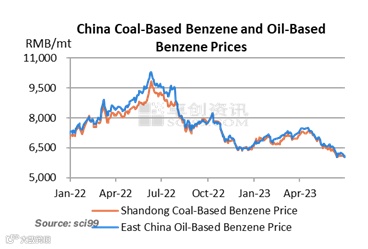
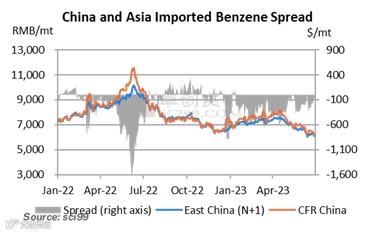
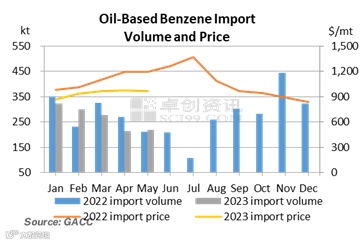
In the first half of the year, the benzene market first fluctuated upward and then kept falling. The price of benzene generally tracked the price of crude oil. The arbitrage window between Asia and China was closed, resulting in a month-by-month decline in China’s benzene imports, which was fueled by strong demand for oil blending in Europe and America in the first half of the year. Domestic inventory in East China’s main port has gradually decreased since March, supporting the domestic market price to rise. But as the price of benzene increased, the profits of downstream industries were further contracted, and the contradictions in the industrial chain escalated. The ongoing load reduction, shutdowns and maintenance in downstream industries, as well as the delayed production of new downstream units, have also laid the groundwork for the subsequent price decline in benzene prices. In April, benzene prices began a round of decline due to the high port inventory in East China, insufficient terminal orders and a lack of strength in crude oil. Entering June, a series of bearish news such as the expected opening of internal and external arbitrage windows continued to dampen the market confidence. Consequently, benzene prices continued its declines in June. From January to June 2023, the average benzene price in East China was RMB 6,929/mt, down 10.18% Y-O-Y.
The highest price of benzene in the first half of 2023 occurred in mid-April at RMB 7,495/mt. On the one hand, the rise in crude oil provided cost support to benzene, and on the other hand, it was expected that multiple downstream new units will be put into operation within the year, which would boost the benzene demand. These factors strengthened market confidence and led to higher prices. Afterward, due to weak demand performance and the banking crisis in Europe and America, crude oil prices fell significantly, resulting in a significant decline in benzene prices. In H1 of April, crude oil prices exhibited a short-term rebound, fueling up benzene prices again. However, after that, with ample supply and weak demand, benzene prices posted a downward swing again and continued until mid-June. On June 27, the benzene price in East China closed at RMB 6,085/mt, setting a new low since February 2021 while reaching a new low for 2023.
Crude oil market review:
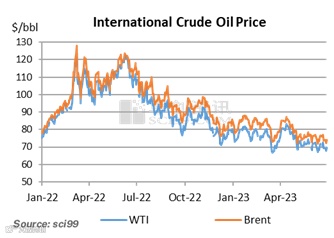
With a range of $70-90/bbl in the first half of the year, which was essentially consistent with the anticipated range in the annual report, crude oil prices posted broad fluctuations in 2023. Due to the continuous interest rate hikes by the Federal Reserve and the European Central Bank, the market maintains pessimistic expectations of economies such as Europe and the U.S. entering a recession, limiting the upward momentum of oil prices.
During the first half of the year, crude oil prices fell several times, with US crude oil falling below the $70/bbl mark and even reaching $67/barrel. However, they quickly rebounded and returned to the volatile range. Compared to the rapid rebound after the sharp decline of crude oil prices in March, the strength and magnitude of the rebound after the decline in May weakened. As a result, the operating range of crude oil prices narrowed to $70-80/bbl.
Supply and demand review:
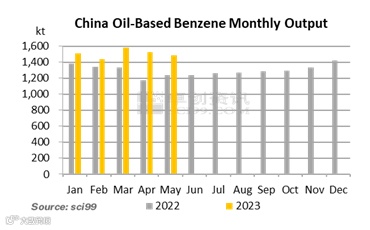
From January to June 2023, the total output of oil-based benzene was 9,069.2kt, a Y-O-Y increase of 17.51%. The output increment generally benefited from the production of newly added units at Sinopec Guangdong Petrochemical, CNOOC Ningbo Daxie Petrochemical and Hubei Jinao Mainly due to the production of new units such as Guangdong Petrochemical, Ningbo Daxie, and Jinao Science & Technology Chemical Industry.
From January to June 2023, the total output of coal-based benzene was 1,990kt, up 90kt or 4.75% compared to the same period last year. The profits from coal-based benzene production were moderate from January to April, so producers mostly ran at high operating rates. After May, Tangshan Xuyang Chemical brought its new unit online, further expanding coal-based benzene capacity.
The import volume of benzene totaled 1,345.3kt from January to May, down by 3.41% compared to the same period last year. It is anticipated that the imports in June will be 230-250kt. Therefore, the total import volume in the first half of 2023 will be around 1,585.3kt, a Y-O-Y decline of 1.01%.
As of the end of June, the commercial inventory of oil-based benzene at East China ports was 196.8kt, up 3kt from 193.8kt on May 31, and up 191.56% Y-O-Y.
From January to June, the demand for benzene in the four major downstream industries reached 11,103.2kt, up 10.22% from 10,074.1kt in 2022.
Styrene: Styrene output saw an M-O-M decline of 11.47% in June because many units were shut down. It is expected that the output in July will be 1,390kt or so.
The total output of styrene from January to June 2023 was 7,345.4kt, a Y-O-Y increase of 7.48%. In the first half of 2023, the output increase benefited from the production of new units at Zibo Junchen New Material, Lianyungang Petrochemical and Sinopec Guangdong Petrochemical.
CPL: The operating rate of the CPL industry inched up from last month. A couple of units cut down operating rates, and some units raised operating rates. In the first half of 2023, the average operating rate of the CPL industry rose slightly after a decline, fluctuating around 70%-73% overall, except for May. In the second quarter, unit maintenance and production reduction were more frequent, and the operating rate hit a half-year-low in May.
Phenol: The operating rate of the phenol market remained unchanged compared to last month. From January to June 2023, the domestic output of phenol is estimated at 2,071.7kt, an increase of 17.54% compared to the same period last year. In the first half of the year, the capacity of phenol and acetone increased notably, with three sets of units being put into operation. Although some producers carried out intensive maintenance in the second quarter, the supply increment was still relatively significant.
Aniline: The operating rate and output of aniline saw an M-O-M decline in June. Many producers reduced operating rates, including Shandong Jinling Chemical, Shanxi Tianji Coal Chemical Industry Group and Jiangsu Fuqiang New Material, etc. The operating rate of the aniline industry from January to June was around 73%, an increase of 1.5 percentage points Y-O-Y.
H2 Forecast:
Benzene prices are expected to bottom out in the third quarter and rebound in the fourth quarter. Cost-wise, it is projected that the price of oil would vary upward in the second half of the year. At the end of the year, the WTI and Brent oil prices may return to $80-85/bbl, which is about $10/bbl higher than where they are now. On the supply side, the newly added benzene capacity will be concentrated in the third quarter. In terms of demand, new advantageous real estate policies are anticipated to be implemented in the second half of the year. The second half of the year will be better than the first, and the styrene, CPL, and other downstream businesses, as well as other downstream industries, will all benefit from the terminal industry’s recovery, which will subsequently support the benzene market. Additionally, benzene’s absolute value is very low in the historical cycle, which can encourage a recovery in the price on the domestic market.
The new benzene units will be put into operation in June and July, and there will be no additional units in the second half of the year. In terms of downstream units, three styrene units with a total capacity of 1,800kt/a, four CPL units with a total capacity of 700kt/a, five phenol units with a total capacity of 1,295kt/a, and three adipic acid units with a total capacity of 980kt/a are expected to be put into operation.
……
All information provided by SCI is for reference only, which shall not be reproduced without permission.
Please click "Read more" for the full article.