

Where will PE Market Go Amid Supply-Demand Structure Changes
From 2018 to 2023, China’s PE capacity is gradually rising. Although the import volume showed a downtrend on the capacity expansion, the imported PE resources still exerted certain impacts on China’s PE market with the advantages of low cost and high performance. Where will China’s PE market go amid intensifying competition?
In the past two years, China’s PE market witnessed high costs, low profits and sluggish demand, leading to new thoughts and attempts on the industry development.
Expanding Consumption Fields & Extending Industrial Chain
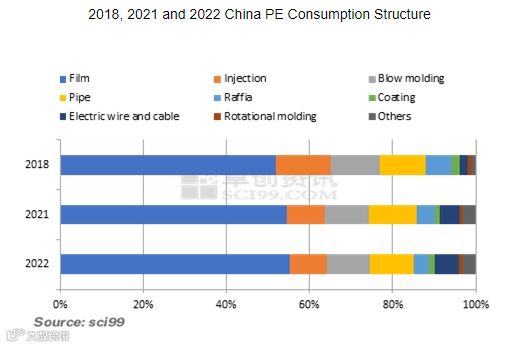
As for the consumption structure, the film field consumed the largest amount of PE worldwide. As for China’s market, the film field took up 55% of total PE consumption in 2022, together with 9%, 10% and 11% in the fields of injection, blow molding and pipe respectively. In the past five years, the niche fields of rotational molding and coating maintained favorable development. Meanwhile, orders for electric wires and cables continued to improve in 2022, benefiting from bullish factors in the construction of new infrastructure, light rail, subway, urbanization pipe network as well as the rapid development of the photovoltaic industry. Therefore, PE consumption in this field increased to around 6% in 2022.
Faced with competition among homogeneous products, on the one hand, producers and traders actively expand the downstream application fields of their products. On the other hand, extending the industrial chain is also an option for many polyolefin enterprises. For example, some PP raffia producers have matched production lines of BOPP or processing enterprises of plastic weaving and non-woven fabrics. As PE enterprises are subject to the large number of downstream applications and a lack of sufficient conditions for large-scale production, they strengthen cooperation with downstream enterprises in some high-end fields, making the production of customized and specialized products to become normal.
Diversified Production & Customized Products
As for PE products, the diversification of upstream feedstock and downstream purchasing modes played an important role in the PE market. In the long term, the diversification and customization of products will be one of the methods to cope with the intensifying competition.
In recent years, most petrochemical enterprises in China have gradually developed towards product differentiation and high-end specialization so as to improve their product competitiveness and to better meet the needs of downstream enterprises. Some of them have started to adopt the model of individual customization and exclusive production and supply. At the same time, many of China’s domestic petrochemical enterprises are actively producing full coverage products with different pressure levels, different diameters, natural color materials and mixed ingredients, pipes and pipe fittings, large, medium and small series of blow molding products, produce special materials such as high-rigidity small blow molding, oil tank material and IBC; and actively develop metallocene film, ultra-high molecular weight PE and very-low density PE, as well as special pipe materials for floor heating pipes and gas pipes.
For example, in 2022, PetroChina Dushanzi Petrochemical improved the quality and output of products such as metallocene resin and PE-RT pipe material DGDZ3606, and enhanced their production and sales. Backed by a combination of efforts from chemical sales branches in North China and Northwest China, from Q1 to Q3, 2022, the output and sales volume of new materials including metallocene resin and PE-RT pipe material DGDZ3606 hit 279kt
As the competition in the market continues to intensify, more and more refining-chemical enterprises will choose to broaden their product routes and improve product quality in the future. It is expected that in 2023, the number of enterprises involved in the development and research of new brands such as special materials will increase significantly, and the development of PE products in the field of high-end and specialization will reach a new level.
Improving Exports
From 2018 to 2020, China’s PE export volume fluctuated within 220-300kt, while it surged from 2021 to 2022. China’s PE export volume reached 722.1kt, up 41,71% Y-O-Y. In 2022, China’s PE export volume rose greatly and hit a five-year high in June mainly due to the large price spreads among different regions. In addition, ocean freight declined gradually, granting export arbitrage opportunities for China. Therefore, China’s PE producers and traders proactively expanded their export business, pushing up the export volume notably. Some Chinese-made resources were exported to South America, Southeast Asia, etc. In H2, with the global economic growth slowing down, the demand weakened, and the price kept falling, dampening the export willingness.
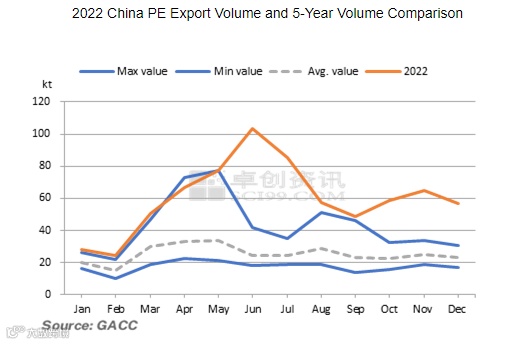
In 2022, China’s PE imports declined while exports improved due to the low prices of PE products in China’s domestic market. The main export mode was still via Hong Kong of China for export and re-export trade. Apart from other traditional Southeast Asian regions such as Vietnam and the Philippines, China’s PE export volume to Russia, Bangladesh in South Asia and Brazil in South America also ramped up somewhat.
According to SCI, Chinese-made PE products will enjoy more advantages in these regions in line with the increase in China’s PE export rebates, the deepening of bilateral and multilateral agreements with the ASEAN, South Korea, etc. and further implementation of the “Belt and Road initiative”. It is estimated that with the continuous release of China’s PE capacity and the development of diversified feedstock structure and technological innovation, Chinese-made PE products will improve in quality and price as well as gradually expand their shares in the international PE market. However, due to the lack of competitiveness of Chinese-made resources in price, it is expected that PE exports will not see a great increment in the short run, but improving exports will definitely be one important measure taken by producers and major traders to deal with the capacity expansion.
On the whole China’s PE industry will see both challenges and opportunities as well as competition and upgrading. The diversification of upstream feedstock to reduce costs and expansion of product range and exports may be the core solutions to cope with the imminent challenges.
All information provided by SCI is for reference only, which shall not be reproduced without permission.
Please click "Read more" for the full article.