

Competition in Ivory Board Market to Intensify as Capacity Expansion Accelerates
Intro: During the past three years, the ivory board capacity expanded rapidly with the trend of consumption upgrades and rising environmental awareness. The market has grown especially fast since 2021. But with the launch of new capacity, the market competitive pressure will rise apparently.
Ivory board industry entered a capacity expansion cycle with changing supply-demand pattern
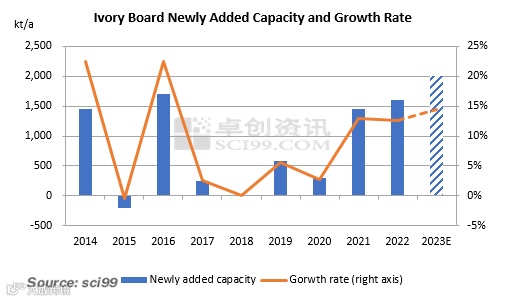
Since 2014, the ivory board capacity has gradually increased. In 2021, the industry entered a new round of capacity expansion. SCI estimates that the net increase of ivory board (commodity-grade) capacity totals 3,050kt/a from 2021 to 2022, and an estimated 2,000kt/a may be added in 2023 with a Y-O-Y growth rate of 14%. In the next five years, there is still 22,550kt/a planned ivory board capacity which is mostly expansion at existing players, but the number of new entrants is also increasing.
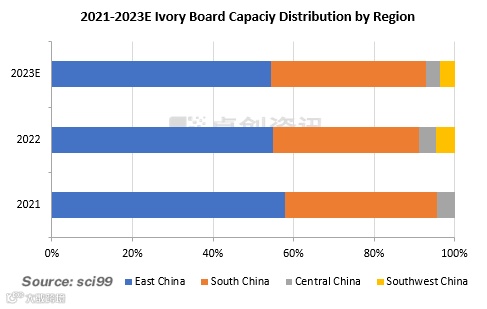
As seen from the planned ivory board capacity projects, commodity-grade ivory board accounts for nearly 60% of the total, while food and other ivory board grades account for the rest 40%. In terms of geographic distribution, East China, South China and Central China are the top three ivory board producing regions. In 2022, as Nine Dragons Paper (Chongqing) switched a duplex board line to ivory board production, Southwest China has also become a main producing region. Therein, East China ranks first, accounting for 54% of the total in China, followed by South China, which accounts for 38%. Because the anticipated new capacity expansion in 2023 is located in Jiangsu and Fujian, East China and South China will remain the most important ivory board producing regions. From a longer perspective, up to 49% of the planned ivory board capacity is in South China, and it may become the top ivory board producing region. But because there are uncertainties involved, the commissioning of new capacity still depends on factors such as market trends, environmental impact assessment and actual construction, etc.
Capacity expansion driven by demand and profit
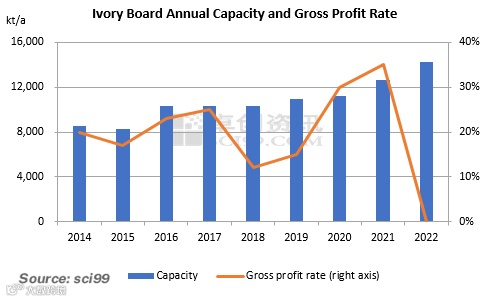
Ivory board is widely used in the packaging of consumable products, and bolstered by rising consumption quality, the demand for ivory board expanded. From 2014 to 2022, the average annual growth rate of ivory board consumption in China is 2%. Excluding the significant consumption drop in 2022, the average annual growth rate will be around 5%. The overall increase in demand is the main driver behind capacity expansion. From 2014 to 2022, the annual average ivory board capacity growth rate was around 8%.
As seen from the industry’s profitability, the annual average gross profit between 2014 and 2021 averaged 10%-34%. In particular, the gross profit rate rose to above 30% from 2020 to 2021. In 2021, as the ivory board price surged to record highs, the gross profit in May was close to 50%. The high profitability promoted capacity expansion within the industry, and there had been more planned ivory board projects since 2020.
Besides, favorable policies also promoted industry expansion. In January 2020, the National Development and Reform Commission and the Ministry of Ecology and Environment jointly issued the “Opinions on Further Strengthening the Treatment of Plastic Pollution”. The upgrade of the plastic ban stimulated the substitution trend with paper-based alternatives. As result, the ivory board market experienced a policy boost. In addition, due to the waste paper import ban and the duplex board capacity elimination in Fuyang created a supply gap of 1,100kt/a, creating demand for ivory board and boosting the optimistic anticipation in the market.
Competition to intensify as market becoming oversupplied
Starting from 2021, the ivory board market supply surpassed demand. With the release of newly added capacity in the future, the competitive pressure will intensify. Generally, the industry will be deemed as overcapacity if the operating rate goes below 75%. SCI’s data indicates that the ivory board industry operating rate has dropped from 68% in 2021 to only 62% in Q1 of 2023 despite a rebound in 2022. Against the backdrop of general deceleration in economic growth around the world, the market demand trend may deviate from the rapid supply surge. Thus, attention should be paid to the risk of supply-demand imbalance after rapid capacity expansion.
All information provided by SCI is for reference only, which shall not be reproduced without permission.
Please click "Read more" for the full article.