

China Calcium Carbide Market Semi-Annual Analysis
Preface: In H1, 2023, coal prices saw a downward trend, giving thinner cost support to the calcium carbide market. In addition, downstream industries were in the doldrums, dragging down the demand. Thus, calcium carbide prices moved down constantly and dropped to a record low since 2021 sometimes. In H2, 2023, bearish factors may still affect the calcium carbide market. In addition, the calcium carbide supply is expected to increase. SCI reckons that calcium carbide prices will decline further and hover at lows.
In H1, 2023, China’s calcium carbide prices fluctuated downward. First, the drop in the feedstock price overpassed expectations, giving thinner cost support to the calcium carbide market. Second, the drop in the PVC price was also higher than expected, dragging down the demand and affordability for calcium carbide. Up to June 30, 2023, the average EXW price in the main producing regions such as Wuhai, etc. was RMB 3,202.64/mt, down 22.47% Y-O-Y and down 12.69% from H2, 2022. Up to June 30, 2023, the closing price of calcium carbide in Wuhai was RMB 2,750/mt, down 24.66% or RMB 300/mt from the beginning of 2023.
In H1, 2023, calcium carbide prices reached highs in January and then fluctuated downward and dropped to the lowest point on June 30, 2023, with RMB 2,750/mt, which was the lowest price since 2021. The bottom-peak price in H1, 2023 was RMB 1,100/mt.
Calcium carbide prices saw low points in April and June. In early April, calcium carbide prices dropped to RMB 2,950/mt. First, the calcium carbide industrial operating rate was relatively high in March, propping up the supply. However, PVC units underwent intensive maintenance, dragging down the demand. Thus, the calcium carbide supply-demand imbalance strengthened. After that, overhauled PVC units restarted, while the increase in operating rates of calcium carbide units was slow. Therefore, backed by improved fundamentals, calcium carbide prices rebounded to RMB 3,150/mt in end-May. However, with PVC units undergoing intensive maintenance, the calcium carbide industrial operating rate being recovered, and the feedstock price decreasing, calcium carbide prices dipped to RMB 2,750/mt in June.
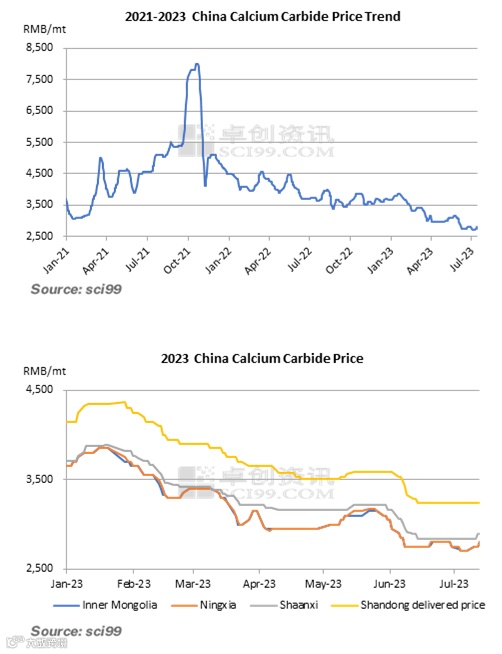
In H1 January: The calcium carbide prices moved up. Before Spring Festival, the EXW price in the main producing regions increased by RMB 2,00/mt. First, calcium carbide output was low caused by unstable production of unplanned unit shutdown. Second, the PVC industrial operating rate was stable-to-rising, propping up the demand. In addition, downstream enterprises hoarded goods before the holiday. The highest EXW price in Wuhai was RMB 3,850/mt on January 20.
End-January to end-February: The calcium carbide prices saw a downtrend. From H2, January, calcium carbide prices began to move down. First, semi-coke prices dropped by RMB 350/mt, dragging down the cost of calcium carbide. Second, affected by improved profits, calcium carbide producers raised operating rates, propping up the supply. Thus, calcium carbide producers cut offers to promote sales under sales pressure. In end-February, the EXW price in Wuhai dropped to RMB 3,300/mt.
End-February to early March: The calcium carbide prices rebounded. There were increased shutdown units, denting the calcium carbide supply. The EXW price rebounded and then stabilized at RMB 3,400/mt.
Mid-March to end-April: The calcium carbide prices dropped and then fluctuated. In mid-March, some overhauled calcium carbide units restarted, so the calcium carbide industrial operating rate was stable-to-rising. In addition, caustic soda prices saw a downward trend, and PVC prices fluctuated at lows. Ahlor-alkali producers faced cost pressure amid intensified profit losses. Thus, PVC enterprises cut operating rates, declining the demand for calcium carbide. Amid obvious supply-demand conflict, calcium carbide prices slid further. In H2 March, calcium carbide producers in the main producing regions cut offers notably to promote sales, while procurement prices also shrunk. In April, the EXW price of calcium carbide was RMB 2,950/mt most of the time.
Early May to end-May: The calcium carbide prices bottomed out. Within the month, the EXW price rose by RMB 200/mt. First, the calcium carbide supply was tight most of the time. In end-April, calcium carbide producers cut operating rates to a record low since 2022 or halted production to avoid risks amid profit losses. Decreased output boosted the EXW price. Second, with the restart of intensive overhauled PVC units, calcium carbide demand climbed. The EXW price in Wuhai increased to RMB 3,150/mt.
End-May to mid-June: The calcium carbide prices hit a record low. The semi-coke price dropped by RMB 380/mt. The calcium carbide industrial operating rate was over 70%, while PVC units underwent intensive maintenance. The weakened fundamentals and declined costs dragged down the EXW price in Wuhai to RMB 2,750/mt.
Mid-June to end-June: The calcium carbide prices fluctuated. As some PVC units underwent maintenance in end-June, coupled with decreased operating rates of calcium carbide units, the distribution of calcium carbide supply presented an unbalanced situation. Thus, market players held watch-and-see sentiments. The EXW price in Wuhai first rose to RMB 2,800/mt and then fell to RMB 2,7500/mt.
Fundamentals and feedstock were the main factors affecting calcium carbide prices in H1, 2023. Macro atmospheres mainly affected the commodity market and then affected the PVC industry.
Demand: The underperformed PVC market dragged down the demand for calcium carbide.
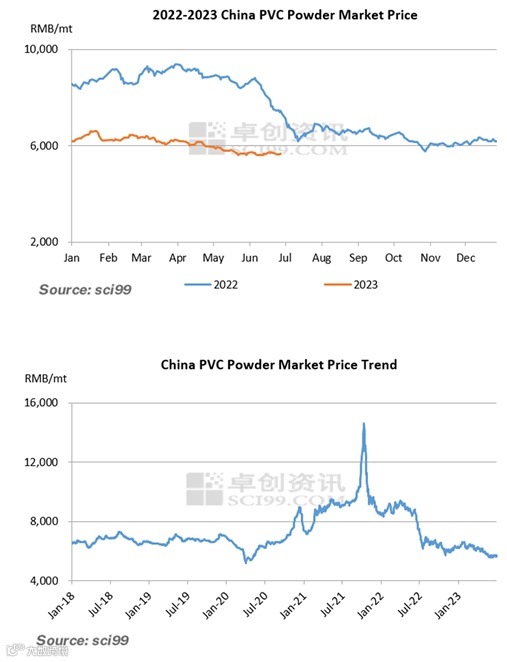
In 2023, China’s PVC prices fluctuated downward. Taking SG-5 in the Hangzhou market as an example, PVC powder price was RMB 6,200/mt at the beginning of 2023 and reached the highest point (RMB 6,600/mt) in end-January and then saw a downward trend. The PVC powder price dropped to RMB 6000/mt or so in end-March and then hovered at RMB 5,500-5,700/mt. Up to June 29, 2023, the average self-delivery price of PVC powder (in cash, and with 13% VAT) was RMB 6,090/mt, down 30.45% Y-O-Y. In addition, caustic soda prices moved downward in 2023. Taking liquid caustic soda 32% diaphragm in Shandong as an example, it dropped to RMB 775/mt, down 27.9% from the beginning of 2023. The closing price was RMB 745/mt on June 30, down 30.37% from the beginning of 2023. Profit losses at chlor-alkali enterprises intensified with the drop in PVC and caustic soda prices. Thus, chlor-alkali enterprises showed weak interest in producing, dragging down the demand for calcium carbide. Calcium carbide prices moved down and reached low points affected by the intensive maintenance of PVC units.
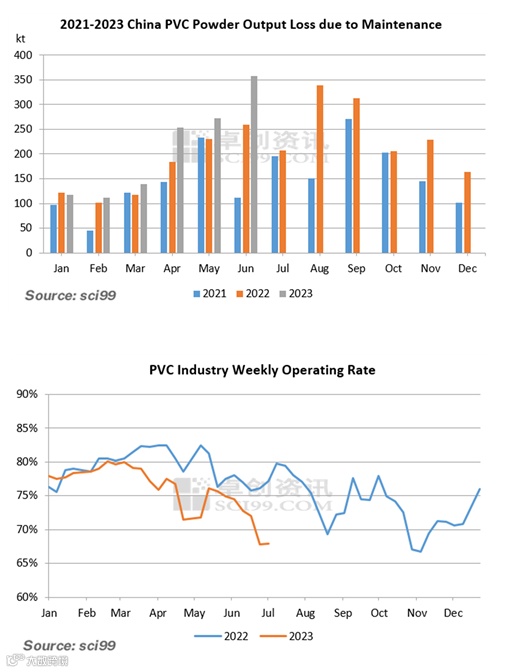
In H1, 2023, the PVC industrial operating rate was lower than that in the same period last year for most of the time mainly due to severe profit losses. A couple of PVC units ran unstably, and the restart of overhauled units was delayed. PVC output loss due to maintenance in H1, 2023 totaled 1,249.13kt, up 235.36kt Y-O-Y. Newly added 1,700kt/a units (the 100kt/a EDC-based PVC unit at Dezhou Shihua Chemical, the 400kt/a calcium carbide-based PVC unit at Shandong Xinfa Chemical, the 400kt/a ethylene-based PVC unit at Guangxi Huayi New Material, the 400kt/a ethylene-based PVC unit at Wanhua (Fujian), the 400kt/a ethylene-based PVC unit at Cangzhou Julong Chemical) were put into operation, which failed to improve the demand for calcium carbide notably.
Supply: The calcium carbide industrial operating rate fluctuated with a large range.
The highest calcium carbide industrial operating rate was around 75%, while the lowest one was around 65%. Only one newly-added unit at Zhonglian Chemical was put into operation. Thus, the change in operating rates was the main reason for calcium carbide output changes. Calcium carbide producers raised operating rates gradually when the price rose. After that, as calcium carbide prices moved down amid oversupply, producers cut operating rates again. The price of calcium carbide and the operating rate affect each other, and frequent changes in calcium carbide operating rates were the main reason for price fluctuation.
The average operating rate of calcium carbide was 71.11%, down 6 percentage points Y-O-Y. The total output of calcium carbide was 13,783.7kt, down 4.39% Y-O-Y.
Feedstock: Semi-coke prices fell notably, dragging down the cost of calcium carbide.
The coal price saw a quick drop in 2023, denting the semi-coke price. Up to June 30, the EXW price of semi-coke in Shaanxi was RMB 900/mt, down RMB 645/mt, equivalent to RMB 516 of the cost of calcium carbide from the beginning of 2023. In addition, the price of electricity in Inner Mongolia was also more flexible in 2023, and the average price declined compared with the end of 2022. Prices of calcium oxide, electrode paste and freight also shrunk, denting costs of calcium carbide.
On the whole, the demand was weak in H1, 2023, while supply fluctuated. Feedstock prices moved downward. In H2, 2023, the effect of negative factors may weaken, and the calcium carbide market may hover at lows.
Supply: More calcium carbide capacity is planned to be put into operation, propping up the output.
……
All information provided by SCI is for reference only, which shall not be reproduced without permission.

Please click "Read more" for the full article.