

2023 China Methanol Capacity Analysis
In recent years, affected by the high production cost and the relatively weak macro economy, the methanol price and profit have been stable-to-declining, dampening down the investment and construction of newly added projects. Meanwhile, influenced by the “Dual Carbon” policy, methanol producers are also faced with a severer market environment. By the end of December 2023, China’s annual methanol capacity is predicted to reach 108.46 million tons, up 6.64% from 2022.
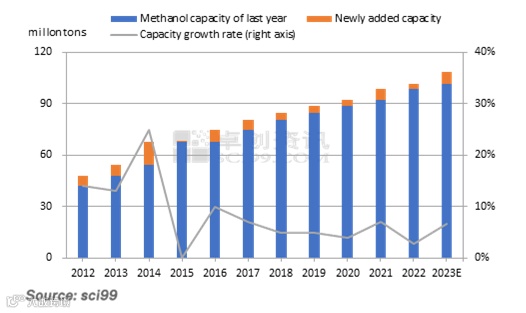
From the perspective of global methanol production, almost all industrial methanol is synthesized by pressurized catalytic hydrogenation of carbon monoxide and carbon dioxide. Typical processes include feedstock gas production, feedstock gas purification, methanol synthesis, and crude methanol rectification. Natural gas, naphtha, heavy oil, coal and its processed products (coke and coke oven gas), acetylene tail gas, etc. can be used as feedstock for the production of syngas.
Except for China, methanol production in the rest of the world mainly uses natural gas as feedstock. In China, methanol production mainly uses coal as feedstock, because China has rich coal but lacks oil and gas. According to SCI’s estimation, by the end of 2023, China’s coal-based methanol capacity may account for 73.49% of the total. In addition, most of the newly added methanol units use coke oven gas as feedstock in 2023, so the proportion of coke oven gas-based methanol capacity may reach 16.69%, up 3.96 percentage points Y-O-Y.
In China, most methanol units are located in Northwest China which is rich in coal resources. In 2023, the newly added units at Ningxia Baofeng Energy Group and Ningxia Kunpeng Clean Energy were put into operation, pushing up the methanol capacity proportion of Northwest China to 56.50%, up 0.68 percentage points Y-O-Y. Coke oven gas-based methanol units are mainly located in the areas where the coking industry is developed, such as Shanxi. Natural gas-based methanol units are concentrated in areas with relatively rich gas resources, such as Sichuan and Chongqing.
In recent years, with some large CTO/MTO projects put into operation and some small methanol units eliminated, China’s methanol capacity has developed in the direction of large-scale and intensification. The proportion of large methanol units has increased by a large margin. In 2023, the proportion of methanol units with capacity of 1,000kt/a or above is estimated at 48%, and that of methanol units with capacity of 400kt/a or above is estimated at 77%.
All information provided by SCI is for reference only, which shall not be reproduced without permission.
Please click "Read more" for the full article.